
If Google has officially stated that AI content is fine, then why does it struggle to capture the first page?
Think about it for a second.
You’ve probably done it too. You’ve handed an AI a topic and asked it to write an essay in one go.
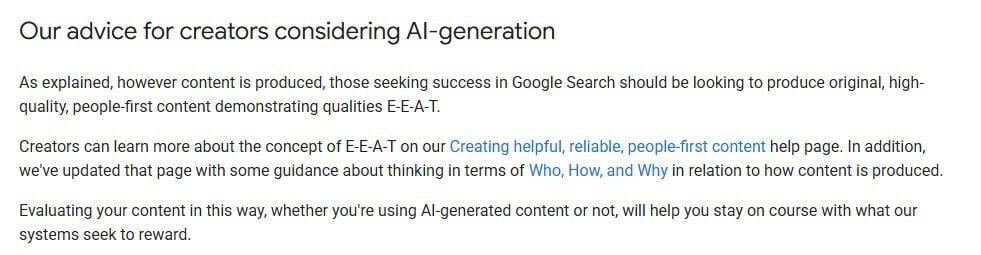
That right there is the problem.
Most people want a magic button. They want to type one simple prompt and receive a masterpiece on the first try. But not even the World’s best prompt engineers can pull a perfect, high-ranking output from a single prompt.
AI just isn’t there yet, and it may never be.
AI is your most powerful assistant. It should be your partner for deep research, a tool for understanding audience intent, and a scout for finding content gaps that everyone else missed.
In this blog, we are going to dive deep into the AI content vs. human content debate. We’ll explore how AI impacts SEO and rankings in 2026 and, most importantly, the workflow you need to blend AI efficiency with human insight to dominate the search results.
Laten we beginnen.
Belangrijkste opmerkingen
- Human written content is 8x more likely to secure the top ranking than pure AI generated content.
- The hybrid approach of AI human edited content matches the quality of human writing at a fraction of the cost.
- Google favors the deep experience and expertise signals found in human written SEO content over robotic text.
- High level creators use AI as a research partner for finding keyword gaps rather than a one click solution.
- Pure AI content suffers from a structural backlink disadvantage that hurts its long term search authority.
- Original data and primary evidence are the only ways to dominate Google AI Overviews and capture high intent traffic.
What is AI Content vs. Human Content?
First, let’s understand what the content is.
Content is anything that informs, entertains, or persuades an audience. This includes text, video, audio, and images.
Voorbeelden:
Maak je nooit meer zorgen dat AI je sms'jes herkent. Undetectable AI Kan je helpen:
- Laat je AI-ondersteund schrijven verschijnen mensachtig.
- Omleiding alle grote AI-detectietools met slechts één klik.
- Gebruik AI veilig en vol vertrouwen op school en op het werk.
| Type inhoud | Text Example | Visual/Audio Example |
| Onderwijs | A technical textbook. | A filmed surgery or a math tutorial video. |
| Amusement | A mystery novel. | A blockbuster movie or a Spotify playlist. |
| Sociale media | A Twitter thread. | An Instagram Reel or a TikTok dance video. |
| Branding | A company slogan. | A professional logo or a brand’s “jingle.” |
| Marketing | A sales email. | A product photography shoot or a 3D ad. |
| Nieuws | A written report. | A live broadcast or a drone shot of an event. |
Now, what is AI content?
Any media created or synthesized by AI models based on human instructions (prompts) is called AI content.
Bijvoorbeeld:
- Images created by tools like Midjourney or DALL-E
- Video generated by models like Sora or Veo
- Audio/Voice created by ElevenLabs or Lyria
Human content is media captured or created by people using their physical senses, gear, and artistic talent.
When we compare AI-only vs AI-human edited content, the difference lies in the soul and experience embedded in the work.
Bijvoorbeeld:
- A photo taken by a photographer at a wedding or a hand-drawn digital painting
- A vlog filmed on an iPhone or a cinematic movie shot on a Hollywood set
- A podcast recorded in a studio or a live vocal performance by a singer
How AI Impacts SEO and Google Rankings
Let’s see the positive and negative impacts of using AI on SEO and Google rankings:
- Winning AI Summaries: Well-structured AI generated content vs human content data helps your site appear in Google’s AI snapshots.
- Better Click Rates: AI is highly effective at writing catchy headlines and descriptions that convince people to click on your link.
- Keeping Readers Interested: By organizing your posts more clearly, AI ensures you answer exactly what the user is looking for, keeping them on your site longer.
- The Struggle for #1: While AI helps you rank, the very top spot is still almost always won by human writers who offer unique personal opinions.
- Fewer Backlinks: Other websites are far less likely to link to your content if it feels like a generic machine wrote it without any new insights.
- Unstable Traffic: Pure AI content often sees a quick boost in traffic followed by a sudden crash once Google identifies the content as low-effort.
- Spam Filters: Mass-producing low-quality AI pages can get your entire website flagged or completely hidden from search results.
- Lack of Real Research: Since AI cannot interview experts or conduct original experiments, it often lacks the “expert” feel that search engines demand.
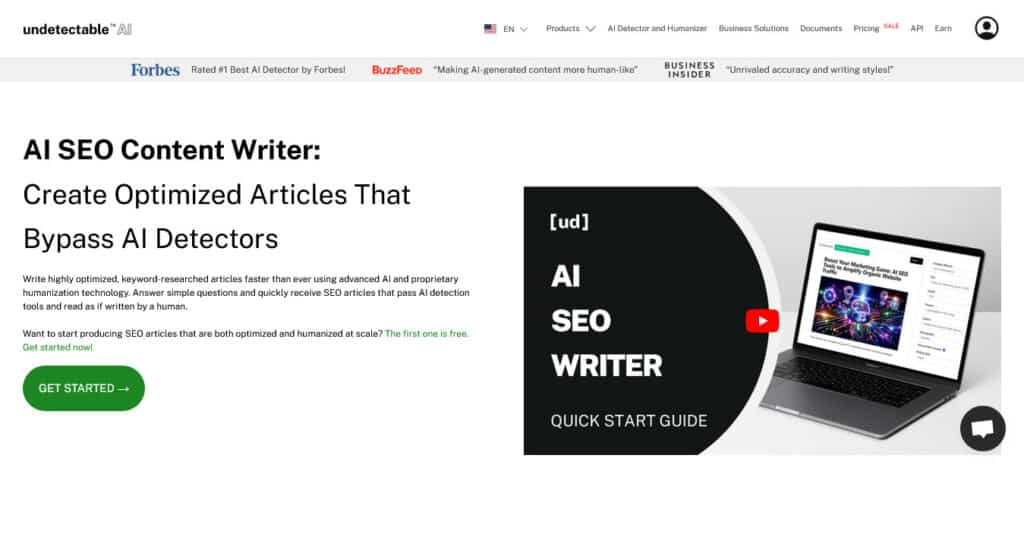
If you want to rank higher without spending hours writing, this AI SEO Content Schrijver tool can help you. It lets you build search-ready drafts that satisfy both Google and your readers.
- Losing Reader Trust: If your audience feels they are reading a robot, they might leave your site, which tells Google your page is not helpful.
In 2026, the real competition isn’t Human vs. AI…
It’s AI-only vs. AI + Human. The hybrid approach achieves near-parity with human writing at a fraction of the cost.
Can AI Content Be Detected?
Yes. AI content can be identified either by a human eye (if the reader has even a little experience with AI patterns) or through specialized AI detection software.
But the reality of AI content vs. human content detection is complex than a simple “yes” or “no.”
It’s because AI is trained on human data and it can mimic us perfectly. Conversely, humans who write formally or technically get falsely accused of being robots. That’s why, you can never be 100% certain.
The lesson → Never trust claimed accuracy blindly.
Even with advanced technology, several blind spots prevent these tools from being perfect:
- The False Positive Issue: High-quality human writing (especially from non-native speakers or technical experts) is frequently flagged as AI.
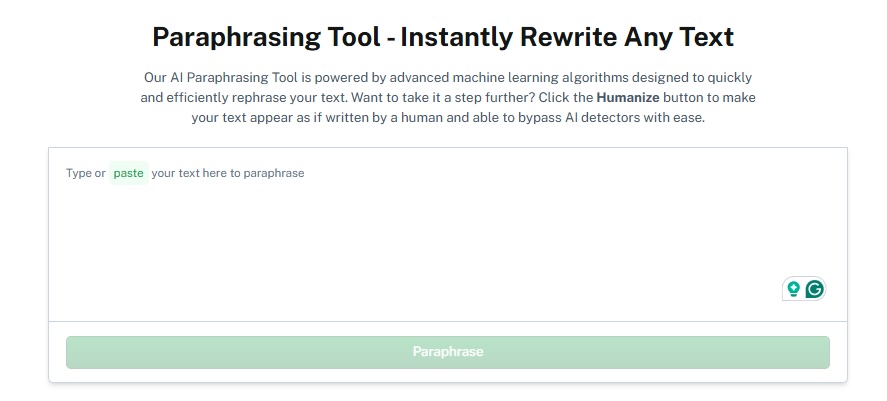
- Paraphrasing Drop: Once AI content is restructured, detection accuracy plummets by 20% or more. If your draft feels a bit too mechanical, use this Parafraseren to mix up the structure and keep your writing fresh and unpredictable. This is a key step when you compare AI-only vs AI-human edited content for safety.
- Hybrid Content Problem: Over 73% of marketers now mix AI drafts with human edits. Detectors can’t figure out where the robot ends and the human begins.
- Length Gap: For texts under 300 words, accuracy drops. There simply isn’t enough data for a machine to find a reliable pattern.
Across virtually all major detectors, paraphrased or humanized AI content causes a detection drop of at least 20%, proving that the more you refine your work, the harder it is for a machine to claim it.
When is AI Content Actually Useful?
AI being useful doesn’t mean it produces the single best output possible. It means it provides the best output per dollar/hour in specific scenarios.
It’s useful when you need to balance quality with high-volume efficiency.
Here is when AI content shines:
- Creating Commodity Content at Scale
AI is excellent for generating thousands of pages that would be impossible for human teams to write manually, such as:
- Location Pages: Creating “Best Electrician in [City]” pages for 500 different cities using the same format.
- Productomschrijvingen: Writing unique, SEO-friendly descriptions for a catalog of 10,000 SKUs.
- FAQ Pages: Generating structured, clear answers to hundreds of common customer questions.
- First-Draft Acceleration
AI is a cure for blank page syndrome. If you’re a senior writer, it will let you skip the staring-at-the-screen phase by providing a solid outline and a functional first draft in seconds.
- Content Repurposing
You can take one high-quality blog post and use AI to write multiple formats. Bijvoorbeeld,
- Give AI your blog and instruct it to write a punchy LinkedIn post in the style of Justin Welsh
- Create a viral Twitter (X) thread like Dickie Bush
- Draft a high-conversion email newsletter following the principles of Gary Halbert.
- Multilingual Content Scaling
If you are a native speaker of one language but need to produce content for a different market, AI is your best ally.
You know that you can’t fully rely on Google Translate, right? Modern AI can be given specific instructions to write fluently in any language.
- Informational and Low-Competition Keywords
For straightforward queries, AI is incredibly efficient. It can include straightforward answers like “What is a 401k?” or “How to boil an egg?” These are low-competition topics where the answer is factual and direct.
How to Combine AI and Human Creativity Effectively

A successful strategy isn’t choosing between AI vs. human content, it’s a hybrid.
Here is the 7-step hybrid content workflow to help you scale while staying authentic.
Step 1: Human-Led Planning
Perform manual research to decide on 4-5 potential topics. Once you have a shortlist, feed them to the AI with specific instructions to finalize the best one.
You can also use AI to generate audience intent, unique content angles, and a differentiating point-of-view (POV).
Step 2: Outline Creation (AI + Human)
Once the topic is final, it’s time for the skeleton. Have the AI generate an outline based on current SERP analysis. Then, your job is to review it.
- Does this satisfy search intent?
- What’s missing?
- What’s redundant?
As a human, bridge the gap between standard info and valuable info.
Step 3: Deep Research
Feed the AI all your audience data and your refined outline. Instruct it to conduct updated, accurate research as of today’s date. Ask for specific stats, real-world examples, and interesting trivia.
Opmerking: Always double-check these AI-generated stats against original sources.
Step 4: The First Draft (AI-Generated)
Provide the AI with your refined outline, talking points, brand voice guidelines, and that research doc. Let the AI generate the full first draft. This saves you from blank page syndrome and gives you a solid base to work from.
Step 5: E-E-A-T Injection (Human)
This is where you transform AI content vs. human content into a masterpiece. Use your energy to inject Experience, Expertise, Authoritativeness, and Trustworthiness.
- Add personal anecdotes and firsthand observations (e.g., “When I tested this strategy in April 2026…”).
- Include expert quotes from real interviews rather than generic AI summaries.
- Strip out AI signature phrases like “In today’s fast-paced landscape” or “It’s worth noting.”
Short on time?
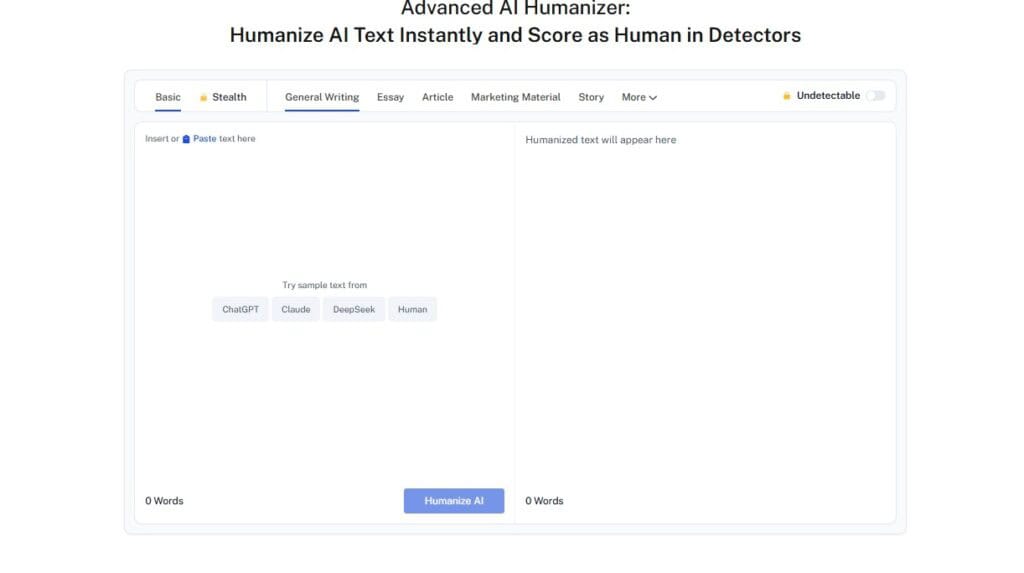
If English isn’t your first language or you aren’t confident in your humanizing skills, you can use our Undetectable AI’s AI Humanizer.
It thinks like a human writer to restructure your content so it bypasses detection tools and feels natural to your readers.
Step 6: SEO Optimization Pass (AI-Assisted)
Use AI to suggest 10 versions each for your title tags and meta descriptions. Have it suggest internal link opportunities within your existing content. Let the AI generate 5 options for each, but ensure a human chooses the best one.
Step 7: Publish + Measure (Human-Decided)
Publish the post under a real author name with a complete bio. Track your rankings, engagement (time on page, bounce rate), and the backlinks you earn. Don’t let your content go stale.
Content freshness is now a top ranking factor, and a top differentiator in AI content vs human-written seo content. Set a human-led schedule to update your stats and info every few months to maintain your position at the top.
Performance Measurement: AI vs. Human Content
- Comparing the Data
While AI can get you onto the playing field, human-led content still wins the championship. A massive study of 42,000 pages recently revealed a staggering perception gap in the industry.
While 72% of SEO professionals believe AI-written content ranks just as well as human content, the data shows that human-written content is 8x more likely to hit the #1 spot.
Currently, pure AI content has only a 9% chance of ranking first, while human content holds a dominant 80% share of those top positions.
- Insights to Action
AI has structural disadvantages in building authority. AI-only content earns fewer editorial backlinks than human-written pieces. Every unearned link is a missed opportunity to grow.
So, you must change hoe you use it. Transition from pure AI to AI-assisted workflows as it works better.
- Building a Strategy
AI Overviews (SGE) have changed how traffic flows. So now, use AI to increase your production speed that top teams are seeing, but dedicate your saved time to generating original stats and primary evidence.
This hybrid approach allows you to scale your volume while ensuring your content remains in the elite AI-assisted articles that actually capture high-intent traffic and maintain a #1 ranking.
Probeer de widget hieronder om toegang te krijgen tot onze AI Detector en Humanizer!
Eindgedachten
Ultimately, the battle of AI vs. human content isn’t about which one is better, but how they can work together. While pure AI generated content is fast, it lacks the E-E-A-T signals required for top-tier rankings.
By choosing AI-human edited content, you get the best of both worlds: the velocity of a machine and the authority of a person.
In 2026, Google rewards those who use AI to enhance creativity. When you compare AI-only vs AI-human edited content, the winner is the one who creates a wall of text, while the other builds a brand.
Investing in human-written SEO content (supported by the research power of AI) is the only way to safeguard your site against future core updates. It ensures your pages are seen by algorithms, but also trusted by people.
Start using a hybrid workflow we’ve mentioned in this blog to dominate the search results with AI vs. human content strategies that resonate, build authority, and secure the #1 spot for the long haul.
Blend AI efficiency with human creativity and keep your content authentic with Niet detecteerbare AI.