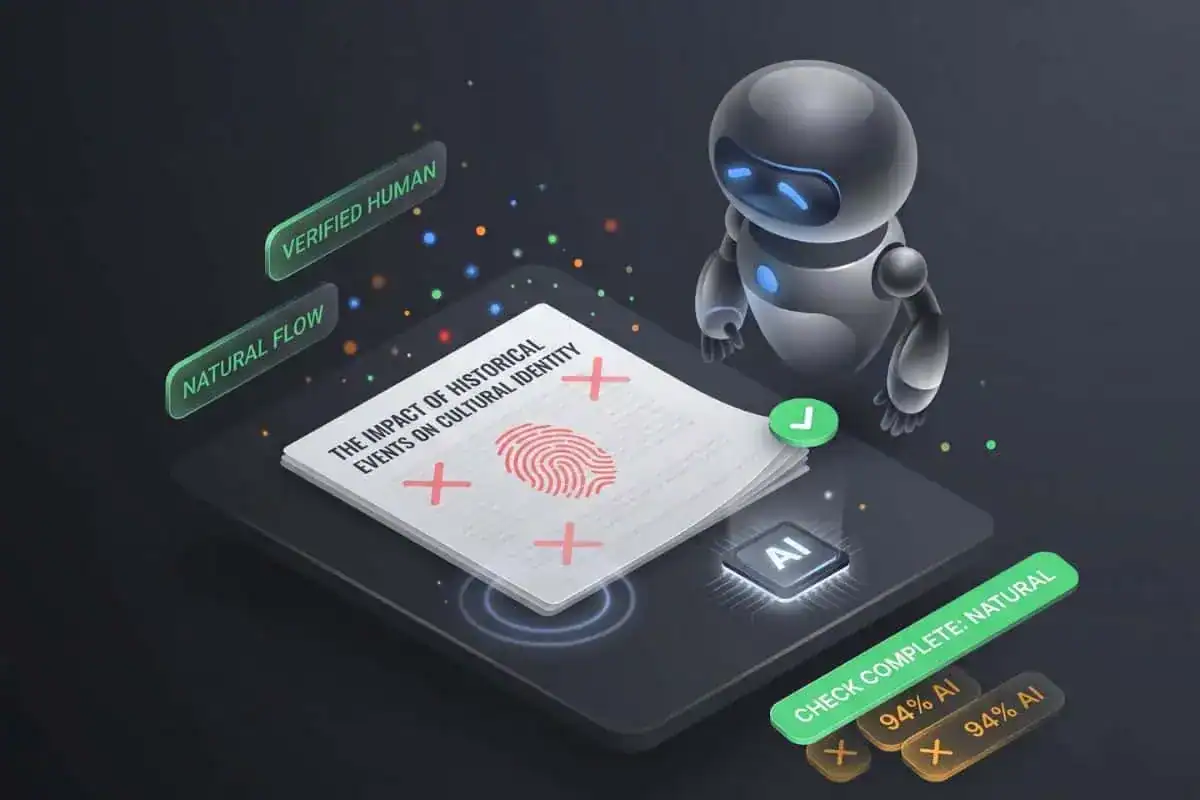
A teacher’s worst moment isn’t catching a cheater. It’s falsely accusing a student who didn’t cheat at all. Students pour hours into original work, only to watch it get flagged by a tool that can’t actually prove anything, it can only guess.
That guess is exactly what an ai detection false positive is. And the guess is wrong far more often than most people assume, especially for students who write in a second language.
A University of Chicago Booth research review found that today’s leading commercial detectors keep false positive rates below 1% across most genres of writing. That is a real improvement over where the industry started.
Back in 2023, a widely cited Stanford study found some detectors falsely flagged over 61% of essays written by non-native English students, compared to under 10% for native speakers, and that early bias is still the reference point most educators cite.
The tools have gotten better, but the underlying pattern, formal or predictable writing reading as more “AI-like”, hasn’t fully gone away, and it’s still the group most likely to get caught in a false flag today.
Teachers, academic institutions, and content teams all need to understand how these tools actually work, because the cost of getting it wrong falls on real people with real consequences.
Vamos entrar no assunto.
Principais conclusões
-
An AI detection false positive happens when human-written content gets wrongly flagged as machine-generated, usually because of predictable phrasing or formal sentence structure, not because AI was actually used.
-
Even a 1% error rate can mean hundreds of false accusations every year, which is exactly why several major universities stopped relying on these tools.
-
Non-native English speakers face the highest risk, since clear, structured, textbook-style writing statistically resembles AI output more than casual native writing does.
-
No single detector score should ever count as proof on its own. Cross-checking results across tools and keeping a paper trail of your drafts is the strongest protection you have.
-
Undetectable AI’s Detector, Humanizer, and Grammar Checker are built to catch these risks before you submit anything, cross-referencing multiple detection models and smoothing out the stiff phrasing that tends to trigger false flags in the first place.
O que são falsos positivos na detecção de IA?
An AI detection false positive happens when an automated scanner wrongly flags original, human-written content as machine-generated text, turning an honest student or professional submission into an unfair subject of investigation.
It’s worth sitting with that word “false positive” for a second, because it captures the whole problem: the tool isn’t lying on purpose, it’s just wrong, and it doesn’t know it.
Detectors rely on mathematical algorithms rather than factual proof. They measure statistical traits like perplexity (how predictable your word choices are) and burstiness (how much your sentence length varies) to estimate authorship.
Machen Sie sich nie wieder Sorgen, dass KI Ihre Texte erkennt. Undetectable AI Kann Ihnen helfen:
- Lassen Sie Ihr AI-unterstütztes Schreiben erscheinen menschenähnlich.
- Bypass alle wichtigen KI-Erkennungstools mit nur einem Klick.
- Verwenden Sie AI sicher und zuversichtlich in Schule und Beruf.