
The failure to catch ChatGPT-generated submissions can result in inflated grades for educators, SEO penalties for content marketers, or reputational damage for publishers. However, advancements in generative AI technology have made it increasingly difficult to distinguish ChatGPT outputs from human writing.
In this article, we discuss if ChatGPT content is detectable, what signals AI detectors use, and how to strengthen your assessments of suspicious content.
Let’s dive in.
Key Takeaways
- ChatGPT content can be detected through recurring linguistic, statistical, and model-specific patterns, but no detector can definitively prove AI authorship.
- Detection accuracy can vary based on factors such as content length, ChatGPT model version, prompting style, and AI humanization.
- The strongest way to investigate suspected ChatGPT content is to combine AI detection with manual review, fact-checking, past writing comparisons, and author questioning.
- Undetectable AI’s Text Detector can provide supporting evidence by identifying signals commonly associated with ChatGPT-generated writing.
Is ChatGPT Content Detectable?
While no method can definitively confirm that ChatGPT produced a piece of content, most large language models produce recurring linguistic and statistical patterns that skilled human reviewers and AI detectors can refer to as signals of AI generation.
AI detectors, in particular, can scan content for these signals and use them to estimate the likelihood that content originated from ChatGPT.
How Do AI Detectors Identify ChatGPT Content?
ChatGPT and other text generators create outputs by predicting the most likely continuation of a unit of text. Because text generation relies on probability, generative AI outputs often repeat statistically probable patterns.


Never Worry About AI Detecting Your Texts Again. Undetectable AI Can Help You:
- Make your AI assisted writing appear human-like.
- Bypass all major AI detection tools with just one click.
- Use AI safely and confidently in school and work.
AI text detectors use linguistic and statistical analysis to examine content for these patterns, which they then use to estimate the likelihood that AI generated the content.
Text detectors learn what patterns to look for during training and evaluation. Developers feed these models vast datasets consisting of human-written and AI-generated samples, then teach them which characteristics appear more often in each category.
Because ChatGPT is among the most popular generative AI tools, many AI detectors are trained to identify ChatGPT outputs.
ChatGPT Signals AI Detectors Look For
AI detection systems use statistical and linguistic analysis when evaluating inputs.
Statistical Patterns
Statistical patterns refer to the patterns in text that detectors can measure.
This can include:
- Perplexity: How predictable is the sequence of words? AI-generated text tends toward lower perplexity because language models prefer statistically probable word and phrase choices.
- Burstiness: How much does the text vary in word choice and sentence structure? AI-generated text typically shows less variation in sentence length and complexity than human writing.
- Word distribution: How frequently do specific words, phrases, and token sequences occur? Detectors can compare these distributions with patterns that appear in their training data.
Linguistic Patterns
Linguistic patterns are the non-measurable features that describe how a piece of text uses language.
This includes:
- Vocabulary: What words did the writer use?
- Syntax: How did the writer construct the sentence?
- Sentence structure: What are the patterns in sentence length, complexity, and variation?
- Discourse structure: How does the writer organize ideas, explanations, transitions, and paragraphs?
- Stylistic consistency: How consistently does the writer maintain specific linguistic patterns?
AI detectors compare inputs against samples from their training data, evaluating whether the former contains linguistic patterns that frequently appear in the latter.
Model-Specific Signals
Some text-generation models may produce recurring statistical and linguistic patterns as a result of training, fine-tuning, model architecture, generation settings, and prompting. For example, many claim that ChatGPT favors the em dash, words like “delve,” “testament,” and “navigating,” or the “It’s not just X, it’s Y,” structure.
While no method can definitively confirm that ChatGPT produced a piece of content, the model produces recurring linguistic and statistical patterns that skilled human reviewers and AI detectors can recognize. AI detectors use these patterns as signals of AI generation, which contributes to the overall probability score.
What Affects ChatGPT Detection Accuracy
While AI detection developers fine-tune models to maximize accuracy, detection performance may still vary depending on several factors, including length, model versions, prompt customization, and AI humanization.
Length
Longer samples provide more data to analyze and extract signals from, which is why most text detectors set minimum lengths. Short samples may not offer enough information for detectors to reliably identify patterns.
Model Version
Available ChatGPT models, such as GPT-5.6, GPT-6, and their variants differ slightly in how they reason, generate text, and follow instructions. These differences shape the patterns they leave.
Detectors trained on older ChatGPT models may be less effective at identifying output from newer models. A reliable detector should regularly update its models to account for developments in generative AI.
Prompt Customization
When writers do not specify a particular tone or style, ChatGPT follows the most statistically probable patterns it learned from training. Many outputs created without style specifications display the statistical and linguistic patterns AI detectors and human reviewers expect, making detection easier.
Prompting ChatGPT to use a specific tone or style can change these characteristics. Fortunately, enough statistical and linguistic patterns outside of surface-level style remain, which means that detection, while difficult, is still possible.
Humanization
Some writers use AI humanizers to erase the patterns text generators leave. They rephrase sentences to introduce variety in text length and word predictability, which masks the signals AI detectors look for. In these cases, it’s better to rely on manual review and
How to Check if Text Was Written By ChatGPT
AI inspections should begin with manual review and end with a second opinion from an AI detector, with the manual review examining the work in context and the AI detector flagging signals you might have missed. If your investigation uncovers enough suspicious indicators, consider asking the author to explain their work.
Check for Repetitive Structure and Generic Phrasing
ChatGPT-generated outputs typically follow statistically predictable word choices, phrasing choices, and sentence structures. Neutral or generic writing styles, especially if they are uncommon in your field, should be your first sign to investigate deeper.
Verify Facts, Quotes, and Citations
Another common giveaway of ChatGPT writing is a lack of genuine substance. The depth of a ChatGPT output depends heavily on the prompt, context, and information provided, which means that writers who use ChatGPT to avoid deeper thinking and research often produce content that lacks original perspectives, specific evidence, and meaningful analysis.
ChatGPT can also spread misinformation, repeat out-of-date information, or cite broken links without intending to. A writer who uses ChatGPT to rush outputs may skip the fact-checking process and publish with errors.
Compare the Text With Past Writing
An effective way to corroborate suspected AI-generated writing is to compare the submission against the writer’s past work. Significant discrepancies in writing choices, such as sentence structure, vocabulary, and tone may indicate that someone or something else authored the piece.
Get a Second Opinion from an AI Detector
AI detectors can provide another source of evidence by analyzing the text for patterns associated with AI-generated writing. The resultant detection score can serve as a signal to deepen your investigation.
Here’s the Undetectable AI text detector in action. We generated a 650-word article comparing the works of John Keats and Lord Byron, then fed it to the text detector for analysis.
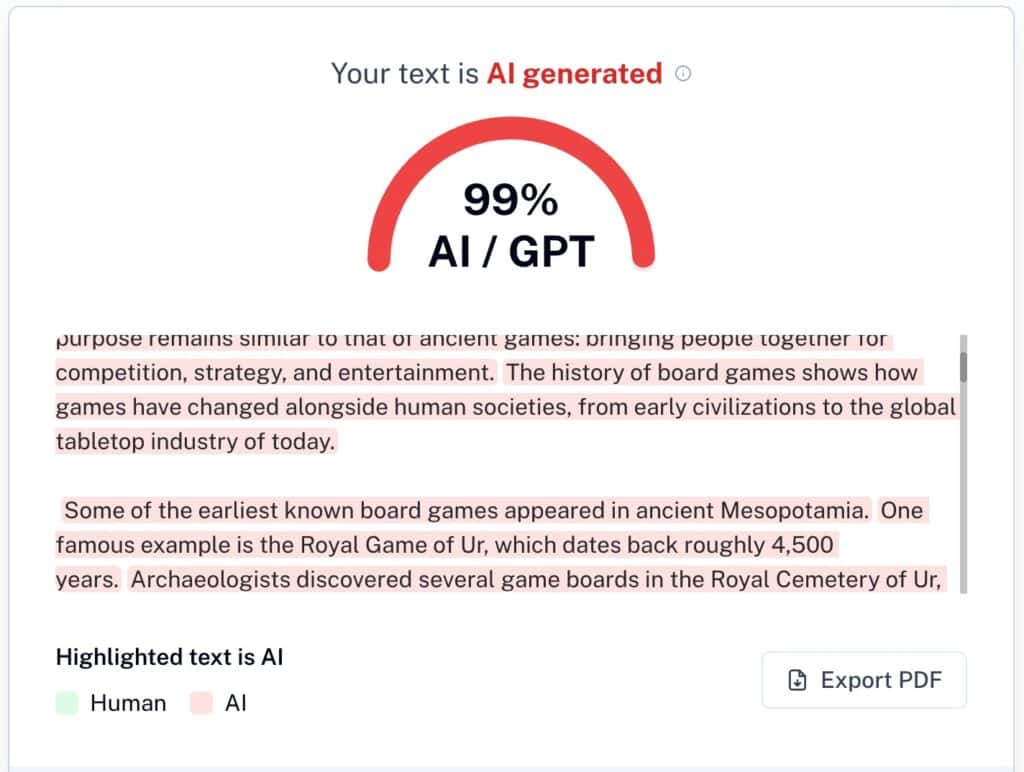
As predicted, the text detector gave it a score of 99%, flagging most of the text as AI-written. Predictable word choices, monotonous sentence variation, and a lack of original insights likely contributed to this score.
Ask the Writer About Their Work
The evidence collected from the steps above cannot definitively verify authorship. However, uncovering enough suspicious indicators can justify questioning the author about their work. A one-on-one discussion can provide additional evidence, context, and information that automated analysis cannot.
Ask the writer about their writing process, sources, arguments, and the reasoning behind specific writing choices. A writer who developed their work themselves should generally be able to explain the creative process with little trouble.
You can also ask for specific documents that show the writer’s involvement in developing the piece.
These include:
- Version history: Google Docs, Microsoft Word, and other word-processing applications can preserve earlier versions of a document. These records may reveal drafts, outlines, revisions, and other changes made during the writing process.
- Drafts and outlines: If the writer drafted outside the final document, you can request the past versions of the work.
- Research notes: Notes, source lists, annotations, and other research materials can show how the writer gathered, integrated, and built upon the information used in the piece.
- Source materials: Articles, books, interviews, or other materials the writer consulted can provide additional context on how they developed and supported their arguments.
Not all authors will disclose AI use when asked, especially if an admission could cost them grades, money, or credibility. However, an open conversation remains the best approach. It gives the author a chance to defend their work while giving you an opportunity to assess their credibility.
Frequently Asked Questions
Is ChatGPT-generated text detectable?
To an extent. AI detectors can flag if a piece of text contains linguistic patterns, statistical patterns, and model-specific signals commonly associated with generative AI. However, most calculate the likelihood that generative AI wrote or edited the piece rather than providing a definitive verdict.
Can AI detectors tell if ChatGPT wrote something?
As mentioned above, AI detectors can calculate the likelihood that a piece of text originated from AI. Some detectors can identify the model that most likely produced the text. However, most produce AI likelihood scores without explicit model attribution.
Can ChatGPT content pass an AI detector?
Rarely. AI detectors flag new content for patterns common to generative AI outputs in their training data. Since ChatGPT is among the most popular generative AI tools, most AI detection developers train models on ChatGPT outputs, rendering them more effective at identifying ChatGPT signals.
Does editing ChatGPT content make it undetectable?
Not necessarily. AI detectors analyze linguistic and statistical patterns associated with AI-generated text. Rewriting a ChatGPT essay can change these patterns and make detection less reliable, but light edits may not be enough to substantially alter the characteristics a detector uses to classify the text.
Final Thoughts
While no method can definitively verify whether ChatGPT produced a work, a strategic combination of manual review and AI detection can uncover enough indicators to build an informed evaluation of authorship. If the evaluation raises serious concerns, it’s worth discussing the work with the author directly.
Undetectable AI’s text detector can provide strong supporting information for AI investigations. Having been trained on vast amounts of ChatGPT-generated samples, it can effectively flag whether a work contains signals commonly associated with generative AI.