
AI writing has a reputation problem in SEO circles right now. A lot of people assume that if you use AI to create content, Google will eventually find out and tank your rankings. I used to think the same thing, so I decided to test it properly.
I run Undetectable AI, so generating and testing AI content is literally what I do every single day. Because of that, I’ve seen the patterns up close. And you know what? The actual issue is that AI content usually gets published without enough editing, so it ends up thin and generic.
So what happens here is that Google penalizes the “thin and generic content” as spammy, and you think that the problem is using AI for writing content.
To prove this point, I ran a test, and what came back surprised me, and I think it’ll surprise you, too. But that’s not all, I will also explain how to use AI to create content so you don’t have to worry about Google penalties ever again.
Wichtigste Erkenntnisse
- I tested 10 ranking articles across 3 keywords on the Undetectable AI Detector. The scores ranged from 10% AI to 93% AI.
- A page scoring 93% AI sits at #1 for the keyword “how to save money fast,” and another one scoring 66% AI sits at #9 for “how to prepare for an interview,” which clearly means that position, and AI score don’t work as we presume.
- 30-minutes of focused human editing was often enough to make the AI-generated version perform better than both the raw AI and the fully human-written versions.
- The biggest ranking variable right now is accepting that an AI-generated draft still needs human judgment.
What Ranking Actually Requires in 2026?
Google’s search systems in 2026 no longer reward or rank your content based on whether it was written by humans or generated by AI. What they reward is content that helps people and fulfils the search intent.
Nach Angaben von Google’s Search Central documentation, the focus remains on original information, complete answers, real expertise, and trust signals. It’s that simple.
Moreover, content created mainly to manipulate rankings or mass-produce pages without adding any value whatsoever falls under Google’s spam policies.
Machen Sie sich nie wieder Sorgen, dass KI Ihre Texte erkennt. Undetectable AI Kann Ihnen helfen:
- Lassen Sie Ihr AI-unterstütztes Schreiben erscheinen menschenähnlich.
- Bypass alle wichtigen KI-Erkennungstools mit nur einem Klick.
- Verwenden Sie AI sicher und zuversichtlich in Schule und Beruf.
In other words, the question now is no longer “Was this written by AI?” but “Does this deserve to rank?” To test if this theory matched reality, I conducted a small study across several search queries and analyzed a few pages already ranking on Google’s first page.
I then checked each page with Undetectable AI’s AI detector to see if any pattern existed between rankings and AI-generated scores.
My Findings From the Study
For the keyword “Best CRM Software,” the results were mixed. Here’s the SERP ranking as of Wednesday, 17th June, 2026:

As you can see:
- HubSpot ranked #1, but showed a probability of 37% AI score when passed through Undetectable AI’s Detection tool, which is still considered human-written.
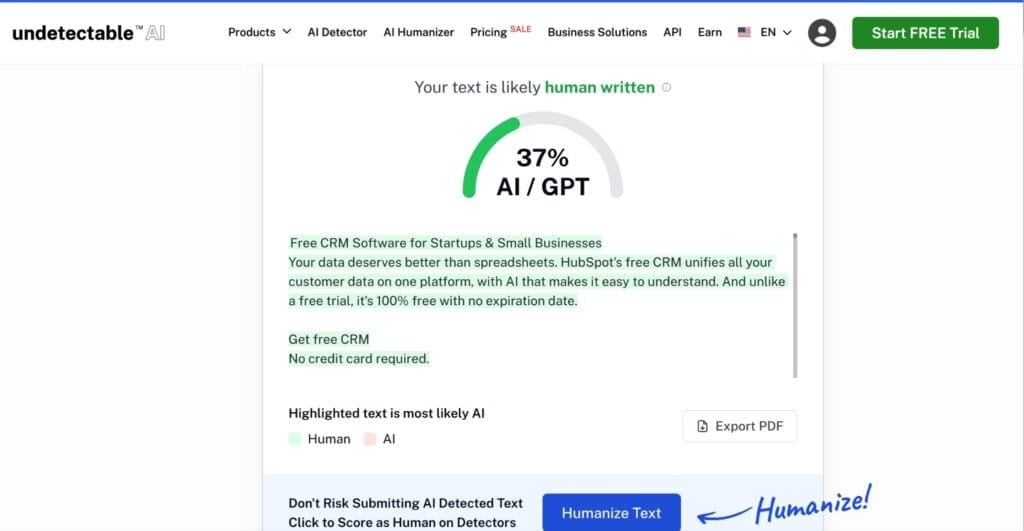
- We then checked the AI score of Zapier, which is ranking at #2, and it showed the probability of 57% AI-generated content:
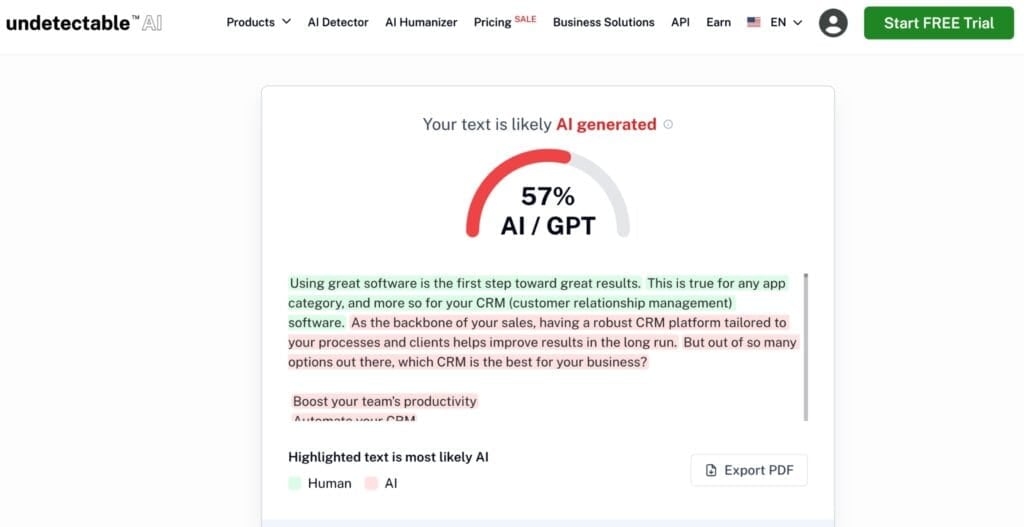
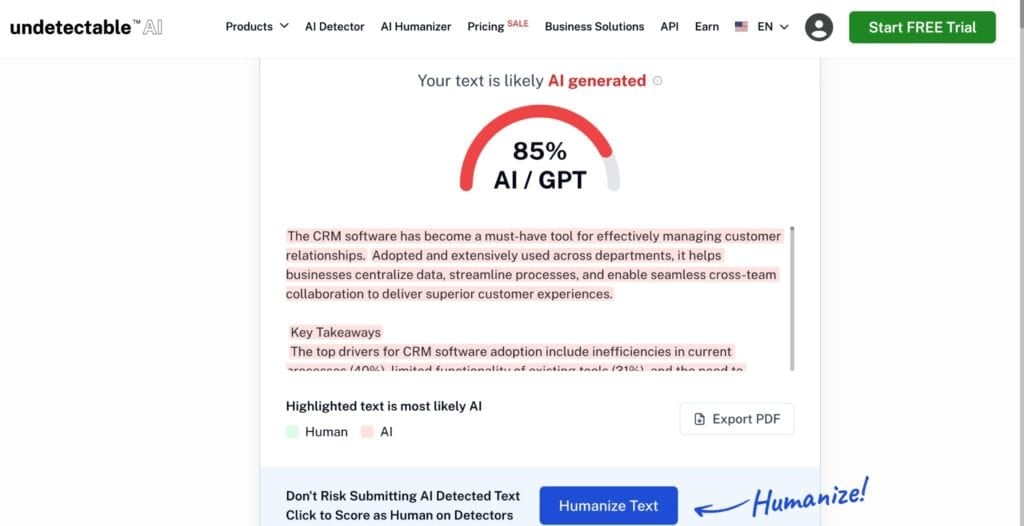
- For the same keyword, Creatio is ranking at position #8 and shows an AI score of 85%. To my surprise, AI-generated content was not excluded from page 1, which shows that pages with high AI scores still ranked when provided value, although they tended to appear lower.
Moving forward, the second keyword I tested, “How to Save Money Fast,” showed me something even more interesting which I’ll discuss in a bit.
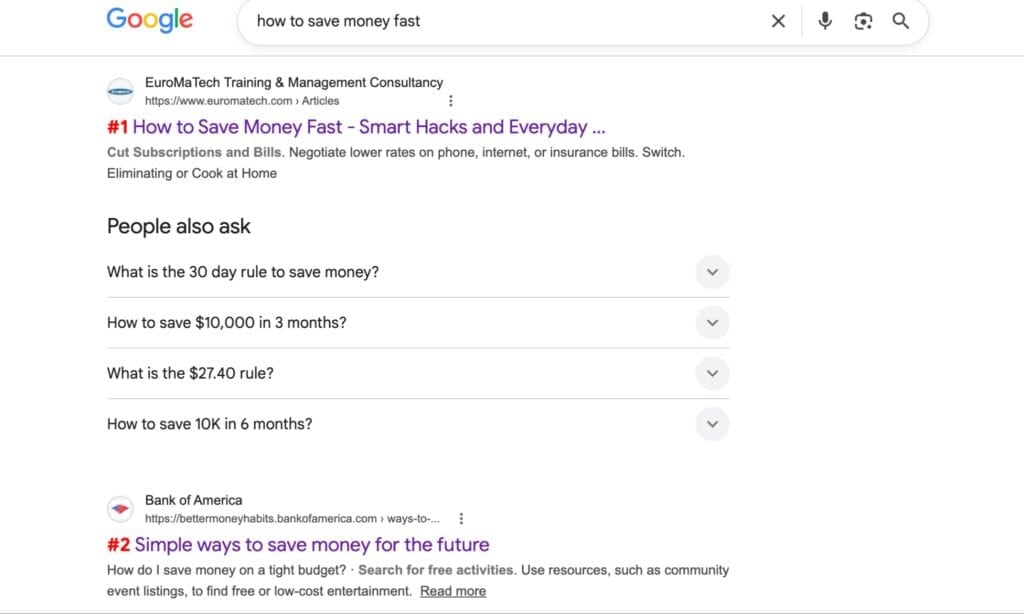
For now, these were the SERP results for the second keyword “How to Save Money Fast,” as of Wednesday, 17th June, 2026:
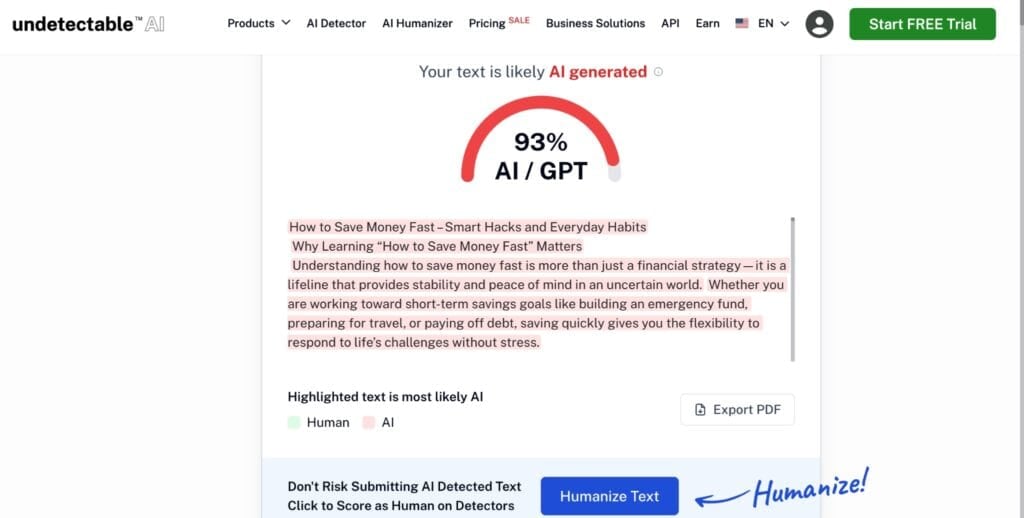
- The #1 ranking page for this keyword had a 93% AI-generated score:
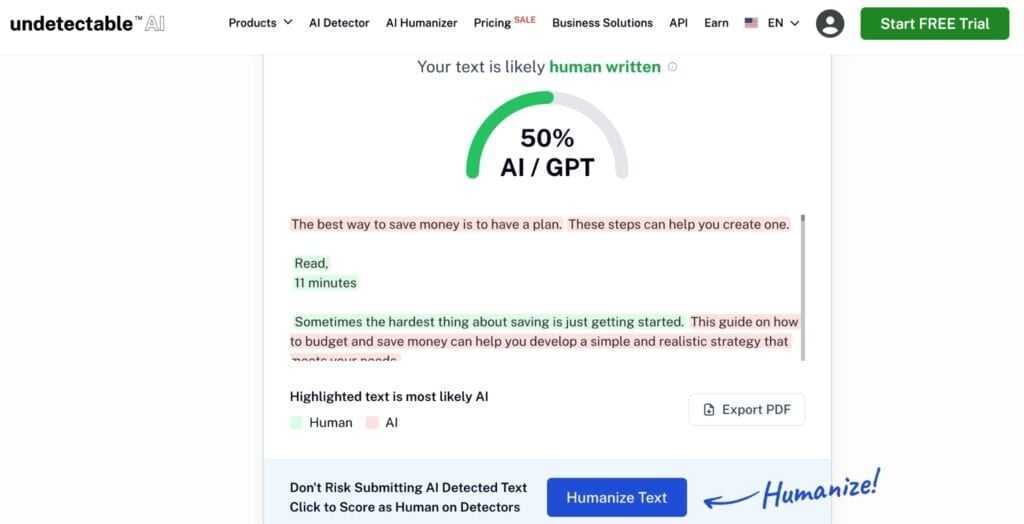
- On the other hand, a page ranked #2 for the exact same keyword came with a more human-written score of 50%
Here is a summary of the experiment I conducted and discussed above.
Keyword 1: Best CRM Software
| Rank | URL | AI-Erkennungsergebnis | Urteil |
| #1 | hubspot.com/products/crm | 37% | Human written |
| #2 | zapier.com/blog/best-crm-app | 57% | KI-generiert |
| #8 | creatio.com/glossary/crm-software | 85% | KI-generiert |
| #9 | brevo.com/blog/best-crm-software | 72% | KI-generiert |
Keyword 2: How to Save Money Fast
| Rank | URL | AI-Erkennungsergebnis | Urteil |
| #1 | euromatech.com/articles/how-to-save-money-fast | 93% | KI-generiert |
| #2 | bettermoneyhabits.bankofamerica.com | 50% | Human written |
| #6 | moneysmart.gov.au/saving/how-to-keep-saving-money | 72% | KI-generiert |
| #7 | americasaves.org/resource-center/insights/54-ways-to-save-money | 31% | Human written |
Keyword 3: How to Prepare for an Interview
| Rank | URL | AI-Erkennungsergebnis | Urteil |
| #1 | indeed.com/career-advice/interviewing/how-to-prepare-for-an-interview | 48% | Human written |
| #9 | https://grow.google/grow-your-career/articles/interview-tips/ | 66% | KI-generiert |
So, we can fairly conclude from these results and screenshots that Google is not penalizing AI-written content. If AI detection percentages determined rankings, a page scoring 93% AI would have never gained the first position.
The Pattern I Found
The rankings appeared to depend on factors such as:
- Search intent satisfaction
- Brand authority
- Depth and completeness
- Topical relevance
- User trust signals
- First-hand experience and expertise
- Technical quality and page experience
My study supports what Google’s documentation has been saying for years, that quality matters more than the method of creation. The content that wins is the content that fulfils the user intent better than other competing pages.
How We Ran the Test (The Method)
Further to my study and to explain how to use AI to create content, I compared different content approaches targeting the same set of keywords. Those content approaches were:
- Raw AI content with no edits
- AI-generated content followed by roughly 30-minutes of human editing and fact-checking
- Completely human-written content
I tried to keep all three versions as similar as possible. The articles had comparable word counts, also followed the same internal linking structure, and targeted the same search intent. I then tracked their ranking weekly in Ahrefs over a 6-week period.
This controlled setup was important because changing multiple variables would have made the results unreliable. Therefore, by keeping everything the exact same, the only meaningful difference between the pages was the content creation method itself.
The Ranking Trajectory: 6 Weeks of Data
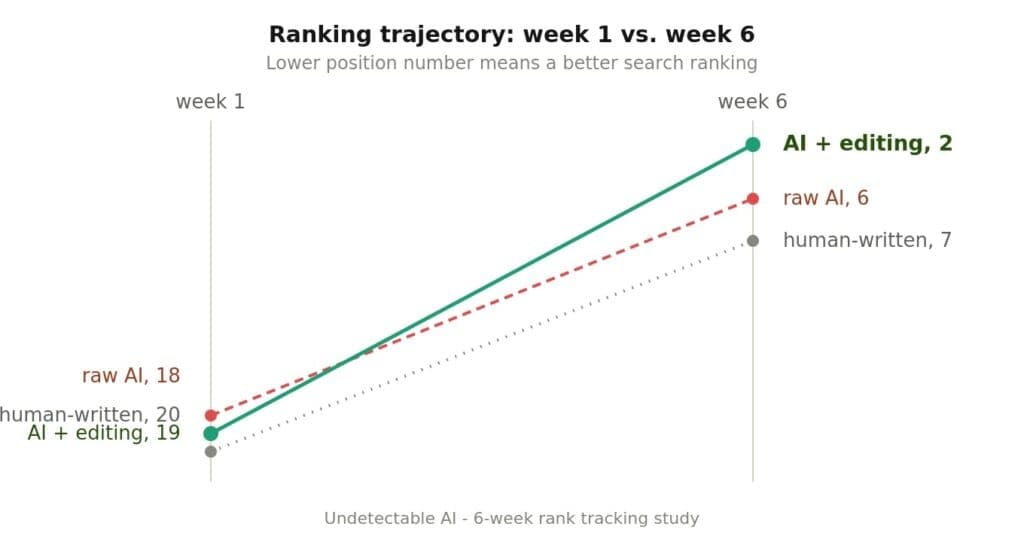
The 6-week data showed three different patterns:
- At first, I noticed that raw AI content gained rankings quickly, but most pages dropped around week 3 and showed little to no traction.
- Whereas human-written content improved steadily, although it started more slowly.
- However, by week 5, the pages that combined AI with roughly a few minutes of human editing had overtaken both groups and continued to gain traction through week 6.
While all three methods produced rankings, the edited AI content consistently demonstrated the strongest upward trajectory.
What the Data Shows for Each Method
Here, I’m sharing some insights that I noticed during my 6-week study. There was one common thing that happened with all three of my content approaches. They all ranked at first, but how they behaved later on the SERP is worth discussing:
Raw AI Output
As I had established previously, raw AI content showed the quickest initial traction, with most pages gaining visibility during the first 2 weeks. However, growth slowed massively around week 3-4, and rankings became stagnant. But why is it the case, you might ask.
Well, Google’s people-first content guidance clearly gives importance to originality, expertise, and depth (also known as E-E-A-T signals), which may explain why unedited and generic drafts struggled to maintain their position.
This happens because generic content is basically recycled information that is just paraphrased by the bots, and Google disregards it for not providing any value to the users.
Whereas, Google prefers and ranks content with E-E-A-T signals because they help identify that the content was created by people who have actual expertise on that specific topic.
AI + Human Editing (30 min)
The best performing approach in our test combined AI with roughly a few minutes of human editing. What’s interesting to note here is that the first draft was completely generated by AI, so how did it end up performing the best?
Well, I only made a few tweaks here and there, added some examples that suited best, shared my observations on the matter, and improved the introduction. I hardly spent 15 minutes doing these edits, but the results were remarkable.
Following this approach made me able to produce content that was more aligned with Google’s focus on helpful and reliable information.
Just by adding some examples and observations, I managed to fulfil Google’s E-E-A-T requirements in an AI-generated draft, and that’s how you use AI to create content without getting penalized.
Von Menschen geschrieben
Human-written content had the slowest start and took ages to gain traction, as compared to the other two approaches. Here’s something important to note in this approach: although this version was slower to rank, once ranked, it didn’t fluctuate as much. You might be wondering why?
Even I can also tell an AI-generated draft apart from a human-written one, and Google is way smarter than us. The tone, the structure, the examples, everything that stands out feeds the E-E-A-T signals and gets rewarded with its place in the SERP.
Now, if I refer to my study, the rankings were stable around week 3, and the performance of this version remained consistent, which once again proves the fact that Google’s emphasis on experience, expertise, authoritativeness, and trustworthiness (E-E-A-T) is the key to longer-term ranking.
The Edits That Made the Biggest Difference
This section has your answer to how to use AI to create content without getting penalized. After reviewing the pages that performed best in our test, I found out that a few simple edits can make the biggest difference.
- Tightening The Introduction
Removing generic opening lines and answering the search query directly made the content more aligned with the search intent.
- Adding First-Hand Insights And Examples
Next, I made sure to include observations from our own tests and experiences, which satisfied the E-E-A-T signals.
- Supporting Claims With Statistics And Credible Sources
I noticed that referencing studies, industry reports, and official documentation increased trust and made the content more useful for the user.
- Restructuring H2s To Match Intent
Structure is really important, so organizing sections around the questions users actually want answered made the articles easier to read.
- Removing Filler And Repetitive Sentences
Last but not least, cutting unnecessary text improved readability and allowed important information to stand out.
None of these changes required rewriting entire articles. In most cases, about 20-30 minutes of editing was enough.
What This Means for Your AI Content Workflow
My findings suggest that the best approach depends on the type of content you’re publishing. Below are some takeaways from my personal experience of conducting this study:
Publishing At Scale With Tight Deadlines
In this scenario, AI-assisted writing followed by at least thirty minutes of editing can deliver the strongest balance between speed and long-term ranking performance. For most blog posts, this was the most effective workflow in my test.
Homepage Content And Cornerstone Pages
These high-value assets deserve more attention. You should either write them entirely yourself or spend significantly more time editing AI drafts to add expertise, examples, and original insights.
Low-Competition Or Experimental Keywords
Raw AI content can gain visibility quickly, so you can make it useful for testing topics. However, my data showed that performance tends to drop, so these pages should be scheduled for updates and improvements later.
The reason why I suggested going for raw AI content for experimental keywords is that it gives you an idea of how well you can perform on them. After analyzing your performance, I suggest you make the aforementioned edits so it does not lose its ranking.
Here’s a snapshot that you can refer to for your content workflows requirements:
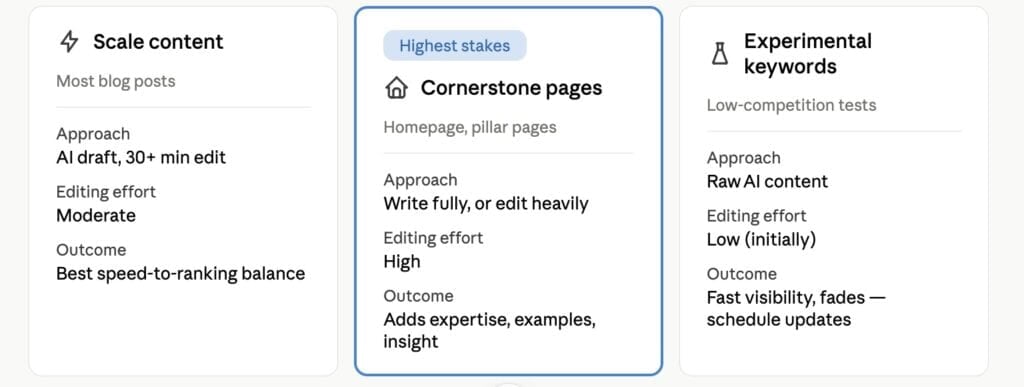
The lesson that I learned from conducting these experiments is that AI works best as long as you are not relying on it blindly, and human input still remains an important factor for ranking on the first page.
Häufig gestellte Fragen
Does Google penalize AI-generated content?
Google does not penalize AI-generated content automatically, and Google is certainly not running AI detection scans on your web pages.
In my 6-week test, raw AI content ranked, but the raw AI-written content’s rankings dropped more quickly than edited alternatives. Google penalizes thin, unhelpful content regardless of how it was produced.
How much editing does AI content need to rank?
In our test, 30 minutes of focused editing (tightening, adding examples, restructuring) was enough for the AI+edited version to outperform raw AI by week 5. Full rewrites are not always necessary.
Is human-written content always better for SEO?
Human-written content is not always better for SEO, especially not in early ranking velocity. Human-written content in my test ranked slower but held position more consistently after week 3. The best-performing pages long-term tend to be AI-drafted with expert editing.
Will AI content hurt my domain authority?
AI content will not hurt your domain authority if it is helpful for the reader, fulfils the search intent, and is well-edited. Domain authority reflects link equity, not content origin. Poor-quality AI content can hurt engagement metrics, which can indirectly affect rankings.
What is the best way to use AI for content that ranks?
Use AI for structure and first drafts, then edit for voice, examples, and depth. Our data suggests the edit step is the variable that separates ranking content from stalled content.
Schlussgedanken
The results of my 6-week experiment suggested that AI content is fully capable of ranking, but rankings are influenced far more by quality than by the tool used to create the draft.
By framing my study as an example for you, I have shown you how to use AI smartly and even how to rank your AI-generated draft with just a few tweaks. Just meet Google’s requirement of people-first content, and you are good to go, with any approach you like.
Having said that, across all three methods, the combination of AI and focused human editing delivered the strongest long-term performance. So, rather than viewing AI as a replacement for writers, the data points toward a more practical role that still benefits from human expertise and editorial judgment.
If you want to humanize your AI-generated drafts before publishing on your website, try Nicht nachweisbare AI for free!