
¿Recuerdas cuando la tecnología punta significaba disquetes e Internet por línea telefónica? Pues ahora disponemos de algoritmos avanzados de inteligencia artificial capaces de procesar cantidades ingentes de datos en cuestión de segundos.
Los avances de la IA han transformado nuestra forma de acercarnos a la información, permitiéndonos obtener respuestas instantáneas y precisas a casi cualquier consulta.
AI systems, while powerful, still rely on the precision of our inputs. Ask the wrong question or be too vague, and you might end up with confusing or irrelevant results.
The key to unlocking AI’s potential lies in knowing how to ask the right questions—questions that tap into its vast knowledge base and algorithms effectively.
In this guide, we’re diving deep into how to engage with AI like a pro.
Whether you’re tackling complex research or solving a technical issue, understanding how to frame your questions can make all the difference in getting optimal answers from AI.
Let’s jump in and explore the art of questioning AI.
Entender cómo procesa las preguntas la IA
First things first, let’s peek under the hood of AI and see what makes it tick when it comes to processing our questions.
Imagine AI as a super-smart (but very literal-minded) friend. It doesn’t benefit from context clues, body language, or shared experiences that we rely on in human conversations.
Instead, it’s working with pure language—the words you type in.
No vuelvas a preocuparte de que la IA detecte tus textos. Undetectable AI puede ayudarle:
- Haz que aparezca tu escritura asistida por IA de aspecto humano.
- Bypass las principales herramientas de detección de IA con un solo clic.
- Utilice AI de forma segura y con confianza en la escuela y el trabajo.
When you ask a question, AI doesn’t just look up the answer in some giant digital encyclopedia.
En su lugar, analiza su pregunta, la descompone en componentes clave y, a continuación utiliza sus vastos datos de entrenamiento para generar una respuesta that best fits what it thinks you’re asking.
It’s like if you asked your friend, “What’s the best way to make a sandwich?”.
Antes de responder, podrían tener en cuenta lo que saben sobre tus preferencias dietéticas, tus habilidades culinarias e incluso el contenido de tu nevera.
AI, on the other hand, will look at the words “best,” “way,” “make,” and “sandwich,” and then generate an answer based on general information about sandwich-making techniques.
That’s why being clear and specific in your questions is so crucial. The more precise you are, the better AI can understand what you’re really asking and provide an accurate, helpful answer.
Formas eficaces de plantear a la IA la pregunta adecuada
Now that we know how AI thinks, let’s talk about how to speak its language. Don’t worry, you won’t need to learn binary code or anything like that.
It’s all about structuring your questions in a way that AI can easily understand and respond to, a.k.a, escribir los mejores prompts.
Preguntas de estructura para mayor claridad
Piense en su pregunta como en un miniensayo. Debe tener un principio, un nudo y un desenlace claros. Empiece por el tema principal, añada el contexto necesario y, a continuación, formule su pregunta concreta.
For example, instead of asking, “What about climate change?” try something like:
“Regarding the issue of climate change, what are the three most significant impacts it’s expected to have on global agriculture in the next 50 years?”
See the difference? The second question gives AI a clear roadmap of what you’re looking for, making it much easier to provide a relevant and detailed answer.
Utilice un lenguaje preciso para obtener mejores resultados
Remember that literal-minded friend we talked about earlier? That’s your AI. It doesn’t understand nuance or implied meaning, so you need to be as precise as possible.
Instead of asking, “How do I fix my car?” try, “What are the step-by-step instructions for replacing the air filter in a 2015 Toyota Camry?”
Cuanto más específico sea, más concreta (y útil) será la respuesta.
Adapte las preguntas al resultado deseado
Think about what kind of answer you’re looking for. Do you want a brief overview? A detailed explanation? A list of steps? A comparison?
- Si quieres una lista: “List five common causes of headaches.”
- Si quieres una comparación: “Compare and contrast the benefits of yoga and weightlifting for overall fitness.”
- Si desea una explicación detallada: “Explain in detail how photosynthesis works in plants.”
By specifying the format you want, you’re more likely to get an answer that meets your needs.
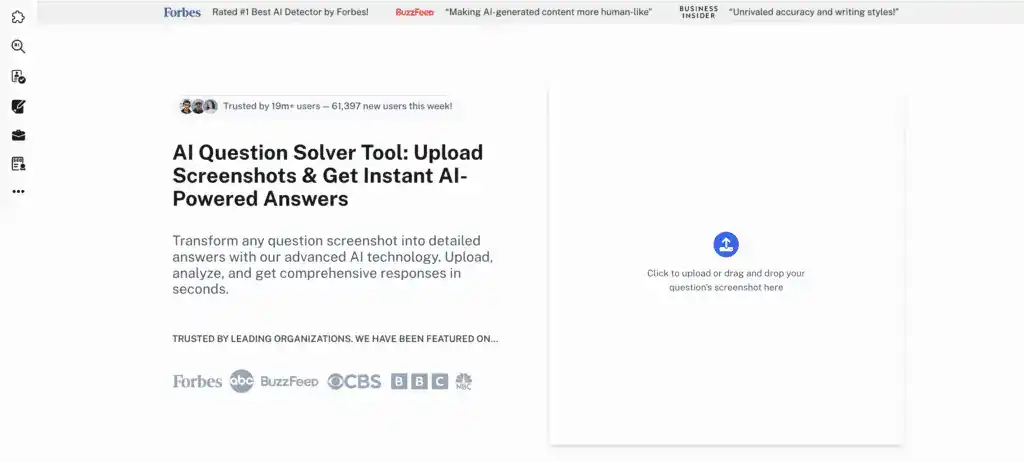
If you want instant, clear answers without wrestling with prompt structure, try using AI Question Solver.
Basta con introducir la pregunta para obtener una respuesta directa y precisa, sin necesidad de ajustes.
Cómo hacer preguntas a la IA sobre los documentos cargados
En OpenAI presentó por primera vez la posibilidad de que ChatGPT aceptara la carga de documentos supuso un cambio radical.
De repente, los usuarios podían ir más allá de las simples preguntas y respuestas y empezar a interactuar con archivos enteros, ya fuera para realizar análisis detallados o para extraer información clave.
Supongamos que ha aprovechado esta función y ha cargado un documento con la esperanza de obtener respuestas claras. Aquí es donde las cosas se ponen realmente interesantes.
Cuando haga preguntas relacionadas con un documento concreto, empiece siempre haciendo referencia a él.
For example, try something like: “Based on the annual report I uploaded, what were the company’s top three revenue sources last year?”
If you need specific details, precision is your best friend. Frame your question to direct AI to a particular part of the document, such as: “In the executive summary of the uploaded business plan, what is the projected growth rate for the next five years?”
You can also ask AI to compare different sections of the document: “Compare the sales figures for Q1 and Q4 as presented in the financial statement I’ve uploaded.”
Always remember, AI can only interpret the information you’ve provided.
If the response seems off, double-check the document you’ve uploaded and ensure your question is clear and focused on relevant content.
Ejemplos de buenas y malas preguntas sobre IA
Alright, let’s put all this into practice with some real-world examples. Think of this as a “What Not to Wear” for AI questions.
We’ll look at some fashion disasters (aka bad questions) and then give them a stylish makeover.
Lo que ocurre cuando se hacen preguntas vagas
Mala pregunta: “Tell me about dogs.”
This question is as vague as they come. It’s like walking into a library and asking for “a book.” Where does the librarian even start?
When you ask AI a question this broad, you’re likely to get a generic, encyclopedic response that might touch on dog breeds, care, history, and behavior – but probably won’t give you any particularly useful or interesting information.
Convierta las malas preguntas en eficaces
Buena pregunta: “What are the top 5 low-maintenance dog breeds for first-time owners living in apartments?”
Now we’re talking! This question gives AI a clear direction. It specifies:
- El número de artículos que desea (los 5 primeros)
- Una característica específica (bajo mantenimiento)
- Un grupo específico (nuevos propietarios)
- Una situación de vida particular (apartamentos)
Con este nivel de detalle, la IA puede proporcionar una respuesta mucho más específica y útil.
Let’s try another one:
Mala pregunta: “How do I lose weight?”
Again, this is too broad. Everyone’s weight loss journey is different, and there are countless approaches to losing weight.
Buena pregunta: “Create a weekly meal plan and exercise routine for a 35-year-old office worker aiming to lose 20 pounds in 3 months through a combination of diet and cardio exercises.”
Esta pregunta proporciona AI con:
- El objetivo específico (perder 9 kilos)
- Un calendario (3 meses)
- Información personal relevante (oficinista de 35 años)
- El tipo de plan necesario (plan de comidas y rutina de ejercicios)
- El método preferido (dieta y ejercicios cardiovasculares)
Con esta información, la IA puede generar una respuesta mucho más personalizada y procesable.
El papel del contexto en las preguntas sobre IA

El contexto es lo más importante when it comes to getting the best out of AI. Think of it as giving AI the backstory it needs to understand where you’re coming from and what you really want to know.
For example, let’s say you’re planning a trip to Japan. Instead of asking, “What should I do in Japan?” try something like:
“I’m planning a 10-day trip to Japan in October. I’m interested in traditional culture, food, and nature, but I’m not into big crowds or nightlife. I’ll be starting in Tokyo and ending in Kyoto. What itinerary would you suggest?”
Esta pregunta proporciona AI con:
- La duración de su viaje
- La época del año
- Sus intereses
- Cosas que debe evitar
- Sus puntos de partida y de llegada
En este contexto, la IA puede proporcionar una respuesta mucho más personalizada y útil, sugiriendo actividades específicas, destinos e incluso consejos de viaje que se ajusten a tus preferencias.
Consejos para evitar errores comunes al pedir IA
Even with the best intentions, it’s easy to fall into some common pitfalls when asking AI questions.
Aquí hay algunos consejos que debes tener en cuenta:
- Evite hacer varias preguntas simultáneamente. AI might focus on one and ignore the others. If you have multiple questions, it’s better to ask them separately.
- Don’t assume AI knows about current events or very recent developments. Its stored knowledge has a cutoff date, so for very recent information, it’s best to include the context in your question.
- Tenga cuidado con los términos ambiguos o las expresiones idiomáticas. AI might misinterpret them. For example, instead of asking, “How can I break the ice at a party?” you might say, “What are some good conversation starters for a social gathering?”
- Don’t expect AI to have personal opinions or preferences. Instead of asking, “What’s the best movie of all time?” try, “What are some critically acclaimed movies from different decades?”
- Evite pedir predicciones sobre el futuro. AI can provide information about trends or expert projections, but it can’t actually predict the future. Instead of “Who will win the next presidential election?” ask, “What factors typically influence presidential elections?”
Cómo refinar las respuestas de la IA para obtener mayor precisión
Incluso cuando se formula una pregunta excelente, es posible que la IA siga ofreciendo una respuesta que resulte imprecisa, incompleta o ligeramente errónea.
Perfeccionar la respuesta es donde tú Aprovecha todo el potencial de la IA., lo que le permite dar forma a su resultado para convertirlo en algo más preciso y útil.
Aquí hay algunas formas sencillas de hacerlo:
- Identifica lo que falta y haz una pregunta de seguimiento para aclarar la parte que deseas mejorar.
- Añade más contexto que la IA no tenía, como detalles del contexto, limitaciones o tu objetivo específico.
- Pida más detalles o profundidad, por ejemplo: “Dé más ejemplos”, “Explique paso a paso” o “Proporcione datos que lo respalden”.”
- Solicite una comparación si necesita conocer las diferencias entre dos opciones o conceptos.
- Pide una versión reformulada o simplificada si la respuesta original te parece demasiado técnica o prolija.
- Procesa la respuesta refinada a través de Undetectable AI para suavizar las expresiones robóticas y dar a la respuesta final un flujo natural, similar al humano.
Al dedicar un momento a perfeccionar las respuestas generadas por la IA, te aseguras de que la información que recibes sea más clara, más precisa y realmente acorde con lo que necesitas.
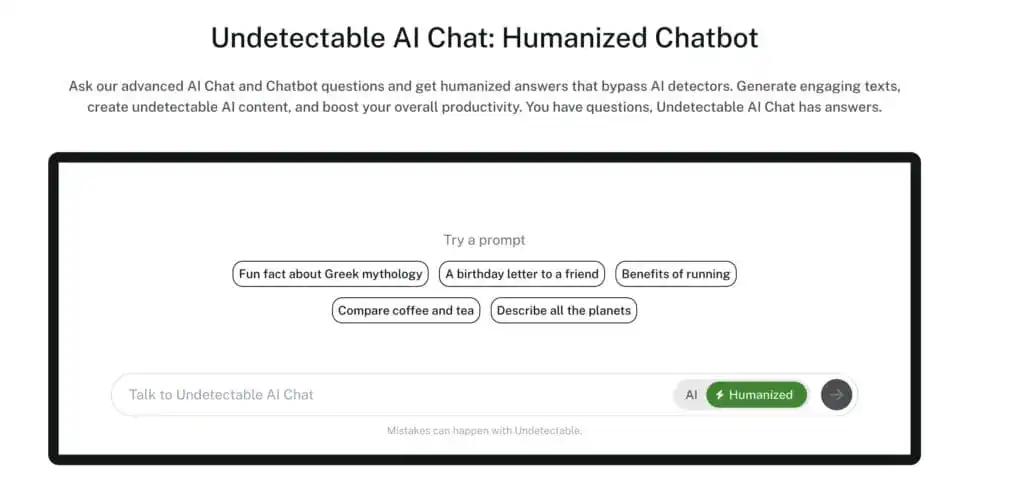
If you’re struggling to get the right results from traditional prompts, Undetectable AI’s AI Chat provides a seamless alternative where you can ask questions in a conversational way.
Este enfoque elimina las conjeturas de las indicaciones estáticas, utilizando un intercambio similar al humano para ayudarle a llegar a respuestas más precisas y matizadas con un esfuerzo significativamente menor.
Utilizar humanizadores de IA para garantizar respuestas precisas
Una de las formas más inteligentes de mejorar las respuestas de la IA es mediante Humanizadores de IA-Instrucciones estratégicas que ayudan a afinar las respuestas, haciéndolas más precisas y adaptadas a sus necesidades específicas.
Piense en ello como un entrenamiento de la IA para que actúe más como un experto humano.
Una herramienta poderosa en tu kit de herramientas para formular preguntas de IA es Undetectable AI.
Esta avanzada tecnología aprovecha Procesamiento del lenguaje natural (NLP**)** techniques to grasp the context and intent behind your questions, leading to more relevant and precise answers.
Además, destaca en la reducción de la ambigüedad. Al reformular o refinar sus consultas, Undetectable AI ayuda a eliminar términos o frases ambiguos, lo que garantiza que la IA generativa entienda su solicitud con claridad.
Pruébelo ahora y experimente la diferencia de primera mano.
Conclusión
Ahí lo tienes: tu guía para dominar el arte de formular preguntas con IA.
From understanding AI’s nuances to employing advanced techniques like humanizers, you’re now equipped to unlock the full potential of AI in your everyday work.
Recuerde que preguntar a la IA de la forma correcta conduce a respuestas más nítidas y matizadas.
Y con herramientas como IA indetectableCon la tecnología de la información, puede garantizar que sus resultados sean lo más humanos posible sin dejar de beneficiarse de la eficacia y la inteligencia de la inteligencia artificial.
Pruebe estas estrategias y pronto descubrirá que formular a la IA las preguntas adecuadas puede marcar la diferencia.
Así que adelante, perfecciona tus preguntas, interactúa con la IA y comprueba lo potentes que pueden ser tus resultados.
¡Feliz interrogatorio!