If you have ever asked yourself what AI checker do teachers use to catch essays written by ChatGPT, you are asking the right question at the right time. Artificial intelligence has quietly rewritten the rules of the classroom.
Homework that used to take a weekend now takes ten minutes, and teachers are left trying to figure out which papers reflect real learning and which ones came from a chatbot.
A recent nationwide survey found that the majority of graduating seniors admit to using AI for schoolwork in some form, and nearly half say they used it while writing major papers, according to a senior class survey conducted by the Yale Daily News.
Numbers like that explain why “what AI checker do teachers use” has become one of the most searched questions among educators. So let’s break it down properly, tool by tool, and talk about what actually works.
Let’s dive into it.
Principales conclusiones
- Teachers are not asking whether students use AI anymore. They are asking how to detect it fairly and consistently.
- No single AI checker is perfect, so most educators pair detection tools with conversations, drafts, and writing history.
- Undetectable AI Detector is one of the most trusted tools among teachers because of its accuracy and low false positive rate.
- Students should treat AI as a research partner, not a ghostwriter, if they want to stay on the right side of their school’s policy.
- Understanding how AI checkers work helps both teachers and students use them responsibly instead of fearfully.
Why Teachers Are Turning to AI Checkers
The short answer is that almost every student has tried using artificial intelligence to help with an assignment at some point. Teachers started noticing patterns.
Essays with the exact same structure. Vocabulary that suddenly sounded far more advanced than a student’s usual work. Assignments submitted hours after they were given instead of days.
Writing tools built on large language models made it genuinely difficult to separate a student’s own voice from AI-generated content. That is not a small shift. It touches grading, fairness, and the basic trust between a teacher and a class.
No vuelvas a preocuparte de que la IA detecte tus textos. Undetectable AI puede ayudarle:
- Haz que aparezca tu escritura asistida por IA de aspecto humano.
- Bypass las principales herramientas de detección de IA con un solo clic.
- Utilice AI de forma segura y con confianza en la escuela y el trabajo.
Most teachers are not against students exploring AI. What bothers them is the fairness gap. If one student spends three hours drafting a research paper by hand and another produces the same paper in ninety seconds with a chatbot, the grading scale suddenly means two different things.
AI checkers exist to close that gap, not to hunt down students for sport.
It also is not about mistrust. It is about the fact that human intuition alone is no longer reliable enough to catch AI writing, especially as models keep improving. Teachers want a tool that gives them a second opinion before they raise a concern with a student.
Is Using AI for Homework Actually Cheating?
This is where things get murky, and it is worth addressing directly. Research from RAND on the American Youth Panel found that most students do not consider most uses of AI, like brainstorming or checking grammar, to be cheating.
The exception is when a student asks AI to generate direct answers for them. That is the line most students recognize themselves, even if their school has not spelled it out yet.
What Counts as Misuse
Generally, using AI to organize your thoughts, check for grammar errors, or explain a confusing concept is considered acceptable in most classrooms. Submitting AI-written paragraphs as your own original work is where the trouble starts.
Why the Line Keeps Moving
Every school has a different policy, and those policies are still catching up to how fast the technology moves. That inconsistency is part of why AI checkers matter so much right now. They give teachers a consistent standard to apply, rather than relying purely on gut feeling.
El impacto de las herramientas de escritura ChatGPT y AI en la educación
Artificial intelligence did not just change how people search for information. It reshaped how students approach the entire writing process. With ChatGPT, a student can generate a full essay in under a minute, complete with a thesis, supporting arguments, and a conclusion.
The impact of ChatGPT on education goes well beyond essay writing. Students are using it for research summaries, creative writing prompts, math problem solving, and even coding assignments. Calling all of this cheating misses the nuance. For plenty of students, AI functions more like a writing partner or a study buddy than a shortcut.
Teachers are adjusting instead of fighting it. Many schools have stopped trying to ban AI outright and are instead teaching students how to use it responsibly, while relying on detection tools to flag content that clearly crosses the line into full AI authorship.
Questions of who actually owns Contenidos generados por IA are also becoming part of the classroom conversation, especially for students working on portfolios or creative projects.
What AI Checker Do Teachers Use Today?
So, what AI checker do teachers use in practice? The honest answer depends on the school, the subject, and the budget available.
There is no single tool that every classroom relies on. If you want a broader comparison, this roundup of the best AI detectors for teachers is a good place to start. For now, here are the tools that come up most often.
Detector de IA indetectable
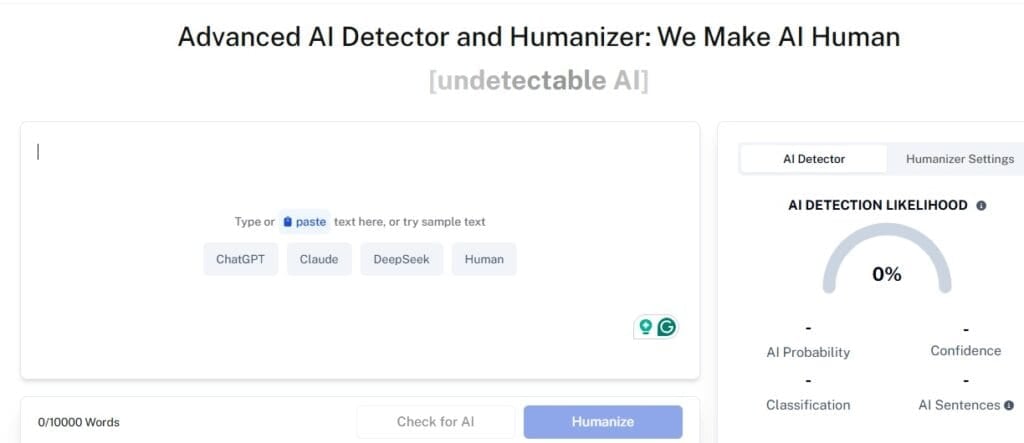
One of the most talked about tools in schools right now is the Undetectable Detector de IA. It is built for everyday classroom use, meaning you do not need any technical background to run a check.
It earned a perfect accuracy score across a round of independent testing by ZDNet, which put ten different detectors through the same set of tests. That kind of third party validation is exactly what teachers want before they trust a tool with a student’s grade.
The AI Checker is capable of detecting content for artificial intelligence tools such as ChatGPT, along with Gemini, Claude, Llama, and other major models. It also highlights the specific sentences that triggered the AI flag, so teachers can see exactly what raised suspicion instead of receiving a vague percentage with no explanation.
Beyond detection, the same platform offers an Humanizador AI and paraphrasing tools, which teachers sometimes use to show students how easily AI phrasing can be reworked, and why relying on it is risky.
GPTZero
GPTZero is a widely used free tool that scans for AI patterns in writing. The free version gives a basic reading, but a paid plan is required for a full breakdown of the results.
Turnitin
Turnitin built its reputation on plagiarism detection long before AI writing was a concern, and it has since added AI detection features.
The catch is that it is only available through an institutional license, so students cannot check their own work with it ahead of submission. That is one reason teachers often point students toward tools like the Undetectable AI Checker for a self check before they turn something in.
Copyleaks
Copyleaks is another option in the comprobador de plagios and AI detection space. It performs reliably on ChatGPT generated text, but accuracy can drop when it is tested against newer or less common language models.
None of these tools were built to punish students. They exist to protect academic integrity and give teachers a fair, evidence based way to start a conversation.
Cómo funcionan los AI Checkers para los profesores

AI checkers rely on machine learning models trained to spot patterns typical of generated text. Specifically, they look for:
- Repetitive sentence structures and predictable rhythm
- Perplexity and burstiness, which measure how predictable and varied the word choices are
- Overly formal or generic vocabulary
- A lack of personal voice or first hand experience
- Unnatural transitions between ideas
- Inconsistent knowledge or tone within the same piece of writing
In short, the tools are trained to notice writing that sounds “too smooth” to be human. To see this in action, teachers can use the Undetectable AI Detector by pasting a sample of text into the checker, clicking scan, and reviewing the results within seconds.
The tool highlights flagged sentences so it is easy to see exactly why a passage was marked as likely AI writing.
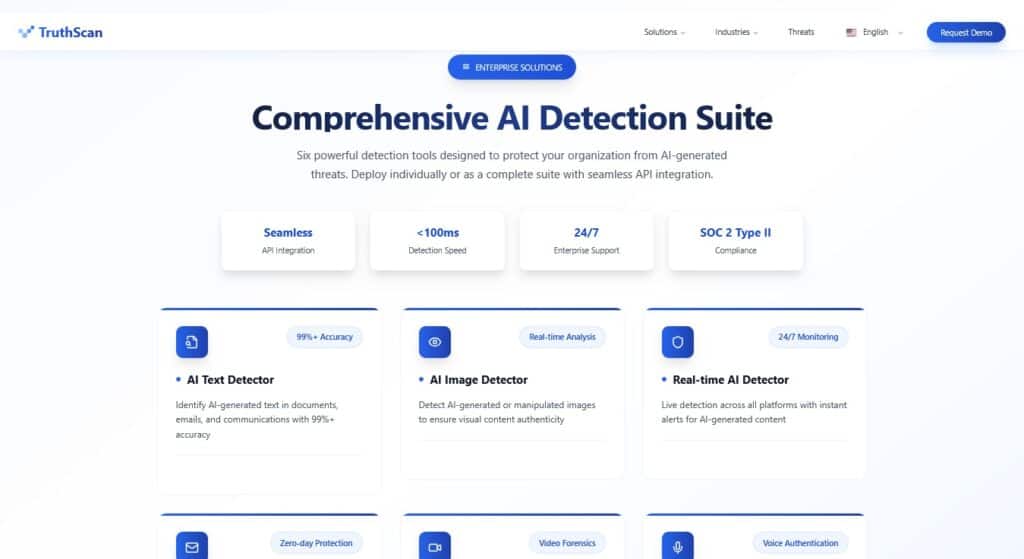
Some schools also lean on tools like TruthScan as an added layer when reviewing suspicious submissions.
Whatever tool is used, it is worth remembering that these results are a starting point, not a verdict. If a checker says a paper is eighty percent AI generated, that number alone should never be the reason a student fails an assignment.
How Accurate Are AI Checkers, Really?
This is the question every teacher eventually asks, and it deserves an honest answer. AI checkers are useful, but Las herramientas de IA no son perfectas, and treating a score as absolute proof can lead to unfair outcomes.
False Positives Explained
A false positive happens when a checker flags genuinely human written text as AI generated. This tends to happen more often with formal academic writing, non native English speakers, and students who naturally write in a structured, formal style.
That is exactly why teachers are encouraged to look at ¿Qué detector de IA utilizan los profesores? with the strongest track record for minimizing false flags, rather than picking the first free tool they find.
Why No Tool Is 100 Percent Foolproof
In a study conducted by professors of the University of Pennsylvania, researchers concluded that “detectors trained on ChatGPT were mostly useless in detecting machine generated text outputs from other LLMs.”
This means a checker trained mainly on one model can miss content written by a different one entirely, or worse, mistakenly flag legitimate student writing. The researchers were direct about the risk this creates if schools rely too heavily on a narrowly trained detector.
The practical takeaway is simple. Use an AI checker as a signal, not a courtroom verdict, and always pair it with a conversation with the student.
¿Qué opinan las escuelas y los profesores sobre el AI Checkers?
Opinions are genuinely mixed. Some teachers treat a flagged result as solid evidence to back up a suspicion they already had. Others worry about the fallout of a false accusation and how it can damage trust with a student who did nothing wrong.
Most schools now advise a blended approach: use the detector, but never rely on it alone. Combine the score with a short conversation, a look at the student’s writing history, and common sense. The consensus among administrators is that AI checkers work best as one part of a larger academic integrity strategy, not a stand alone judge and jury.
School AI Policies: What Is Changing in the Classroom
Policy is where a lot of the real tension lives right now. A national study from Gallup on higher education found that a large share of enrolled students say their school either discourages or fully prohibits AI use, even though a similar share of students report using it anyway.
That gap between policy and reality is exactly why detection tools have become part of everyday classroom management rather than a niche experiment.
Some schools are moving toward clearer tiered policies. For example, allowing AI for brainstorming and outlining but prohibiting it for final drafts, then using an AI checker to confirm compliance rather than to catch every possible instance of misuse.
Others are still working out the details, which leaves teachers filling the gap with their own judgment and their own choice of detection tool.
¿Qué ocurre si los profesores sospechan del uso de IA?

Getting flagged by a checker does not automatically mean a student is in serious trouble. In most cases, it opens a conversation. A teacher might ask a student to explain their process, walk through their notes, or describe how they approached the assignment.
If it becomes clear the student leaned entirely on AI when they should not have, consequences vary by school and can include a rewrite, a grade penalty, a meeting with an academic integrity office, or in more serious repeat cases, suspension.
Some teachers take a zero tolerance stance, while others treat a flagged paper as a teachable moment about over reliance on AI.
The schools handling this well tend to follow a similar pattern:
- Start with a conversation focused on understanding, not accusation
- Reference the school’s specific AI policy before deciding next steps
- Focus on whether the student actually understands the material, not just the score on a detector
Cómo escribir con seguridad en la era del corrector automático
Students need to accept that AI checkers are now a permanent part of the classroom, and they are only going to get sharper over time. That does not mean AI is off limits. It means using it with more intention.
Start by reading your school’s actual AI policy instead of guessing. Some schools allow partial use for research or outlining, while others do not allow it at all. From there, pay attention to what tends to trigger a flag, like repetitive sentence patterns, overly generic vocabulary, or a tone that does not sound like your own writing voice.
Herramientas como el Humanizador AI exist to help writers keep a natural, personal tone if they use AI for early drafting, though the safest long term habit is treating AI as a brainstorming partner rather than the source of your final draft.
Use it to research and organize your thinking, then write the final version in your own words so it actually reflects your understanding of the topic.
Alternativas que los profesores utilizan junto con los AI Checkers
Relying on detection software alone is not a complete strategy, and most experienced teachers know it. A better approach combines a checker with classroom habits that make AI misuse harder to hide and easier to have an honest conversation about.
Many educators are also exploring the wider set of AI tools for teachers that support lesson planning and grading, not just detection.
Common strategies include:
- Asking students to document their research and drafting process
- Building in-class writing time for topics students are likely to outsource to AI at home
- Designing prompts that require personal experience or original analysis
- Encouraging group discussion and peer review before final submission
- Having students explain or present their work verbally to confirm understanding
Creating a classroom culture where students feel safe discussing how and when they used AI tends to produce far more honest outcomes than a purely punitive approach.
Descubra más herramientas aquí, o pruebe nuestro AI Detector y Humanizer en el widget de abajo.
Preguntas frecuentes
What AI checker do most teachers use?
There is no single tool every teacher relies on. Many educators use a mix of Undetectable AI Detector, GPTZero, Turnitin, and Copyleaks depending on their school’s subscriptions and the type of assignment being reviewed.
Can AI checkers be wrong?
Yes. AI checkers can produce false positives, especially with formal academic writing or text from non native English speakers. That is why most teachers treat a flagged score as a starting point for a conversation, not final proof.
Do free AI checkers work as well as paid ones?
Free versions usually offer a basic scan, while paid plans tend to include sentence level breakdowns, higher word limits, and more consistent accuracy. For quick classroom checks, a strong free option like the Undetectable AI Checker can still be reliable.
Can students check their own work before submitting it?
Yes, and it is a smart habit. Running a draft through an AI checker before turning it in helps students see whether their writing might get flagged, and gives them a chance to revise sections that sound too generic or robotic.
What happens if my paper gets falsely flagged as AI written?
Talk to your teacher directly. Bring your draft history, notes, or outline as evidence of your process. Most teachers are willing to review a flagged result rather than treat it as final proof, especially if you can show your work.
Do AI checkers detect paraphrased AI content?
It depends on the tool. Heavily paraphrased AI text is harder to catch than a direct copy paste, which is one reason teachers are cautioned against relying on a single detector or a single score as the whole picture.
Conclusión
There is no single, universal answer to what AI checker do teachers use, because the right tool depends on the classroom, the school’s resources, and the type of assignment being reviewed.
What is consistent is the growing preference for tools that are accurate, transparent, and easy to use without technical training, which is exactly why Undetectable AI Detector has become a go to option for so many educators.
AI checkers were never meant to replace a teacher’s judgment. They are meant to support it. Used alongside real conversations, writing history, and a bit of common sense, they help schools protect academic integrity without turning every assignment into an interrogation.
Whether you are a teacher building a fair AI policy or a student trying to use these tools responsibly, the goal is the same: use AI as a tool, not a shortcut around your own thinking.
Prueba el IA indetectable Detector and Humanizer for yourself to see exactly how it works before you build it into your classroom routine.