
If you’re wondering what AI detector do teachers use, the answer is actually pretty boring: whatever the school pays for.
And for most universities and K-12 districts across the United States, that’s Turnitin.
But after spending years studying AI detectors and running Undetectable AI, I’ve realized that the good teachers don’t stop there. They’ll often use another detector for a second opinion.
So if you’re a teacher looking for a reliable backup AI detector, or maybe you’re a student curious about what your teacher might be using behind the scenes, this guide is for you.
I’m comparing four popular second-opinion AI detectors based on accuracy, compliance, pricing, and how useful they are for teachers.
I’m also sharing some key research on why no AI detector score should ever be treated as evidence on its own, especially when evaluating student work.
Key Takeaways
- For most teachers, Turnitin is the default AI detector because it’s built into their school’s workflow. However, many teachers also use an additional AI detector alongside Turnitin.
- In our testing and research on what AI detectors teachers use, Undetectable AI’s AI Detector was the strongest second-opinion option for teachers, combining high accuracy with a generous 10,000-word free limit that lets teachers scan full essays at once.
- Even in 2026, AI detectors still struggle with certain types of writing, with a Stanford study finding that some detectors incorrectly flagged essays written by non-native English speakers as AI-generated more than half the time.
- The best teachers never rely on a single AI detector score when evaluating the authenticity of a student’s work. Instead, they look for agreement across multiple AI detectors and compare the result against a student’s revision history and previous work.
What Is an AI Detector?
Before we get into the top AI detectors teachers use, it’s worth taking a moment to understand what an AI detector is, and what it isn’t.
Despite the name, AI detectors don’t actually “know” whether a student used ChatGPT or another AI writing tool. Instead, they analyze patterns in the text and estimate how likely it is to have been generated by AI.
Most detectors rely on statistical signals such as perplexity and burstiness.


Never Worry About AI Detecting Your Texts Again. Undetectable AI Can Help You:
- Make your AI assisted writing appear human-like.
- Bypass all major AI detection tools with just one click.
- Use AI safely and confidently in school and work.
Perplexity measures how predictable the word choices are. In general, AI-generated writing tends to be more predictable because language models often favor common words and sentence patterns, while human writing is usually less predictable and contains more variation.
Burstiness measures how much sentence length and structure change throughout a piece of writing. Humans naturally mix short, long, simple, and complex sentences. AI writing is often more uniform.
Based on these signals, the detector returns a probability score of how “likely” a piece of text is to be AI-generated or human.
This is very different from plagiarism checkers, which compare text against existing sources, or revision-history tools, which show how a document was created over time. AI detectors don’t see intent, editing history, or the writing process. They only analyze the final text that’s submitted.
The 4 Best Second-Opinion AI Detectors for Teachers
When we set out to find what AI detector teachers use, we quickly realized that most teachers aren’t really looking for a replacement for Turnitin; they’re just looking for a second opinion.
With that in mind, and after reviewing dozens of tools, four names kept coming up again and again: Undetectable AI, Quillbot, Winston AI, and Scribbr.
To put the top ones to the test, we generated a 400-word essay using ChatGPT (GPT-5.5) and submitted the exact same text to every detector.
We also researched and evaluated each tool on a few factors that are important to teachers, including:
- Free usage limits and restrictions
- Pricing and paid plan availability
- Sentence-level analysis features
- LMS and classroom integrations
- Compliance and security disclosures
- Overall ease of use for educators
Before we get into the details, strengths, and weaknesses of each platform, the following table provides a quick side-by-side comparison of all four tools.
| Undetectable vs Quillbot vs Winston AI vs Scribbr: Quick Facts | ||||
|---|---|---|---|---|
| Criteria | Undetectable AI | Quillbot | Winston AI | Scribbr |
| Accuracy | Very Accurate Flagged our 100% AI-generated essay as 99% likely AI |
Very Accurate Flagged our 100% AI-generated essay as 100% likely AI |
Very Accurate Flagged our 100% AI-generated essay as 100% likely AI |
Very Accurate Flagged our 100% AI-generated essay as 0% human |
| Free tier word limit | 10,000 words per scan | 1,200 words per scan | 2,000 characters per scan | 1,200 words per scan |
| Paid pricing | Plans range from $5 per month to $42 per month. | Plans range from $8.33 per month to $19.95 per month. | Plans range from $10 per month to $26 per month. | $8.33 per month, billed annually for unlimited AI detection. |
| FERPA-Compliant | Not publicly stated. | Not publicly stated. | Not publicly stated. | Not publicly stated. |
| SOC 2-Compliant | Not publicly stated. | Not publicly stated. | Yes. Source: Winston AI privacy matters |
Not publicly stated. |
| AICPA-Compliant | Not publicly stated. | Not publicly stated. | Not publicly stated. | Not publicly stated. |
| Learning Management System (LMS) Integrations | API access supported, no specific LMS integrations listed. | No LMS integrations listed. | Yes, Google Classroom. | No LMS integrations listed. |
| Sentence-Level Highlighting | Yes | Yes | Yes | Yes |
Undetectable AI Detector
When I put myself in a teacher’s shoes, I realized that our own Undetectable AI Detector is one of the few tools that allows you to check an entire essay without immediately running into a word limit.
The free version supports up to 10,000 words per scan, which is significantly more generous than others on this list. That makes it practical for reviewing longer assignments without splitting text into multiple submissions.
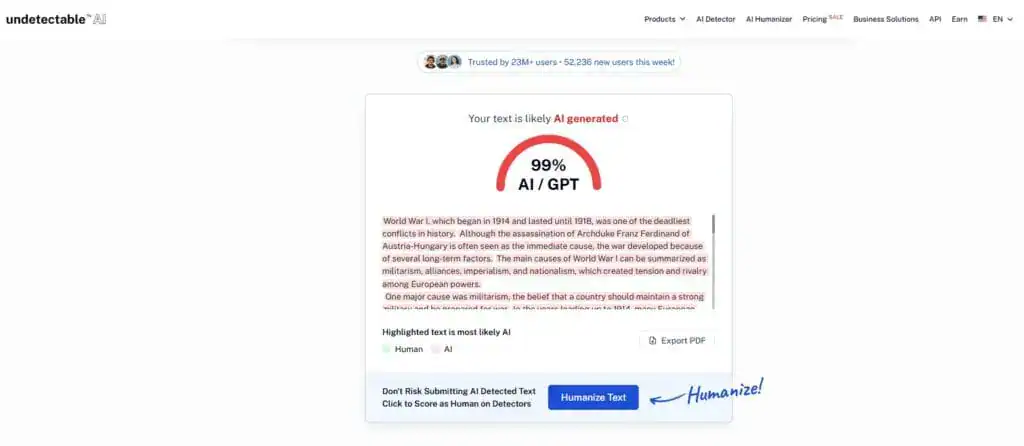
In terms of accuracy, Undetectable AI correctly identified the AI-generated essay as 99% AI. Beyond the score itself, the tool also provides sentence-level highlighting, making it easier to see which sections of a paper are triggering the detection result.
I’d also like to note here that because our AI Detector is built by the team behind our AI Humanizer, it has visibility into how AI-generated text is commonly edited and rewritten before submission.
This is super useful in educational settings, where students rarely submit raw ChatGPT output without making changes.
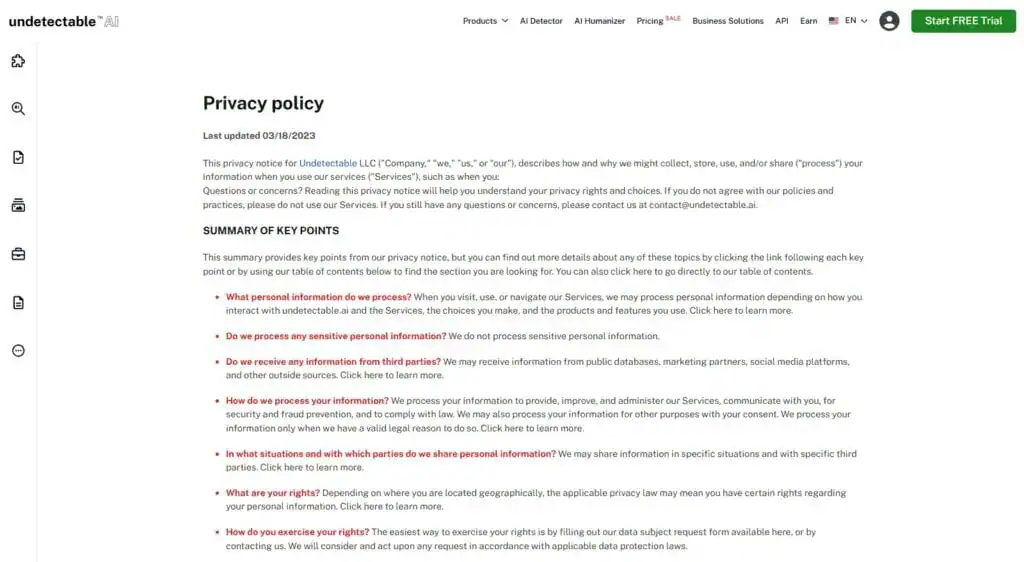
In terms of privacy and compliance, we don’t currently publish FERPA, SOC 2, or AICPA compliance certifications on our website. For individual educators using Undetectable AI as a secondary checker, this isn’t usually a major concern.
However, if this is a priority for your school, please feel free to get in touch, and we’d be happy to discuss our privacy practices and answer any questions.
Overall, here’s what teachers tend to like the most about Undetectable AI, and where it falls short.
| Undetectable AI: Pros and Cons at a Glance | |
| What Teachers Like | Where it Falls Short |
| Generous free limits (10,000 words)Fast scansClear sentence-level highlighting | Like every detector, it can occasionally misclassify human writing.Larger schools and districts may require additional compliance documentation before adoption. |
Quillbot AI Detector
QuillBot AI Detector is one of the easiest AI detectors to try. It’s free to use, doesn’t require an account, and is part of the broader Quillbot writing suite that many students already use for paraphrasing and grammar assistance.
In our test, Quillbot correctly identified the AI-generated essay as AI-written, making it a decent quick-check tool. However, its lower scan limits and history of false positives make it better suited as a lightweight secondary check rather than a tool teachers should rely on heavily.
For teachers looking for a quick second opinion, that’s good news.
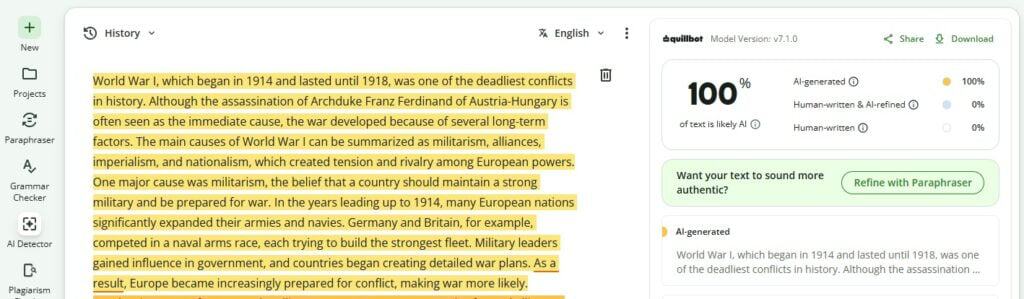
That said, Quillbot is best viewed as a supplementary tool rather than a primary decision-maker. While it performs well on straightforward AI-generated content, there have been documented cases where it produced high AI scores on text written before ChatGPT existed.
This highlights a challenge shared by many AI detectors: predictable human writing can sometimes resemble AI-generated text.
From a compliance perspective, Quillbot does not publicly advertise FERPA compliance, SOC 2 certification, or other education-specific compliance standards. Schools with strict privacy requirements may want to review institutional policies before using the platform with student work.
All in all, here’s what teachers tend to like the most (and the least) about Quillbot.
| Quillbot AI Detector: Pros and Cons at a Glance | |
| What Teachers Like | Where It Falls Short |
| Free to use with no signup required Simple interface with virtually no learning curveUseful for a quick second opinion on shorter assignments | Can produce false positives on highly structured human writingFERPA and SOC 2 compliance certifications are not publicly disclosed. Some users report stability issues with browser and Word integrationsMuch lower per scan word limit compared to Undetectable AI |
Winston AI
Winston AI is the most education-focused detector we tested. In addition to AI detection, it also offers OCR for scanned handwriting and PDF submissions, plus Google Classroom integration for teachers who want AI detection built into their existing workflow.
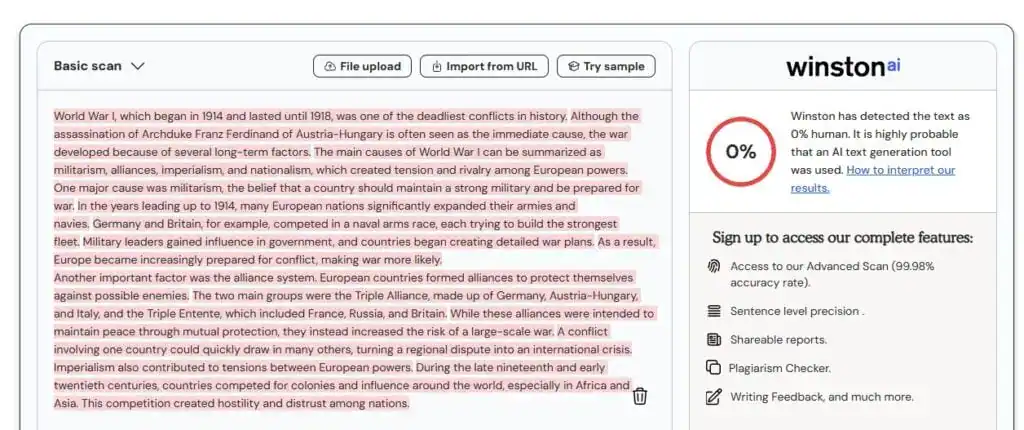
In our test, Winston AI correctly identified the AI-generated essay as AI-written, returning a score of 0% human. It was one of the strongest performers overall and stands out for features designed specifically for educators rather than general consumers.
Winston AI stands out for institutions that prioritize formal security documentation, but for most individual teachers, those enterprise-level requirements may not outweigh practical considerations like scan limits, speed, and accessibility.
It is the only detector in this comparison that publicly states SOC 2 compliance, making it a stronger fit for schools and districts with formal privacy and procurement requirements.
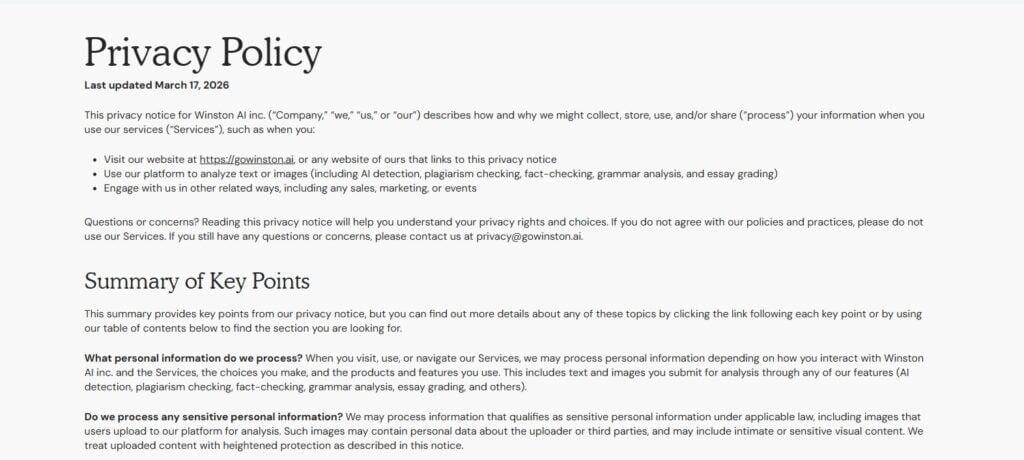
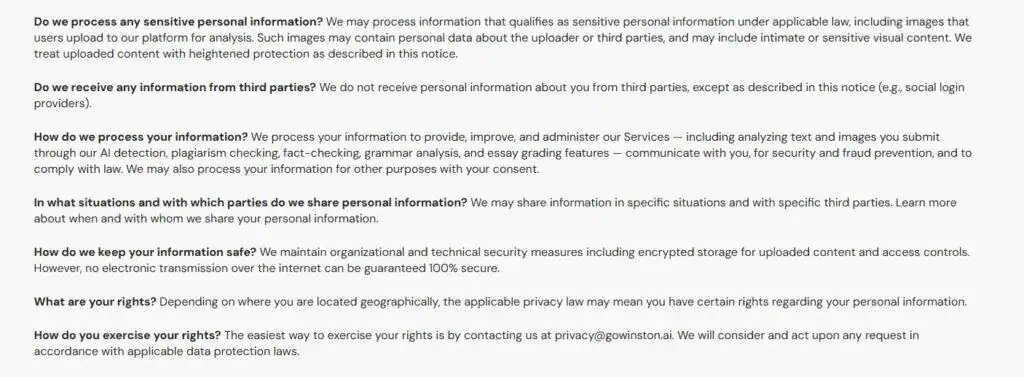
While Winston does not publicly advertise FERPA certification, its transparency around security practices is stronger than many competing AI detectors.
The trade-off is accessibility. Winston’s free tier is significantly more restrictive than Undetectable AI’s, and its interface can feel more feature-heavy if you’re simply looking for a quick second opinion on a paper.
Here’s a quick look at Winston’s pros and cons at a glance.
| Winston AI: Pros and Cons at a Glance | |
| What Teachers Like | Where It Falls Short |
| Google Classroom integration OCR support for handwritten assignments and PDFs Publicly disclosed SOC 2 complianceStrong fit for institutional workflows | Some users report a high amount of false positives on shorter passages Restrictive free tier Much lower per scan word limit compared to Undetectable AI |
Scribbr AI Detector
Scribbr is one of the most recognizable brands in academic writing. Many teachers and students already know it for citation generators, plagiarism checking, proofreading services, and other educational tools, which makes its AI detector a natural place to start.
In our test, Scribbr correctly identified the AI-generated essay as AI-written, which is a great start.
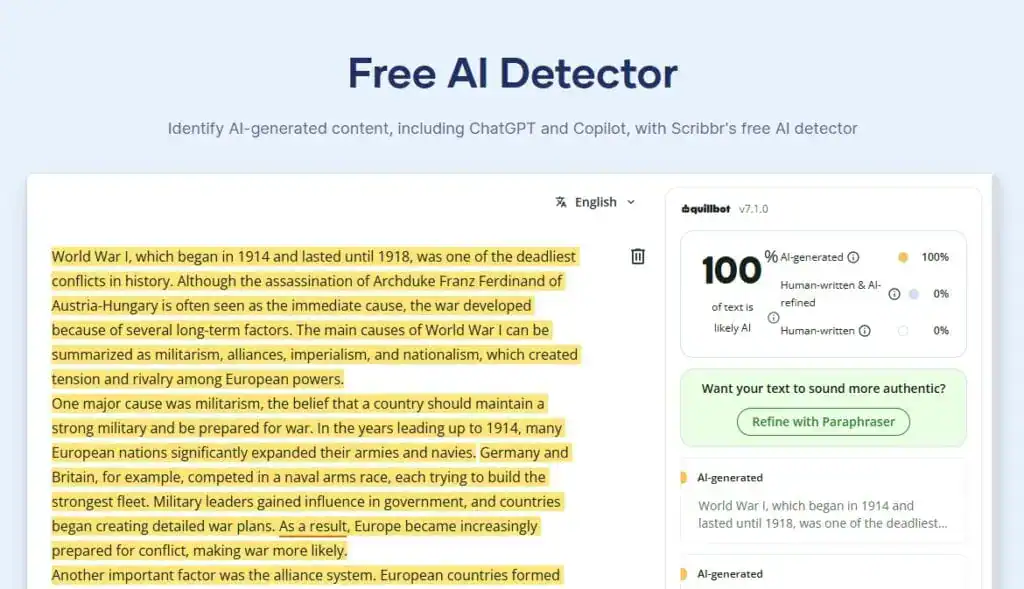
However, Scribbr also notes that its free detector is less accurate than the premium version. That distinction matters because a clean score on the free tier doesn’t necessarily mean you’re seeing the full capabilities of the platform’s detection engine.
For educators who already use Scribbr’s academic tools, its AI detector can be a convenient secondary option. However, its lower free limits and premium-gated accuracy make it less flexible for frequent classroom use.
However, teachers should keep in mind that the most advanced detection features sit behind a paywall.
From a compliance standpoint, Scribbr does not publicly advertise FERPA, SOC 2, or AICPA compliance certifications. As a result, it’s generally better suited for individual checks than institution-wide academic integrity workflows.
Like every detector we tested, Scribbr has clear strengths and a few notable weaknesses. Here’s the short version.
| Scribbr AI Detector: Pros and Cons at a Glance | |
| What Teachers Like | Where It Falls Short |
| Familiar and trusted academic brandClean, ad-free interfacePart of a broader academic writing ecosystem | The free detector is less accurate than the premium versionFERPA, SOC 2, and AICPA compliance certifications are not publicly disclosedLike all AI detectors, false positives are an issueMuch lower per scan word limit compared to Undetectable AI |
Independent Studies on Detector Accuracy
Before trusting any AI detector score, it’s worth looking at what independent research says about these tools.
One of the biggest challenges in AI detection is that accuracy isn’t consistent across every type of writing. A detector might perform well on a clearly AI-generated essay but struggle with edited content, mixed human-AI writing, or work written by non-native English speakers.
That’s why most researchers recommend treating AI detector scores as one signal among many, not definitive evidence that a student used AI.
Here are two of the most widely cited studies on the topic.
Stanford 2023: Bias Against Non-Native English Writers
One of the most influential studies on AI detection came from researchers at Stanford University in 2023.
Researchers found that several popular AI detectors incorrectly flagged TOEFL essays written by non-native English speakers as AI-generated at alarmingly high rates.
Even though the detectors achieved near-perfect accuracy on essays written by U.S. eighth-grade students, they falsely classified 61.22% of TOEFL essays as AI-generated.
At Undetectable AI, we know that false positives can be incredibly frustrating for both students and educators. We also know, based on Stanford’s research, that this is an industry-wide issue, not an issue with a handful of AI detectors.
That’s why AI detector scores should never be treated as standalone evidence of AI use or academic misconduct.
Turnitin’s Own ELL Bias Study
In response to concerns about bias against non-native English writers, Turnitin conducted its own study on English Language Learner (ELL) writing samples.
The company reported a false-positive rate of just 0.014% for submissions that met its 300-word minimum requirement, concluding that its AI detector showed no statistically significant bias against ELL writers.
That’s a dramatically different result from Stanford’s findings. However, it’s important to remember that Turnitin’s research was conducted and published by Turnitin itself rather than by an independent academic research group. And like any self-sponsored research, it should be taken with a grain of salt.
For teachers, the primary takeaway isn’t that one study is “right,” and the other is “wrong”. It’s that AI detection remains an evolving field, and detector scores should always be interpreted alongside other evidence.
Why Undetectable AI Is the Best Choice for Teachers
After testing all four tools, one thing became clear: while several AI detectors can identify obvious AI-generated writing, Undetectable AI offers the most practical and teacher-friendly experience overall.
Unlike many detectors that limit scans to short passages, Undetectable AI allows up to 10,000 words per check, making it far more useful for reviewing full essays, research papers, and long-form assignments without splitting content into multiple scans.
It also combines AI detection with sentence-level analysis, plagiarism checking, citation tools, paraphrasing support, and browser integrations, giving teachers a more complete academic integrity toolkit instead of a standalone detector.
For educators using Google Docs, our Chrome extension makes it easy to scan writing directly inside the browser, which creates a smoother workflow similar to classroom tools like Google Classroom integrations.
While tools like Quillbot, Winston AI, and Scribbr can provide useful second opinions, they each come with trade-offs in word limits, accessibility, or workflow flexibility.
For teachers who want speed, flexibility, and deeper analysis in one place, Undetectable AI remains the strongest second-opinion detector available today.
When AI Detectors Get It Wrong
One of the biggest misconceptions about AI detectors is that they look for “proof” of AI use.
They don’t.
AI detectors are statistical tools, which means they make predictions based on patterns in the text. And like any prediction system, they have predictable failure modes.
The best-documented example is writing from non-native English speakers.
As we saw in the Stanford study, several leading AI detectors incorrectly flagged TOEFL essays as AI-generated at surprisingly high rates.
Turnitin’s own research reached different conclusions, but both studies point to the same reality: evaluating English Language Learner (ELL) writing remains one of the biggest challenges in AI detection.
Formulaic human writing can also trigger false positives.
Academic essays, standardized test responses, and highly structured assignments often follow predictable patterns.
In one example, Quillbot reportedly flagged text written before ChatGPT even existed as 87% AI-generated. This highlights an important limitation of all AI detection tools: predictable writing doesn’t necessarily mean AI was involved.
Short submissions create another challenge.
Most detectors become less reliable when evaluating text under 150 to 300 words because there simply isn’t enough content to measure patterns like perplexity and burstiness with confidence. That’s one reason many AI detection providers recommend minimum word counts before interpreting results.
All of these examples lead me to my final point: no detector score is evidence of AI-use on its own. But it is a reason to have a conversation and dig deeper.
What Teachers Should Do Before Accusing a Student
So you’ve got a paper that scored highly on an AI detector. What now?
Before raising an academic integrity concern, it’s worth taking a few extra steps to make sure you’re seeing the full picture.
For example, you can:
- Verify the result with a second detector. Never rely on a single AI detector score. If one tool flags a paper, run it through at least one other detector and see if it flags similar passages.
- Review the document’s revision history. In Google Docs or Microsoft Word, AI-generated content that’s been pasted in often appears as one large insertion. Human writing typically shows a more gradual pattern of drafting, editing, and revision.
- Compare the paper to the student’s previous work. This is often the most reliable signal of all. Look for sudden changes in vocabulary, sentence structure, writing quality, or argumentation style.
- Look for context, not just scores. Consider classroom performance, participation, rough drafts, outlines, and other evidence that helps explain how the assignment was completed.
- Start a conversation before making an accusation. Instead of leading with the detector score, ask the student to walk you through their writing process. Genuine questions will always reveal more about a student than any AI detector can.
- Consider alternative resolutions. If concerns remain, a revision assignment, oral defense, or follow-up writing exercise is usually more defensible than relying on detector scores alone.
In short, no AI detector should be the sole basis for an accusation, and every flagged paper deserves additional review before any action is taken.
Frequently Asked Questions About What AI Detectors Teachers Use
What is the best AI detector for teachers?
For most teachers, the best AI detector is used alongside . Turnitin remains the institutional default in many schools, but Undetectable AI combines high accuracy, larger scan limits, and detailed sentence-level analysis, making it a more flexible option for reviewing full student submissions.
Do teachers actually use AI detectors?
Yes. Most colleges, universities, and many K-12 districts now have access to AI detection through Turnitin. Many teachers also use free tools like Undetectable AI, Quillbot, Winston AI, or Scribbr when they want a second opinion or additional context.
What’s the best free AI detector for teachers?
Undetectable AI offers one of the largest free scan limits among major AI detectors, allowing up to 10,000 words per scan. This allows you to check full essays without hitting paywalls or character limits.
Is Quillbot AI Detector reliable for grading?
No AI detector is 100% reliable for grading on its own. Quillbot is useful for a quick check, but it has documented cases of flagging pre-2022 human text as AI.
No matter what AI detector you use, you should always pair it with another detector and take time to review other signals too, like the student’s revision history, previous writing samples, and overall classroom performance.
Can teachers tell if I used ChatGPT?
Teachers look for a combination of signals, including AI detector scores, sudden changes in your writing voice, use of vocabulary you don’t normally use, and a lack of revision history in Google Docs.
A detector score alone isn’t proof, but tell-tale signs like a dramatic shift in writing style or unusual vocabulary can be difficult to overlook.
Why do AI detectors flag human writing as AI?
Detectors look for predictable word choices and uniform sentence lengths. If a human writes in a highly formulaic, structured way (which is common for non-native English speakers or students following strict essay templates), the detector may misinterpret it as AI-generated text.
An AI Detector Score Should Never Be the Final Word
For most teachers, Turnitin’s built-in AI detector works best when paired with a secondary tool to validate the initial results before investigating further.
Based on our testing, Undetectable AI delivered the best balance of accuracy, usability, and flexibility for teachers.
Its ability to scan up to 10,000 words at once, highlight suspicious passages at the sentence level, and work across multiple writing workflows makes it the most practical AI detector for educators who want a reliable second opinion.
While no AI detector should ever be treated as final proof, Undetectable AI gives teachers the strongest starting point for identifying potential AI-assisted writing while reducing unnecessary friction in the review process.