
If you take a photo of a mirror, do you see the mirror or the reflection? Paraphrasing is the same.
You might change the reflection, but the mirror (the original AI structure) is still there.
So, can Turnitin detect AI paraphrasing by looking past the reflection?
In this blog, we’re going to find out.
We will explore what AI paraphrasing actually is, what gets flagged and what stays safe, how paraphrasing affects your grades, and the ethical ways to use these tools in your academic journey.
Let’s get into it.
Key Takeaways
- Yes, Turnitin can detect paraphrased and AI-rewritten content.
- Basic grammar fixes are fine, but AI-generated rewrites from tools like GrammarlyGO can be flagged.
- QuillBot-style synonym changes are usually still detected despite rewording.
- Turnitin gives separate similarity and AI scores, so low plagiarism doesn’t mean no AI flag.
- Human-written work can still be falsely flagged, so keeping drafts is important.
- New updates can identify AI humanized text specifically.
- The safest method is writing original content and using AI only for support.
Can Turnitin Detect Paraphrasing? The Honest Answer
Yes, Turnitin can detect paraphrasing. Turnitin claims their AI writing detector has a 98% confidence rating. This detector looks for the similarity as well as the statistical patterns of the text.
The technology uses color-coding to show how a content was put together:
- Cyan (Light Blue) highlights text that is “AI-generated only.”
- Purple flags “AI-generated text that was AI-paraphrased.”
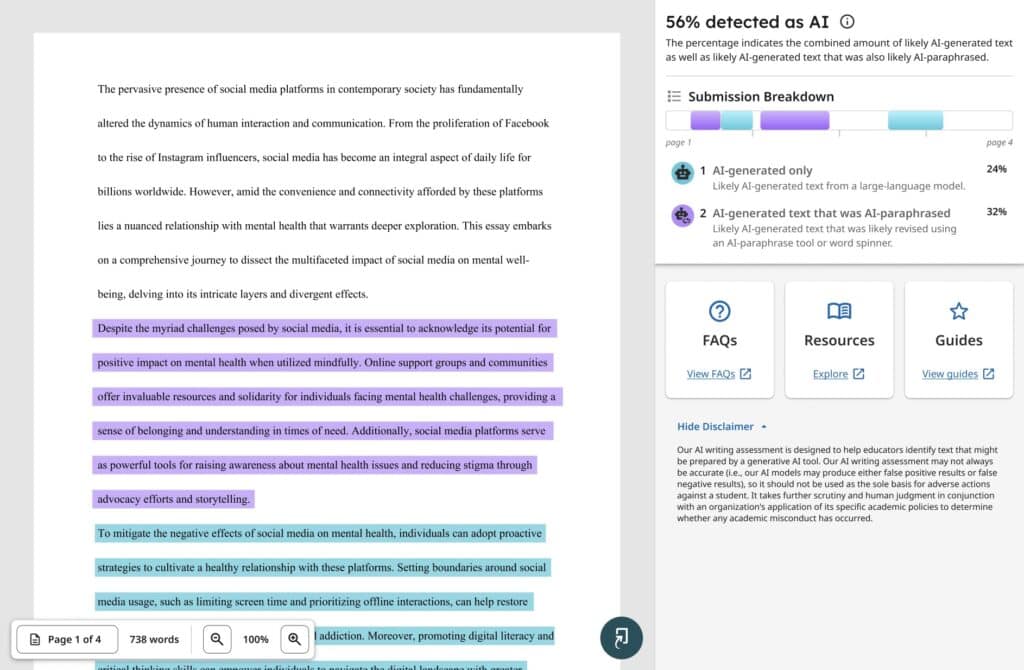
Even if you use a spinner tool to change AI text, Turnitin can still see the original AI structure underneath.


Never Worry About AI Detecting Your Texts Again. Undetectable AI Can Help You:
- Make your AI assisted writing appear human-like.
- Bypass all major AI detection tools with just one click.
- Use AI safely and confidently in school and work.
However, students specifically wonder can Turnitin detect Grammarly paraphrasing? While basic grammar fixes are safe, using AI-based “rewriting” features often triggers these purple flags.
Turnitin can also identify:
- Traditional Plagiarism: Directly copied text from the web, journals, or other students.
- Mosaic/Patchwork Plagiarism: Slightly altered phrases from multiple sources stitched together.
- Self-Plagiarism: Resubmitting your own past work for a new assignment.
- AI Bypasser Text: Since August 2025, they have a counter-bypass feature to catch text meant to trick detectors.
- Code Plagiarism: Checking for copied logic in programming assignments.
What Is AI Paraphrasing (And Why Students Use It)
Paraphrasing means keeping the original meaning of a source but completely changing the wording and the skeleton of the sentences.
Example:
- Original Source: The experiment yielded inconclusive results.
- Good Paraphrase: The findings were not definitive enough to draw clear conclusions.
- Bad Paraphrase: “The experiment yielded unclear results.
AI paraphrasing is when technology (not a human) generates these alternative versions.
Many ask, can Turnitin detect paraphrasing from QuillBot? Since QuillBot is a text spinner, it leaves behind predictable patterns that Turnitin’s sentence-window logic easily catches.
Popular tools in the spinner category include:
- QuillBot
- Grammarly (GrammarlyGO)
- Spinbot
- Wordtune
- AI-based humanizers
According to data from Tyton Partners, Roughly 59% of students are regular AI users, compared to only 40% of educators.
But why is it so popular?
- Many students believe rewording AI-generated text will help them bypass plagiarism or AI detectors.
- It’s faster to have AI draft a paragraph and then spin it than it is to write from scratch.
- Non-native English speakers use these tools to polish their phrasing and sound more academic.
- Students take text from ChatGPT or Claude and run it through a paraphraser to scrub away the robotic signature.
- From fixing writer’s block to cleaning up a confusing first draft, these tools act as a quick editing shortcut.
What Gets Flagged vs What Stays Safe
This table breaks down exactly what triggers a Turnitin flag and what usually stays safe in the 2026 academic environment.
| Scenario | Flagged? | The Reason Why |
| Submitting a full ChatGPT essay (no edits) | ✅ Yes | Raw AI output has a very obvious statistical fingerprint |
| Can Turnitin detect paraphrasing from QuillBot? | ✅ Yes | Doesn’t hide the deep AI patterns |
| Fixing grammar/spelling with Grammarly | ❌ No | Turnitin ignores standard grammar and spelling fixes |
| Can Turnitin detect grammarly paraphrasing? | ✅ Yes | GrammarlyGO uses AI (LLM), which Turnitin now tracks |
| Paraphrasing yourself but mirroring the source | ✅ Yes | This is caught as Mosaic Plagiarism in the similarity report |
| Polishing your own writing with Grammarly | ❌ No | Human-led writing + basic edits is considered safe |
| Using low-quality AI humanizers | ✅ Yes | The August 2025 update specifically targets these tools |
| Professional humanizers (structural rewrites) | ⚠️ Risk | Detection is lower (12–14%), but there is always a risk |
| Using a properly cited quote | ❌ No | It may show up as similar, but it won’t be flagged as AI |
| Submitting bullet points or code | ⚠️ Unreliable | Detectors need full sentences; tables and lists are hard to flag |
| Short papers (less than 300 words) | ⚠️ Unreliable | Turnitin needs at least 300 words to give a reliable score |
| Technical writing (Lab reports/Math) | ⚠️ False Positive | Strict formulas can sometimes look like AI patterns |
| Submitting your own old paper | ✅ Yes | Turnitin stores every old paper in its database |
Your audience doesn’t want to read a technical report that sounds like it was written by a metronome, or content that uses those repetitive, “subject-verb-object” sentence structures over and over.
It makes them feel like they’re reading a manual f than an insightful piece of writing. The reality is, when writing is too predictable, readers tune out.
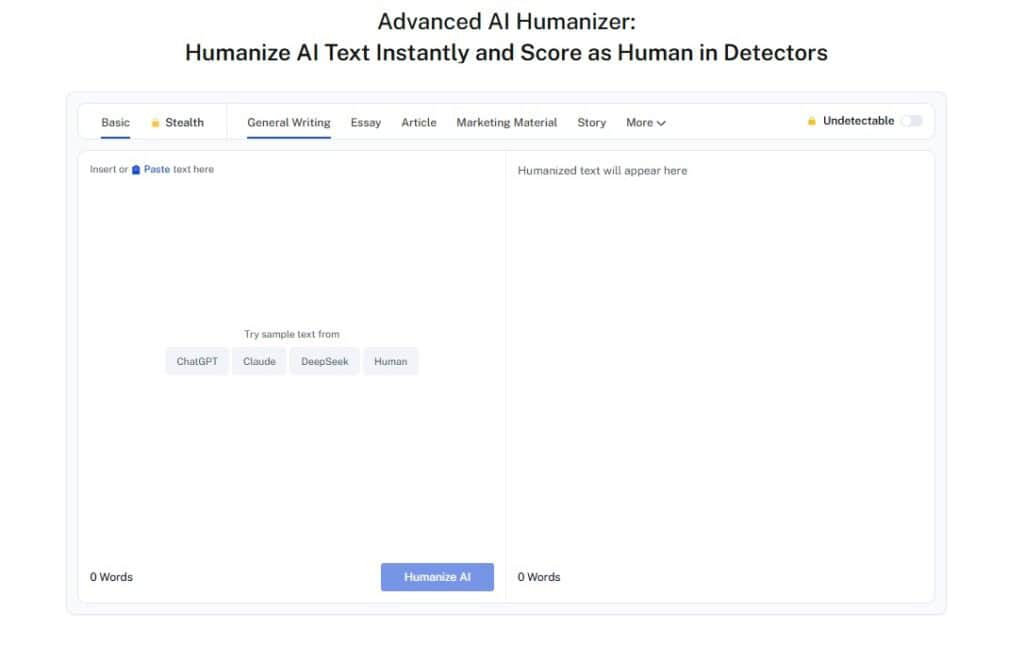
This is where our Undetectable AI’s AI Humanizer comes in. Instead of following a rigid, mathematical pattern, this tool introduces burstiness and linguistic variety.
It breaks up those robotic rhythms by varying sentence length and complexity to make your content humanized.
Click here to use our AI Humanizer to smooth out patterns that feel too predictable.
It’s not about beating a system, it’s about making sure your writing has the natural pulse and personality that keeps a reader actually reading, especially since can Turnitin detect AI paraphrasing by looking for these exact robotic patterns.
How Paraphrasing Affects Your Grades
If you are paraphrasing properly, there are several positive effects of paraphrasing:
- Higher grades (shows academic maturity)
- Better source integration
- Originality score improves (low similarity score in Turnitin)
- Demonstrates critical thinking
However, there is a limit to this. If you are simply swapping words while keeping the same structure, you are surely going to face bad effects. Academic dishonesty can lead to concurrent sanctions:
Grade modifications (Academic sanctions) ➔ Probation (Student conduct sanctions) ➔ Suspension ➔ Expulsion
Academic dishonesty doesn’t just hurt your grades, it is also habit-forming.
Typical Consequences Tier by Tier:
| Severity | Consequence |
| 1st offense, low AI % | Instructor conversation, assignment redo |
| 1st offense, high AI % | Zero on assignment |
| Repeat offense | Course failure (F grade) |
| Serious/repeated violation | Academic probation |
| Severe cases | Suspension or expulsion |
| Research/thesis fraud | Degree revocation, professional consequences |
A study by the University of Reading (Scarfe et al., 2024) revealed that ChatGPT-generated exam answers went undetected in 94% of cases. And on average, they received higher grades than actual student submissions.
Turnitin’s reported false positive rate for AI detection is 4%. This means 1 out of every 25 fully human-written papers could be flagged. ESL students and those with a formal writing style are affected disproportionately.
If you are falsely flagged…
- Keep evidence of your writing process (Google Docs history, notes, drafts)
- Request a meeting with your instructor
- Cite Turnitin’s own documentation regarding their false positive rates
How to Paraphrase Without Getting Flagged
Here are 8 expert tips to help you paraphrase safely and effectively:
- The Read-Close-Write Method
Read your source, close the book or tab, and wait a few minutes. Then, write the information purely from memory. This prevents you from asking, can Turnitin detect QuillBot paraphrasing later, because the structure will be yours.
- Think in Ideas, Not Sentences
Don’t just swap words.
- The Mistake: The results were inconclusive ➔ The findings were unclear. (Too similar).
- The Correct Way: Researchers couldn’t draw firm conclusions from the data.
- Switch Between Active and Passive Voice
If the source is passive, make it active (and vice versa). This changes the sentence skeleton.
- Understand Turnitin’s Sentence Window Logic
Turnitin looks for word choice uniformity. This explains how can Turnitin detect AI paraphrasing even when the words are different but the logic remains the same.
- Add Burstiness to Your Prose
AI writes sentences that are all roughly the same length. Natural human writing has bursts. Use a short, punchy sentence, then follow it with a longer, more complex one.
When you are done mixing your sentence lengths, use our Grammar Checker to make sure your edits sound clean and human.
- Use Field-Specific Terminology
AI prefers generic language that fits every scenario. By using specific jargon from your field, adding local examples, or providing personal analysis, you make the text look human and expert-led.
- Citation Placement
Putting a citation at the end of your paraphrase helps reduce your similarity score. Turnitin is designed to treat properly cited content differently than raw, unattributed text.
- Avoid Chain Paraphrasing
Some students paraphrase a source, then paraphrase that paraphrase. Ironically, this makes your writing look more like AI because the language becomes overly processed and loses its natural flow.
Turnitin vs Undetectable AI: Key Differences
While both tools deal with AI-generated text, they serve completely opposite roles in the writing process.
Here’s how they compare:
| Feature | Turnitin | Undetectable AI |
| Primary Purpose | Institutional detection | Writing enhancement |
| Main Users | Schools & Publishers | Creators & Students |
| Accessibility | Institutional Only | Direct Access |
| Core Function | Flags plagiarism & AI | Rewrites to reduce AI signals |
| Target Models | GPT-4o, Gemini, Claude | Evasion of these models |
| Accuracy | 92–100% (Raw AI) | Redaction to ~12–14% |
| Update Cycle | Quarterly | Continuous |
| Visual Report | Cyan & Purple Coding | Human Probability Score |
| Language Support | EN, SP, JP | Primarily English |
| Plagiarism Database | 1.8B+ Papers / 89M+ Journals | No |
| Authorship Analysis | Forensic Linguistics | No |
| Final Decision | Human Reviewer | User |
Ethical Ways to Use AI Tools
The IEEE and ACM have made one thing clear: AI cannot be an author. To stay ethical, follow these three rules:
- Always review your syllabus or university policy. If it’s not clear, ask your instructor directly.
- Be transparent. A simple footnote like “The author used ChatGPT to brainstorm research topics” is enough if your school requires it.
- AI should enhance your effort, not substitute it. Your analysis and conclusions must fundamentally be your own.
To ensure your work is 100% legitimate and safe from flags, follow this step-by-step process:
- Independent Research: Start by finding your own sources and building your own outline.
- Original Thesis: Develop your own core argument and perspective.
- First Draft: Write the content yourself first.
- AI for Clarity: Use AI for suggestions on how to make your sentences clearer, not to rewrite them for you.
- Grammar Check: Use tools to catch typos or awkward phrasing.
- Verify Sources: Manually check every single citation to ensure the book or article actually exists.
- Final Compliance Check: Confirm that your process matches your university’s specific AI policy.
Use our AI Detector and Humanizer right in the widget below!
Final Thoughts
So, can Turnitin detect paraphrasing? Yes, and the system is getting smarter every quarter.
Whether the question is can Turnitin detect AI paraphrasing from ChatGPT, can Turnitin detect QuillBot paraphrasing, or can Turnitin detect Grammarly paraphrasing, the answer is always the same:
Turnitin doesn’t look for tool names. It looks for patterns. And every paraphrasing tool leaves some kind of pattern behind.
The only real protection isn’t a smarter spinner. It’s smarter writing. Students who research genuinely and use AI as a support tool rather than a ghostwriter will never need to worry about any detector.
Turnitin updates its model quarterly. The gap between undetectable and flagged keeps shrinking. The one thing that never gets detected? Writing that’s yours.
Write smarter, not riskier, and keep your content natural and undetectable with Undetectable AI.