
Generative AI tools make it easier for publishers to proliferate low-quality content. In 2026, researchers at Stony Brook University discovered that approximately 2,000 out of 14,000 self-published genre fiction books sold on Amazon between 2023 to 2026 contained a substantial amount of AI-generated writing.
Though these titles sold fewer units than their human-written counterparts, they still achieved commercial scale, even earning top-ranking positions.
With an increasing volume of AI-generated titles flooding the market, it has become more difficult for readers to avoid low-quality content. Fortunately, there are techniques and technologies available that can help readers discern AI-generated prose from human writing.
In this article, we’ll teach you how to identify AI-written titles using Amazon listings, Read Sample previews, and AI detection tools.
Let’s dive in.
Key Takeaways
- Generative AI makes it easier for publishers to distribute low-quality content at scale. While Amazon requires authors to disclose AI-generated content, it allows AI-assisted content and does not identify every AI-generated book on its platform.
- You can assess a book by reviewing its Amazon listing, reading the available sample, and running excerpts through an AI text detector.
- Signals of AI use that may appear in listings include an unclear author background, an unusual publishing history, generic covers and descriptions, and sudden bursts of books across unrelated topics.
- Signals of AI use that may appear in excerpts include uniform sentence structure, excessive use of transition words, repetitive explanations, a lack of specific details, unsupported claims, and formatting issues.
- An AI detector can help identify writing patterns associated with AI generation, giving you another signal to consider alongside the book’s content, author information, and other evidence.
What Are Amazon’s Rules on AI Writing?
Yes. Amazon accepts books that contain AI-generated content, as long as the author includes appropriate disclosures. Disclosure requirements differ depending on the level of AI involvement.
| AI Use | Author Involvement | KDP Classification | Requires Disclosure? |
| Outlining | The author uses AI to brainstorm or organize ideas, then AI writes the book | AI-assisted | No |
| Editing | The author writes the content and uses AI to refine or check it | AI-assisted | No |
| AI first draft + substantial rewriting | AI creates the initial content, which the author substantially rewrites | AI-generated | Yes |
| Full AI generation | AI creates the text and the author publishes it with little or no substantive human creation | AI-generated | Yes |
Amazon has also implemented specific measures to prevent large-scale distribution of low-quality or misleading content.
Its current documentation states a limit of 10 titles per book format each week, except for publishers that have contacted Amazon for consideration. They also restrict content that is excessively reused or repeated within or across books.


Never Worry About AI Detecting Your Texts Again. Undetectable AI Can Help You:
- Make your AI assisted writing appear human-like.
- Bypass all major AI detection tools with just one click.
- Use AI safely and confidently in school and work.
Which Categories Get Flooded First And Why
Some book formats attract more AI-generated content because they require little original reporting or specialized expertise, which allows authors to produce them quickly and cheaply.
Common targets include:
- Low-content books and workbooks
- Travel guides
- Diet and supplement books
- Self-help titles
- Crypto and side-hustle guides
- Summaries of popular books
6 Listing-Page Red Flags You Can Check Before You Buy
You can spot potential signs of low-quality or AI-generated books by checking the listing. Details such as the author’s footprint, review patterns, and cover quality can help you identify red flags before you buy.
1. The author has no verifiable footprint
Trustworthy authors typically have a website, personal profile, past publications, interviews, conference appearances, or other evidence of relevant expertise.
Newer authors with little public history might provide other evidence of their expertise, such as relevant experience, qualifications, sources, or a detailed author bio.
A lack of public evidence does not indicate AI use on its own. However, if an author claims expertise without providing evidence to support it, treat the claim with caution.
2. The author suddenly publishes across unrelated niches
While it is possible for authors to write across genres and niches, a bibliography containing books on unrelated subjects published within short turnarounds should raise some skepticism.
For example, it’s unlikely that an author can develop enough expertise in cryptocurrency, gardening, children’s activities, nutrition, travel, and tax planning to publish books on each subject within a few weeks.
While this pattern does not explicitly prove AI use, AI is the likeliest reason that a single author can produce content on multiple topics in a short time.
3. The title and subtitle feel written for search
Amazon guidelines state that the title field should contain the actual title of the book. However, some authors cram several search terms together, repeat generic titles, or make unauthorized references to other titles and authors. The latter is explicitly prohibited.
4. The book closely imitates another title
Again, Amazon’s metadata guidelines explicitly prohibit covers that closely resemble another book’s layout, color scheme, fonts, or images. However, bad actors violate these guidelines to deceive customers.
Some authors might also create summaries or companion books that associate with another author’s work without authorization. This violates Amazon’s intellectual property guidelines, which states that publishers must hold the necessary rights to content they upload
5. The cover looks generic and the description makes broad promises
Many AI-generated books aim to appeal to a broad market. They list benefits and make sweeping promises such as “everything you need to know” without describing what the book actually contains. They also use generic covers to appeal to a wide audience without establishing a clear identity or connection to the subject.
This combination of signals point to low-quality or AI-generated content.
6. The reviews arrive in unusual bursts
Some publishers use fake review campaigns to artificially boost public perception. Fortunately, you can spot fake Amazon reviews by checking their timing and reviewer history.
Fake reviews often arrive in clusters within short periods. They come from accounts with little review history, no review history, or a review history consisting of multiple unrelated product ratings within a short period.
8 Signs Of AI-Written Text You Can Spot In The Read Sample Preview
If you need a deeper assessment, you can check the Read Sample preview for a quick peek at the book’s contents. Patterns like uniform sentence construction, overuse of connectors, and lack of personal specificity may indicate AI use.
1. The sentences all have the same rhythm
Human writers typically vary sentence lengths to convey tone, emotion, or emphasis. However, generative AI produces content by predicting statistically likely responses, which tends to erase the natural variation human writing offers.
2. Every chapter follows the same template
AI writers often use templates to generate chapters. This often leads to a suspicious level of chapter uniformity. For example, all chapters might begin with a general introduction, move through exactly three points, then end with a summary that repeats the introduction.
3. The text relies heavily on connectors
As mentioned above, AI generators produce text by predicting the most statistically likely continuation of a given string of text. Many models favor transition words like moreover, furthermore, and additionally, as these appear often in human writing and provide a straightforward way of connecting ideas.
While transition words do not prove AI generation, their excessive use make the possibility more likely.
Common transitions include:
- Moreover
- Furthermore
- Additionally
- In conclusion
- At the end of the day
4. The book contains almost no specific lived details
In nonfiction, human writers often use concrete examples to support their ideas or arguments. They include names, dates, personal anecdotes, and other specifics that add depth to the subject.
However, because AI-generated content relies on recycled information, they may lack the same insights, depth, and originality.
5. The book makes confident claims without evidence
The primary goal of a generative AI model is to produce the most fitting response to a user prompt. It predicts plausible text based on information training data, a process that does not guarantee factual accuracy.
Often, generative AI can repeat information from erroneous training samples, combine information incorrectly, or build responses on outdated information.
Generative AI will not fact-check itself unless prompted. For this reason, AI-generated books often make factual statements without citing sources or establishing concrete proof. Sometimes, facts might even change from chapter to chapter.
6. There is no recognizable authorial voice
Human writers have habits. They may favor certain words, sentence structures, or turns of phrase, which lend their writing a unique voice. In contrast, generative AI follows the most statistically likely writing conventions, which robs content of the idiosyncrasies characteristic to human writing.
7. The book repeats itself
Generative AI tools generate responses incrementally, predicting what comes next based on the preceding context rather than planning the entire response in advance. Most lack a reliable internal mechanism for judging the sufficiency or completeness of a response.
Because of the above limitations, text generators often repeat information or add summaries where none are necessary. As a result, AI-generated writing that has not been adequately edited tends to feel repetitive.
8. The formatting contains artifacts
Poorly-edited AI writing may contain artifacts that hint at or directly confirm AI use. Common artifacts include stray markdown, inconsistent heading levels, odd formatting, or text generation prompts that the editor failed to delete.
How To Check A Book On Amazon In 5 Minutes
Fortunately, it’s possible to flag AI-generated content before purchasing a book on Amazon. The Read Sample preview, listing, and author information can provide enough signals for an initial assessment.
Step 1: Read the Read Sample Preview
The best first step is to check the book’s Read Sample preview. Reading a full page of the body text can give you a glimpse of the language and writing patterns the author will use throughout the book. Look for the signals listed above, such as uniform sentence lengths, excessive use of connectors, and formatting issues.
Step 2: Verify the Author
The next step is to look for publicly available information about the author.
As mentioned above, you can check:
- The author’s website
- The author’s personal profile
- Social media
- Past publications
- Interview appearances
- Conference appearances
- Evidence of experience of expertise
This information helps you assess whether the author has relevant experience and a credible connection to the subject their book covers.
Step 3: Check The Publisher, The Publish Date, and the Author’s Bibliography
Check the publisher, publication date, and author’s other books to see whether they show a consistent publishing history. If the author’s bibliography consists of multiple books across unrelated subjects released within a short timeframe, AI use is highly likely.
Step 4: Run the Excerpt Through an AI Detector
It also helps to run parts of the excerpt through an AI detector. AI detectors specializing in text can scan content for writing patterns commonly associated with AI, such as low sentence length variation and word predictability. They combine these signals to calculate the likelihood that a unit of text is AI-generated.
For best results, paste 300 to 500 words. This gives the detector enough text to map out patterns and produce a more reliable result.
Testing AI Detection for Amazon Books
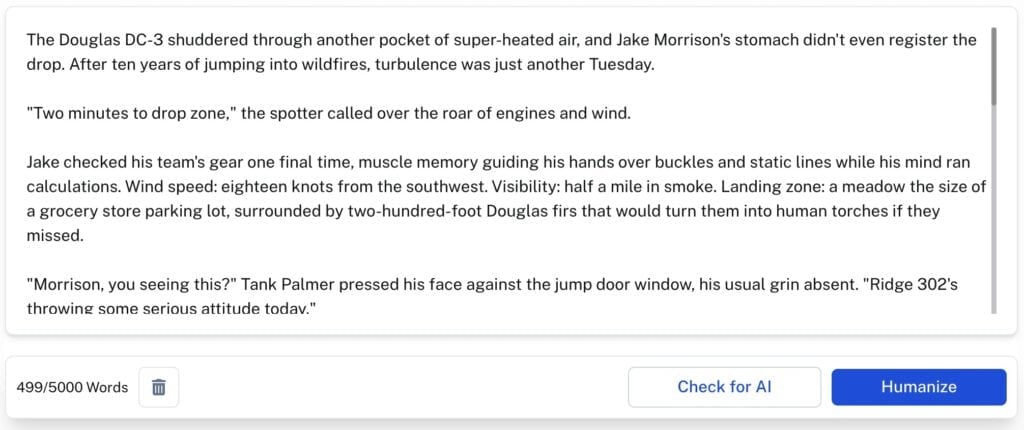
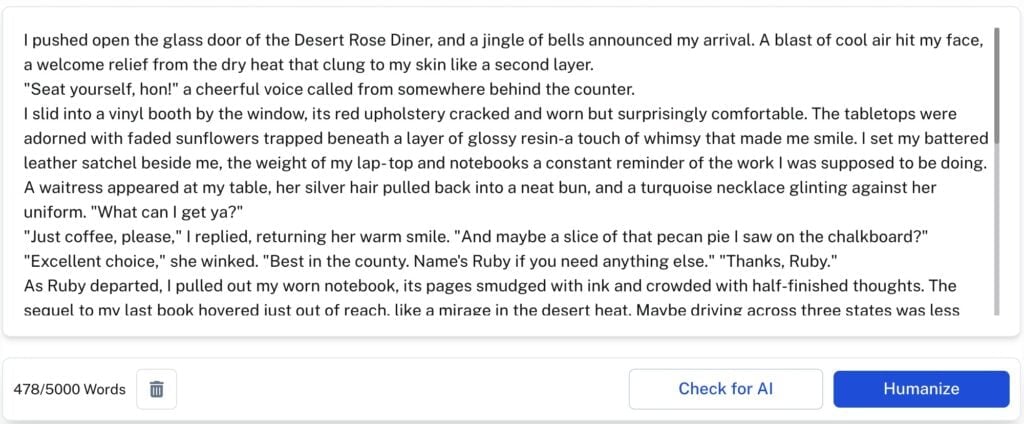
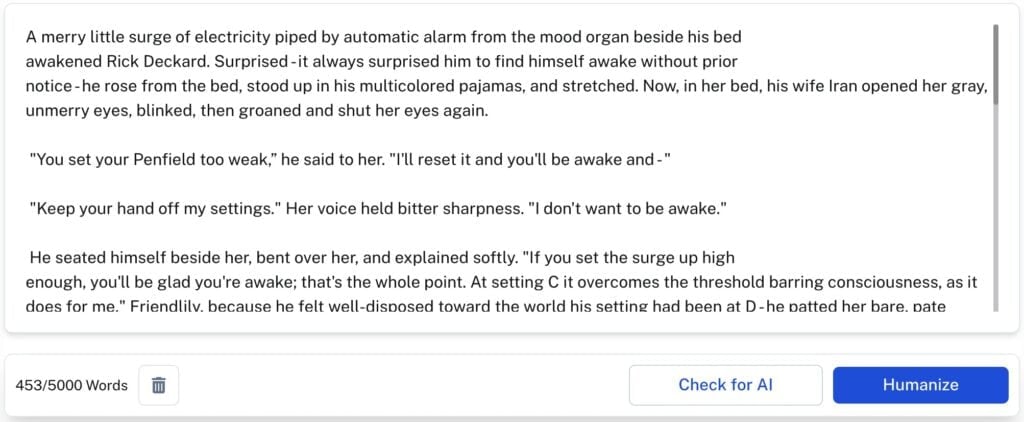
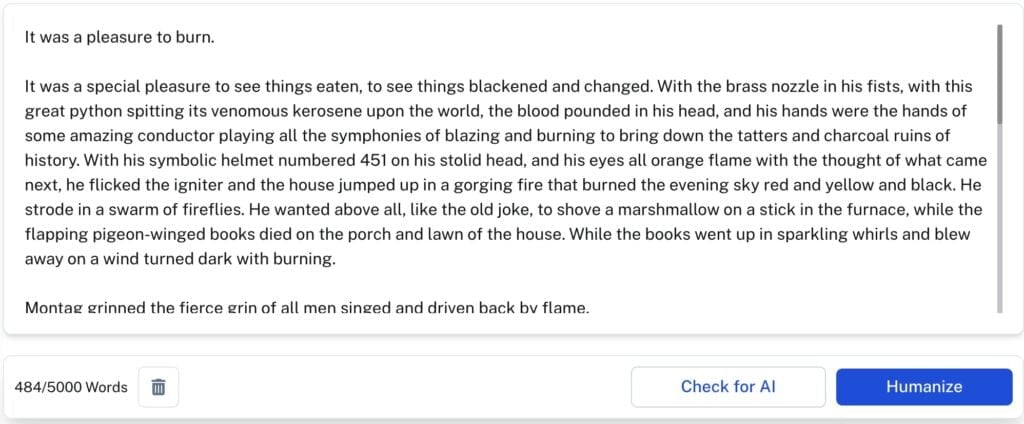
To demonstrate how AI detection works, we ran four excerpts through Undetectable’s AI text detector. Two excerpts came from books that Barnes & Noble confirmed were produced using AI tools, while the other two came from books published before generative AI existed.
All excerpts came from Amazon’s Read Sample preview. We pulled 300 to 500 words from each book to give the detector enough text to identify writing patterns.
Step 1: Gathering the Samples
For our AI-generated samples, we chose Dana Winston’s Fighting Love’s Flame and Sydney Marsh’s Tumbleweeds and Tequila. According to the books’ respective Barnes & Noble overviews, both were produced with the assistance of author-directed AI tools.
Both were published by Future Fiction Press, a publishing company that explicitly promotes the use of AI in writing and publishing.
For our human-written samples, we chose two classics: Philip K. Dick’s Do Androids Dream of Electric Sheep? and Ray Bradbury’s Fahrenheit 451.
Step 2: Running Samples Through the Detector
Next, we pasted 300 to 500 words of each sample through Undetectable AI’s AI detector.
Unsurprisingly, the AI-generated samples showed high likelihood of containing AI-generated content. Fighting Love’s Flame earned a likelihood score of 90%, while Tumbleweeds and Tequila earned a score of 68%, as the detector believed that some parts of the passage were still human-written.
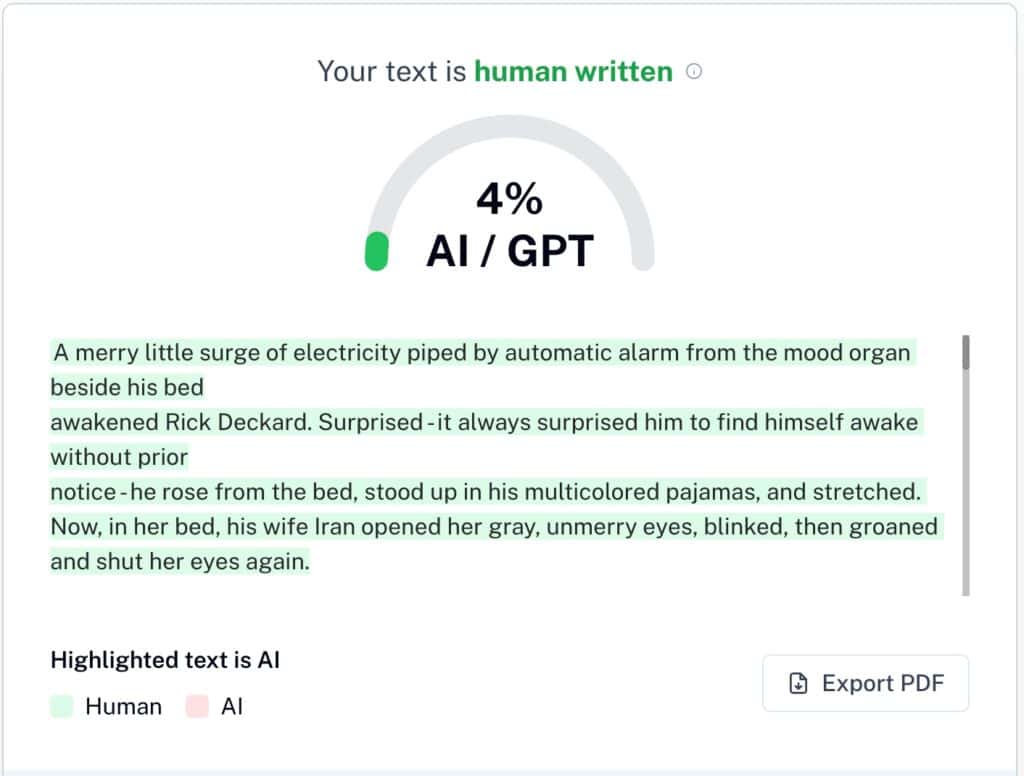
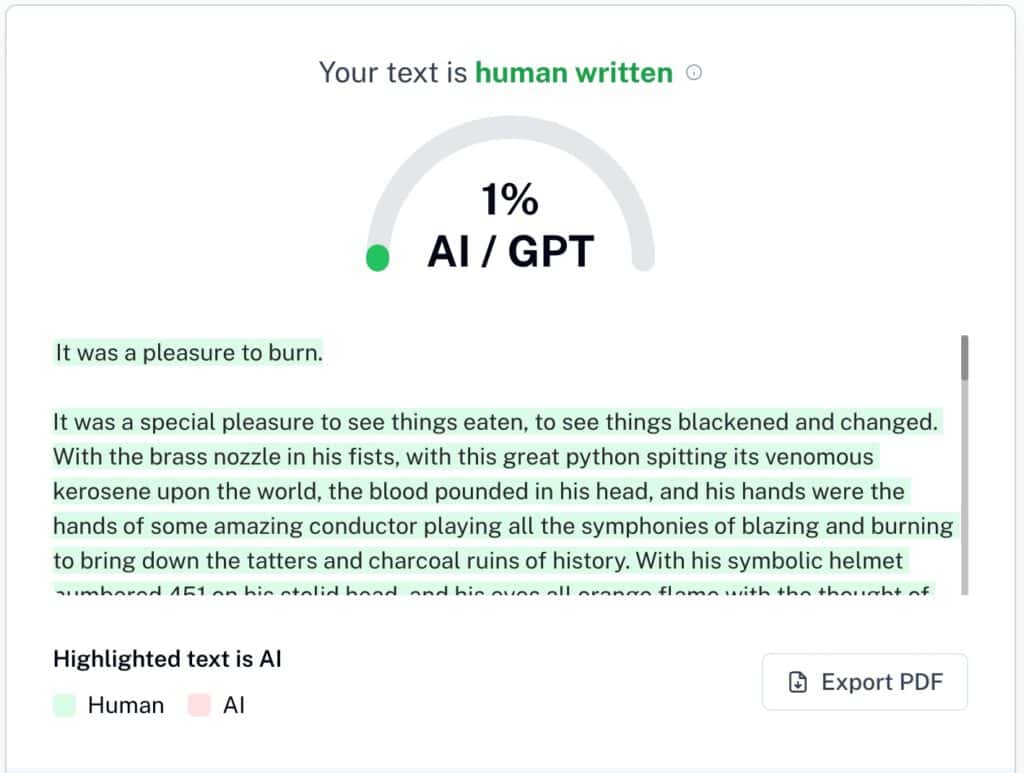
Meanwhile, the human-written excerpts were correctly identified as genuine. Do Androids Dream of Electric Sheep? achieved a detection score of 4%, while Fahrenheit 451 achieved a detection score of 1%.
| Title | AI Score | Verdict |
| Fighting Love’s Flame | 90% AI | AI |
| Tumbleweeds and Tequila | 68% AI | AI |
| Do Androids Dream of Electric Sheep | 4% AI | Human |
| Fahrenheit 451 | 1% AI | Human |
Screenshots:
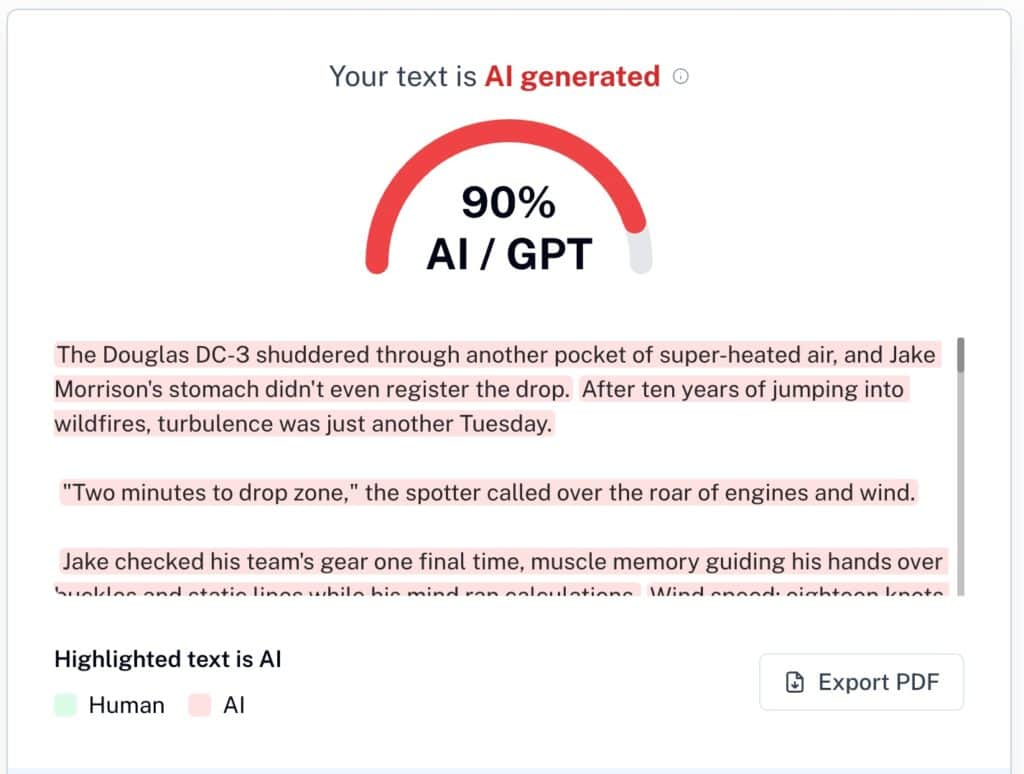
Tumbleweeds and Tequila
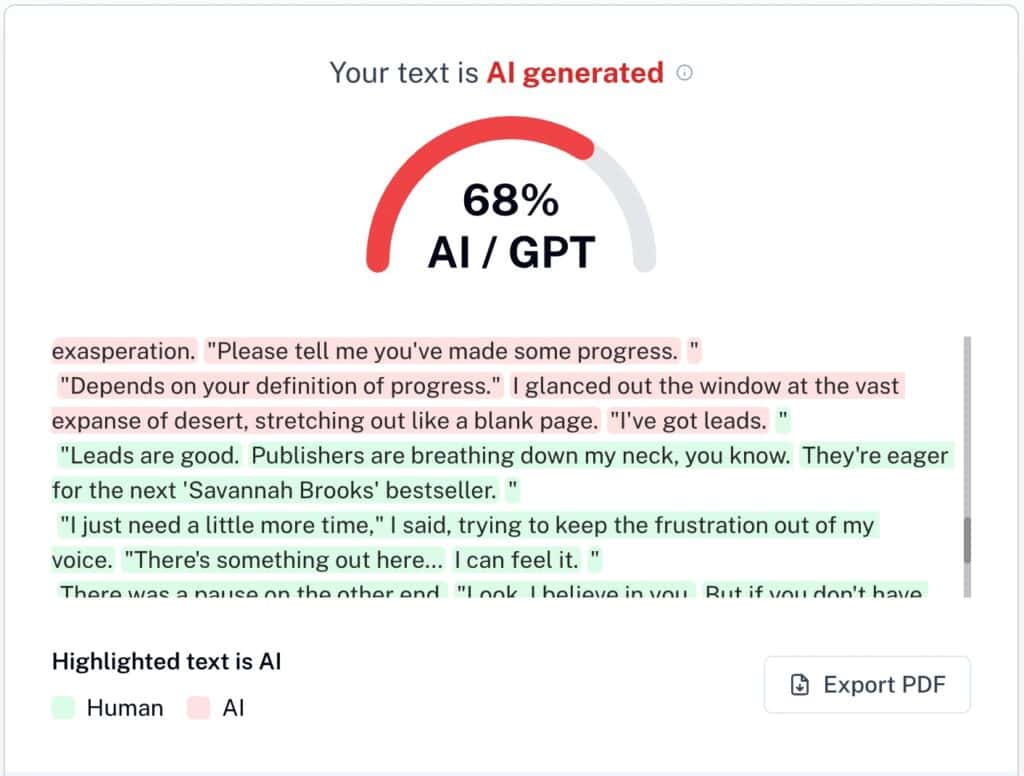
Do Androids Dream of Electric Sheep?
Fahrenheit 451
How to Use an AI Detection Score
Text detectors provide likelihood signals, not explicit verdicts. High detection scores indicate that the text contains multiple patterns associated with AI-generated writing.
However, these scores do not establish authorship on their own. Human-written text can also contain similar patterns, so the results are most useful when considered alongside the text’s writing style, the author’s background, and other evidence.
Frequently Asked Questions About AI-Written Books On Amazon
How can you tell if a book was written by AI?
There are multiple ways to check if a book was written by AI. The easiest is to check the author’s public activity, including their website, personal profile, past publications, or evidence of experience.
You can also read the Read Sample excerpt for patterns associated with AI, such as generic language, repetitive structures, and overuse of transition words. You can also run the excerpt through an AI detector for extra verification.
Does Amazon allow AI-generated books?
Yes. Amazon allows books containing AI-generated content, but KDP requires authors to disclose AI-generated text, images, and translations when they publish or republish a book. Amazon does not require disclosure for AI-assisted content, such as author-created material that AI helps edit or refine.
Can you get a refund for an AI-written book?
Amazon’s return rules for Kindle content depend on the purchase and the applicable marketplace policy. On Amazon.com, the current return policy lists a seven-day window for digital books accidentally purchased from the Kindle Store when they have not been read.
If you believe a book violates Amazon’s guidelines, you can also report the listing. However, reporting a book does not guarantee the book’s removal, nor does it promise a refund.
Are AI detectors accurate on book excerpts?
Detector results provide a useful signal of AI use. However, detection scores show likelihoods, not definitive proof. It’s best to combine AI detection results with other judgments on the author’s footprint, the book’s writing style, and signals that might appear in the listing.
Conclusion: Check The Author, Check The Text, Then Check The Score
Verifying the authenticity of an Amazon book is relatively easy. You can check whether the author has a verifiable publishing history, whether their bibliography shows a consistent track record, and whether the sample contains language patterns associated with AI.
To make the last step easier, run a representative excerpt through an AI detector and use the result to guide your investigation.
If you suspect that a book on Amazon was AI-written, paste a Read Sample excerpt into Undetectable AI’s AI Detector. The model is trained on ChatGPT, Claude, Gemini, and other popular text generation models, giving it broader coverage across AI-generated writing from different models.