
Many Amazon sellers use dirty tactics to manipulate customer opinion of their products.
Some may pay buyers to post positive reviews, others may manually create dummy review accounts, while others use bots to inflate ratings. These issues only worsen as generative AI speeds up the content creation process.
Fortunately, fake reviews are relatively easy to spot, especially with the help of AI detectors. This article teaches you how to spot a fake amazon review, both manually and with AI detector assistance.
Key Takeaways
- The best way to spot a fake Amazon review is to check for similarities with other reviews. Usually, fake reviews are coordinated campaigns where bots or paid accounts regurgitate templated feedback to fake the scale of positive customer sentiment.
- Checking review history can also help in identifying fake reviews. Bots and paid accounts often have empty profiles, repeat similar language across reviews, or post reviews for unrelated products within a short timeframe.
- AI detection platforms are helpful for strengthening assessments. They can tell you the likelihood that a review was AI-generated.
- Combine AI detection scores with other signals, such as generic language, similarities with other reviews, and suspicious reviewer activity to get the strongest assessment.
What Are The Signs of a Fake Amazon Review?
While fake reviews are pretty good at hiding in plain sight, they’re easy to spot once you know what to look for. Similarities to other reviews, suspicious reviewer profiles, and unusual posting patterns give them away.
Similarity To Other Reviews
For fake review campaigns to effectively manipulate the appearance of customer sentiment, large review volumes are necessary. However, fraudsters often hand the same set of instructions to the bots and paid accounts they’ve employed. This leads to fake reviews sharing unusual phrases, sentence structures, or descriptions across different accounts.
Generic Language
Fake reviews tend to list out the product’s selling points. However, these typically read more like robotic enumerations of product benefits rather than descriptions of genuine experiences.


Never Worry About AI Detecting Your Texts Again. Undetectable AI Can Help You:
- Make your AI assisted writing appear human-like.
- Bypass all major AI detection tools with just one click.
- Use AI safely and confidently in school and work.
In contrast, real reviews usually explain how the product performed in everyday use, including specific details about their specific context, what worked well, and what did not.
Empty Reviewer Profiles
Some suspicious accounts provide little information beyond a username, a profile photo, and a few reviews. Though this does not immediately prove that their reviews are fake, the lack of information weakens the evidence that the account represents a genuine customer.
Reviewer History and Timing
The timing of a user’s reviews can also point to fabricated review activity. Paid accounts and bots often post large clusters of positive reviews within short time frames. If these reviews are for unrelated products, it’s even more likely that the user is a paid account or a bot.
How to Check Amazon Reviews Manually: A Step By Step Guide
The process of finding fake reviews involves scanning for suspicious patterns and checking individual profiles.
Compare Negative, Neutral, and Positive Reviews
One of the first steps is to compare reviews across star ratings. If there are significant discrepancies between claims in negative and positive reviews, the situation is worth investigating. Contradictions between experiences described in negative vs. positive reviews might mean that the latter were fake.
Look For Similarities Across Positive Reviews
Coordinated fake review campaigns tend to follow a template. Fraudsters want to paint a specific positive impression of the product, and therefore give bots or paid users the same set of instructions, templates, or talking points.
As a result, reviews in their campaigns end up praising similar features, using similar wording, and sharing similar sentence structures.
Take, for example, these reviews for wireless earbuds.
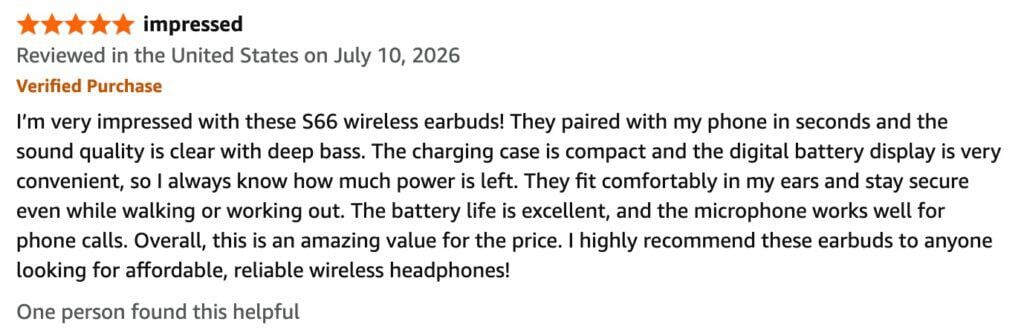
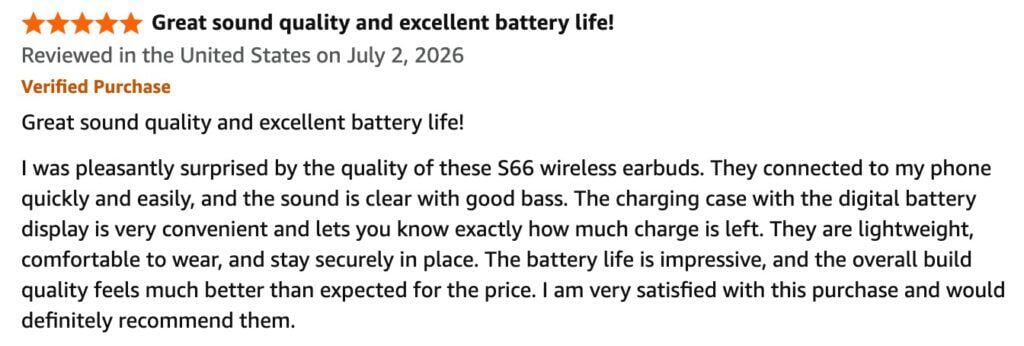
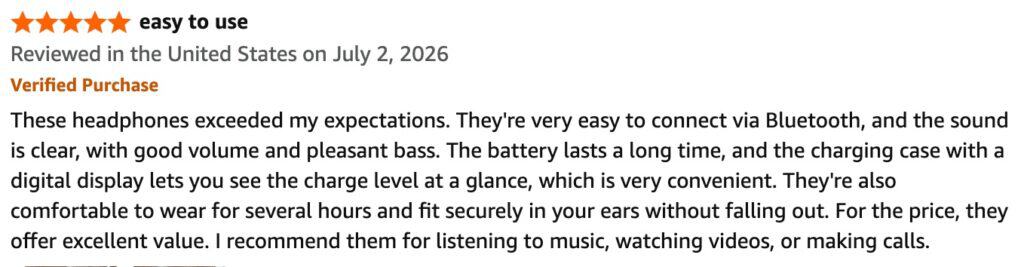
While each review uses slightly different wording, all mention ease of connection, sound and bass quality, charging case convenience, comfort, battery life, and value for money, with very few deviations in how these praises are ordered. All begin by expressing how the reviewer feels about the product and end by recommending the product.
Genuine reviews may bring up the same standout features. However, reviews mentioning more than two of the same features, each in a similar order, is too much of a coincidence to ignore.
Check Each Reviewers’s Profile
Upon identifying suspicious reviews, click on each reviewer’s name or photo to check their review history. As mentioned above, a user’s profile and review history often exhibits clearer signs that they are not a genuine customer.
These include:
- Empty profiles
- Repetitive language across reviews
- Sudden waves of positive reviews within short time-frames
Testing Amazon Reviews with an AI Detector
While you can check fake reviews manually, AI detectors can help provide additional verification. Below, we gathered two sets of samples and tested them against the Undetectable AI Text Detector.
Set A: Similarities Across Reviews
Our first step was to scan a product review section for suspicious similarities across different accounts. We chose wireless earphones, a product known to attract fake review campaigns due to heavy market competition.
Immediately, we noticed that most reviews used variations of the phrases “exceeded expectations,” “pleasantly surprised,” and “amazing value.” These reviews tended to praise the same features, including sound quality, battery life, and charging convenience.
Here are a few examples:
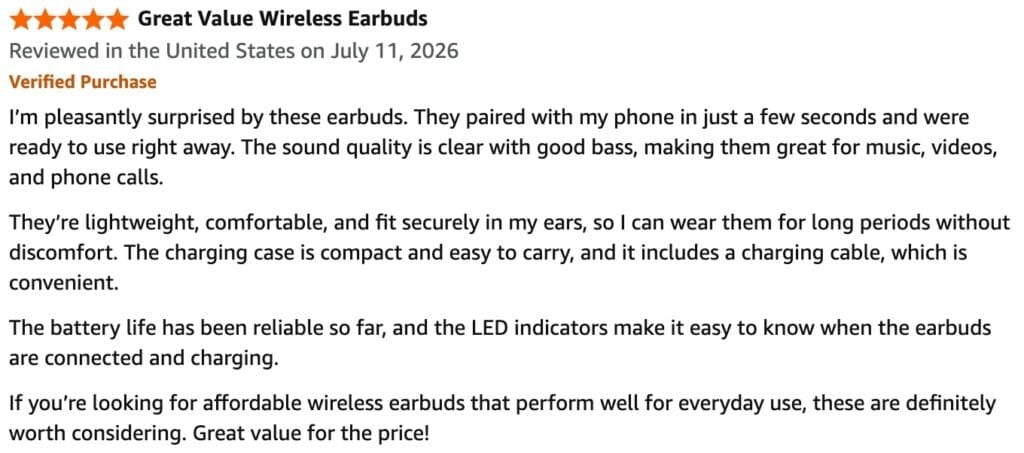
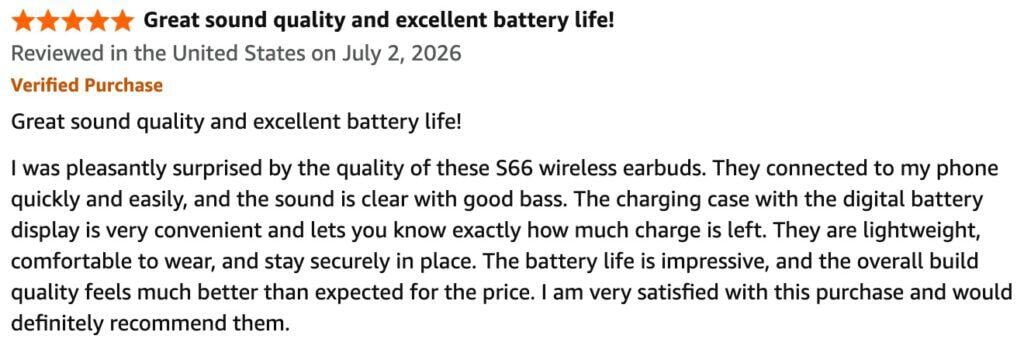
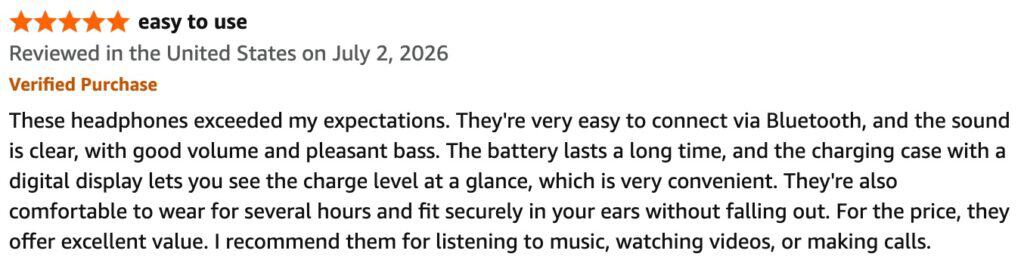
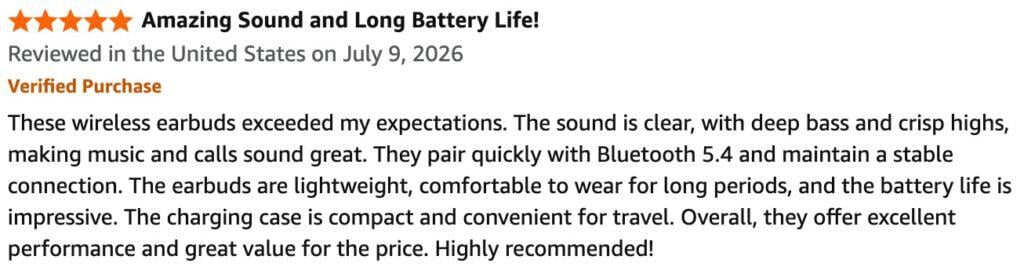
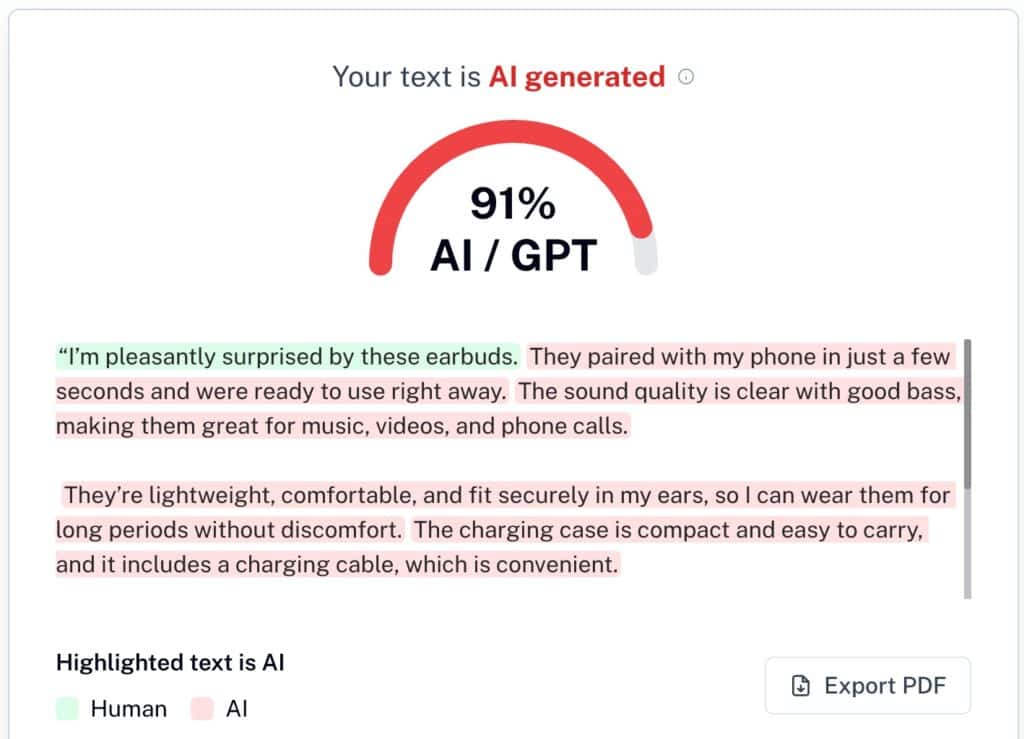
As predicted, our detector flagged all of these reviews as AI-generated.
Review
“I’m pleasantly surprised by these earbuds. They paired with my phone in just a few seconds and were ready to use right away. The sound quality is clear with good bass, making them great for music, videos, and phone calls.
They’re lightweight, comfortable, and fit securely in my ears, so I can wear them for long periods without discomfort. The charging case is compact and easy to carry, and it includes a charging cable, which is convenient.
The battery life has been reliable so far, and the LED indicators make it easy to know when the earbuds are connected and charging.
If you’re looking for affordable wireless earbuds that perform well for everyday use, these are definitely worth considering. Great value for the price!”
AI Detection Score
Review
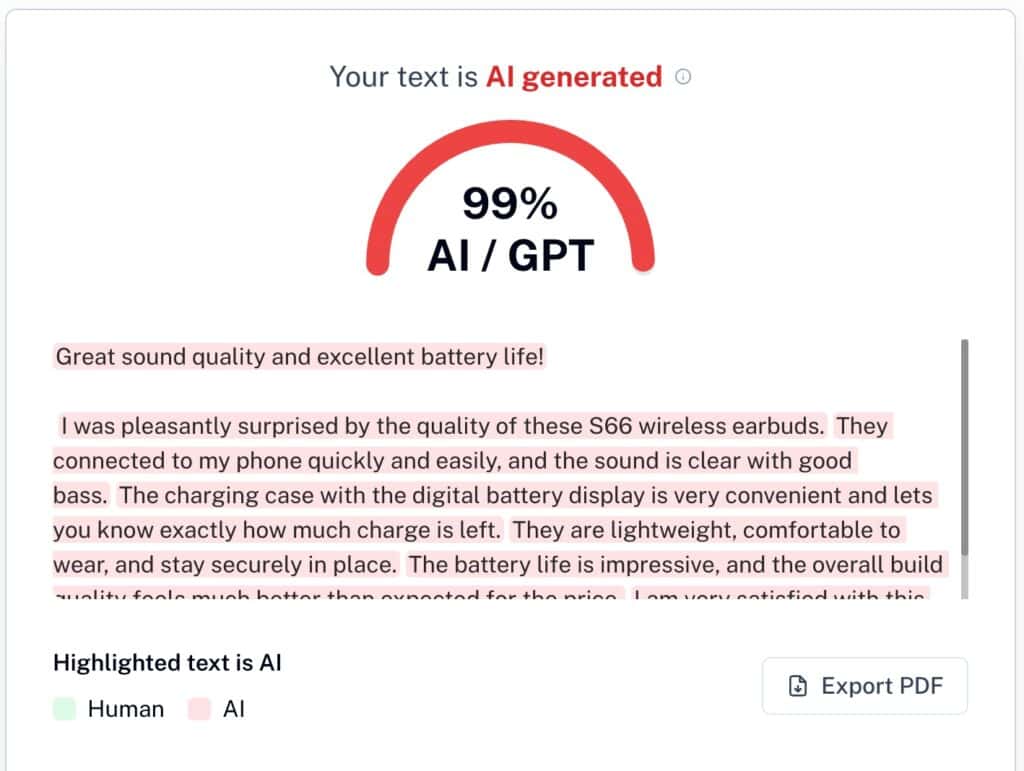
“Great sound quality and excellent battery life!
I was pleasantly surprised by the quality of these S66 wireless earbuds. They connected to my phone quickly and easily, and the sound is clear with good bass. The charging case with the digital battery display is very convenient and lets you know exactly how much charge is left.
They are lightweight, comfortable to wear, and stay securely in place. The battery life is impressive, and the overall build quality feels much better than expected for the price. I am very satisfied with this purchase and would definitely recommend them.”
AI Detection Score
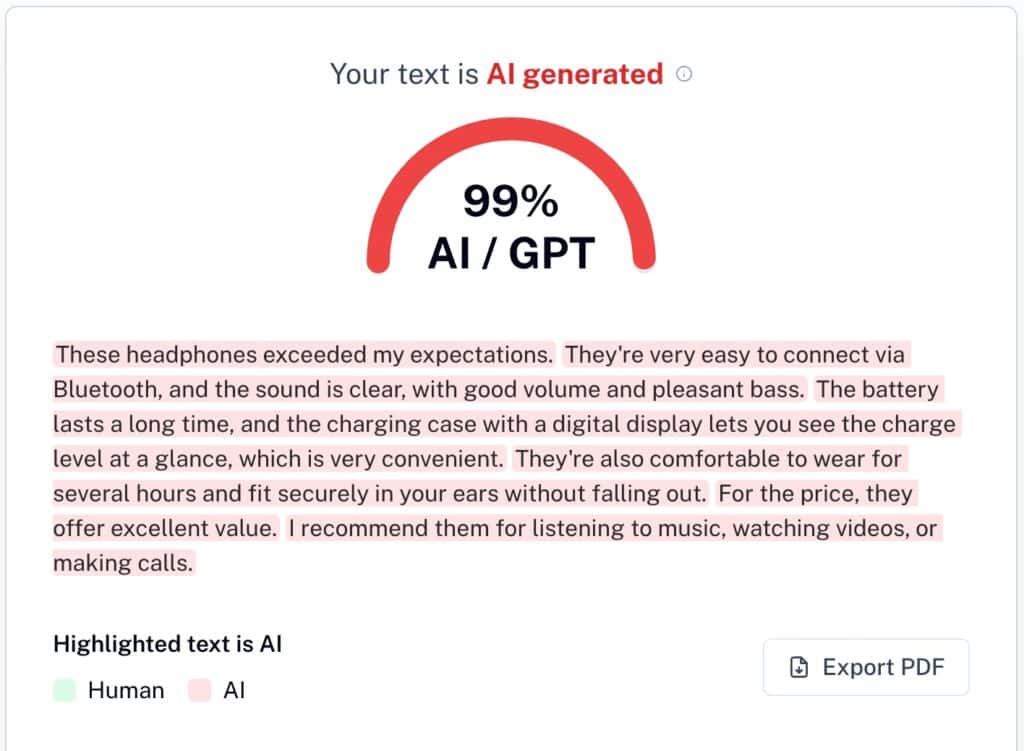
Review
“These headphones exceeded my expectations. They’re very easy to connect via Bluetooth, and the sound is clear, with good volume and pleasant bass. The battery lasts a long time, and the charging case with a digital display lets you see the charge level at a glance, which is very convenient.
They’re also comfortable to wear for several hours and fit securely in your ears without falling out. For the price, they offer excellent value. I recommend them for listening to music, watching videos, or making calls.”
AI Detection Score
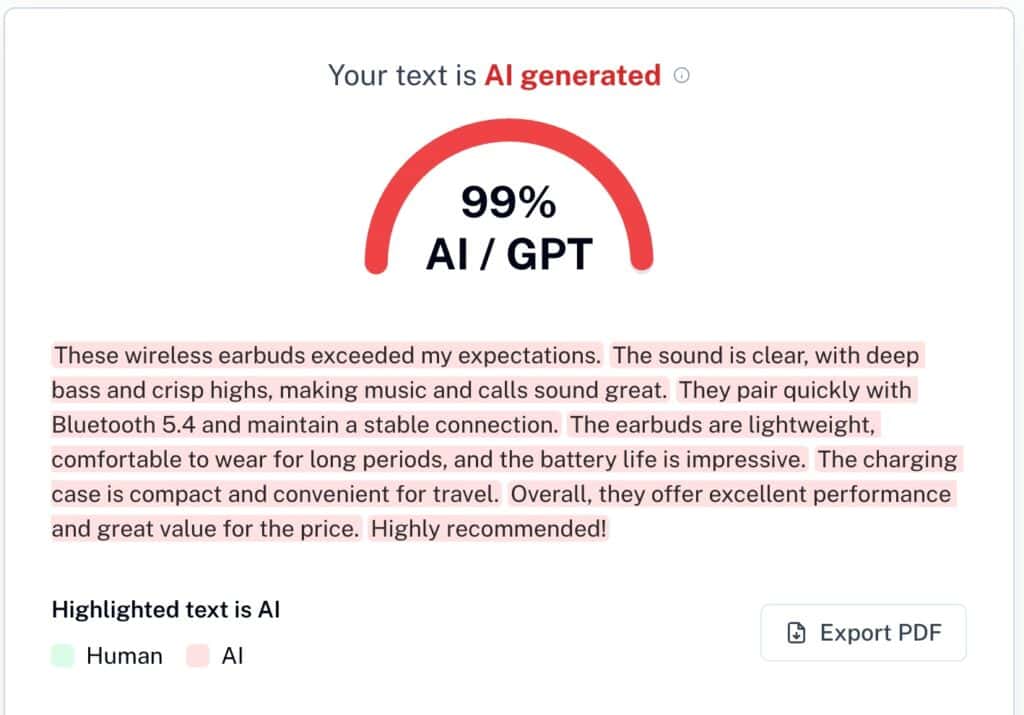
Review
“These wireless earbuds exceeded my expectations. The sound is clear, with deep bass and crisp highs, making music and calls sound great. They pair quickly with Bluetooth 5.4 and maintain a stable connection.
The earbuds are lightweight, comfortable to wear for long periods, and the battery life is impressive. The charging case is compact and convenient for travel. Overall, they offer excellent performance and great value for the price. Highly recommended!”
AI Detection Score
Set B: Suspicious Reviewer History
Another way to verify suspicious reviews is to check the reviewer’s history. For this step, we found one reviewer whose review read as generic, and checked their reviews for other products. Sure enough, many of these reviews were posted within the same timeframe, even if the products were vastly unrelated.
Here are a few examples, all posted on July 10, 2026.




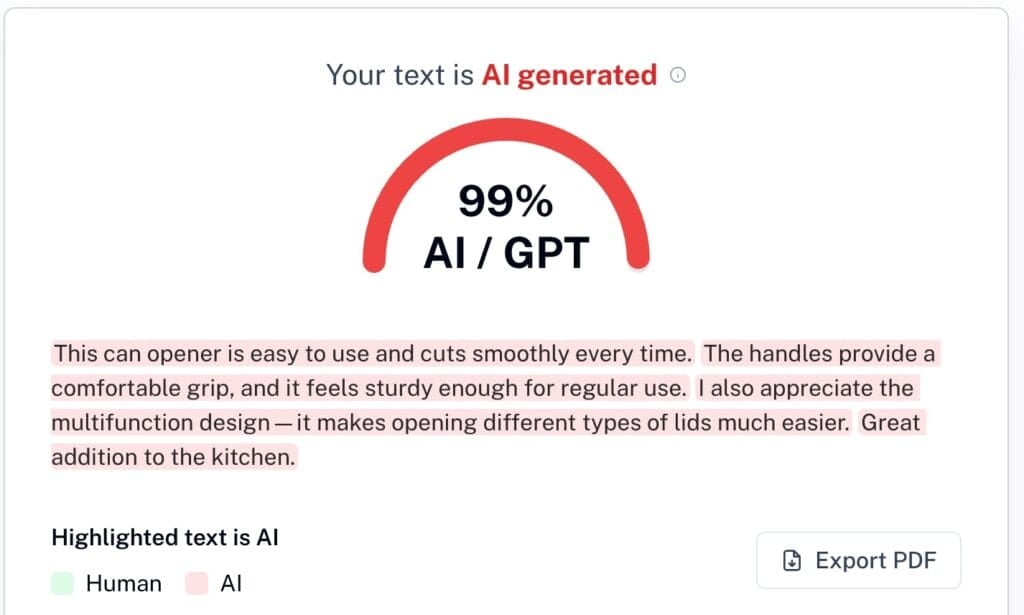
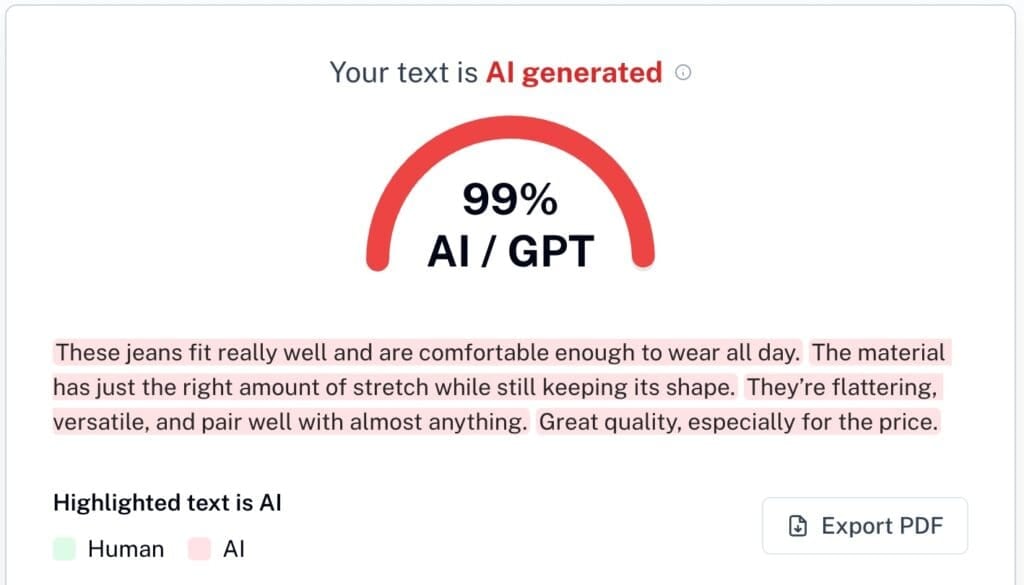
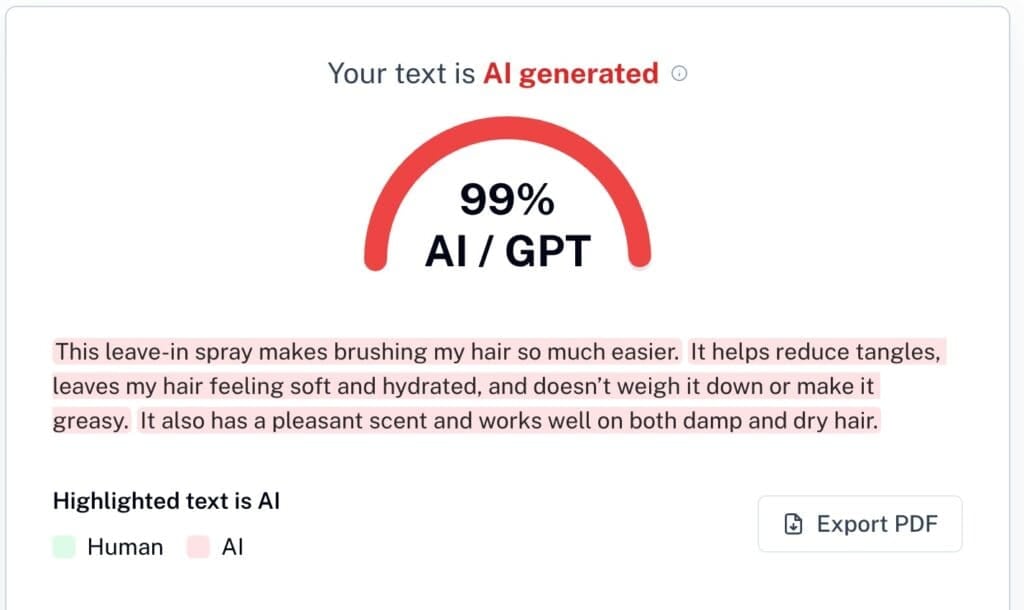
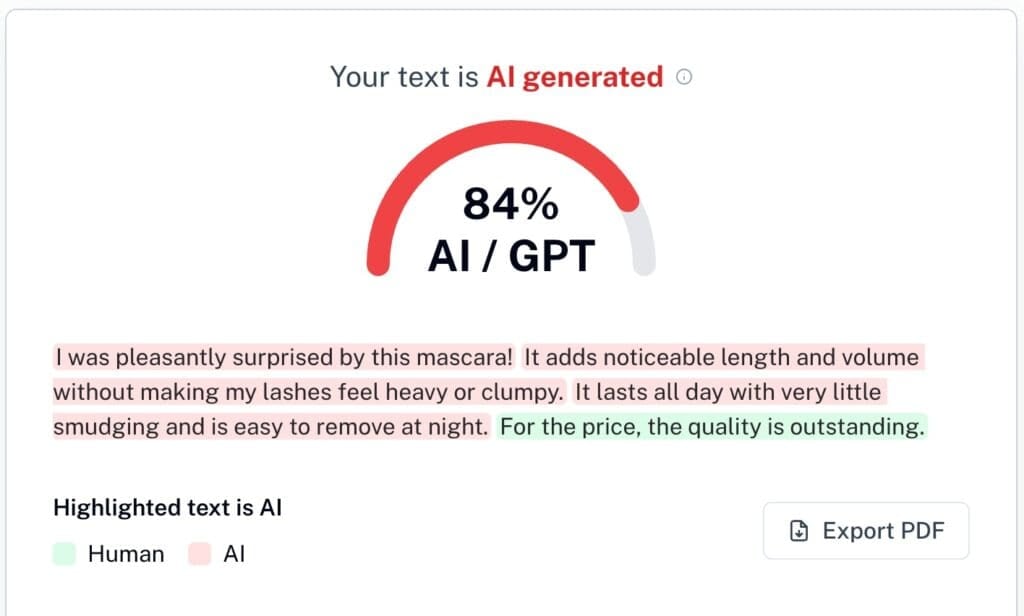
When we ran these reviews through the AI Detector, they all achieved high AI probability scores.
Review
“This can opener is easy to use and cuts smoothly every time. The handles provide a comfortable grip, and it feels sturdy enough for regular use. I also appreciate the multifunction design—it makes opening different types of lids much easier. Great addition to the kitchen.”
AI Detection Score
Review
“These jeans fit really well and are comfortable enough to wear all day. The material has just the right amount of stretch while still keeping its shape. They’re flattering, versatile, and pair well with almost anything. Great quality, especially for the price.”
AI Detection Score
Review
“This leave-in spray makes brushing my hair so much easier. It helps reduce tangles, leaves my hair feeling soft and hydrated, and doesn’t weigh it down or make it greasy. It also has a pleasant scent and works well on both damp and dry hair.”
AI Detection Score
Review
“I was pleasantly surprised by this mascara! It adds noticeable length and volume without making my lashes feel heavy or clumpy. It lasts all day with very little smudging and is easy to remove at night. For the price, the quality is outstanding.”
AI Detection Score
Can AI Detectors Reliably Flag Fake Reviews?
AI detectors are effective at flagging AI-generated writing. However, not all fake reviews use AI, nor are all AI-genererated reviews fake.
Fake reviews predate AI, and are simple enough to produce en masse without generative AI tools. Additionally, some real users use generative AI to assist in writing reviews.
AI detectors are simply a useful last step for verifying whether a review is fake. They are best used with other evaluation signals, such as generic language, similarities to reviews for the same product, and suspicious reviewer activity.
Frequently Asked Questions
What are the biggest signs of fake Amazon reviews?
A major warning sign is repeated phrasing that appears across multiple reviews for the same product. Most fake reviews appear in clusters rather than in isolation, as fraudsters use coordinate campaigns to make positive sentiments seem more widespread.
Coordinated fake reviews campaigns will typically praise the same product features, use similar wording, and follow the same overall structure. You can strengthen your assessment by checking the reviewer’s profile. Paid accounts, dummy accounts, and bots often post multiple reviews with similar language, review several unrelated products in quick succession, or show little other activity.
Can AI detectors identify fake Amazon reviews?
AI detectors can identify writing patterns that suggest a review may contain AI-generated text.
However, detection scores alone cannot reliably prove that a review is fake. Some real users might use AI to articulate their points more effectively, and some fake reviews are human-written.
How can I check an Amazon reviewer’s history?
You can click on a reviewer’s name or profile to see their review activity. Reviews are more likely to be fake if the user posts repeated reviews, uses similar wording across products, or reviews for products with no clear commonalities.
Should I trust an Amazon review with a high AI detection score?
No. A high AI detection score isn’t proof that a review is fake. Sometimes, these are real reviewers that use AI to articulate their points more clearly. To make an accurate judgment, evaluate the detection score alongside other authenticity signals, like the reviewer’s profile, timing, and history.
Final Thoughts
AI detectors can act as a final confirmation of inauthenticity when evaluating suspicious Amazon reviews. High AI detection scores strengthen confidence that a review was not written by a genuine customer.
To build the most comprehensive evaluation, combine detection scores with other signals associated with fake reviews, such as generic language, similarities with other reviews, and suspicious user histories.
Undetectable AI is a reliable tool for flagging suspicious text. It can estimate the likelihood that a piece of content was AI-generated.