
Meeting an essay word count is a common struggle. You either go way over the limit or find yourself staring at a screen with a draft that is far too short.
While you might be looking for ways to shorten an essay to hit a strict maximum, lengthening a short essay is an entirely different sport.
You have to make sure the work does not lose its quality or flow while trying to expand your thoughts.
This blog helps you master this sport by introducing actionable tips that add depth rather than fluff.
You will also explore handy tools to help you on the way and some mistakes to avoid that can compromise your academic integrity.
First, let us explore why you might need to make an essay longer in the first place.
Let’s dive in.
Key Takeaways
- Quality over quantity is the ultimate goal because expanding an essay should always involve adding deeper analysis rather than repetitive filler words.
- Undetectable AI provides a comprehensive suite of tools that help you brainstorm new examples and refine your tone to ensure your work meets professional standards.
- Strategic research is the best way to add length since finding new citations allows you to engage with different perspectives and strengthen your thesis.
- Transitioning smoothly between ideas naturally increases word count while making your arguments more cohesive and easier for the reader to follow.
- Humanizing your AI assisted drafts is essential because it prevents the robotic, predictable patterns that can trigger detection software in academic settings.
Why Essays Sometimes Fall Short of the Required Length
When an essay is too short, it often stems from a few common roadblocks during the drafting phase.
Sometimes, writers suffer from misunderstanding the assignment scope, believing that a surface level answer is sufficient when the prompt actually requires a deep dive into specific subtopics.
Writing too concisely too early in the process can also be an issue; if you summarize your main points in the first few paragraphs, you leave yourself with nowhere to go.


Never Worry About AI Detecting Your Texts Again. Undetectable AI Can Help You:
- Make your AI assisted writing appear human-like.
- Bypass all major AI detection tools with just one click.
- Use AI safely and confidently in school and work.
Another major factor is not including enough evidence or examples to back up your claims, which results in “thin” writing that lacks authority.
Finally, skipping important context or assuming the reader already knows everything about the topic can shave off hundreds of words that are necessary for a well rounded discussion.
To fix this, you must look at your essay as an opportunity to educate someone who is completely new to the subject.
What Teachers Actually Expect When They Set Word Counts
Teachers do not set word counts just to make your life difficult. In the world of academic publishing, a word count is a signal of the expected depth of the argument.
If a professor asks for 2,500 words on the French Revolution, they are essentially saying that the topic is too complex to be covered in 500 words.
They expect to see a nuanced exploration of the causes, the key players, the societal shifts, and the long term consequences. A short essay often suggests that the student has only scratched the surface or has failed to engage with the required reading material.
Furthermore, word counts are designed to push you toward critical thinking. When you are forced to write more, you have to look beyond the obvious answers.
You have to find counterarguments, analyze primary sources, and connect your topic to broader historical or scientific contexts. This process of expansion is where the real learning happens.
It proves that you can sustain a logical argument over a long period, a skill that is vital in professional careers where you might be asked to draft long form white papers or detailed business proposals.
Well structured long essay demonstrates that a student has moved past simple memorization and into the realm of synthesis and original thought.
How to Make an Essay Longer: 8 Easy and Effective Steps
If you have tried your best but still cannot hit the required count, do not panic. These eight steps will help you add meaningful substance to your work.
Step 1: Add More Supporting Examples
A single example often is not enough to fully drive home a point. If you have explained an idea using just one source or anecdote, this is your chance to go deeper.
Adding a second or even third example gives your argument more weight and helps the reader see your perspective in different ways.
If you are writing about the benefits of renewable energy, do not just mention solar power. Spend a few paragraphs discussing wind energy or hydroelectric advancements in specific regions like Scandinavia or the American Midwest.
Step 2: Expand Your Explanations and Analysis
One of the most common mistakes is “dropping” a piece of evidence without explaining it.
After every quote or statistic, you should have at least two to three sentences explaining how that data supports your specific thesis.
Do not let the evidence do the talking for you. Your job as a writer is to connect the dots for the reader, explaining the “so what?” behind every fact you present.
Step 3: Include Relevant Research or Citations
Adding well placed citations demonstrates your depth of understanding. If your essay feels thin, chances are you haven’t explored enough sources.
Find research that highlights different aspects of your topic, such as the economic or psychological impact of your subject.
Step 4: Break Down Complex Ideas in More Detail
Big ideas can often be broken into smaller, more digestible chunks. If you are discussing “Global Warming,” do not treat it as a single block.
Break it down into ocean acidification, melting polar caps, and the disruption of local weather patterns.
By giving each subtopic its own section, you provide more clarity for the reader and naturally increase your word count.
Step 5: Add a Counterargument or Alternative Perspective
Including opposing viewpoints shows that you have thought critically about your topic.
Think about what someone might say to disagree with your main argument, and then write a rebuttal to show why your position still holds weight.
This does not just add words; it adds a level of sophistication to your writing that professors love to see.
Step 6: Strengthen Topic Sentences and Transitions
A choppy essay is usually a short essay. Spend time expanding your topic sentences so they clearly link the previous paragraph to the next one.
Instead of starting a paragraph with “Also,” try a more detailed transition like “Building upon the economic arguments mentioned previously, it is also important to consider the social implications.”
Step 7: Expand the Introduction and Conclusion Thoughtfully
The introduction and conclusion should not be overlooked. In the intro, you can add a key statistic or a vivid anecdote to grab the reader’s attention.
In the conclusion, go beyond just summarizing. Offer a thought provoking takeaway or discuss the future implications of your findings. This provides a satisfying “full circle” experience for the reader.
To make sure your final paragraph provides a sophisticated reflection of your expanded arguments, you can use our Conclusion Generator to add depth and meaningful reflection to your essay’s end without resorting to unnecessary fluff.
Step 8: Use Transition Sentences and Phrases
Transitions act as the glue for your essay. Longer transitional phrases increase your word count while improving the overall flow of the piece.
They help guide the reader through your logic, making the essay feel more like a journey than a list of facts.
| Category | Transition Sample |
| Adding a Point | Furthermore, it is equally important to note that |
| Comparing Ideas | In a similar fashion, we can observe that |
| Showing Contrast | On the other hand, a differing perspective suggests |
| Concluding | To bring the various arguments full circle, it is clear |
Examples of Expanding an Essay Without Adding Fluff
Example 1: Turning a Short Explanation Into a Full Analysis
- Original: Exercise is good for mental health because it releases endorphins.
- Expanded: Regular physical activity is a vital component of mental well being because it triggers the release of endorphins, the body’s natural feel good chemicals. Furthermore, exercise provides a healthy distraction from daily stressors, allowing individuals to clear their minds while improving their physical stamina.
Example 2: Adding Evidence to Strengthen an Argument
Instead of just saying “Social media is addictive,” cite social media usage statistics to show exactly how many billions of people are engaging with these platforms daily.
Then, explain how the “infinite scroll” feature is specifically designed to keep users engaged for hours on end.
Example 3: Expanding a Paragraph With Relevant Context
If you are discussing a historical event, do not just give the date. Describe the political climate of the time.
What were the people wearing? What were the main economic fears of that decade? This background information makes your essay more immersive and significantly longer.
Smart Writing Techniques That Naturally Increase Word Count

Use Clear Transitions Between Ideas
Good transitions do more than just connect sentences; they build a bridge of logic.
If you find your paragraphs are ending abruptly, you can use our AI Essay Rewriter to help you find more sophisticated ways to link your thoughts together.
This tool can suggest transitional sentences that feel organic and professional.
Expand on Key Concepts With Real-World Examples
Abstract ideas are often short and hard to grasp. By grounding your argument in real world scenarios, you make your point clearer and your essay longer.
Discuss a specific case study or a news event from the past year that illustrates your thesis in action.
Provide Brief Background Information
Even if you think the reader knows the topic, providing a brief history can be helpful.
It sets the stage for your argument and shows that you have done the prerequisite research to understand the origins of the issue you are discussing.
Common Mistakes to Avoid When Trying to Make an Essay Longer
- Adding Unnecessary Filler Words: Using phrases like “at this point in time” instead of “now” might add a few words, but it makes your writing look amateurish and frustrating to read.
- Repeating the Same Point Multiple Times: Graders can spot circular logic from a mile away. If you find yourself saying the same thing in three different paragraphs, you need to find a new subtopic to explore instead.
- Including Irrelevant Information: Just because a fact is interesting doesn’t mean it belongs in your essay. If you are writing about biology, do not include a long section on the history of the telescope unless there is a very clear connection.
- Overcomplicating Simple Ideas: Do not use a thesaurus to find the longest possible word for a simple concept. Clarity is always more important than sounding like a dictionary.
- Analyze Evidence Instead of Just Presenting It: The biggest missed opportunity for length is failing to analyze. Never end a paragraph with a quote; always follow it up with your own interpretation.
How Undetectable AI Can Help Improve Essay Development
Expand Ideas While Maintaining Natural Flow
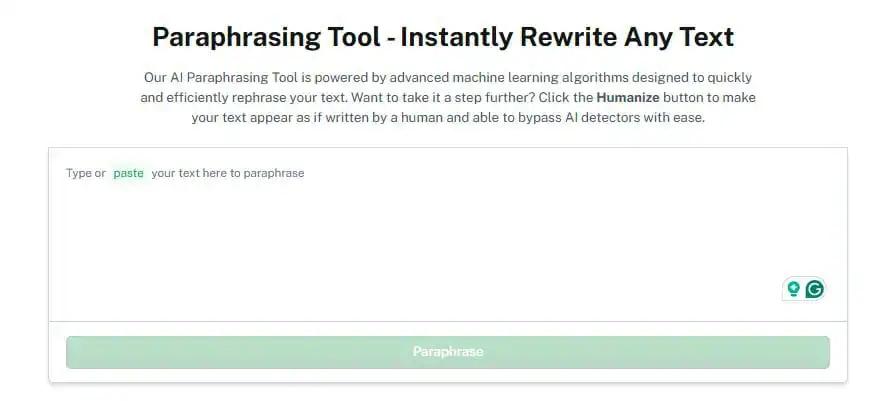
If a section of your essay feels too thin, you can use our Undetectable AI’s Paraphrasing Tool to explore new ways of stating your points.
This helps you find more detailed vocabulary and sentence structures that add weight to your draft without making it feel overstuffed.
- Use the tool to brainstorm alternative perspectives.
- Find more formal ways to express casual thoughts.
Improve Sentence Variety and Readability
A repetitive rhythm can make even a long essay feel short and uninspired. Our Undetectable AI’s Sentence Rewriter helps you vary your sentence lengths and structures. This makes the reading experience more engaging and prevents the “drone” of constant short sentences.
- Turn two short sentences into a complex, thoughtful one.
- Break up overly dense blocks into clear, punchy segments.
Turn Short Drafts Into More Detailed Explanations
Our AI Paragraph Rewriter is perfect for taking a “bullet point” thought and expanding it into a full, reasoned paragraph.
It helps you flesh out your logic by suggesting additional context or secondary points that you might have missed during your initial brainstorming session.
Refine AI-Assisted Writing to Sound More Human
If you have used AI to help you research or outline, it is vital to ensure the final output does not sound like a machine.

Our Undetectable AI’s AI Humanizer is specifically designed to remove the robotic “fingerprints” from AI text, ensuring your expanded essay sounds authentically yours.
- Ensure your tone is consistent across the entire document.
- Avoid the predictable word patterns that trigger AI detectors.
Check out our AI Detector and Humanizer in the widget below!
FAQs
Is it okay to use AI to make my essay longer?
Yes, if you use it as an assistant to help you brainstorm new examples or refine your analysis. Using AI to generate “filler” is a bad idea, but using it to help you think deeper about a topic is a great way to improve your writing.
What is the best way to hit a word count without fluff?
The most effective method is to add more research and counterarguments. These additions provide genuine value to the reader and show that you have a comprehensive understanding of the subject matter.
Does changing the font or margins help?
No. Most professors and submission portals look at the digital word count, not the number of physical pages. Attempting to “stretch” an essay visually is a common mistake that usually results in a lower grade for not following the spirit of the assignment.
Conclusion
A high word count demands a piece of writing that is detailed, thoughtful, and impactful. You cannot just add fillers or redundant information to hit a number; you must strive to add genuine depth to your discussion.
By using actionable strategies like adding more evidence, exploring counterarguments, and expanding your analysis, you set yourself up for academic success.
Plus, by utilizing the right technology to polish your work, you can ensure that your voice remains clear and authoritative from the first page to the last.
Meeting a word count requirement is about more than just quantity; it is about proving that you have mastered the topic at hand.
Explore Undetectable AI today to expand your ideas while keeping your writing human.