
We all know how important self-reflection is for personal growth, but just the thought of looking at an empty journal before you can gather enough courage to start writing gives most of us chills.
It is not easy. And most of us ultimately end up skipping it altogether.
When AI is used for almost every task at work, why not use it for your own improvement, too?
Imagine the impact you would get if your work tasks for a month got analyzed by a system that told you how well you performed at each and how you could get better at them!
AI adds a data-driven dimension in self-reflection, and it does so while making it pretty easy too. All you do is set yourself a project in AI Chat with a custom prompt.
In this article, we’re going to talk about how exactly you could use AI for self-reflection to improve your work habits.
Key Takeaways
- AI self-reflection means to use an AI tool for conveniently looking back at your work habits and finding ways to improve them for maximum productivity.
- AI can be used for mood-tracking, sentiment analysis, self-reflecting on your performance in meetings, keeping track of your tasks, and a lot more.
- You don’t need fancy AI tools for self-reflection. A simple ChatGPT or Gemini project will get you the job done.
- It’s better to not take the suggestions you get in AI-self reflection rigidly. Instead, try them out to see if they work for you. If not, change the approach until you find optimum solutions.
What Is AI Self-Reflection?
The meaning of AI self-reflection is simply the use of artificial intelligence to look at your work so that you can get feedback on your performance, and potentially improve it.
Self-reflection is a natural process where we analyze our thoughts, behaviors, emotions, and actions to get a better understanding of ourselves. And like all other aspects of life, AI has made its place in this one, too.
Before we get into the specifics of how AI helps you self-reflect, it’s important we differentiate self-reflection from overthinking. In both of these, you think about your actions.


Never Worry About AI Detecting Your Texts Again. Undetectable AI Can Help You:
- Make your AI assisted writing appear human-like.
- Bypass all major AI detection tools with just one click.
- Use AI safely and confidently in school and work.
Overthinking, however, is a repetitively negative thinking process in which you keep on dwelling the mistakes rather than moving towards a solution. Self-reflection, in contrast, is meant to bring change in your future behavior. It is genuinely constructive.
Using AI for self-reflection requires you to make this distinction because AI tools will only go where you prompt them to go. If you just use it to ask whether how you performed a task was right or wrong, there’s a 90% chance that AI will only validate your behavior.
For the purposes of self-reflection, we specifically use it to come up with other, better ways to perform the said task.
Tracking Your Work Patterns With AI
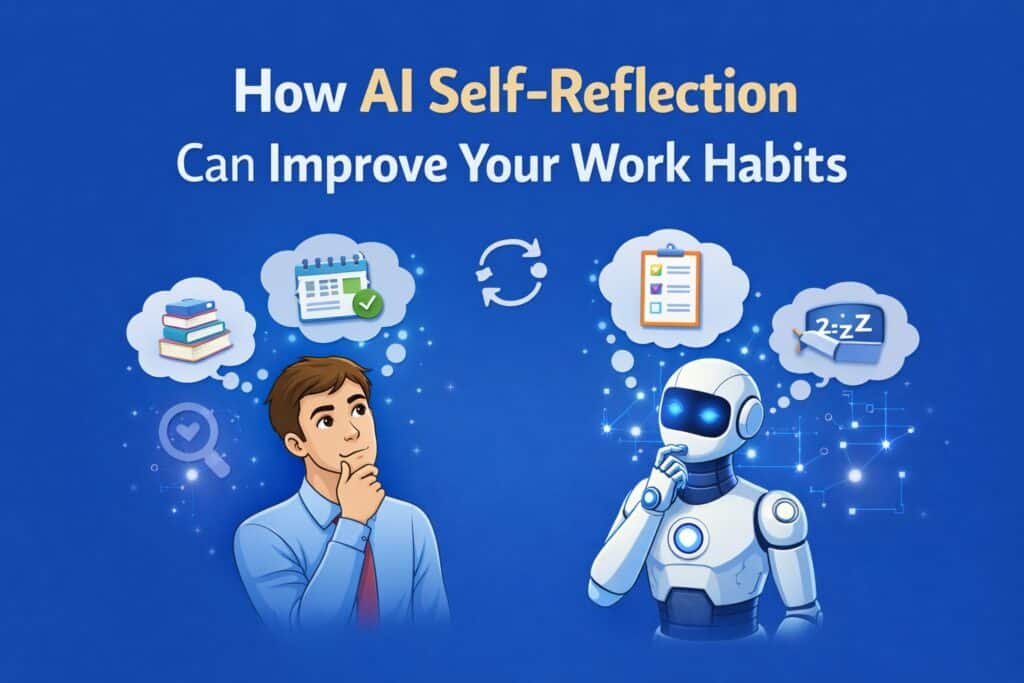
Let’s take an example of ChatGPT as the tool we use for AI self-reflection. All you have to do to set up your workflow is to start a new project.
For different goals, you could have different chats in the same project. Import some data files you want AI to analyze for you, if there are any, and give it a specific prompt (more on this later).
Now, there are many different mechanisms through which AI can track your work patterns. Here are some of them.
Sentiment Analysis
If you’re in business, you’re likely familiar with sentiment analysis, i.e., the process of understanding how satisfied a customer is based on their tone of communication.
Several AI tools allow you to analyze emails, messages, comments, feedback surveys, and other communication tools for that matter.
When you do it for your customers, why not do it for yourself or your employees?
Use the same AI tools for a sentiment analysis of your work emails and internal communication with the company. Try to make sense of the kind of communication patterns that cause misunderstandings.
Take note of things that have produced good feedback. A thorough check will help you narrow down the specific skills you need to learn for better work performance.
Mood Tracking
It is genuinely not possible for a human to stay in the same mood for the 8 hours they are at work. You could set up a mood tracking system for a few weeks, where you record your emotional state at multiple specific times of the day.
Analyse your tracked mood data for 2–3 weeks to understand what time of the day you feel your best.
That is the time you want to dedicate to high-stakes work tasks so that you can give your best there. A tired, emotionally drained brain is bound to make mistakes.
Self-reflecting Your Behavior in Meetings
There are AI meeting apps that record you as you attend meetings and analyze those recordings. Now, you can benefit from the analysis in various ways.
Of course, they help you summarize key meeting notes and catch up if you’ve missed any important info.
But when used for self-reflection, you can track how you spoke during the meeting, you were able to articulate your intended reasonings the way you wanted, you were audible and clear enough, were your pauses rightly placed, how well you took questions, etc.
All of these are great points to focus on as you improve your meeting performance over time.
Reflecting On Productivity Trends
Daily or weekly check-ins
An AI-powered productivity app can be used to digitally check in:
- The core tasks you had scheduled for the day
- The tasks you were able to complete and the ones you couldn’t
- Any specific reasons you can think of due to which you couldn’t finish your required daily tasks
- Any unforeseen challenges you came across during the day
- How you handled them
Now, I certainly don’t want you to log every little thing you did obsessively. Just keep an overview of tasks that require major chunks of your time.
Over time, you’ll be able to identify what kind of projects drain you faster and what’s the kind of project you enjoy the most doing. You’re basically building a feedback loop that’s specific to your habits.
These check-ins could be daily or weekly, depending on how comfortable you are.
Compare outcomes with goals
The purpose of self-reflection is to produce a tangible improvement. You can track yourself all you want, but if those tracked moments are not followed by specific, action-based improvements, there’s no point in it.
Therefore, always have a broad goal in mind when you use AI for self reflection (getting better at communication, for instance).
Then, think of specific actions you must take to make it happen. The actions must be measurable in some way so that you can quantify your improvement.
For example, reducing the number of filler words in your communication is a measurable change that you can compare over time. It makes you more attentive towards your articulation.
Integrating AI Feedback Into Habits
The feedback you get through AI self-reflection must be put into practice for it to generate results.
There are, however, two paths you could go:
- Treat feedback as insights
- Take them as rigid instructions
I recommend going the first route because it does not strip you of the power of control.
If, for example, it tells you that you function better at night rather than early in the morning, it could either be true, or it could be because the day you logged good results from working at night was the day you took a strong caffeine fix before getting to work.
The result may not be accurate in determining that you’re a night owl. It could be skewed by other behaviors that AI never takes into account.
So, it’s better to integrate the feedback into your work habits only where it makes sense. Also, you could try following it and see if you’ve noticed any measurable improvements in a few weeks.
If not, it’s best to adjust your approach rather than staying stuck with the suggestions you received through AI.
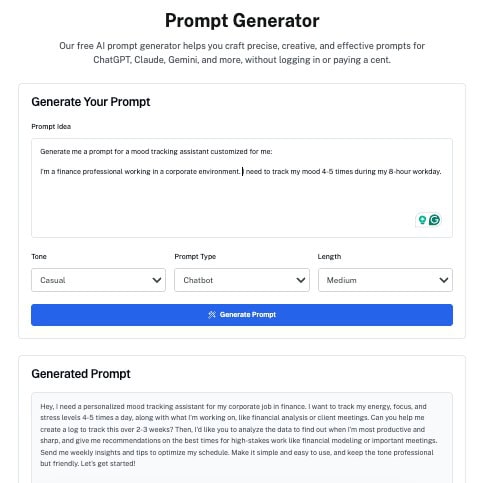
You also need specific prompts to give to AI for it to function as your work coach. The Undetectable AI’s Prompt Generator generates the best custom prompts based on some questions about the kind of tasks you want AI to do for you.
These prompts work great for ChatGPT, Gemini, Claude, or any AI bot you want to use for self-reflecting.
Avoiding Overreliance on AI
Of course, there’s a limit to the use of AI in self-reflection.
You can’t use it as a replacement for therapy, for example.
If your behaviors are concerning, if you think you need a communication coach, if you’re having trouble understanding your emotions, you most definitely need a human therapist to make sense of it all.
AI tools are also inherently limited to the data on which they have been programmed.
So, there are chances you won’t be satisfied with the response you get at times, which should be okay because it is self-reflection at the end of the day, you get to decide what you want to take from AI output and integrate into your workflow.
Instead of using a generic AI for your review, you could opt for a tool with better humanized responses, too.
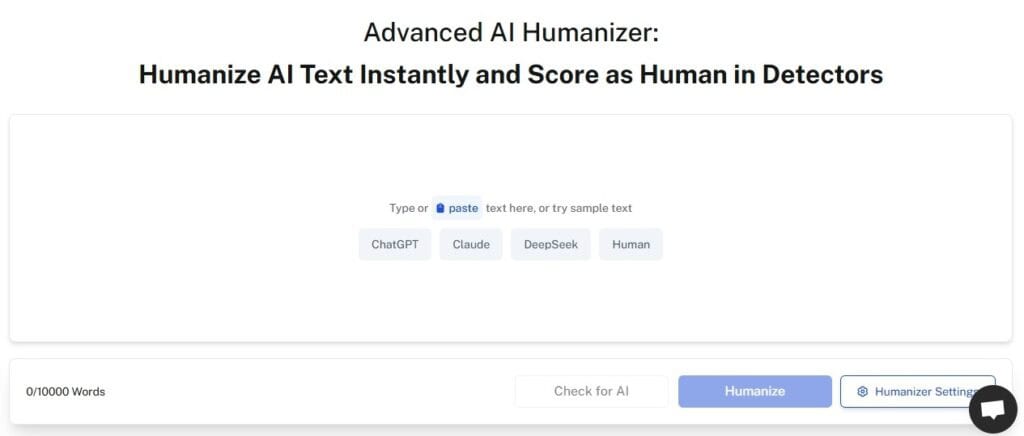
Undetectable AI, for example, has a built-in AI Humanizer tool structured on conversations we have as humans, with a sprinkle of unpredictable sentence structures, lengths, and some run-on sentences here instead of a predictable approach in the exact same pattern.
Such a tool will help you with tasks like communication.
Give our AI Detector and Humanizer a spin in the widget below!
Final Thoughts
Self-reflecting by yourself is great, but at times you get stuck at something you can’t find a solution of, you could use AI as a thinking partner.
It will help you make sense of the decisions you’ve made, and whether or not they contributed towards your progress at work.
Any AI tool will work for basic self-reflection as long as you have the right prompt for it.
Use Undetectable AI prompt generator to get you there, or better yet, simply use Undetectable AI suite for an inherently humanized AI self-reflection partner.
Check out Undetectable AI today!