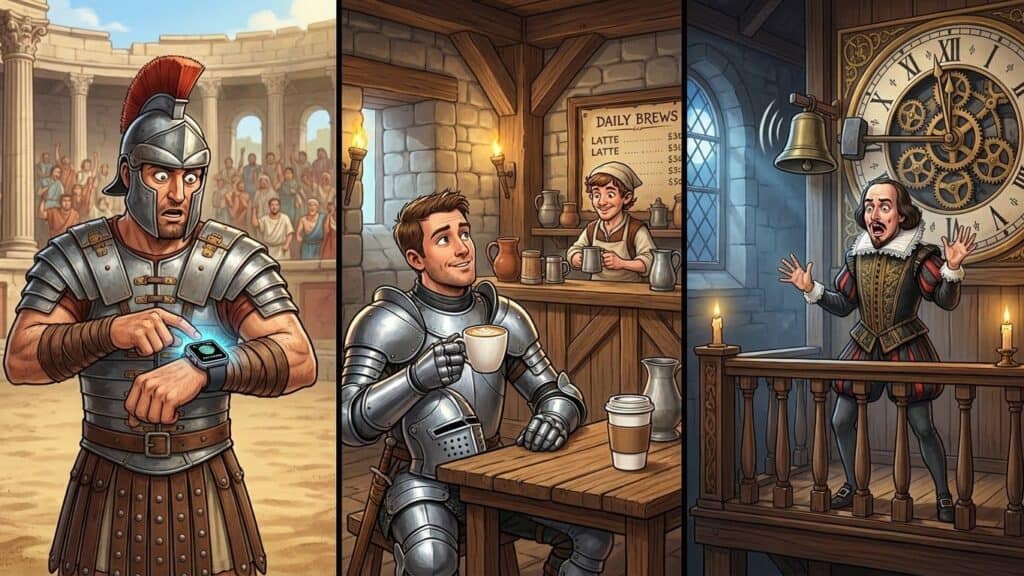
A Roman gladiator checking his Apple Watch. A medieval knight ordering a latte. Shakespeare’s character hearing a clock strike… 300 years before clocks even existed.
Sounds weird, right?
But wait.. If you’ve seen the new period spoof film Fackham Hall, you know exactly what we mean.
This Downton Abbey–style comedy thrives on absurd, out-of-place jokes and visual gags that break all historical rules deliberately.
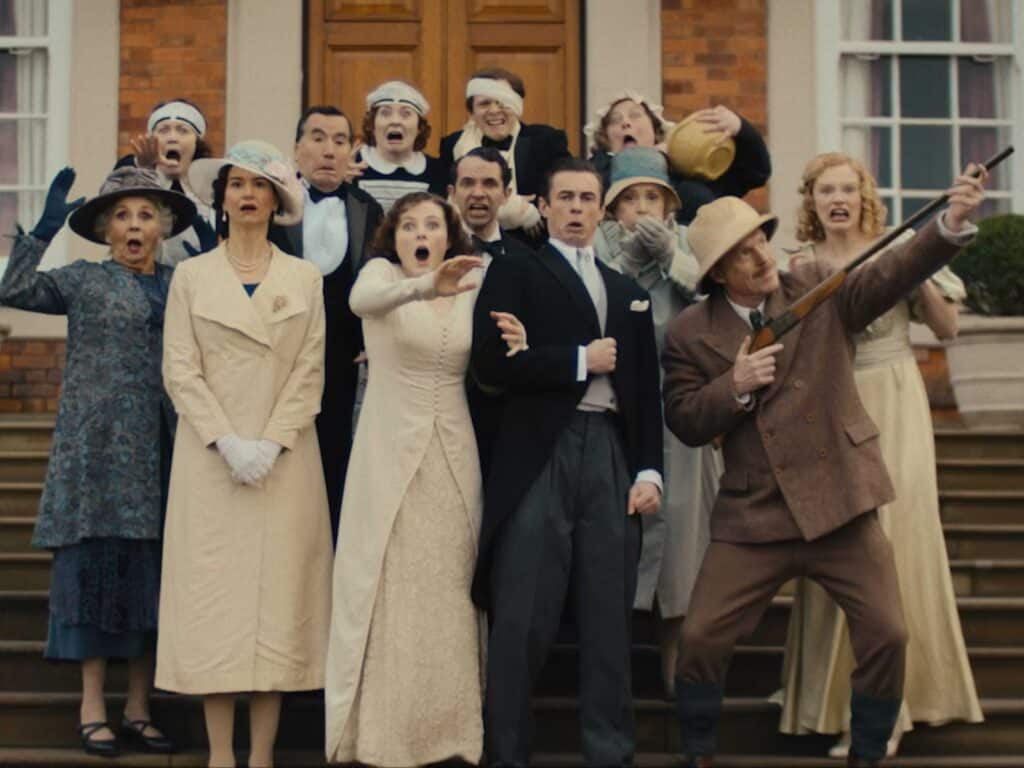
Over-the-top humor, sight gags, and pop-culture references collide with its historical setting, making fun of the genre itself rather than aiming for strict accuracy.
What is this trick called? It’s called anachronism.
In simple terms, it means putting something from one time period where it doesn’t belong, and replacing something expected with something unexpected.
And in this blog, we’ll cover exactly that.
We’ll see anachronism meaning with examples, and the different types you’ll see in books, movies, and games.
We’ll also learn how and why it happens in stories, why writers use it deliberately, and how to spot it and the tools that can help
Let’s jump in.
Key Takeaways
- Anachronism definition: Something placed outside its correct time period – an object, person, idea, or behavior that doesn’t match its era.
- The types of anachronism include Parachronism (past lingering), prochronism (future appearing early), behavioral anachronism (modern attitudes in historical settings), and false anachronism (viewer misunderstanding).
- Writers deliberately use anachronisms for humor, emotional connection, satire, and making historical stories relatable to modern audiences.
- You can detect them by watching for modern language, contemporary slang, and behaviors that feel “off” for the time period.
- From the Society for Creative Anachronism recreating medieval culture to games like the Anachronism card game, the concept influences both scholarly study and popular entertainment.
What Is Anachronism?
Most people think of anachronism as a simple “mistake in time,” but anachronism’s meaning goes deeper than that.
It’s not just about something showing up where it doesn’t belong, it’s about our relationship with time itself.
Let’s break it down in a clear, understandable way.


Never Worry About AI Detecting Your Texts Again. Undetectable AI Can Help You:
- Make your AI assisted writing appear human-like.
- Bypass all major AI detection tools with just one click.
- Use AI safely and confidently in school and work.
- Anachronism Definition
The word anachronism comes from two Greek roots:
- Ana (meaning “against” or “backward”)
- Chronos (meaning “time”).
Put together, they form the idea of something being “against time.”
From this, the anachronism definition came to mean anything placed outside its correct time period whether it’s an object, a person, or an idea that doesn’t match the era it appears in.
If we look back into its history, the term itself didn’t exist in English until the early 17th century.
The earliest recorded use comes from a 1617 sermon by John Hales, where he used the word to describe errors in dating events.
This tells us that people only started caring about precise historical accuracy once society began treating history as a discipline that needed structure and verification.
Earlier civilizations didn’t think this way.
For example: Medieval artists often painted ancient philosophers in clothes from their own time.
Not because they didn’t know better, but because it helped viewers relate to the figure. Historical accuracy simply wasn’t the priority, meaning and symbolism were.
Interestingly, people’s love for historical recreation continues today.
The Society for Creative Anachronism, started in 1966, purposely mixes elements from different medieval times.
Members study and recreate medieval culture, arts, and combat, combining various eras into one fun and immersive community experience.
- Anachronism Examples
Here are three clear examples of anachronism:
- Unintentional Error
These happen when creators miss details or don’t research properly.
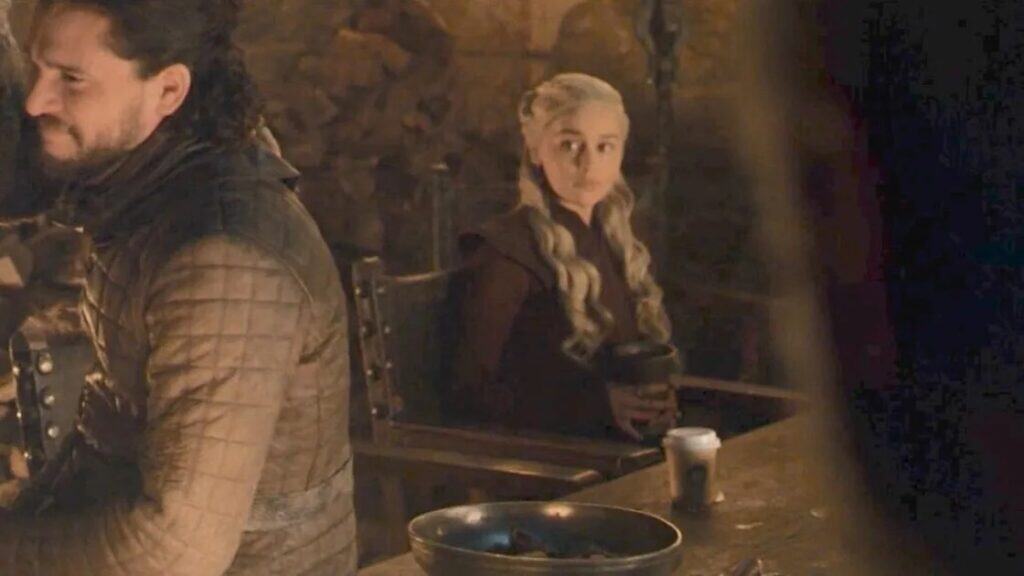
A classic example is the Game of Thrones coffee cup incident. In one scene, a modern disposable cup appears on a table in a medieval-style setting.
It instantly breaks the realism because the object clearly doesn’t belong in that world. That’s an unintentional anachronism.
2. Intentional Artistic Choices
Sometimes anachronisms are used on purpose to create a mood, make a point, or help modern audiences connect emotionally.
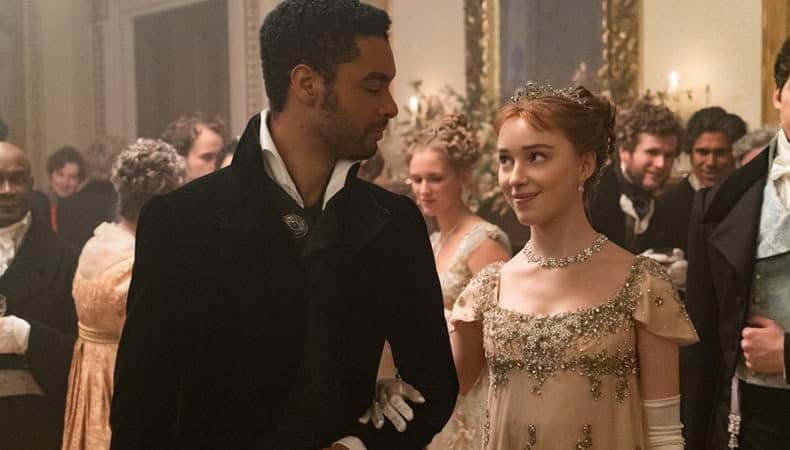
The Netflix show Bridgerton is the perfect example. Although the story takes place in the Regency era, the soundtrack features modern pop songs.
This blend of old and new creates a familiar emotional tone, making the historical world feel more relevant and accessible to today’s viewers.
3. Sociological Usage
Anachronism isn’t always about objects or historical settings. It can also describe people or ideas.
Merriam-Webster includes a broader meaning: someone whose beliefs or behavior feel outdated can also be called “an anachronism.”
For instance, a politician holding rigid, old-fashioned views may be described this way.
In this context, “time” doesn’t refer to history, it refers to cultural progress.
This usage appears in phrases like “girl anachronism,” which can describe someone who seems to exist out of sync with contemporary culture or attitudes.
Types of Anachronism
Understanding the anachronism meaning requires knowing its different forms.
These are the top five types of anachronism:
| Type of Anachronism | Definition | Mechanism | Examples |
| Parachronism (The Lingering Past) | When an object, custom, or idea from the past appears in a later period where it feels outdated but not impossible. | Past elements appearing in the present or future. | – A businessman in 2024 writing with a quill and inkpot. – A modern teenager using 1920s slang like “the bee’s knees.” |
| Prochronism (The Impossible Future) | Placing an object, idea, or technology in a time before it existed which is the classic “historical error.” | Future elements appearing in the past. | – A Roman gladiator checking a wristwatch. – A character in the 1800s discussing “neurosis” pre-psychoanalysis. – Shakespeare’s mechanical clock in Julius Caesar (set in 44 BC). |
| Behavioral & Cultural Anachronism | When characters in historical settings act, speak, or think with modern morals, psychology, or language. | Modern behaviors inserted into past societies. | – A 14th-century character promoting 21st-century humanism, equality, or democracy. – A 1920s character saying “My bad” or “I’m stressed out.” |
| Metachronism | Placing an event after its proper time, a shift in historical sequence. | Events from earlier periods are moved forward in time. | – Timeline compression in films where years of events are shown happening in one dramatic week. |
| False Anachronism | When audiences incorrectly assume something is anachronistic due to misunderstanding history. | Viewer error, not creator error. | – Criticizing a Tiffany-style ring in an 1890 setting (even though it was invented in 1886). – Complaints that period films look “too clean” even when bright colors and new machinery were historically accurate. |
These types also show up in entertainment, like the Anachronism card game.
This collectible strategy game mixes warriors and artifacts from different historical periods, creating fun, intentional anachronistic battles between ancient heroes and medieval knights.
Why Anachronisms Happen in Stories
Anachronisms appear in stories for reasons far more complex than simple “mistakes.”
Let’s explore the reasons one by one:
- To Make Characters Emotionally Relatable
Readers want characters they can feel.
Example:
A Viking protagonist speaks calmly about “communication issues” in his marriage.
→ But no Viking in the 9th century had that therapeutic vocabulary.
→ Writers add this modern emotional language so the audience connects instantly.
- To Reduce Cognitive Load (Make the Story Easier to Follow)
Pure historical accuracy can be mentally exhausting.
Example:
A medieval queen in a film says, “I’m overwhelmed.”
→ The phrase didn’t exist then, but…
→ It saves the audience from deciphering old idioms like “my spirit buckles under its burdens.”
- To Enhance Artistic Expression
Sometimes creators want the clash of eras, it delivers a stylistic punch.
Example:
Bridgerton ballroom scene with a string-quartet version of Ariana Grande.
→ Historically inaccurate, but
→ The emotional beat lands perfectly because the audience recognizes the melody.
- Because Storytelling Compresses Time (Metachronism)
Real history is messy. Stories need flow.
Example:
A biopic shows two major revolutions happening in the same year.
→ In reality, they were decades apart.
→ Writers compress timelines to maintain narrative momentum.
10 Years of History → 2 Weeks in the Movie → Tighter Story
- Practical Production Constraints (Unintentional Anachronisms)
Not every “mistake” is philosophical, some are just set issues.
Example:
The famous Game of Thrones coffee cup.
→ Not symbolic or intentional.
→ It was just a rushed scene, a missed detail, and became an instant meme.
- Audience Misconceptions (False Anachronism)
Sometimes the viewer is wrong.
Example:
A bright, clean Victorian street in a show.
→ Audience says: “Too clean! Unrealistic!”
→ Reality: many Victorian areas were bright and newly built at the time.
→ The viewer’s imagination of “old = dirty” creates the false anachronism.
- Symbolism & Commentary (Purposeful Meaning)
Anachronisms can carry intentional depth.
Example:
A historical drama shows a suffragette holding a smartphone.
→ Impossible? Yes.
→ But symbolically, it connects the fight for rights across eras.
→ The device becomes a metaphor, not a prop.
Why Writers Use Anachronism on Purpose
There can be many purposes for using anachronism, not just one.
Let’s explore some of them:
| Reason | Why It Works | Example |
| 1. Humor / Funny Effect | Mixing old and new surprises the reader and makes them laugh. | A king in the Middle Ages checking his phone. → Funny because phones didn’t exist back then. |
| 2. Satire / Making a Point | Shows modern problems in a past setting to highlight issues in today’s world. | A medieval court arguing about “data privacy for carrier pigeons.” → Jokes about modern privacy issues. |
| 3. Highlighting Themes | Shows that some things, like power or greed, stay the same across time. | A Pharaoh with a modern assistant. → Shows hierarchy hasn’t changed much. |
| 4. Make Story Relatable | Adds small modern touches so readers understand characters and feel connected. | A 1700s poet giving a “motivational speech.” → Easy for readers to relate to tone. |
Using intentional anachronism can be essential for creating humor, satire, or stylistic contrast… but you don’t need to spend hours experimenting or rewriting.
Instead, use Writing Style Replicator to:
- Add humor, satire, or stylistic contrast effortlessly.
- Test different tones and see what works best.
- Make your writing stand out while keeping it natural and engaging.
How to Spot Anachronism in Books, Movies, and Media
Anachronisms aren’t always easy to detect, especially when subtle modern phrasing or behaviors slip into historical settings.
Spotting them requires attention to both language and context, because what feels “off” isn’t always a physical object, it can be dialogue, thought patterns, or social behavior.
- Watch For Modern Language and Wording
Writers and filmmakers sometimes unintentionally use words or expressions that wouldn’t exist in the era being portrayed.
Example: A character in a Victorian novel saying, “That’s so stressful!” clearly doesn’t match the 19th-century vocabulary.
Tip: AI Detector can flag these phrases that feel out-of-era or stylistically “too modern.” It highlights dialogue, narration, or captions that might break the historical immersion.
This gives creators a quick view of where the language may clash with the intended setting.
You can spot the modern language and wording by:
- Looking for slang, idioms, or casual phrasing that feels contemporary.
- Asking yourself: Would someone from this period say this?
- Rewrite Modern Phrasing to Fit the Era
Once you know where the anachronism exists, the next step is refinement. Modern phrasing can be rewritten to match the historical tone without losing anachronistic meaning.
Example:
- Instead of “That’s so stressful!” in a Victorian novel,
- A period-appropriate rewrite could be: “This weighs heavily upon my nerves.”
Tip: AI Humanizer can take flagged phrases and rework them into language that feels authentic to the era. This ensures that dialogue and narration maintain readability while staying true to the historical setting.
- Look Beyond Words
Anachronisms aren’t limited to language. They can appear as:
- Modern problem-solving approaches or attitudes.
- Social behaviors that wouldn’t exist in the historical context.
You can use the AI Detector flags behavioral or cultural inconsistencies described in text.

The AI Humanizer can suggest adjustments that make the character’s thoughts, actions, and dialogue fit the era more convincingly.
Test your writing through our AI Detector and Humanizer in the widget below!
Final Verdict
Most people think anachronism is always a mistake that needs fixing.
But actually, anachronism can be a tool, or a mistake (hello, Game of Thrones coffee cup). But more often, it’s a deliberate choice that makes stories more relatable, emotional, and memorable.
From the Society for Creative Anachronism blending medieval periods, to modern period dramas showing characters out of sync with their time, to the Anachronism card game throwing historical warriors into impossible battles, this idea shapes how we experience both history and fiction.
Understanding anachronism makes you a better creator. Once you know the rules of time, you can break them on purpose.
Whether you’re writing historical fiction, analyzing period dramas, or creating content that needs to feel real, precision matters.
Also, creating period-appropriate content without accidental anachronisms takes attention to detail:
- AI Detector spots modern phrasing that breaks historical immersion before your readers notice.
- AI Humanizer rewrites flagged phrases into natural, era-appropriate language.
- Writing Style Replicator lets you test different tones from serious historical accuracy to intentional comedic anachronism
Stop guessing if your 1920s character would say “ghosted,” or if your Victorian protagonist sounds too modern. Get instant feedback on every phrase, every line of dialogue, every narrative choice.
Try Undetectable AI free today and write with confidence that every word belongs exactly where (and when) you put it.