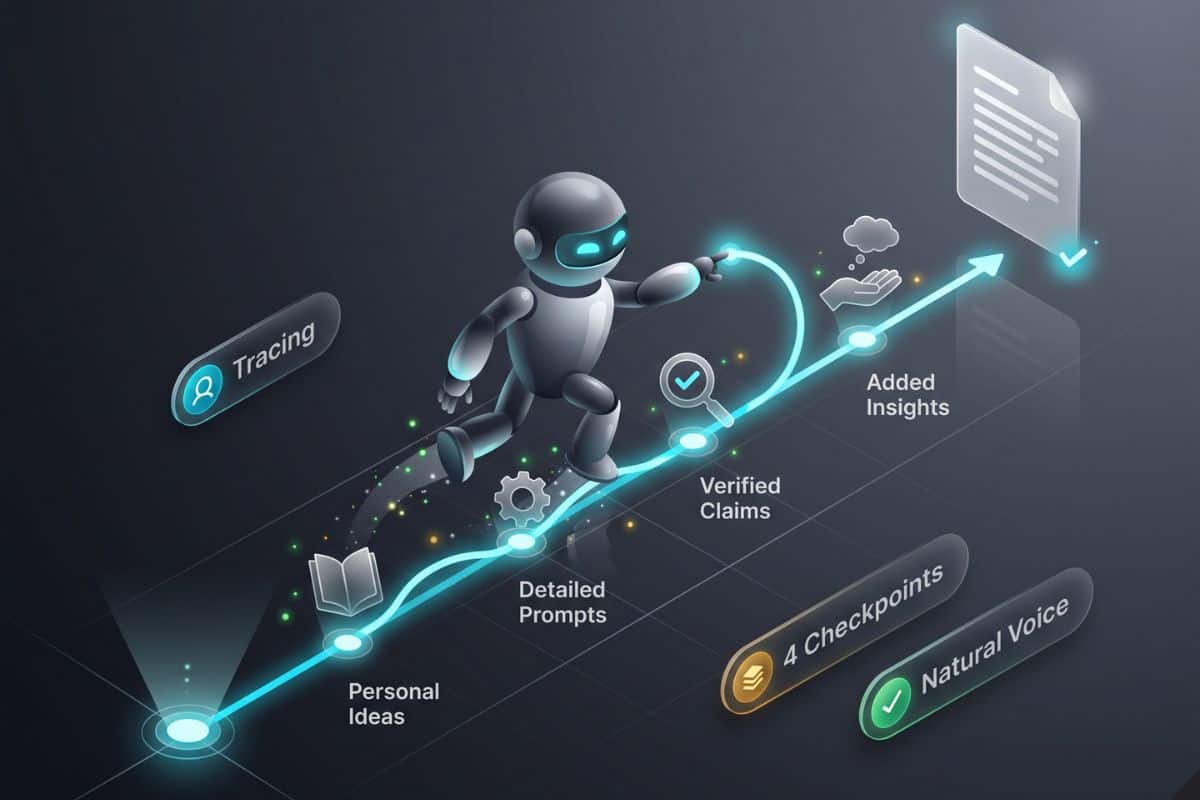
Understanding how AI detection tools can help you navigate evolving policies surrounding generative AI, whether you use AI to support writing or not.
By becoming familiar with the signals popular models evaluate, you can identify the habits that make writing sound formulaic, evade detection, and produce essays that sound more authentic, engaging, and human.
Vamos nos aprofundar no assunto.
Principais conclusões
- Text detectors measure word predictability and sentence length variation to flag AI-generated works.
- Running AI-generated text through an AI humanizer dramatically reduces detection risk.
- The best way to avoid detection is to use AI as a supplement for creation rather than relying on it for the whole process. Feed generative AI assistants specific ideas for arguments, tone, and direction, provide personal insights, and fact-check thoroughly.
The Signals that AI Detectors Flag
AI text detectors scan content for linguistic patterns that are commonly associated with AI-generated writing. More specifically, it looks at perplexity, which refers to the predictability of word choices within a sequence, and burstiness, which refers to the deviations in sentence length or structure.
Perplexidade
Generative AI produces content by estimating the most statistically likely continuation of a string of text. Naturally, because it uses probability to generate text, the words it chooses tend to be very predictable.
Perplexity is the measure of this predictability. AI text detectors verify content authenticity by measuring how predictable the word choices in a piece of text are. The lower the perplexity, the likelier the involvement of generative AI.
Nunca mais se preocupe com a detecção de seus textos pela IA. Undetectable AI Pode lhe ajudar:
- Faça sua escrita assistida por IA aparecer semelhante ao humano.
- Bypass todas as principais ferramentas de detecção de IA com apenas um clique.
- Uso IA com segurança e com confiança na escola e no trabalho.
Explosão
As mentioned, generative AI relies on probability to produce responses. It is designed to pick the most average possible way to express an idea, which means it chooses lengths and structures that conform to the norm.
The measure of variation in sentence length and structure is called burstiness. Generative AI models tend to produce content with low business. Meanwhile, humans usually use different combinations of lengths to convey tone, emphasis, or emotion, resulting in high burstiness.
Limitações da detecção de IA
While low perplexity and burstiness are common in AI-generated text, they can also appear in human-written work. Low perplexity, for example, can be the result of a limited vocabulary, while low burstiness can occur in contexts where tone and emotion matter less. These limitations are the reason AI detectors sometimes produce falsos positivos.
How to Make an AI-Generated Essay Undetectable
As mentioned above, AI text detectors flag AI-generated content by measuring word predictability and sentence variation. Erasing these traits from AI-generated outputs requires significant re-writes, and at that point, it might be more efficient to just write the essay on your own.
If you want to make an essay undetectable with minimal time and effort, the best option is to use an AI humanizer. These tools rework AI-generated outputs, making them sound natural and fluid enough to bypass AI detection.
IAs indetectáveis Humanizador de IA is a good example of an AI humanizer. This tool rewrites AI-generated content to sound both human and suitable for the piece’s specific use case, be it an essay, marketing material, cover, report, or other.
How Effective Are AI Humanizers?: A Test
To test how effectively AI humanizers can bypass AI detection, we decided to run a simple test. Here, we ran human-written, AI-generated, and humanized writing samples through four of today’s top AI detectors, then compared results.
Step 1: Selecting the Competitors and Tools
The first step in our test was to pick the AI detectors that would process our samples. These were:
- IA indetectável: Naturally, we wanted to include our own product in the mix. Our free-to-use AI detector can flag content generated by ChatGPT, GPT-4, GPT-5, Claude, Gemini, DeepSeek, Llama, and more.
- GPTZero: GPTZero was one of the first AI detectors to roll out in the market, and as a result, it remains one of the most popular. It is known for its sentence-level analysis, with advanced models able to identify which sentences most likely originated from generative AI.
- Originalidade AI: Originality is a high-rigor enterprise platform designed specifically for schools and agencies. It uses a modified version of Google’s Bidirectional Encoder Representations from Transformers (BERT) model to read the left and right sides of words at once and grasp nuances that sequential readers typically miss.
- Quillbot: While Quillbot is primarily an AI writing assistant, it also comes with a lightweight detector that helps writers quickly identify what to rework. This detector can flag human-written, AI-generated, and AI-refined work.
Step 2: Producing Samples
After choosing our detectors, it was time to prepare our human-written and AI-generated samples. First, we wrote a short introduction for an article about selecting the best CPAP mask. Next, we asked ChatGPT to generate a sample of the same length.
| Amostra escrita por humanos | ChatGPT Sample |
| Finding the mask for my CPAP machine was one of the challenging parts of my sleep apnea treatment journey. When I began looking, there was an overwhelming multitude of products available on the market, and no doubt has this number multiplied. I also needed to consider my unique needs, including my facial anatomy, breathing patterns, and sleeping habits. Since I knew my choice would really move the needle for both my long-term health and nightly comfort, I wanted to be extremely thorough in my research. While your doctor and CPAP supplier can usually help you find a suitable mask, it is still wiser to do some research yourself. Here’s a list of factors to take into account, some common problems of CPAP masks, and tips on how to try masks out. | Choosing the right CPAP mask can make a significant difference in how comfortable and effective your sleep therapy feels. With several mask styles, sizes, and designs available, finding the right option can seem overwhelming, especially if you are new to CPAP therapy. A mask that fits well can help minimize air leaks, reduce discomfort, and make it easier to use your CPAP machine consistently throughout the night. The best CPAP mask depends on more than personal preference. Your breathing habits, sleep position, facial structure, pressure settings, and tendency to breathe through your mouth can all affect which mask works best for you. In this guide, we explain the main factors to consider when choosing a CPAP mask, from mask type and fit to comfort, leakage, and ease of maintenance, so you can make a more informed choice. |
Step 3: Humanizing the AI Output
The next step in the test was to humanize the ChatGPT sample. We ran the text through Undetectable AI, with the highest power (Undetectable) setting on for best results.
As expected, we got a neat two-paragraph article that retained the main idea while sounding fluid and human.
Here are the three samples side by side:
| Human Sample | ChatGPT Sample | Humanized ChatGPT Sample |
| Finding the mask for my CPAP machine was one of the challenging parts of my sleep apnea treatment journey. When I began looking, there was an overwhelming multitude of products available on the market, and no doubt has this number multiplied. I also needed to consider my unique needs, including my facial anatomy, breathing patterns, and sleeping habits. Since I knew my choice would really move the needle for both my long-term health and nightly comfort, I wanted to be extremely thorough in my research. While your doctor and CPAP supplier can usually help you find a suitable mask, it is still wiser to do some research yourself. Here’s a list of factors to take into account, some common problems of CPAP masks, and tips on how to try masks out. | Choosing the right CPAP mask can make a significant difference in how comfortable and effective your sleep therapy feels. With several mask styles, sizes, and designs available, finding the right option can seem overwhelming, especially if you are new to CPAP therapy. A mask that fits well can help minimize air leaks, reduce discomfort, and make it easier to use your CPAP machine consistently throughout the night. The best CPAP mask depends on more than personal preference. Your breathing habits, sleep position, facial structure, pressure settings, and tendency to breathe through your mouth can all affect which mask works best for you. In this guide, we explain the main factors to consider when choosing a CPAP mask, from mask type and fit to comfort, leakage, and ease of maintenance, so you can make a more informed choice. | There are many styles of masks for CPAP, in a variety of sizes and designs. The mask can make or break your sleep apnea treatment. A well-fitting mask will help to prevent air leaks, be very comfortable to wear, and help you use your CPAP machine effectively during the night. In choosing a CPAP mask there are many factors to take into account. This includes your individual breathing habits, your preferred sleeping position, your individual facial features, the amount of pressure that you are set on and whether you are a mouth breather or not. This guide will go through the different points to consider when choosing a CPAP mask, including the different styles and how to get the best fit, how comfortable the mask is to wear, the different types of leaks and how to clean and look after your mask. |
Step 4: Multi-Tool Detection Auditing
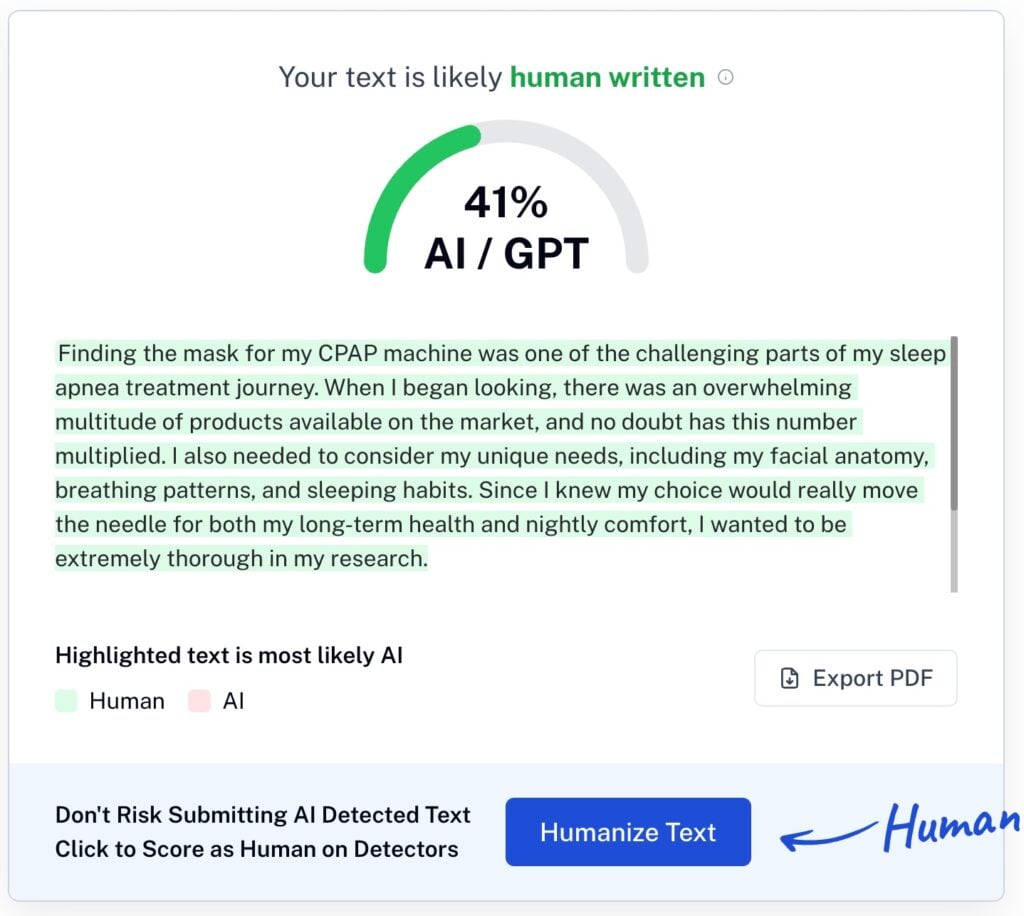
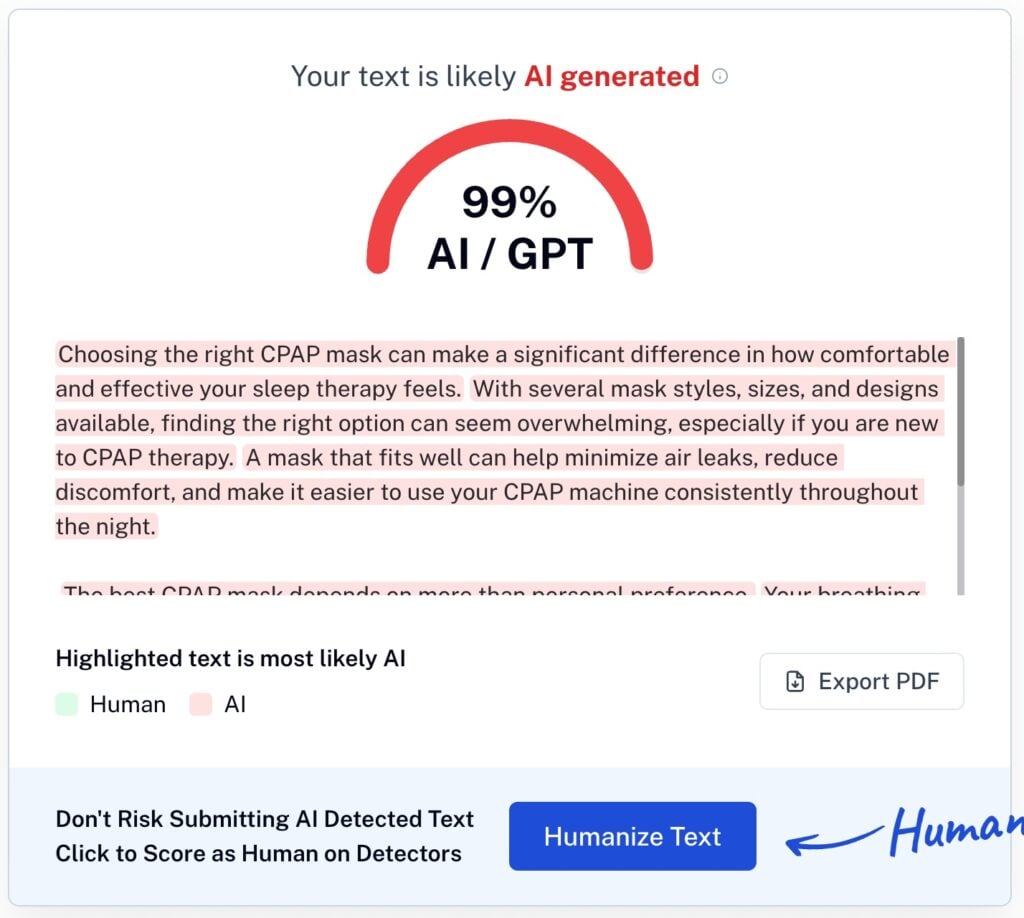
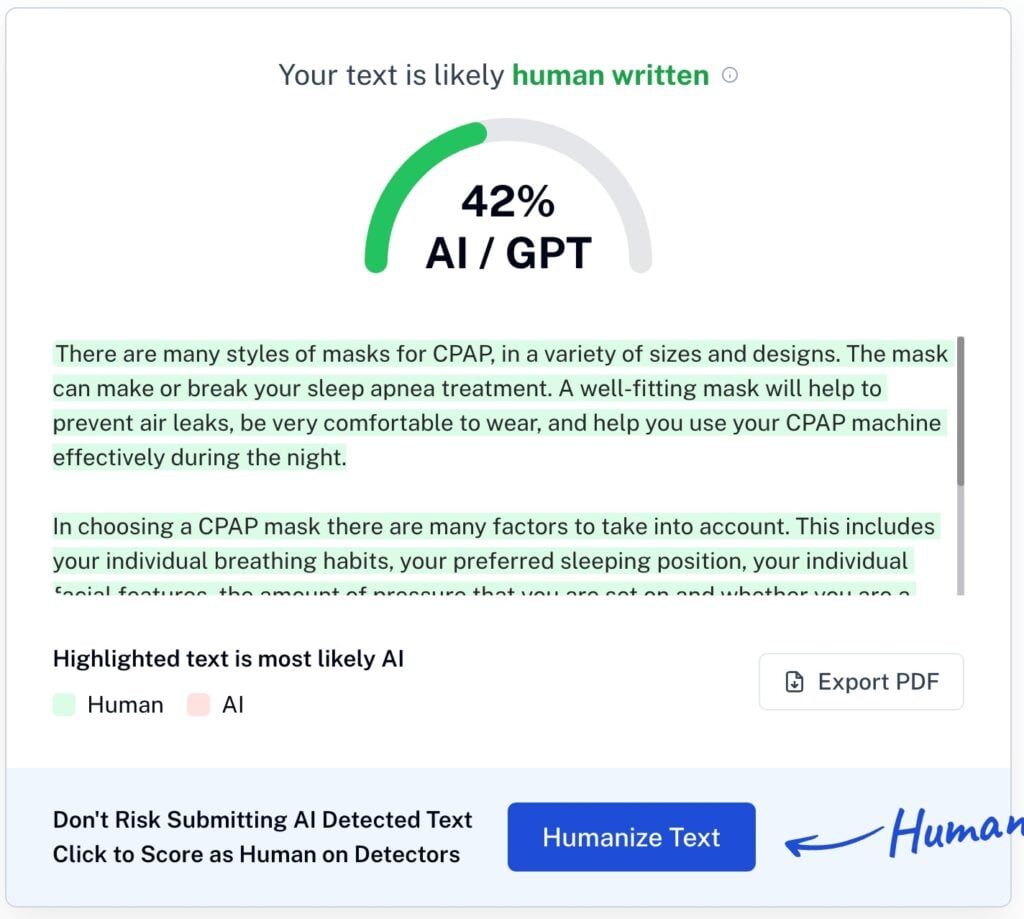
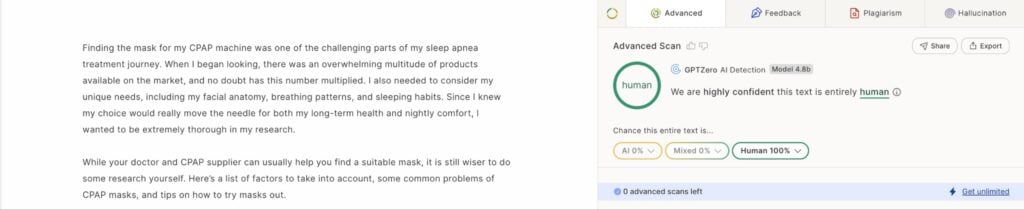
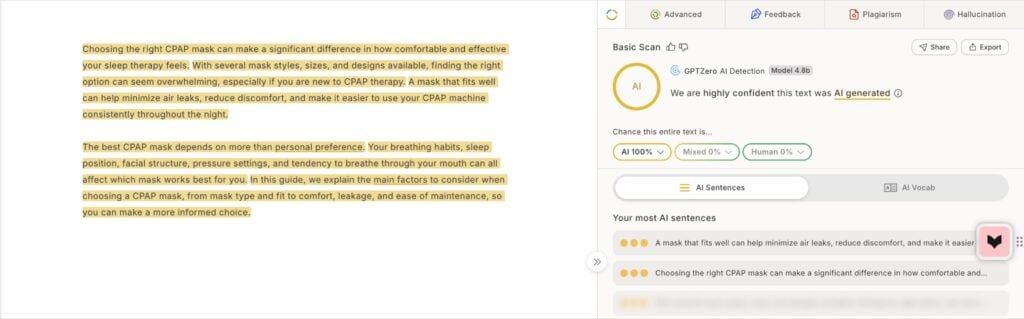
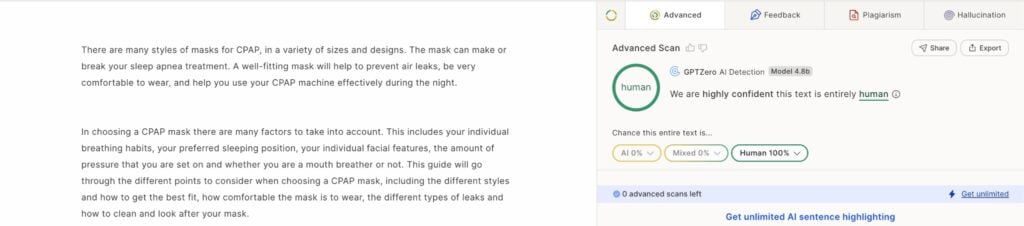
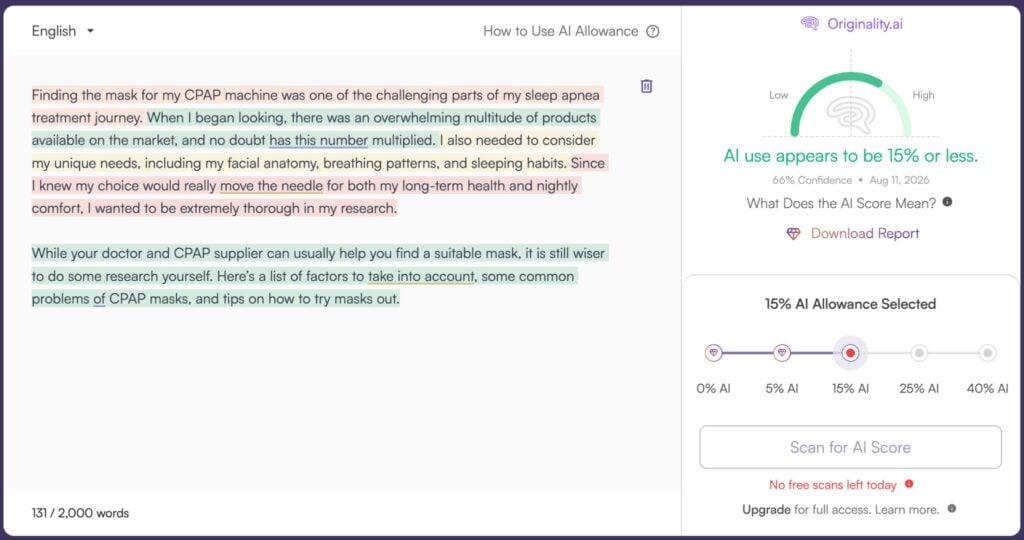
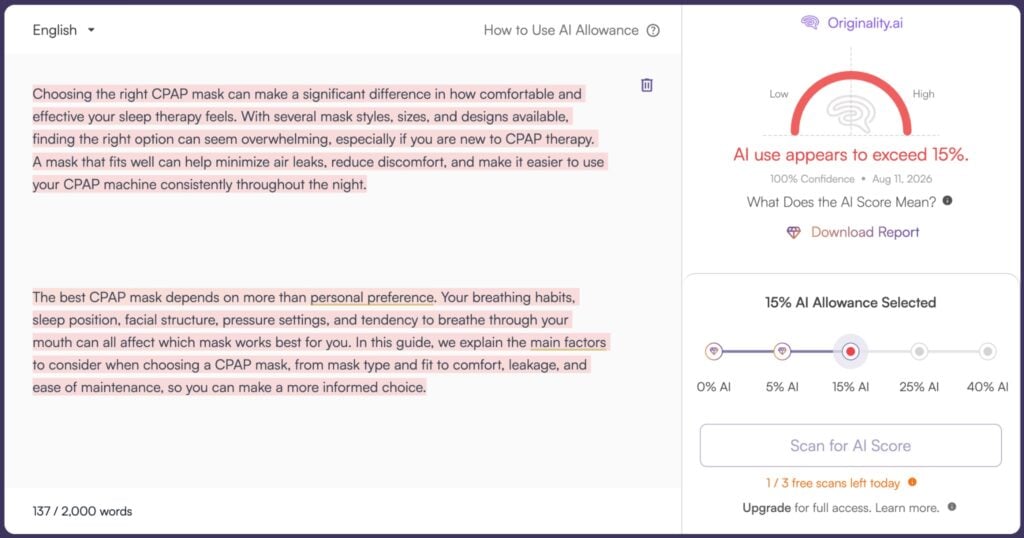
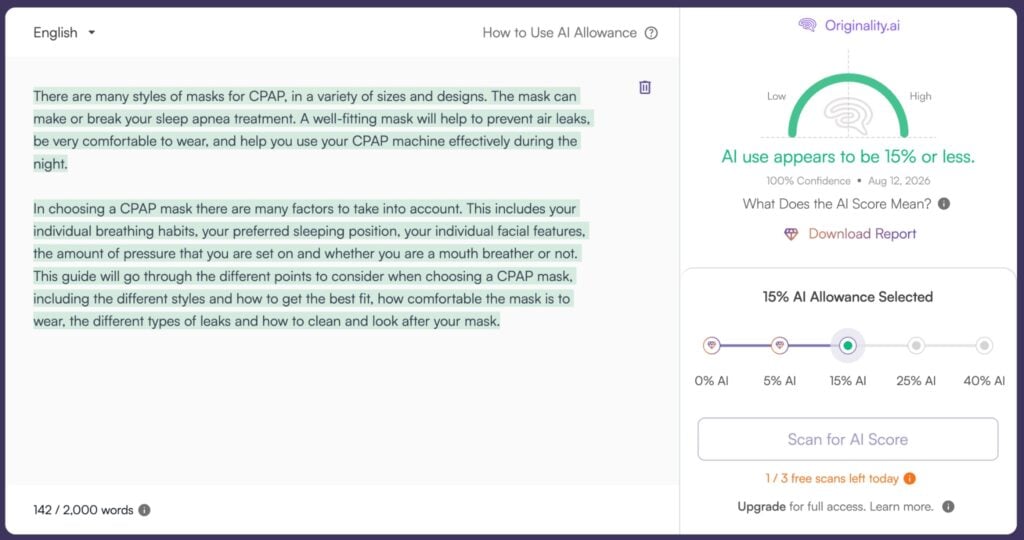
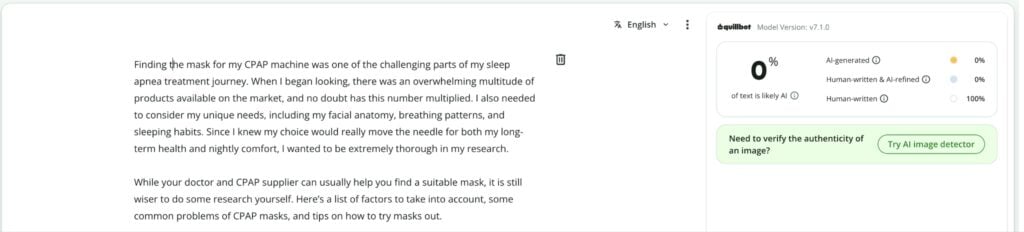
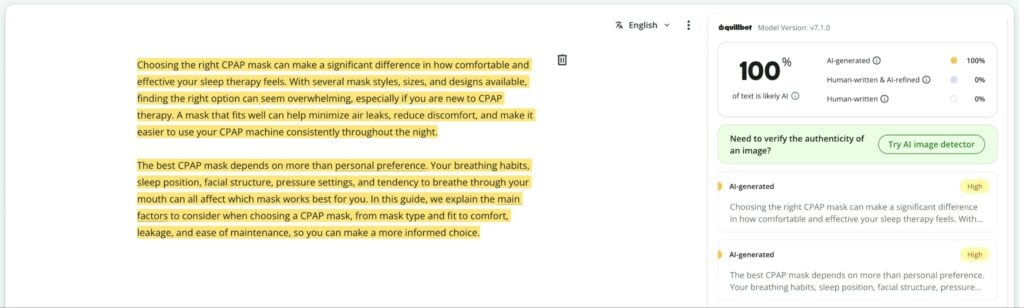
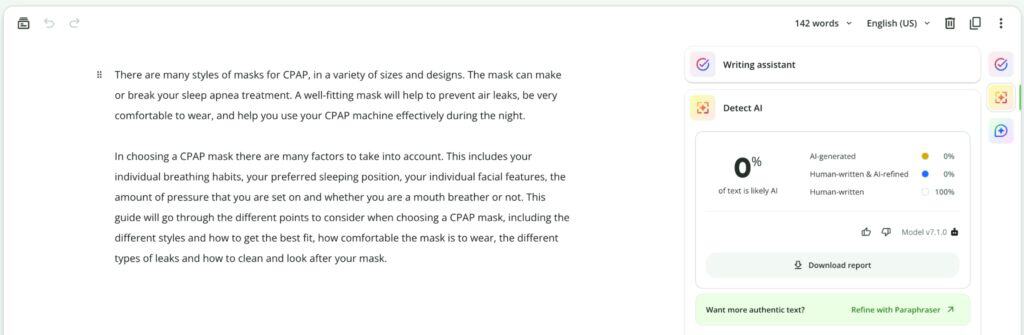
Finally, we ran the samples through the chosen detectors. Predictably, all detectors scored the AI-generated sample poorly while labelling the humanized sample as purely human-written.
| Detection Tool | Human Sample Score | ChatGPT Sample Score | Humanized ChatGPT Sample Score |
| Undetectable AI | 41% AI | 99% AI | 42% AI |
| GPTZero | 0% AI | 100% AI | 0% AI |
| Originalidade IA | Less than 15% AI66% Confidence | More than 15% AI100% Confidence | Less than 15% AI100% Confidence |
| QuillBot | 0% AI | 100% AI | 0% AI |
Undetectable AI
GPTZero
Originalidade IA
Quillbot
What Makes Undetectable AI the Top Humanizer?
As shown above, Undetectable AI can effectively bypass detection even from top detectors like GPTZero, Originality AI, and QuillBot.
It can effectively restructure AI-generated content to improve structure and vocabulary choices while retaining meaning. This makes it one of the best choices for AI humanization.
Undetectable AI also comes with a built-in AI detector, which flags the parts of your text that sound AI-generated. It is trained to detect outputs from top generative AI models like Claude, Gemini, and ChatGPT, so you can reliably identify passages that require revision.
How to Use an AI Essay Assistant Before You Write
Though AI humanizers are useful as a final safeguard against AI detection, you can produce better writing when you combine the efficiency of generative AI with thorough planning, auditing, and personal insights.
Not only will these practices help you ignorar detectores de IA, but they also produce essays that are engaging, accurate, and original.
Build A Thorough Prompt
It goes without saying that generating an essay from a bare-bones prompt and submitting it as is is a bad strategy. The most apparent drawback here is that you miss the opportunity to learn from the writing process, as you let the AI run undirected.
But your lack of involvement in the work is in itself also a problem. By not giving AI direction, you risk generating content that sounds predictable and generic.
You’ll get better results when you use AI to help express your ideas rather than replace the thinking process. Enter your own ideas into the prompt, specify which points to emphasize, and recommend how the information should flow.
Making deliberate choices about your essay’s arguments, structure, and tone lets your perspective shine through, resulting in writing that feels more original and coherent.
Verify Facts and Claims
Text generators prioritize producing fluent, relevant responses to a prompt. However, fluency and relevance do not guarantee factual accuracy.
Because language models generate text by predicting likely sequences of words, they can produce plausible-sounding claims that are incorrect. AI assistants can also produce fabricated or inaccurate citations, weakening the credibility of your work when left unchecked.
When an AI assistant makes a factual claim, ask it to provide the sources behind that information. Then, check those sources yourself to confirm that they exist, support the claim, and come from reliable publications or organizations. These corrections ensure that your final work rests on information you can stand behind.
Include Personal Insights
While AI can pull information from a vast array of sources, it does not have its own experiences or perspectives. The lack of personalization is what often makes AI-generated writing sound generic. If you rely solely on AI without providing your own input, your writing will be less likely to engage readers.
The best remedy is to add your own insights. Share observations, experiences, interpretations, or examples that are relevant to your argument. With these unique details, you can prove to the reader that you played an active role in developing the work. This gives your writing a more distinctive and credible voice.
Review and Rewrite
Think of AI as a more sophisticated version of your phone’s predictive text. At its core, a language model generates text by estimating continuations based on patterns it learned during training.
While this process helps AI-generated writing effectively mimic standard writing styles, this does not guarantee that every response will sound natural.
That is why you should always review and rewrite AI-generated text before you use it. Read each passage critically and compare it with your own judgment, knowledge, and writing style. Cut unnecessary explanations, replace awkward phrasing, and keep only the ideas that strengthen your argument.
Perguntas frequentes
Can AI detectors trigger false positives on original human essays?
Yes. AI text detectors flag AI-generated content by analyzing text for statistical and linguistic patterns, which can include the predictability of word choices and patterns in sentence structure and length.
However, human writing can also exhibit these characteristics, especially in pieces that follow informative, formal, or highly structured styles.
What percentage score should I aim for on an AI detector to be safe?
Most AI detection scores are probabilities. They show the likelihood that a piece contains AI-generated text, rather than measuring the fraction of the piece that is AI-generated.
The lower the score, the better, since this indicates a much lower likelihood of generative AI use. It’s best to refer to your institution’s policies for what specific score to aim for.
How does Undetectable AI Humanizer rewrite text without changing the main idea?
Undetectable AI uses custom fine-tuned AI models to rewrite text. Its Humanizer applies pre- and post-processing alongside the model to adjust elements such as tone, style, syntax, and sentence structure while attempting to preserve the original meaning.
Considerações finais
Although generative AI is an undeniably useful productivity aid, its divisiveness in academic settings means that use usually involves the risk of consequences.
AI humanizers can help you bypass detection, especially when supplemented with thorough planning, fact-checking, and editing. To reap the benefits of generative AI efficiency, use it to amplify your thinking, not replace it.
Undetectable’s AI Text Detector can help you check whether your work still reads like AI. It is free to use and can flag writing from popular AI assistants, including ChatGPT, Gemini, and Claude.