Written by AI or written by a human? In 2026, that question comes up more than most people realize, whether you’re a teacher reading an essay, a hiring manager reviewing a cover letter, or just someone scrolling through a blog post that feels a little too polished.
AI writing tools are everywhere now. From ChatGPT to Gemini to countless AI writing assistants, generating a full article, essay, or email takes seconds.
In fact, researchers tracking AI adoption note it’s reshaped how content gets produced across education, SEO, journalism, and beyond, and that shift shows no signs of slowing down.
So how do you actually know if something was written by AI? We’ve spent a lot of time testing detection tools, comparing their results, and learning what actually works (and what doesn’t).
Whether you’re sniffing out an AI-generated essay, double-checking a freelancer’s work, or just curious about that suspiciously perfect blog post, this guide breaks it all down.
No fancy jargon. Just straight talk from people who’ve been in the AI detection trenches.
Lassen Sie uns eintauchen.
Wichtigste Erkenntnisse
- AI-generated content is everywhere in 2026, so knowing how to tell human writing apart from text written by AI has become a practical, everyday skill.
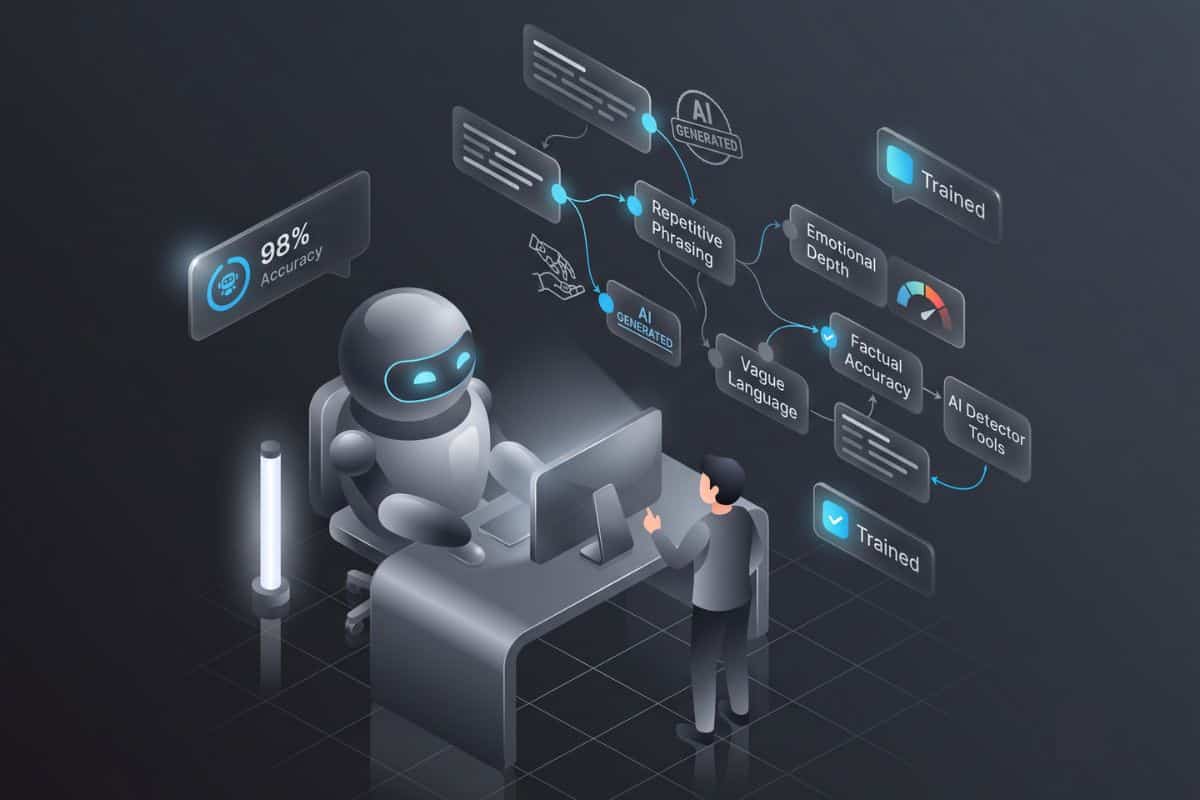
- Common signs of AI writing include overly perfect grammar, repetitive phrasing, vague generalizations, and a lack of personal voice or emotional depth.
- Detection tools are useful but not foolproof. Combining more than one tool, and pairing that with your own judgment, gives you a far more reliable read than trusting a single score.
- Teachers, professors, employers, and publishers increasingly rely on AI checkers, but false positives are real, especially for non-native English writers, so context always matters.
- Undetectable AI’s AI Detector uses a multi-model approach for more accurate results, and its companion writing assistant helps creators keep their own work natural and authentically human.
- If you want a fast, transparent first read on any piece of text, Undetectable AI’s free checker is one of the simpler ways to start before digging deeper.
Was sind KI-generierte Inhalte?
Picture asking a very capable computer program to write an essay on climate change. Within seconds, it produces something structured, grammatically clean, and ready to publish. That’s AI-generated content, in a nutshell.
Here’s the part people miss though: it’s not just essays anymore. In 2026, AI writes product descriptions, cover letters, social captions, and even attempts at poetry. Some of it is genuinely good. Some of it (looking at you, AI-generated jokes) is not.
What actually separates AI content from human writing? Speed, for one. While a person is still working out their next sentence, an AI model can produce an entire article. It’s also remarkably consistent, since there’s no writer’s block for a language model.
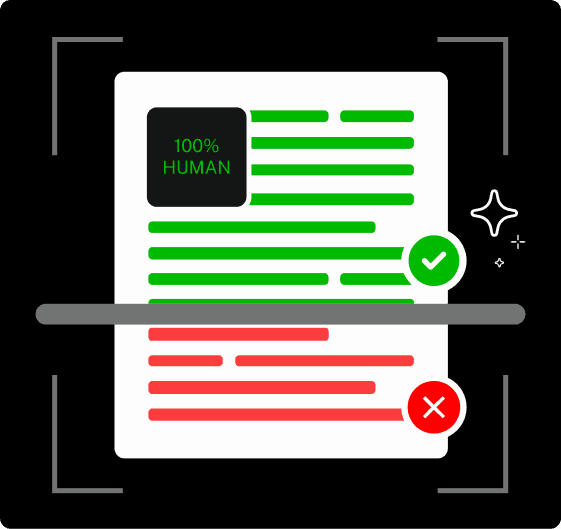
Machen Sie sich nie wieder Sorgen, dass KI Ihre Texte erkennt. Undetectable AI Kann Ihnen helfen:
- Lassen Sie Ihr AI-unterstütztes Schreiben erscheinen menschenähnlich.
- Bypass alle wichtigen KI-Erkennungstools mit nur einem Klick.
- Verwenden Sie AI sicher und zuversichtlich in Schule und Beruf.
But AI content still isn’t perfect. Detection itself is probabilistic rather than definitive, meaning tools calculate the likelihood that something was machine-written based on patterns rather than certainty.
And AI can still get facts wrong in confident, oddly specific ways. One widely used starting point for understanding what counts as AI-generated content, and how it differs from human writing at a technical level, is IBM’s overview of AI-generated content.
Demand for this kind of content isn’t slowing down either. Broader AI-driven productivity growth is projected to run nearly 25% higher than growth without AI involved, which means more AI-assisted writing is landing in inboxes, classrooms, and search results every year.
How to Tell if Something Was Written by AI
Alright, let’s get into the practical part. How do you actually catch AI writing in the act?
Here’s what tends to work, based on hours of playing digital detective.
Use an AI Detection Tool First
Your fastest option in 2026 is still a dedicated AI checker. A solid go-to sollte nicht nachweisbare AI sein, since it’s built to give you a clear human-versus-AI probability in seconds. Just paste in the text and let it do the work.
Watch for the “Too Perfect” Pattern
AI writing often reads like the student who never missed a grammar rule. It’s flawless, it uses tidy transitions, and it rarely wanders off topic the way real people do. If a piece of writing feels a little too polished, that’s worth a second look.
Prüfung auf emotionale Tiefe
This is where AI still tends to fall short. Human writing carries personal anecdotes, specific opinions, and small emotional details that are hard to fake. If an article on a genuinely difficult topic reads flat and detached, there’s a decent chance it was generated rather than written.
Spot the Repetition
AI models like to circle back to the same idea, just reworded slightly. A good in-depth guide on how Undetectable AI evaluates writing patterns explains why this happens: the underlying models are trained to favor familiar, high-probability phrasing, which naturally leads to repetition. Humans rarely repeat themselves this much unless they’re stalling for a word count.
Fact-Check Anything That Feels Off
AI models can still hallucinate facts, dates, and statistics with total confidence. The good news is that detection systems and the models themselves have both improved at catching these mistakes over time, but they’re far from perfect, especially around recent events. If something reads slightly off, verify it before you trust it.
Die besten Tools zur Identifizierung von AI-Inhalten
No detector is flawless, but some consistently perform better than others. Here’s a rundown of the top options in 2026.
Undetectable AI: AI Detector
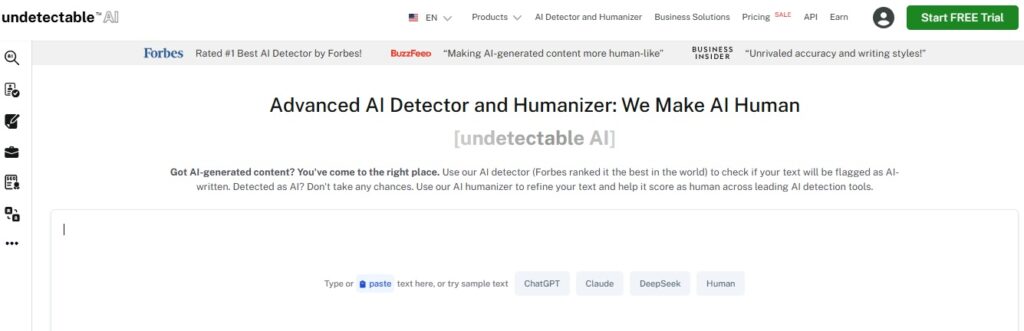
Undetectable AI has become one of the most recognizable names in AI detection, largely because of its multi-model approach. Instead of relying on a single algorithm, it leverages multiple AI models to analyze text from different angles, which tends to produce more consistent, reliable results.
In independent testing, including evaluations from ZDNet, Undetectable AI has consistently placed among the top-performing tools for accurate AI detection.
Key features:
- Multi-model analysis for more accurate scoring
- A clean, approachable interface for professionals and casual users alike
- Regular updates that keep pace with evolving AI writing styles
One standout feature is transparency: Undetectable AI’s AI-Detektor shows why specific parts of a text were flagged, rather than just handing you a single unexplained percentage.
That’s genuinely useful if you’re trying to understand and improve your own writing style, not just check someone else’s.
There’s also an ethical writing assistant built into the platform, designed to help creators refine their work so it stays natural and human, not just “pass a test.”
OpenAI’s Classifier
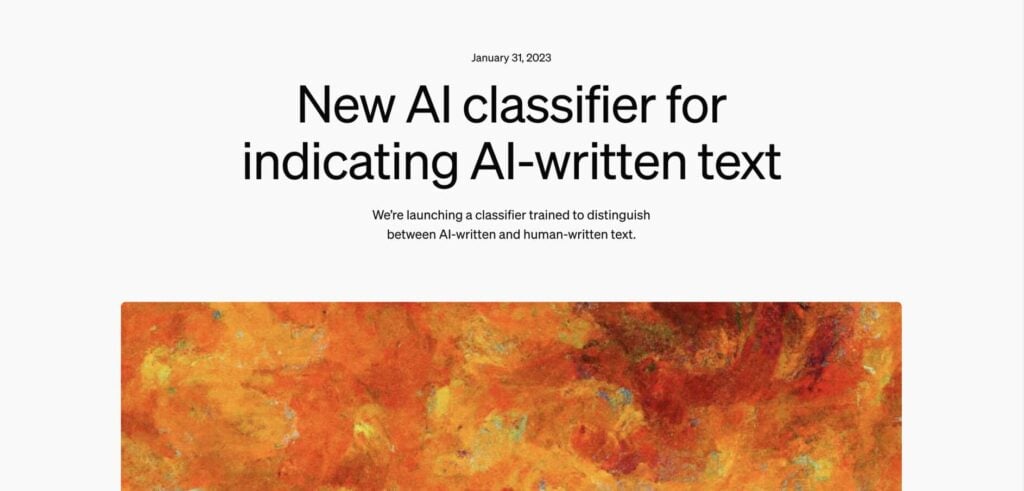
OpenAI, the company behind ChatGPT, built its own classifier for AI detection. It’s more limited than dedicated detection tools, but it’s straightforward.
Key features:
- Built by the same team behind ChatGPT
- A simple, no-frills interface
- Kostenlose Nutzung
The classifier compares text patterns against known AI-generated writing and returns a probability score. Its main limitation is that it’s mostly trained on English text and tends to struggle with short samples or highly technical writing.
Grammarly’s AI Writing Check
Grammarly, already known for grammar and spelling, added an AI Writing Check feature to its toolkit.
Key features:
- Built into Grammarly’s existing writing tools
- Flags likely AI text while also suggesting edits
- Available as a browser extension across platforms
It analyzes word choice, sentence rhythm, and repetition patterns, then returns a percentage score reflecting how likely AI was involved.
Effektiver Einsatz von AI-Erkennungstools
A detection tool is only as useful as the way you use it. Here’s how to get more reliable results.
- Use more than one tool. No single detector is infallible, so cross-referencing results gives you a fuller picture.
- Give it enough context. Longer samples generally produce more accurate results than a single sentence or short paragraph.
- Factor in the content type. Technical or highly structured writing can sometimes get flagged simply because it’s formal, not because it’s AI-generated.
- Keep your tools updated. AI writing models evolve constantly, and detection tools need to keep pace.
- Don’t rely on tools alone. Use detection as one part of a broader review that includes your own critical reading.
- Understand false positives and negatives. No detector is 100% accurate, so treat every score as a strong signal, not a verdict.
- Consider ethical AI writing assistance. If you want your own content to stay authentically human while still using AI to help draft or edit, tools built for that purpose can help you refine tone without losing your voice.
Signs You Can Spot Without Any Tool

Even without software, there are patterns that tend to give AI writing away.
Hier sind fünf wichtige Punkte, auf die Sie achten sollten:
1. Sich wiederholende Phrasen oder Patterns
Because AI models are trained on massive datasets, they tend to gravitate toward common, high-probability phrasing, which shows up as repeated ideas or sentence patterns.
2. Unnatürliche Tonhöhenverschiebungen
AI is good at holding a steady tone, but it can stumble on the subtle shifts human writers make naturally within a single piece.
3. KI-spezifische oder vage Begriffe
When AI isn’t confident about specifics, it tends to default to broad, general statements instead of concrete detail.
4. Ungeschickter Satzfluss
Sentences can be grammatically correct yet still feel slightly stiff or unnatural to a human reader.
5. Ungenaue oder zu allgemeine Fakten
This is where a bit of claim-checking goes a long way, especially for anything involving recent events or niche subject matter.
Can Teachers and Professors Tell if Something Was Written by AI?
This is one of the most common real-world questions we get, and the honest answer is: often, yes, but not always the way people assume.
Most schools don’t rely on a single method. Teachers combine AI detectors with things like writing-style comparisons, in-class writing samples, and simply knowing how a particular student normally writes. A sudden jump in vocabulary or sentence complexity is often just as telling as any detector score.
On the tools side, our own research into what AI detector teachers actually use in 2026 found that many educators don’t stop at their school’s built-in checker.
They pair it with a second opinion from a separate detector before drawing any conclusions, precisely because no single score should be treated as proof on its own.
What Happens If Your Work Gets Flagged
Getting flagged doesn’t automatically mean trouble. It usually starts a conversation: your professor might ask about your drafting process, request to see notes or revision history, or simply ask you to explain your reasoning on a specific section.
If it becomes clear the work was entirely AI-generated without disclosure, consequences depend heavily on the school’s academic integrity policy.
It’s also worth understanding how this plays out with the tools professors actually rely on. Our breakdown of whether professors can detect ChatGPT-written work walks through exactly how instructors and institutions approach this, and what factors make detection more or less likely at your specific school.
Why Even Experienced Reviewers Get It Wrong Sometimes
Detection isn’t just a software problem. Trained human reviewers can misjudge writing too, especially formal, highly structured prose that just happens to resemble AI output. That’s part of why layering multiple signals, not just one tool and not just one person’s read, tends to produce fairer outcomes.
The Real Stakes of Spotting AI Content
This isn’t just an academic exercise. A recent Pew Research Center survey found that a large majority of Americans, roughly three in four, say it’s extremely or very important to know whether text, images, or videos were made by AI rather than a person, yet only about one in ten feel confident they could actually tell the difference themselves.
That gap matters well beyond the classroom. Publishers need to verify authorship for credibility. Employers screening applications want to know whether a cover letter reflects a candidate’s actual writing.
Content teams need to confirm that published work meets their editorial standards. And readers, generally, just want to know what they’re consuming.
Because most people can’t reliably eyeball AI writing on their own, pattern recognition becomes a trainable skill.
One Forbes Technology Council contributor, who spends much of his workday building AI detection systems, describes how the process changes the way you read entirely: eventually you stop reading purely for content and start noticing the underlying tells instead, the same kind of pattern-spotting this guide has been walking through.
Can AI Detection Be Fooled? The Ongoing Cat-and-Mouse Game
Here’s the honest truth: yes, to some degree. AI “humanizer” tools exist specifically to rewrite AI-generated text so it reads more naturally and scores lower on detection tools.
This creates an ongoing back-and-forth between detection technology and rewriting technology, each one adapting to the other.
That said, this isn’t necessarily a bad thing when it’s used ethically. An AI Humanizer can help a writer who used AI for a first draft turn that draft into something that genuinely sounds like them, adding personal voice, tightening awkward phrasing, and removing the repetitive patterns that make AI text easy to spot in the first place.
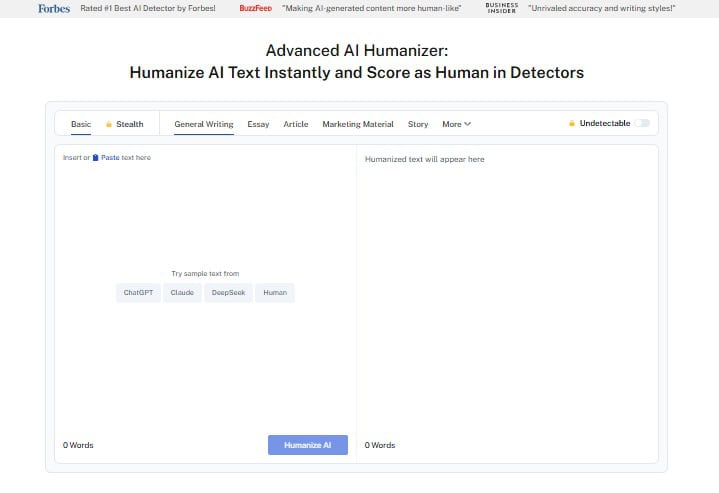
Used that way, it’s less about evading detection and more about producing better, more authentic writing.
The takeaway for anyone trying to detect AI content: no single scan is ever final. Detection tools, humanizing tools, and human judgment all keep evolving in response to one another, which is exactly why layering multiple checks matters so much.
Grenzen der AI-Erkennungswerkzeuge
AI detection has come a long way, but it’s important to understand where it still falls short.
- Evolving AI models. As writing models improve, they get harder to detect, and tools have to constantly play catch-up.
- False positives. Human-written content, especially technical or highly formal writing, can still get incorrectly flagged.
- Short text samples. Most detectors need enough text to analyze; a sentence or two rarely gives reliable results.
- Language and context gaps. Many tools are strongest with English and may struggle with other languages or specialized jargon.
- AI-assisted human writing. When a person uses AI to brainstorm or polish their own writing, it creates a genuine gray area that’s hard for any tool to classify cleanly.
- Inconsistent methodologies. Different detectors use different scoring approaches, so results can vary noticeably between tools.
Häufig gestellte Fragen
How can you tell if something was written by AI without using a tool?
Look for overly polished grammar, repeated phrasing, vague generalizations, and a lack of personal detail or emotional nuance. None of these alone is proof, but a combination of several is a strong signal.
Is there a 100% accurate way to detect AI-generated text?
No. Every detection tool works probabilistically, meaning it estimates likelihood rather than certainty. The most reliable approach combines more than one tool with your own critical reading.
Can AI detectors be wrong about human-written text?
Yes. False positives happen, particularly with formal, technical, or non-native English writing. That’s why a single flagged score should prompt a closer look, not an automatic conclusion.
Do AI humanizer tools actually beat detection tools?
They can reduce detection scores by smoothing out repetitive patterns and adding more natural variation. Detection tools and humanizing tools continue to evolve against each other, so results shift over time.
Which AI detector is best for long-form content like essays or articles?
Tools built for longer text samples, like Undetectable AI’s detector, tend to perform better on full essays and articles than tools optimized for short snippets, since they have more context to analyze.
Schlussfolgerung
As AI keeps working its way into everyday writing, being able to tell what’s written by AI and what’s genuinely human has become a practical skill, not just a curiosity. Detection tools offer real value, but they’re one part of a bigger picture that still needs human judgment.
The takeaway is simple: pair the technology with your own critical thinking. Tools like Undetectable AI give you a strong starting point, with multi-model analysis and clear, explainable results that go beyond a single number. From there, trust your instincts, look at the context, and don’t treat any one score as the final word.
If you create content and want to keep it authentically yours, even while using AI as part of your process, Nicht nachweisbare AI offers more than detection. Its ethical writing assistant helps you refine your work so it stays natural, human, and genuinely yours.
Whether you’re a teacher, a content creator, a hiring manager, or just a curious reader, staying sharp on this skill is only going to matter more from here.