
AI writing tools are getting popular every day and are becoming better at mimicking human writing. It is almost impossible to tell what is written by a human or what is written by AI.
There is a high chance that you have read something recently that wasn’t by a human being at all.
AI detection has become difficult, and it isn’t foolproof anymore.
However, there are still ways to tell that something is artificially written, especially when you know what to look for. Continue reading to find out.
Key Takeaways
-
Detecting AI writing is harder now because models are getting advanced
-
Look for patterns like repetitive structures, generic tone, or predictable vocabulary
-
No detection method is 100 percent accurate. There are false positives and negatives
-
The best approach is to combine multiple detection methods
Challenges of Spotting AI Writing as Models Improve
To be honest, Artificial intelligence has gotten really, really good. In 2020, when ChatGPT was released, AI text was mechanical and simple to detect.
But in 2025, AI text is nearly impossible to detect.
This is because Large Language Models (LLMs) have become more advanced.


Never Worry About AI Detecting Your Texts Again. Undetectable AI Can Help You:
- Make your AI assisted writing appear human-like.
- Bypass all major AI detection tools with just one click.
- Use AI safely and confidently in school and work.
They can now mimic humor, emotion, and even personal quirks. AI models such as GPT-4 and Claude can now produce content that is hard to differentiate from human writing.
Now, having a “gut feeling” that something is AI-generated is not enough anymore. AI has been taught to mimic human inconsistencies and personal touches that used to be a dead giveaway.
Also, there are now tools that are specially created to detect AI writing.
AI detection and evasion have become a never-ending game of cat and mouse. When you think about it, artificial intelligence has only gotten smarter, but it has not gotten perfect.
It is still easy to spot things that give it away; you just have to know where to look.
Common Traits of AI Writing
AI is still not perfect, even with the constant upgrades. Even the best models have their habits.
Here is how to detect AI writing free:
Repetitive Sentence Structures
One thing about AI, it thrives on patterns.
AI loves patterns, and there is a high chance that if you see the same type of rhythm in a sentence over and over, chances are it is machine-generated.
With AI-generated text, you will notice that all the sentences follow similar structures. Sometimes it could be the same sentence length.
This is because AI models cannot recognise redundancy. They wouldn’t be able to realise they are doing the same thing over and over again.
Human beings naturally vary their sentence flow and length.
Sometimes we write long sentences with multiple clauses, and other times we just stick with short sentences. AI tends to be more predictable in this regard.
If you’re worried that your application might trigger a “pattern recognition” flag, the key is to use a tool that understands how to vary sentence flow naturally.
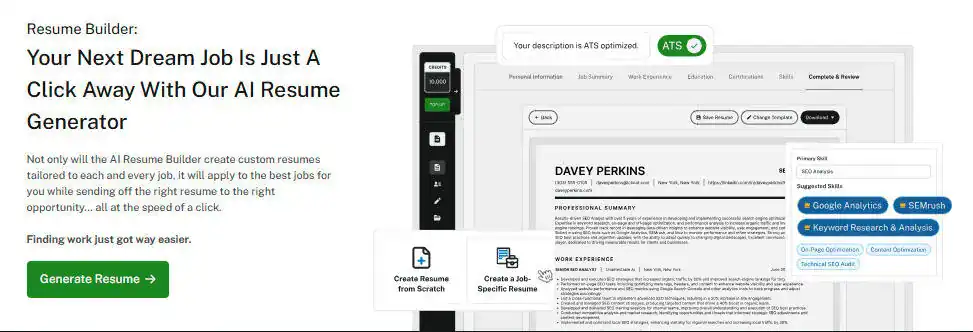
Also, if you want a professional edge, Undetectable AI’s Resume Generator is built to produce resume content that avoids the predictable rhythms of standard AI, helping you appeal to both human recruiters and modern detection algorithms.
Overly Formal or Generic Tone
Artificial intelligence can try to “sound human,” but not perfectly. It later turns out to be professional or too vague. Humans tend to write with quirks, slang, and personality.
For example, if you are trying to figure out how to detect AI in student writing.
A regular student, when writing about their weekend, will probably not say “Subsequently, I proceeded to the recreational facility” instead of “Then, I went to the gym.”
This example shows that the natural default of AI is to talk formally or in an academic tone, even if it is not necessary.
It uses big words when a simple one works better. You can say AI tries too hard to sound smart, and humans do not do that in casual settings.
Lack of Deep Personalization or Context
Unlike AI, it is easy for you and me to have inside jokes with friends.
Artificial intelligence struggles with inside jokes, memories, or context that only the writer knows about. It cannot have personal experiences or cultural references.
So, if it feels like anyone could have written it, then it is most likely AI.
As an example, AI might refer to ‘a local restaurant,’ instead of a specific restaurant, or might discuss childhood memories in a general way, but not in a very specific way, only a real person would be able to know.
So if you are learning how to detect AI in writing, you should pay attention to personal anecdotes that feel like they could apply to anyone.
Predictable Vocabulary and Transition Words
When you use AI regularly, you can easily detect AI writing.
This is because artificial intelligence uses predictable words. AI has a constant vocabulary and words it uses; sometimes it overuses these words.
Words like moreover, furthermore, leverage, comprehensive, or additionally are common with AI writing. Transitions in AI are almost too perfect.
Human beings are more likely to mix it up or write messy transitions, creating a more natural flow.
How to Detect AI Writing: Technical Methods

There are methods that detection tools use.
They include:
Statistical Fingerprinting and Burstiness Analysis
I know this may sound ‘technical,’ but it is actually simple.
Statistical fingerprinting evaluates patterns, such as word choice, grammar, and structure, to create a special “writing DNA” profile of human vs. AI-generated content.
Burstiness refers to how sentences vary in length and complexity in a text.
Human beings often write in bursts. That is, they sometimes write short sentences or long ones, creating an irregular pattern.
However, AI tends to be more consistent in its sentence patterns. It creates fewer ‘bursty’ sentences.
Statistical fingerprinting and burstiness are the elements that make it easy for detection tools to identify potential AI content.
Stylometry and Syntax Pattern Recognition
Stylometry is the study of a writing style based on measurable characteristics like the average word length, the complexity of the sentences, punctuation, and grammar patterns.
It is similar to how you can identify the text style of your friend without seeing his or her name.
Since AI models are known for having patterns, artificial intelligence detectors have also been trained to recognise these patterns.
For example, if a text often starts with “Furthermore,” and avoids contractions, it may be flagged as AI-generated. AI has its own “style” that leaves traces.
Stylometry and syntax patterns are effective for detection, but they work better when combined with perplexity analysis.
Semantic Drift and Logic Flow Analysis
Semantic drift is the term you use to describe when an AI model’s output moves away from the original prompt’s subject, reducing the quality of the text.
Logic flow analysis is a process within semantic evaluation that examines how ideas and statements connect and transition in a sentence.
You have probably read an AI-generated text that makes sense at first, but as you go on, you start to realise that it starts drifting logically. Well, that is a common trait of AI writing. The text starts with clarity and ends in confusion.
AI detection systems look at how ideas connect in a writing, and when they notice an incoherent flow, they flag it as artificial. Although human beings are also capable of writing incoherently, it is not the same with AI.
Best AI Detection Tools in 2025
Now let’s talk about tools that can help you determine when AI is in play.
These tools include:
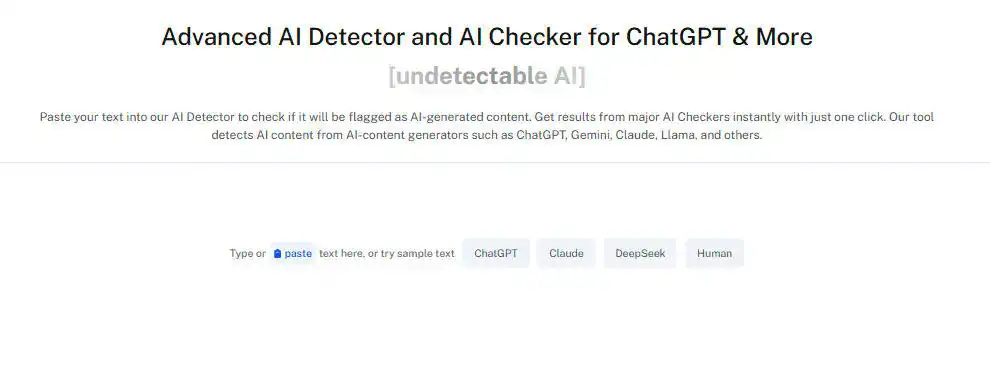
Undetectable AI

One of the best AI tools of 2025 is Undetectable AI.
It is the best because it saves you the stress of checking other detectors individually. You can get results for other AI detection at the same time by using Undetectable AI, saving you time and effort.
Another reason why you should choose Undetectable AI is that the tool can detect AI writing and humanize at the same time.
The algorithm for this tool is one of a kind, and it detects a lot of AI text that most tools would miss.
The interface is also simple to use, so you don’t have to stress about how to use it. The tool also supports multiple languages.
Anyone can use the tool, from marketing professionals, SEO writers, bloggers, journalists, to researchers. As long as you are concerned about being falsely accused of using AI, the tool is for you.
The humanized content that Undetectable AI also provides passes through AI detection smoothly. It even has the potential to rank well on search engines.
The quality is human-like, and it reads well for your audience and search engine algorithm.
According to Forbes, Undetectable AI is “The #1 best AI detector rated by Forbes.”
TruthScan
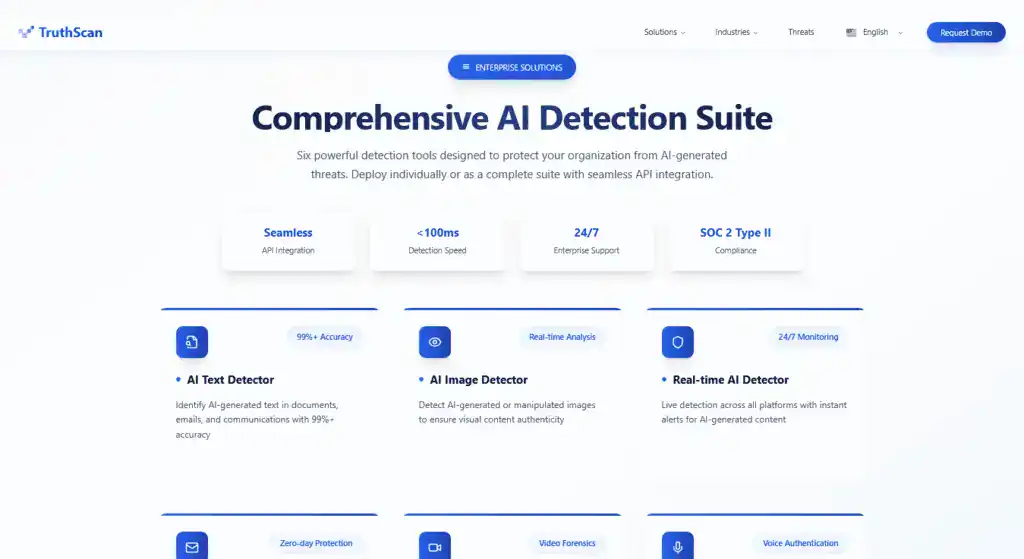
Another AI detection tool that has been gaining traction lately is TruthScan.
This tool focuses on accuracy and reducing false positives. It is trained to identify paraphrased, humanized, and modified AI content.
You can get real-time content analysis with sub-100ms response times.
That is, the tool enables immediate detection and automated response workflows.
TruthScan is regularly updated to stay up-to-date with the latest AI LLM.
So, it can detect text from ChatGPT, GPT-4, Claude, Bard, Jasper, Copy.ai, and other AI writing tools.
Human Techniques to Spot AI Writing
Sometimes, the best AI writing detection tool is your brain. You can always tell that a text was generated by artificial intelligence.
Here is how to not detect AI writing using tools alone:
- Read out the content out loud: The best way to detect AI writing is by reading it out loud. You can know that something sounds unnatural when spoken, even if it looks okay on paper. When you are reading it, pay attention to the flow. Does it sound natural or not?
- Look for specific details: AI does not like to make specific references. For instance, when you are writing about your experience in a restaurant, you would most likely state the name of the restaurant. But, AI would not because it is not aware of the restaurant.
- Check for Emotions: Artificial intelligence cannot express emotions like humans can. It often gives a textbook description of an emotion because that is what it has been programmed to do. A writing by a human being has a raw and imperfect description of feelings.
- Try to notice repetitive sentences: AI is known for following the same pattern. These patterns are usually almost too perfect to be real. Human beings are more likely to switch things up in writing. This is because humans prefer flow to patterns.
- Look for fluff: An AI-generated content is sometimes made up of a lot of content that has little or no meaning. So if you are trying to detect AI by yourself, look out for sentences that seem reasonable at a glance, but are unreasonable after reading.
The main thing to do when using human techniques to detect artificial intelligence writing is to ask yourself, “Would a real person actually write this way?
When to Use AI Detection Tools
When does detection actually matter, and when should you use AI detection tools?
Academia: Safeguarding Integrity
Using artificial intelligence in academia is probably the most common use right now.
Many educators have expressed concern about the rate at which students rely on AI. So, as a student, it is advisable not to rely on AI as your final mode of research.
Teachers should also use the best detection tools to detect writing. Emphasis on “the best” because most tools produce false positives.
It is also proper to be transparent about detection methods with students.
In most cases, educators can also teach students how to use artificial intelligence in a way that protects academic integrity.
Business: Fraud Prevention in Hiring/Resumes
While some form of AI assistance might be acceptable for cover letters and resumes, it can be misleading about an applicant’s communication skills.
AI detection tools can help HR departments fish out overdependence on artificial intelligence in applications.
You can collaborate with Undetectable AI’s AI Detector to help sort out AI-generated applications. Just visit Undetectable AI Business Solutions now.

Journalism: Content Verification for Credibility
With the way misinformation spreads fast, journalists need to find good AI detection tools to verify sources.
AI tends to provide wrong quotes and facts. So it is important to fact-check every information from an AI-generated article.
Marketing: Checking Outsourced Content Quality
As a company, if you are outsourcing content creation, you want to make sure you are getting quality content.
One way you can do this is by using AI detection tools.
These tools can help you ensure that your content is human-written and not just AI-modified.
Limitations of AI Detection
To be honest with ourselves, AI detection tools are not perfect, and there is a high chance that you are getting wrong results.
Here are some limitations of AI detection:
- False positives, especially after using certain vocabulary and patterns
- False negatives, especially if the content has been edited with humanizers
- Bias against non-native English speakers
- Constant upgrading of AI LLMs
- Inability of AI to understand context
- Inability to provide solid proof
Detection + Humanization: The Future-Proof Workflow
Everyone is using AI these days, and nobody is going to abandon it because the system actually works.
So as time goes on, the future of content creation is not going to be about avoiding AI entirely, but about using it transparently.
But before that time comes, you can start by doing your own part, which is combining AI assistance with your human creativity.
What you should do is:
- Use AI for the initial draft
- Pass through humanization
- Edit and personalize
- Use detection tools
- Do final human review
This approach makes sure that AI is a useful tool while maintaining authenticity. So don’t be ashamed of using artificial intelligence as long as you are using it transparently and effectively.
Preserve Your Voice with the Writing Style Replicator
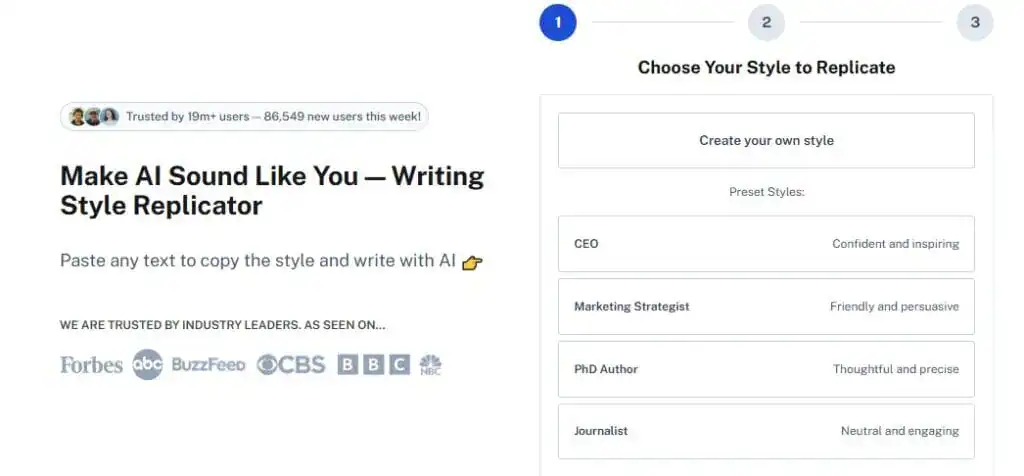
If you’ve ever reworked AI-assisted text and felt it lost your natural tone, Undetectable AI’s Writing Style Replicator helps you bring it back.
It studies your original writing samples and mirrors your phrasing, rhythm, and tone to rewrite content that still sounds like you.
It bridges the gap between AI assistance and human originality, keeping your message genuine while ensuring every sentence sounds like it was written by you — not a machine.
Undetectable AI: All-in-One Content Integrity Solution
Undetectable AI offers more than detection and humanization.
They ensure that every content that goes through their system is valuable and authentic.
They also provide solutions that help their users understand and improve their content.
So if you want tools that work effectively in 2025, choose Undetectable AI.
Work smarter—analyze and improve your content with just one click below.
Final Thoughts
Detecting AI writing can be complicated, thanks to advancements in LLMs. That’s why you need to find the right tools. You also need to find a way outside of tools by using your own brain.
Even the best tools can fail you sometimes.
The most important thing to do is understand the context of what you’re reading, and know that AI detection tools have their limitations.
You can also trust the assistance of tools such as TruthScan and Undetectable AI, but it is your intuition that completes the process.
It is not about eliminating AI in writing, but rather about being more open and maintaining quality.
It is important to remember that AI can become a powerful tool as long as it is used ethically.
Keep your content authentic and trustworthy with Undetectable AI—your reliable partner in the AI era