
Most writers think they’re bad at writing.
They’re not. They’re just not great at choosing the right words.
Often, you write a grammatically perfect piece, add descriptive words and fancy vocabulary, yet somehow it still feels lifeless, flat, or boring… as if AI wrote it.
The truth is, your ideas aren’t the problem. Neither is grammar or your vocabulary. The problem is diction.
What is diction?
Diction is the words and phrases you pick to give your writing tone, energy, and life.

In this blog, we’ll cover exactly that. You’ll learn what is diction, diction examples, types of diction, and how to identify them in a sentence.
We’ll also cover common mistakes, and proven ways to improve diction in your own writing, plus much more.
Let’s dive in.
Key Takeaways
- Diction is deliberate word choice that shapes tone, emotion, and meaning.
- The 7 types of diction (formal, informal, slang, pedantic, concrete, abstract, poetic) have different purposes.
- Diction reveals character through geography, class, education, and era.
- Use the Diamond Analysis Formula to systematically analyze diction: (1) Identify the specific word, (2) Unpack its connotation, (3) Note its emotional effect, (4) Connect it to the larger theme.
- Concrete diction (appeals to senses) sticks in memory 2-3x better than abstract diction.
- Sound patterns (phonesthetics) subconsciously control reader emotion.
What Is Diction?
- Diction Definition
What is diction?
Diction is the words and phrases a writer chooses to express their ideas.
These choices create the overall “feel” of the writing and determine its tone, emotion, and style.


Never Worry About AI Detecting Your Texts Again. Undetectable AI Can Help You:
- Make your AI assisted writing appear human-like.
- Bypass all major AI detection tools with just one click.
- Use AI safely and confidently in school and work.
The word “diction” comes from two sources:
- Latin dictio, meaning “speech”
- The Proto-Indo-European root deik-, meaning “to show”
Examples:
- “The old man shuffled down the street” vs. “The old man walked down the street”
- “Shuffled” shows us his weak, tired movement, we can picture his dragging feet
- “Walked” just tells us he moved, with no visual detail
- “The room was filled with a rancid odor” vs. “The room smelled bad”
- “Rancid odor” makes us almost smell the spoiled, disgusting scent
- “Smelled bad” is vague and creates no sensory experience
- “Crimson blood stained the floor” vs. “Red blood was on the floor”
- “Crimson” evokes richness, danger, and intensity
- “Red” is flat and doesn’t trigger the same emotional response
Notice how choosing words like “shuffled” instead of “walked” or “crimson” instead of “red” directs the reader’s attention and emotions in specific ways.
This is the essence of diction meaning.
In ancient Rome, the way people spoke (their diction) was used to judge their character and persuade audiences.
Basically, word choice reveals 4 key things about a character or narrator:
- Geography: Regional vocabulary tells us where someone is from
- Example: “pop” (Midwest US) vs. “soda” (Northeast US) vs. “coke” (Southern US)
- Socioeconomic Status: Word patterns reveal class background
- Working-class speech vs. aristocratic vocabulary
- Education Level: Technical or professional terminology shows expertise
- A doctor saying “myocardial infarction” vs. “heart attack”
- Time Period: Slang places characters in specific eras
- “groovy” (1960s–70s) vs. “lit” (2010s–20s)
- Diction Examples
Let’s now look at three diction examples of diction across different contexts:
- Literary Diction – The Great Gatsby
In F. Scott Fitzgerald’s novel, diction reveals everything about who the characters really are.
Nick Carraway (the narrator) uses abstract, poetic language:
- Words like “incarnation” and “blossomed”
- This shows he’s educated and philosophical
- He romanticizes everything he observes
Jay Gatsby speaks very differently:
- Uses simple, everyday words: “surprised,” “didn’t care”
- But constantly adds “old sport” to his speech
- He’s mimicking how he thinks wealthy people talk
The Effect: Nick is a genuine intellectual observer from an established family. Gatsby is a self-made man desperately trying to fit into high society.
His simple vocabulary mixed with forced upper-class phrases reveals he’s an outsider pretending to belong.
- Pop Culture & Slang – The Language of Belonging
Slang represents one of the most dynamic types of diction and acts as a social marker:
Examples Across Decades:
- 1990s: “rad,” “all that and a bag of chips,” “as if!”
- 2010s: “lit,” “fam,” “on fleek,” “savage”
- 2020s: “that’s giving [X],” “slay,” “unhinged,” “no cap”
The Effect: Slang signals who you are, your age, what subculture you belong to, whether you’re “in” or “out.”
When used naturally, it builds authenticity and connection. When used awkwardly, it creates cringe and distance.
- Marketing Diction – Vitamins vs. Painkillers
In marketing, understanding what is diction can make or break a sale.
The difference between abstract and concrete diction determines success:
Abstract (Weak) Diction:
- “We provide high-quality integrated solutions for business optimization”
- Vague, forgettable, sounds like every other company
- Doesn’t create urgency or show specific value
Concrete (Strong) Diction:
- “Shave 20 hours off your work week with our one-click invoicing tool”
- Specific numbers, clear benefit, tangible result
- Shows exactly what problem you solve and how
The Effect: Concrete diction is vastly more persuasive because it paints a clear picture. “Shave 20 hours off your work week” makes you imagine what you’d do with that extra time.
“Integrated solutions” makes you imagine… nothing. Marketers often say products are either “vitamins” (nice to have) or “painkillers” (must have).
Why Diction Matters in Writing
Diction definition means choosing the right words. When you pick strong, precise words, they have a big impact on your writing.
Here are the top 4 reasons why diction matters:
- They Show, Don’t Tell
Good diction lets the readers draw their own conclusions instead of being told what to think. This is one of the most powerful diction examples of how word choice creates meaning.
Example:
- Telling: “The professor was arrogant and condescending.”
- Showing: The professor adjusted his spectacles and sighed. “Perhaps if you’d consulted the seminal works I referenced in my monograph, this wouldn’t perplex you so thoroughly.”
The second version shows his superiority complex through his word choices. Readers experience his arrogance firsthand rather than being told about it.
- Create Tone and Atmosphere
Words are the building blocks of mood. Understanding diction meaning helps you choose words that build specific moods.
Horror Genre:
- Uses words like: shadows, decay, writhing, suffocating, cold, hollow, creeping
- These create unease and dread
Romance Genre:
- Uses words like: tender, warmth, flutter, gentle, blush, whisper, embrace
- These create intimacy and softness
The Danger of Wrong Diction: Imagine a horror scene that says “The ghost appeared and it was somewhat unpleasant.” These words completely destroy the terrifying atmosphere.
- Boost Memory and Impact
Concrete, sensory words create lasting mental images, while abstract words fade from memory almost immediately.
Concrete Words (memorable):
- Apple, scream, thunder, blood, fire, silk
- These trigger mental images. You can see, hear, or feel them
- They activate both visual and language processing areas in the brain
Abstract Words (forgettable):
- Concept, justice, progress, quality, innovation, optimization
- These have no physical form, nothing to picture
- They engage only language processing, making them weaker
Real-World Application:
- Weak: “We need to improve our organizational efficiency metrics.”
- Strong: “We’re drowning in paperwork while customers wait on hold for 45 minutes.”
- Connect with the Audience
Diction signals who you are and who you’re speaking to. The right words build trust and rapport; the wrong words create instant disconnection.
Mismatched Diction Examples:
Slang in a Medical Textbook:
- “The patient’s ticker was straight up not vibing, so we had to yeet them into surgery, no cap.”
- Breaks professional credibility completely
- Shows poor understanding of appropriate types of diction for formal contexts
Overly Formal Language in a Teen Blog:
- “Upon awakening this morning, I commenced my ablutions and thereafter partook of a modest repast.”
- Sounds robotic and alienates the young audience who expects casual, authentic voice
Appropriate Diction Builds Connection:
For teenagers: “I woke up late, rushed through a shower, and grabbed a granola bar on my way out.”
For medical professionals: “The patient presented with acute cardiac distress, necessitating immediate surgical intervention.”
The Principle: Your word choices tell readers whether you understand them, respect them, and belong to their world.
The Main Types of Diction

Understanding different types of diction helps writers choose the right register for their audience and purpose.
Here are the 7 main types of diction:
| Type | Characteristics | Usage | Example |
| Formal (High) | Complex sentences, extensive vocab, no contractions, strict grammar, no slang | Academic papers, legal docs, serious literature, eulogies | I respectfully dissent from the prevailing opinion regarding this matter. |
| Informal (Low) | Conversational tone, contractions, simple vocab, shorter sentences, idioms | Blogs, emails, personal essays, realistic dialogue | I totally disagree with what everyone’s saying about this. |
| Slang | Highly informal, ephemeral, used by subcultures | Dialogue, youth content, character building | That fit is drip. |
| Pedantic | Overly academic/technical, shows off intellect, overly precise | Characterization of obsessive, arrogant, or nerdy characters | The gastronomic nuances of this repast are insufficiently developed. |
| Concrete | Appeals to senses; specific nouns and active verbs | Poetry, descriptive prose, marketing copy | The lemon juice stung the paper cut on his finger. |
| Abstract | Refers to concepts, ideas, or emotions | Philosophy, theory, political speeches | Freedom is the ultimate goal of democracy. |
| Poetic | Lyrical, rhythmic, figurative; sound-focused | Poetry, lyrics, elevated prose | The dawn stepped softly in with golden sandals. |
Each of these types of diction serves a specific purpose and creates a distinct effect on readers. Mastering when to use each type is essential for effective writing.
How Diction Shapes Tone and Voice
To understand what is diction and its impact, we need to see how it shapes both tone and voice:
Voice is the personality of the writer. It’s who you are as a writer. Tone is the writer’s attitude toward a specific subject. It’s how you feel about what you’re discussing right now.
Now let’s understand how diction shapes both.
Example: Describing a School
The subject is identical, but watch what happens when we change only the word choices:
Diction Set A: Academy, institution, halls of learning, scholars, curriculum, educators
| Tone | Respectful, formal, serious |
| Voice | Educated, traditional, establishment-oriented |
| Emotional Effect | The school feels prestigious and important |
Diction Set B: Prison, containment center, inmates, guards (instead of teachers), sentence (instead of class period)
| Tone | Cynical, rebellious, bitter |
| Voice | Angst-ridden, youthful, anti-authoritarian |
| Emotional Effect | The school feels oppressive and dehumanizing |
What Changed? The subject (school) is the same. The basic facts haven’t changed. Even the sentence structure could be identical. But the diction has completely transformed the emotional reality of the text.
Diction doesn’t just shape meaning through definitions, it shapes tone through the physical sound of words. This is called phonesthetics.
| Sound Type | Letters / Examples | Effect on Tone | How It Feels to Say | Best For | Example Phrase |
| Harsh Sounds | Plosives: b, p, t, d, k, g | Explosive, percussive, aggressive | Mouth “attacks” these sounds; require force | Action, anger, violence, intensity, disruption | Kick the door! Break through! Stop dead! |
| Smooth Sounds | Sibilants: s, sh, z; Liquids: l, r | Flowing, soft, continuous | Mouth glides through these sounds; require ease | Romance, nature, persuasion, calm, comfort | Silence flowed like liquid silver, a whisper of soft light |
How to Identify Diction in a Passage
You can identify diction in any passage using the Diamond Analysis Formula.
This method helps you connect a micro element (a single word) to the macro meaning (the overall message) in four clear steps:
Step 1: Technique (Identify the Word)
What specific word choice are you examining?
Example: The author uses the word ‘infested’ to describe the city.
Step 2: Association (Unpack the Connotation)
What does this word imply? What images, emotions, or cultural associations does it carry?
Example: Infested’ implies disease, insects, vermin, filth, invasion, and a lack of control. It suggests something contaminated that needs to be exterminated.
Step 3: Effect (How It Makes Readers Feel)
What emotional or psychological response does this create in the audience?
Example: It creates visceral revulsion and disgust. It dehumanizes the city’s inhabitants by equating them with pests—things to be eliminated rather than people to be helped.
This step reveals how diction examples like “infested” manipulate reader emotions through connotative associations.
Step 4: Meaning (Connection to Theme)
How does this word choice support the larger message or theme of the work?
Example: This reinforces the theme that the ruling class views the poor as subhuman pests rather than as fellow citizens deserving dignity. The diction reveals the dehumanizing ideology that justifies their oppression.
In the age of AI, analyzing diction has become a bit more challenging. AI tools often use very “average” word choices. They’re correct but flat, formal, and not very human. This can make the writing feel stiff or robotic.
AI Detector helps you find these unnatural sections. If it flags a passage, it usually means your diction is too plain, too repetitive, or missing the unique sound of human expression.
Use this AI Detector to spot where your writing feels artificial so you can refine the tone.
If your writing feels stiff or too academic, this AI Humanizer can smooth it out. It rewrites sentences to sound more natural, adjusts phrasing, varies sentence length, and adds a warmer, more human tone.
Common Mistakes Learners Make
Understanding diction meaning includes knowing what NOT to do.
These are the mistakes most people keep repeating:
- Thesaurus Syndrome
Using fancy or rare words just to sound smarter. Example:
- Changing “The house was big” to “The domicile was voluminous.”
It sounds forced or incorrect. “Voluminous” describes hair or clothes, not houses. The reader gets distracted, and the flow breaks.
- Inconsistency
Mixing formal and casual diction in the same context for no reason. Example:
- The CEO’s presentation was elucidating, but I thought his vibes were off.
It’s unclear whether this is a professional critique or casual gossip, and it weakens your credibility.
- Abstraction Overload
Using too many abstract nouns (words ending in -tion, -ness, -ment) instead of direct action. Example:
- Utilization of the resource is necessary for the achievement of the goal.
This is dull, vague, corporate language. Use concrete, active diction: “We must use the tool to reach the goal.”
- Unintentional Repetition
Reusing the same strong word too many times close together. Example:
- The glowing light of the glowing fire lit up the glowing room.
It makes your writing feel lazy and flat. This is not the same as purposeful repetition (like “I have a dream…”). Unplanned repetition simply irritates the reader.
How to Improve Diction in Your Own Writing
These five methods will help you sharpen your word choice and master what is diction in practice:
- The Stephen King “10% Rule”
Write your first draft freely without worrying about diction. Then, during revision, force yourself to cut the word count by 10% without losing any meaning.
This way, you will naturally replace “ran really fast” (3 words) with “sprinted” (1 word).
- Blackout Poetry
Take a page from a newspaper or an old book. Use a black marker to cross out almost all the words, leaving only a few visible that form a new poem or sentence.
- Writing in E-Prime
Write a paragraph without using any form of the verb “to be” (is, are, was, were, am, be, been). “To be” verbs are passive linkers.
Removing them forces you to find active, punchy verbs to describe action and existence.
- Before: “The man was angry.”
- After: “The man scowled and stomped his foot.”
- The “Specific vs. General” Spectrum Exercise
Take a bland sentence and rewrite it three times, increasing the specificity of the diction each time.
- Level 1: The animal made a noise.
- Level 2: The dog barked loudly.
- Level 3: The Golden Retriever bayed at the thunder.
It trains your brain to reach for the “painkiller” words (Level 3) rather than the “vitamin” words (Level 1).
- Translation and Imitation
Read a passage from a famous author (e.g., Hemingway). Rewrite the passage trying to keep the meaning but change the voice to the opposite (e.g., rewrite Hemingway in the style of Jane Austen).
This highlights exactly which words create the “voice.” You realize that changing “woman” to “lady” or “drink” to “libation” drastically alters the text’s DNA.
This exercise deepens your understanding of types of diction.
- If you find it hard to notice awkward or weak word choices in your own writing, the Paragraph Rewriter can help a lot. Just paste your paragraph into the tool and try different settings. When you see how it rewrites your ideas, you discover new and stronger word choices you may not have thought of. It works like a quick editor.
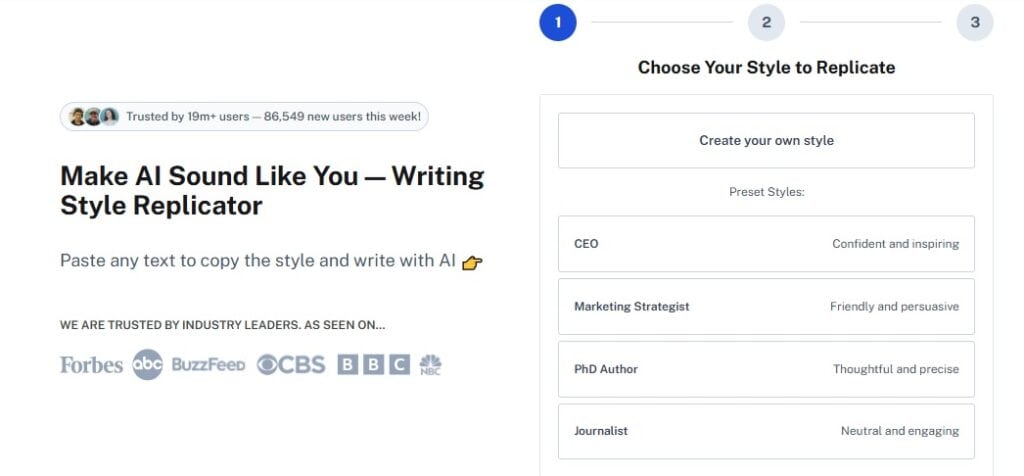
- Plus, the Writing Style Replicator lets you experiment with different tone and voice variations, helping you find the style that fits your message perfectly. You can see how different types of diction transform the same content.
Start using our AI Detector and Humanizer in the widget below!
Conclusion
Stop writing blindly. Every word you choose either builds your intended meaning or destroys it, there are no neutral choices.
Start with this…
Open something you wrote recently.
- Scan for weak verbs (“was,” “went,” “said”) and replace them with specific ones (“glared,” “stormed,” “hissed”).
- Then look for abstract nouns (“efficiency,” “optimization,” “quality”).
- Replace them with concrete images (“20 hours saved,” “one-click solution,” “silk-smooth finish”).
That’s it. There you’ve used the diction.
Try the AI Detector on your work to spot robotic patterns. Use the AI Humanizer if your writing feels stiff.
Experiment with the Writing Style Replicator to see how different diction creates different voices.
Diction is a skill. And you just learned how to build it.
Keep your writing human and authentic with Undetectable AI.