
Stephen Fry once said, “The English language is like London… sacred yet profane.”
In reality, Fry’s full quote is much longer than that, as he mentioned several opposing ideas back to back.
But even though it’s trimmed down, we still get the point. What helped with that were those three dots.
Those three dots are a tool writers use to convey more with less, without altering the message. Writers use this purposefully for brevity, flow, and sometimes dramatic effect.
Carrie Bradshaw practically lived in them (“I couldn’t help but wonder…”), and plenty of young adult protagonists rely on them to keep you hanging during those dramatic pauses.
It’s dramatic. It’s mysterious. And honestly? It’s one of the most misunderstood marks in the English language.
Whatever you’re writing, may it be fiction, essays, or emails, understanding how to use an ellipsis correctly can level up your writing.
Key Takeaways
- An ellipsis (…) indicates omitted text, trailing thoughts, or meaningful pauses in writing.
- It consists of three periods with specific spacing rules depending on your style guide.
- Ellipses create suspense, suggest hesitation, or show interrupted speech in dialogue.
- Overusing ellipses can make writing feel vague, melodramatic, or AI-generated.
- Different style guides (MLA, APA, Chicago) have different formatting requirements for ellipses.
What Is an Ellipsis?
The ellipsis isn’t just three random dots you throw in when you’re feeling mysterious.
It’s a legitimate punctuation mark with specific uses and rules.
The word comes from the Greek elleipsis, which means “omission” or “falling short.” And that’s exactly what it does.


Never Worry About AI Detecting Your Texts Again. Undetectable AI Can Help You:
- Make your AI assisted writing appear human-like.
- Bypass all major AI detection tools with just one click.
- Use AI safely and confidently in school and work.
It shows that something has been left out, whether that’s words in a quotation, a thought that trails off, or a pause heavy with meaning.
Think of an ellipsis as the punctuation mark that embraces silence. Where other marks tell you to stop (period) or get excited (exclamation point), the ellipsis tells you to linger.
To wait. To wonder what comes next.
Ellipsis Definition
Here’s the technical definition:
An ellipsis is a set of three spaced or unspaced periods (…) used to indicate the omission of words from quoted material, an unfinished thought, a pause in dialogue, or a trailing off in speech or thought.
The plural of ellipsis is ellipses (pronounced eh-LIP-seez). Yes, you can have more than one in your writing. But should you?
We’ll get to that.
Ellipsis Examples
Let’s look at how ellipses actually work in real text:
- In quotations:
- Original: “The best time to plant a tree was twenty years ago. The second best time is now.”
- With ellipsis: “The best time to plant a tree was twenty years ago… The second best time is now.”
- In dialogue: “I thought we were going to…” Sarah’s voice faded as she realized he wasn’t listening.
- For trailing thoughts: Maybe if I had studied harder… but there’s no point thinking about that now.
- For dramatic pause: And the winner is… actually, let’s take a commercial break first.
The Main Uses of an Ellipsis
An ellipsis serves four primary functions in writing.
1. Showing omitted text in quotations
This is the most traditional use.
When you’re quoting someone and want to skip irrelevant parts, you use an ellipsis to show where you’ve cut material.
This keeps quotations concise and focused without misrepresenting the source.
Example: According to the report, “Sales increased dramatically… resulting in record profits for the quarter.”
2. Indicating a pause or hesitation
In creative writing or dialogue, ellipses show when a character pauses mid-thought or hesitates before speaking. This creates natural speech patterns and reveals emotional states.
Example: “I don’t know if I should… what if it doesn’t work out?”
3. Creating suspense or anticipation
Writers use ellipses to build tension. That pause before a reveal? That moment before everything changes?
The ellipsis lives for this drama.
Example: She opened the envelope slowly. Inside was…
4. Trailing off or leaving thoughts incomplete
Sometimes we don’t finish our sentences. Sometimes the unsaid speaks louder than words. The ellipsis captures that perfectly.
Example: If only things had been different…
Ellipsis vs. Other Punctuation Marks
An ellipsis isn’t the same as other punctuation, even though writers sometimes use them interchangeably.
1. Ellipsis vs. Dash: A dash (whether em dash, en dash, or hyphen) shows interruption or adds emphasis.
An ellipsis shows trailing off or omission. The dash is abrupt. The ellipsis is gentle.
Dash example: “But I thought you said”—
Ellipsis example: “But I thought you said…”
2. Ellipsis vs. Period: A period ends a complete thought definitively. An ellipsis suggests the thought continues, even if unspoken.
Period: The party ended.
Ellipsis: The party ended…
See the difference? The period closes the door. The ellipsis leaves it cracked open.
3. Ellipsis vs. Comma: Commas create pauses within sentences for grammatical clarity. Ellipses create pauses for dramatic or emotional effect.
Comma: I wanted to go, but I was tired.
Ellipsis: I wanted to go… but something held me back.
How Ellipses Affect Tone and Rhythm
The ellipsis doesn’t just tell readers what you mean. It tells them how to feel.
An ellipsis slows down reading. It forces the reader to pause, to breathe, to anticipate what comes next. In fiction, this creates tension.
In persuasive writing, it emphasizes key points. In personal writing, it conveys vulnerability or uncertainty.
Think about the difference between these two sentences:
“She didn’t show up.”
“She didn’t show up…”
The same information, but with a completely different emotional weight. The second one suggests disappointment, confusion, or the weight of unspoken implications.
You can test this yourself using Undetectable AI’s Writing Style Replicator.
Try writing a paragraph with and without ellipses. Upload both versions and see how the tone analysis changes.
The tool picks up on how pauses and trailing thoughts shift the emotional register of your writing.
It’s fascinating to see how three little dots can completely transform reader perception.
To study how these shifts work, Undetectable AI’s AI Essay Writer is useful in this context.
You can experiment by generating the same idea in two different styles.
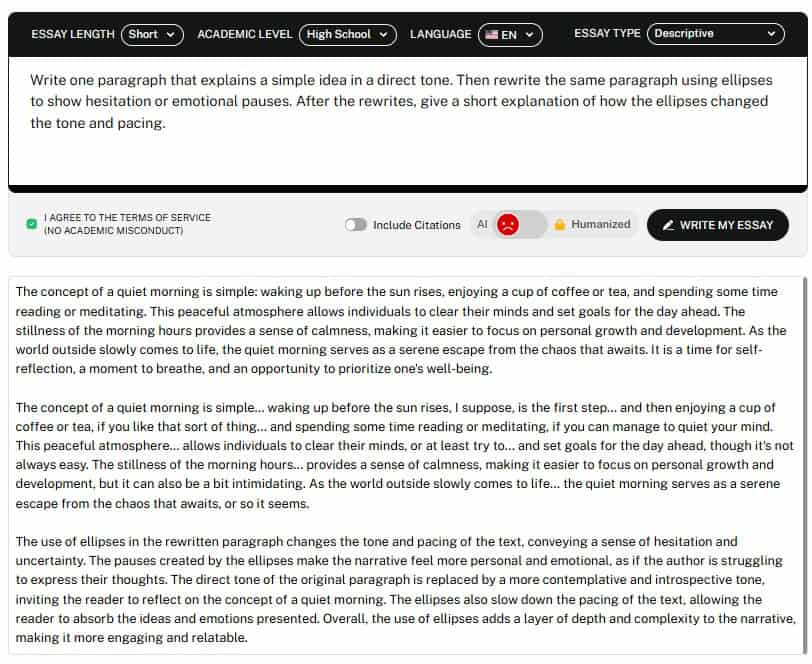
One version stays direct. The other uses ellipses to add emotional pauses or uncertainty.
Comparing the two side by side shows how a small punctuation choice changes the mood, pacing, and depth of a line.
It is an easy way to study how tone transforms when thoughts trail off or soften.
How to Format an Ellipsis Correctly
Most people think ellipses can be dropped anywhere because they look simple. And yes, you can use them freely in casual writing.
But formatting matters once you move into academic work, quotations, or anything that relies on proper citation rules.
Each style guide has its own version of what an ellipsis should look like, and getting it wrong can mess with clarity or break citation accuracy.
That is why every writer needs to know the exact formatting.
Different style guides have different rules for ellipses, and they’re surprisingly specific.
- Chicago Manual of Style: Chicago uses three spaced periods with spaces before and after: word . . . word
If the ellipsis comes at the end of a sentence, you use four periods (the sentence’s period plus three ellipsis periods): word….
Original: She said she would finish the report today.
Chicago ellipsis: She said she would…. finish the report today.
- MLA Style: MLA uses three unspaced periods with a space before and after: word … word
If you’re omitting material after a complete sentence, keep that sentence’s period, then add the ellipsis: word. … word
Original: Literature reflects the complexity of human experience in every era.
MLA ellipsis: Literature reflects the complexity of human experience. … in every era.
- APA Style: APA also uses three unspaced periods with spaces before and after: word … word
For omissions at the end of sentences, use four periods with no space before the first: word….
Original: The findings suggest a strong correlation between the variables.
APA ellipsis: The findings suggest a strong correlation … between the variables.
- AP Style: AP treats the ellipsis as a single three-dot unit with spaces before and after: word … word
Original: The coach said the team would improve after the break.
AP ellipsis: The coach said the team would improve … after the break.
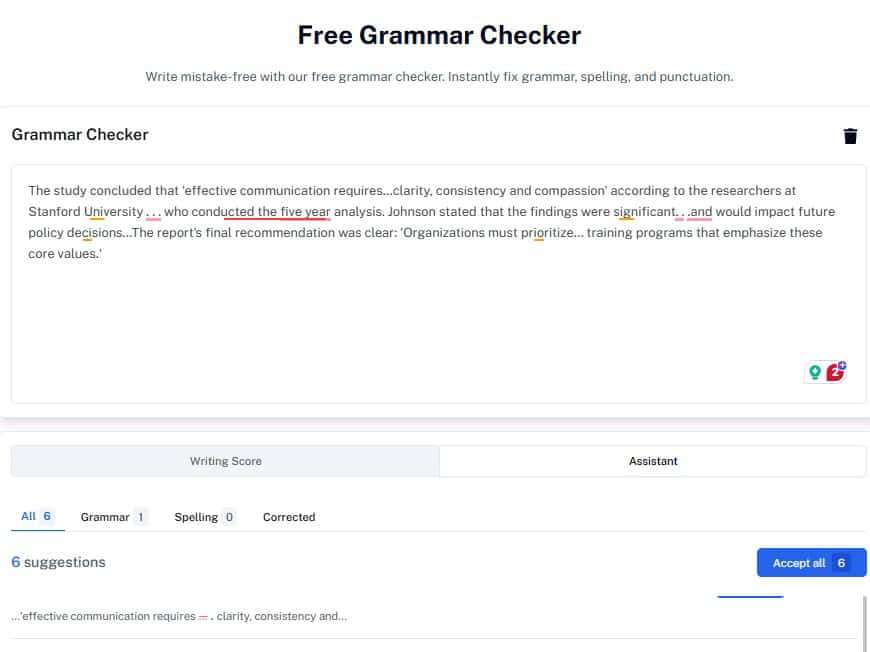
Confused? Well, that’s not surprising. This is exactly why tools like Undetectable AI’s Grammar Checker exist.
You can set your preferred style guide (MLA, APA, Chicago, or AP), and the tool automatically flags incorrectly formatted ellipses and suggests the right formatting for your chosen standard.
Common Mistakes When Using Ellipses
Let’s talk about what not to do, because ellipses are one of the most overused and misused punctuation marks in modern writing.
1. Using more than three periods: Four dots, five dots, an entire trail of dots across the page… unless you’re formatting according to specific style rules (like Chicago’s four-period rule), stick to three.
Any more than that looks unprofessional and reads like you’re unsure how to use punctuation.
2. Sprinkling ellipses everywhere: Overusing ellipses makes your writing feel vague and indecisive. It’s like speaking in uptalk. Everything sounds like a question. Nothing feels definitive.
Your reader starts wondering if you actually have a point or if you’re just… you know… hoping they’ll figure it out.
Ellipses can be particularly common in AI-generated text. Machines love ellipses because they fill space without committing to meaning.
Undetectable AI’s AI Detector specifically flags this pattern. If your writing has an ellipsis every few sentences, the tool will catch it as a sign of mechanical or non-human writing patterns.
3. Using ellipses passive-aggressively: We’ve all received that text. “Sure… if that’s what you want…” Ellipses have become the punctuation equivalent of a heavy sigh or uncertainty.
In professional or academic writing, this undermines your credibility. Save the passive-aggressive ellipses for texting your friends about the person who never replied to your group chat.
4. Forgetting the purpose: Every ellipsis should serve a function.
Ask yourself: Am I omitting quoted text? Showing hesitation? Creating suspense? If you can’t answer that question, you probably don’t need the ellipsis.
If you’ve already written something and suspect you’ve gone overboard with ellipses, Undetectable AI’s AI Humanizer can help.
Paste your text into the tool, and it will rewrite sentences that use ellipses too frequently or awkwardly.
The tool replaces vague trailing-off with clearer phrasing while maintaining your intended tone.
Sometimes you need that ellipsis. Sometimes you just need to commit to your sentence.
How to Use Ellipses Effectively in Your Writing
Now that we know what not to do, let’s talk about best practices.
Use ellipses sparingly
Like hot sauce or glitter, a little goes a long way. One well-placed ellipsis has impact. Ten ellipses in three paragraphs dilute your message and exhaust your reader.
Match ellipses to your context
Formal academic writing? Stick to using ellipses for quotation omissions only.
Creative writing? You have more freedom to use them for rhythm and tone. Professional communication? Proceed with caution.
An email that reads “I was wondering… could you possibly… maybe send that report?” sounds unclear.
Read your writing aloud
This is the best test. If you’re using an ellipsis, pause where it appears. Does the pause feel natural? Does it serve the meaning? If the pause feels awkward when spoken, it’ll feel awkward when read.
Consider alternatives
Sometimes an ellipsis isn’t the right tool. If you want to show an interruption, try a dash. To build suspense, try using a paragraph break.
If you want to show omission in quoted material, make sure you’re not changing the original meaning.
Know your audience
Genre matters. Literary fiction embraces ellipses for their emotional resonance.
Technical writing views them with suspicion. Young adult fiction loves them for capturing teenage uncertainty. Academic writing tolerates them only for quotations.
Understanding these nuances helps you use ellipses strategically rather than automatically.
Experience our AI Detector and Humanizer in the widget below!
Dot Dot Done
The ellipsis is small but mighty.
Three little periods that can change the entire mood of a sentence, reveal character depth, or trim quotations without losing meaning.
When used well, ellipses add sophistication and nuance to your writing. When used poorly, they make you sound like you’re uncertain about everything you’re saying.
The key is intentionality. Every ellipsis should have a purpose. Every pause should mean something.
And if you’re not sure whether your ellipses are helping or hurting your writing, it’s worth getting a second opinion.
If you’re ready to master the art of the ellipsis (and every other aspect of strong writing), try Undetectable AI today and see how the right tools can transform your punctuation game from confusing to confident.
Because sometimes the most powerful thing you can say is…