
Is it enrolment vs enrollment? You’ve probably second-guessed yourself about this while filling out a form or writing an email to someone overseas.
But do you know that both spellings are actually correct? But which one should you use? Well, it totally depends on where your reader is located.
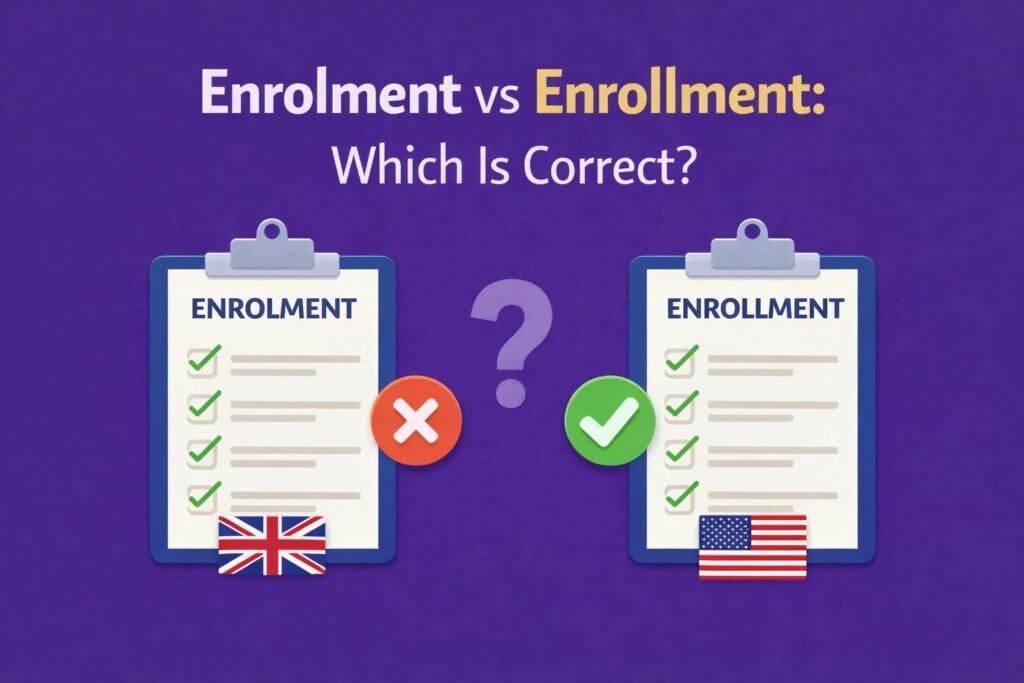
Americans spell it with two l’s. The British, Australians, and most of the Commonwealth use just one. Sounding simple, right? But there’s a twist that confuses even experienced writers.
This word breaks the usual spelling pattern between American and British English.
In this article, you’ll learn exactly when to use which spelling, why this exception exists, and how to avoid the mistakes that make your writing look sloppy.
Let’s dive in.
Key Takeaways
- The two words are different primarily due to their geographical disparity. Enrollment is the standard spelling in American English, while enrolment is preferred in British English.
- The core meaning remains the same. They refer to the act of officially joining something (like a school or program) or the total number of people who signed up.
- There are many British/American spelling differences where British English adds a double consonant (e.g., traveling vs. travelling). But this pair is an exception. The American version has the double “l,” and the British version has a single “l.”
What Is the Difference Between Enrolment vs Enrollment?
Meaning
Both enrolment and enrollment are nouns that come from the verb “to enroll.” They basically refer to the formal act of registering or signing up for a group, course, or service.
Nowadays, these words are most often used in education. For instance, when signing up for a university semester, or in public services, such as enrolling in a healthcare plan or military service.
At times, they also refer to the state of being registered or the total number of people in a program (e.g., “The school’s enrollment has increased”).


Never Worry About AI Detecting Your Texts Again. Undetectable AI Can Help You:
- Make your AI assisted writing appear human-like.
- Bypass all major AI detection tools with just one click.
- Use AI safely and confidently in school and work.
Although the words mean the same thing, their use depends entirely on geography.
Take a look at the table below to get a clear insight into their differences:
| Enrollment (American English) | Enrolment (British and Commonwealth English) |
| Uses two l’s | Uses one l |
| Standard in the United States | Standard in the UK, Australia, Canada, and New Zealand |
| Commonly used in American writing and publications | Commonly used in British and Commonwealth writing and publications |
Know that there is one notable exception to the usual double consonant rule in English. Normally, British English doubles the final consonant (travelling), and American English uses a single letter (traveling).
Here, the pattern is reversed, which often trips up writers following regional spelling rules.
History
When we go through history, it turns out that both words date back to the 14th century. They originated from the Old French term enroller.
Below is a breakdown of where it came from:
- This word combines en- (to put in) with rolle (a roll of parchment).
- The root “roll” comes from the Latin rotulus. It means a small rolled document.
Later on, the spelling difference between enrol vs enrollment became standard in the 19th century.
In British English, Samuel Johnson’s 1755 dictionary set enrol as the norm. On the flip side, in American English, Noah Webster’s 1828 dictionary defined enroll with two “l’s,” preserving the connection to the root word roll.
Fast forward to this day, enrollment vs enrolment spelling differences stand as a prime example of the disparity between American and British English.
When to Use?
The rule of using both spellings is quite straightforward. You just have to match your spelling to your reader’s location.
Enrollment
You can use this spelling when you’re writing for an American audience. If your content is going to appear on a U.S. website, in an American publication, or if you’re submitting work to a university or organization based in the States, go with the double “l.”
American style guides, academic institutions, and government bodies all expect this spelling. Using the single “l” version in American contexts won’t just look odd. It might actually get flagged as a spelling error.
Enrolment
This is the spelling you want when you’re writing for readers in the UK, Australia, New Zealand, India, or most other Commonwealth countries. British style guides and educational institutions prefer the single “l” version.
If you’re creating content for a British university website, an Australian government form, or a publication based anywhere in the Commonwealth, you should go with enrolment.
But what about Canada? Well, honestly, it gets a bit tricky there. Canadian institutions tend to lean toward the British spelling in formal and academic contexts.
But you’ll see the American version popping up more often in business and tech writing because of American media influence. When in doubt, check what the specific organization you’re writing for uses.
If you’re using AI tools to help with your writing, the output might not always match your target audience’s spelling conventions.

Running your content through Undetectable AI’s AI Humanizer can help fix these inconsistencies and make your examples feel more natural for whichever region you’re writing for.
Examples of Enrolment vs Enrollment
If you want further clarification, the table below might help you understand the implementation:
| American English | British English |
| You need to enroll in the workshop before Friday to secure your spot. | Please enrol for the training session by Monday to confirm your place. |
| Many students enroll in online courses during the summer break. | A growing number of learners enrol in distance programmes during holidays. |
| The company offers a program anyone can enroll in to improve their skills. | The organisation runs a scheme that staff can enrol in to develop new abilities. |
| Parents are encouraged to enroll their children in the after-school club. | Guardians are advised to enrol their kids in the weekend activity group. |
| She decided to enroll in a photography class to learn new techniques. | He chose to enrol in a cooking course to pick up some new recipes. |
These are some typical use cases for the terms in two dialects. You may come across many other instances of enrollment vs enrolment in everyday writing. Simply remember that spelling varies with the target audience.
Context and Region Matter
The choice between enrolment and enrollment is one of the most curious spelling differences in English.
Usually, most spelling differences follow a clear pattern:
- British English often keeps extra letters (like travelling or cancelled)
- On the other hand, American English prefers shorter forms (e.g., traveling or canceled).
But this word flips that logic. And this twist is important for writers to consider when paying attention to regional usage.
The American Standard: Enrollment
In the U.S., the double “l” in enrollment is the standard. As mentioned above, it comes from Noah Webster’s work in American lexicography.
Interestingly, while Webster usually simplified spellings, he kept the double “l” here to match the root word roll. Historical research shows that while enrolment appeared in early American writing, by the mid-1800s, enrollment became almost universal.
So, today, using the single “l” in U.S. academic or legal writing is often marked as incorrect rather than just a regional difference.
The British and Commonwealth Standard: Enrolment
In the U.K. and much of the Commonwealth (including Australia, New Zealand, and India) enrolment is the preferred spelling. This follows the British verb enrol. It comes directly from the Old French enroller.
Furthermore, in Australia, government departments such as the Department of Education always use enrolment in official statistics and international student records.
As for India, where British English guides academic writing, enrolment is the standard for census and educational reporting.
The Canadian Hybrid
Canada is a mix of both systems.
Canadian English usually follows British spelling for words like colour and centre. But American forms often appear in technical or business writing.
For example, the University of Toronto’s 2024-25 Enrolment Report shows a strong preference for the single “l” spelling. Yet in the private sector, enrollment is becoming more common due to American media and software influence.
This brings us to the point that the debate of enrollment vs enrolment Canada is more about institutional demand than regional preference.
Moreover, data from the Oxford English Corpus and Google Ngram Viewer show that both spellings have been around for centuries. It’s the people who use them differently now.
In British English, enrolment still rules, though enrollment is creeping up thanks to digital globalization.
The main takeaway for writers is to vibe with your audience’s location and pick your “l” accordingly.
If you’re struggling to keep your spelling consistent across a long document, or if your sentences feel clunky after switching between regional styles, Undetectable AI’s Paraphrasing tool can help.
It rephrases confusing or repetitive sentences while keeping your meaning intact. That way, your content stays clear and readable no matter which audience you’re writing for.
Enrolment vs Enrollment in Education Writing
Educational or academic writing has its own protocols when it comes to spelling. The writers in this domain need to know their audience because “enrollment” and “enrolment” signal regional accuracy.
In the U.S., the National Center for Education Statistics (NCES) and top universities stick to the double-l enrollment. While in the UK, the Department for Education, and in Australia, educational bodies, always go with enrolment.
Also, if you evaluate the educational writing scene in Canada, you might be intrigued by the nuances you will find there.
Although Canadian English mixes British and American styles, schools and universities, like the University of Toronto and British Columbia’s Ministry of Education, mostly stick with the British spelling enrolment.
Disparities like this clearly show high stakes for international education consultants. They often switch styles of enrolment vs enrollment Canada depending on whether they’re talking to a student in London or a registrar in New York.
When you’re writing academic content, sounding natural matters just as much as getting the spelling right.
So If you’ve used AI tools to help draft your educational materials, it’s worth checking whether the output sounds human.
Undetectable AI’s AI Detector tool can help you spot robotic patterns in your writing so your content doesn’t come across as stiff or machine-generated.
Frequent Mistakes and Guidelines
Figuring out the “l” in enrolment can feel like walking on a knife’s edge. Even experienced writers slip up because English handles suffixes in inconsistent ways.
If you wish for your work to look sharp, watch out for the following mistakes, and follow the guidelines given below:
- The Double-L Trap in the UK: A common slip-up is thinking that, because British English uses travelling and cancelled, it should also use enrollment. But this is one of those rare times the rule flips. In the UK, always go with the single “l”: enrolment.
- Inconsistent Conjugation: Many writers wrongly write enroled or enroling for a British audience. Remember that no matter the region, the past tense and present participle always use a double “l”: enrolled and enrolling.
- The Mid-Sentence Switch: The most common error is spelling drift. This is where “enrollment” appears in the introduction and “enrolment” in the conclusion. Such differences usually happen when you copy and paste from different international sources.
To make your scripts on point, refer to the table below:
| Word Form | American English | British/Canadian/AU |
| Verb (Infinitive) | Enroll | Enrol |
| Noun | Enrollment | Enrolment |
| Past Tense | Enrolled | Enrolled |
| Continuous | Enrolling | Enrolling |
Pro Tip for Maximum Accuracy: If you are writing for a global audience and aren’t sure which to choose, pick one and be consistent.
Most editors will forgive a regional preference as long as it doesn’t fluctuate. Also note that if you are submitting to a specific journal or university, check their style guide (such as APA for the US or Oxford for the UK) to ensure you meet their specific “l” count.
Use our AI Detector and Humanizer right in the widget below!
Final Thoughts
Look, at the end of the day, this whole enrolment vs enrollment debate comes down to one question. Who are you writing for?
If your readers are in America, use the double “l.” If they’re in the UK, Australia, or anywhere else in the Commonwealth, go with the single “l.” That’s really all there is to it.
The mistake most writers make is not that they pick the wrong spelling. It’s that they switch between the two halfway through a document. Nothing screams “I copied this from multiple sources” louder than inconsistent spelling.
So pick one version based on your audience and stick with it throughout. Your readers probably won’t notice if you get it right. But they’ll definitely notice if you get it wrong.
Keep your spelling consistent and audience-ready with Undetectable AI’s humanizing and proofreading tools.