
Have you ever wondered why AI detection tools sometimes flag content that was written with real thought and effort behind it?
AI detection has moved from a niche concern into something students, marketers, agencies, and everyday writers run into constantly.
Detectors sit inside learning management systems, editorial workflows, and hiring pipelines, quietly scoring text before a human ever reads it. That creates a real problem: even careful, original writing can get mislabeled, and content that leans on AI assistance can slip through untouched.
This guide walks through five proven strategies for managing AI detection while keeping your writing clear, credible, and genuinely useful to readers. You’ll also find an updated look at how detection tools actually perform, where they get it wrong, and what new transparency rules mean for anyone publishing AI-assisted content.
Vamos a ello.
Principales conclusiones
- AI detection tools look for statistical patterns, low sentence variation, predictable word choice, and repeated structure, not some magic “AI signature.”
- No detector on the market is fully reliable. Independent testing consistently shows real-world accuracy well below what vendors advertise, and false positives on genuine human writing remain common.
- Manual editing, varied sentence rhythm, and personal insight are still the most durable ways to reduce detection risk, no tool replaces good editing.
- New disclosure and labeling requirements are reshaping how AI-generated content has to be handled, especially for anything published in the EU.
- Deepfake detection has become just as urgent as text detection, given how fast synthetic audio and video fraud is growing.
Detectores de contenidos AI
Detectores de contenidos AI are built to spot patterns typical of machine-generated writing. Instead of “reading” for meaning the way a person does, they run statistical checks against language routines, sentence rhythm, keyword repetition, and patrones de puntuación.
Businesses, schools, and publishers lean on these tools to protect content integrity, catch manipulated text, and confirm authenticity before something goes public.
Cómo funcionan realmente las herramientas de detección de IA
Most detectors score text using two core ideas: perplexity and burstiness. Perplexity measures how predictable each word choice is; lower perplexity usually means more predictable, machine-like phrasing.
No vuelvas a preocuparte de que la IA detecte tus textos. Undetectable AI puede ayudarle:
- Haz que aparezca tu escritura asistida por IA de aspecto humano.
- Bypass las principales herramientas de detección de IA con un solo clic.
- Utilice AI de forma segura y con confianza en la escuela y el trabajo.
Burstiness looks at how much sentence length and structure vary throughout a piece. Human writing tends to swing between short and long sentences, while AI output often settles into a steadier, more uniform rhythm.
Some tools also cross-reference multiple detection models at once and look for embedded watermarks left behind by certain AI writing systems.
Why AI Detection Matters to Businesses and Schools
Educators use AI detection to support academic integrity, though most now treat a flag as a starting point for a conversation rather than proof on its own. Publishers and SEO teams use it to keep content policies consistent and avoid thin, templated writing that search engines tend to deprioritize.
Companies rely on it to protect brand voice and confirm that public statements, reports, and marketing copy weren’t generated with zero human review. Across every use case, the tools work best as a signal, not a verdict, since even the strongest detectors still misfire on both sides.
In fact, a Forbes analysis of digital forensics found that tools built to spot synthetic content caught some fakes, missed others, and flagged authentic material as synthetic often enough to concern experienced investigators.
5 Proven Ways to Bypass AI Detection
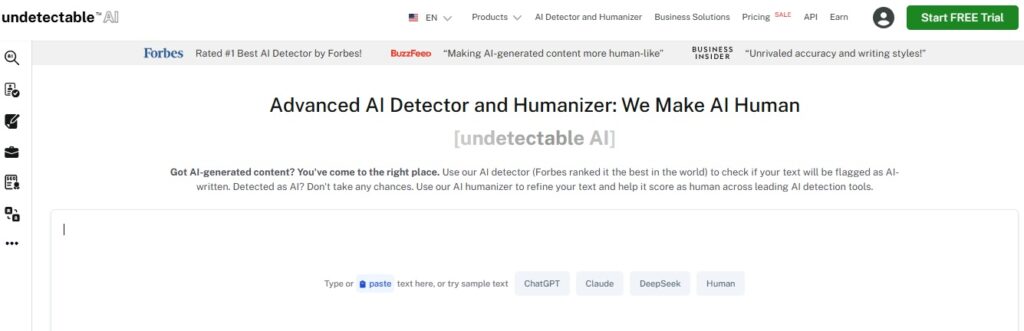
1. Use Undetectable AI’s Detection and Humanizing Tools
Undetectable AI is built to check your writing against several major detection engines at once, then refine the structure so it reads naturally while keeping the original meaning intact.
It’s become a go-to option for students, marketers, and writers who need content that holds up under multiple detectors instead of just one.
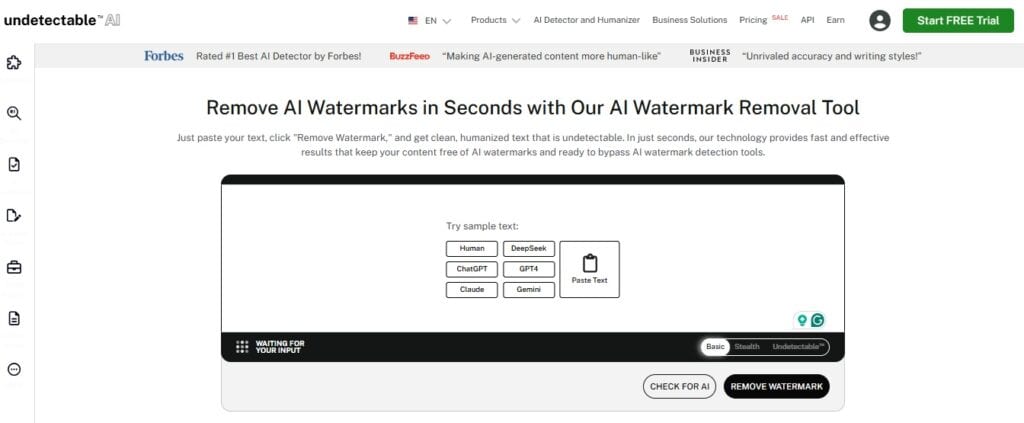
Su Eliminador de marcas de agua de texto AI clears invisible watermarks that some AI writing systems embed automatically, which can otherwise trip up detection tools even after you’ve edited the text by hand.
If you want a deeper walkthrough of how the underlying detection logic works, this breakdown of the digital fingerprints AI leaves behind is worth a look.
2. Manually Edit AI-Generated Content
Manual editing remains one of the most reliable ways to reduce detection risk. Rewriting phrasing, adjusting word choice, and restructuring sentences by hand removes the repetitive patterns detectors are trained to catch.
This step also improves the piece on its own merits: manually edited content generally reads better, flows more naturally, and better reflects your actual voice.
For a full walkthrough on turning a rough AI draft into something that reads like it came from a person, see this guide to humanizar los contenidos generados por IA.
3. Change Your Writing Style and Tone
Adjusting sentence structure, tone, and word choice throughout a piece reduces the uniform patterns AI detection tools rely on. This works best when it’s done deliberately rather than randomly, since the goal is variation that still reads clearly and stays on topic.
If you’re looking for more structured guidance on blending AI assistance with your own voice, check out Cómo puede ayudar la IA con la escritura for practical tips.
4. Vary Sentence Length and Structure
AI-generated text tends to fall into predictable rhythms: similar sentence lengths, similar openings, similar transitions.
Mixing short, direct sentences with longer, more detailed ones breaks that pattern and creates the natural unevenness detectors associate with human writing.
This also tends to make content more engaging to read, since a steady drumbeat of same-length sentences gets monotonous fast.
- Alternate short and long sentences within the same paragraph
- Vary how paragraphs open instead of repeating the same sentence structure
- Watch for repeated transition words like “additionally” or “furthermore” and swap them out
- Read the piece aloud; awkward, robotic-sounding sections usually reveal themselves quickly
5. Incorporate Real Examples and Personal Insight
Specific examples, first-hand observations, and niche industry knowledge introduce the kind of variability AI models struggle to generate on their own.
A detail only you would know, a real client story, a specific number from your own experience, does more to make content feel human than any structural trick. It also tends to build more trust with readers, since specificity reads as credibility.

Why AI Detectors Sometimes Get It Wrong
False positives are one of the most persistent problems in AI detection, and they’re worth understanding before you treat any single score as final. Detectors are tuned to flag low perplexity and low burstiness, but plenty of legitimate human writing shares those traits.
Formal academic prose, technical documentation, and writing by non-native English speakers often use more standardized vocabulary and sentence structure, exactly the pattern detectors are built to catch. That means a careful, well-organized human writer can score just as “AI-like” as an actual AI draft.
Independent benchmarking backs this up.
Testing across major current language models found that even the strongest AI detectors miss between fifteen and thirty percent of AI-generated text, with accuracy varying significantly depending on which model produced it, while false positive rates on genuine human writing ranged from three to twelve percent.
Put simply: treat any AI detection score as one data point, not a final judgment, and pair it with human review whenever the stakes are real, like a grade, a job, or a client relationship.
The Rules Are Changing: Labeling and Disclosure for AI Content
AI detection isn’t just a content-quality issue anymore, it’s becoming a compliance one. Regulators are moving toward requiring that AI-generated content be clearly disclosed, not just detectable after the fact.
Under the EU’s new transparency rules, companies must ensure their AI systems and AI-written content are clearly labeled, using watermarks and other markers so audiences can tell what they’re looking at.
Deployers publishing that content are required to disclose it in a way ordinary readers can actually notice, not just bury in fine print, and non-compliance carries real financial penalties.
For anyone publishing content that could reach EU audiences, that means AI detection now cuts both ways: it’s not just about whether content passes a detector, but whether your workflow can demonstrate proper disclosure where it’s required.
Content teams working across regions should build a habit of tracking which pieces used AI assistance and to what degree, since “detectable” and “disclosed” are becoming two separate compliance questions.
Tips for Creating Reliable, Undetectable AI-Generated Content

Beyond the five core methods, a few supporting habits make a real difference in how natural and credible your content ends up.
Use Multiple Credible Sources
Pulling from several reputable sources adds depth and perspective that a single AI-generated draft usually lacks. It also strengthens your content’s authority and helps you avoid the flat, generic tone that comes from relying on one model’s output alone.
Always verify facts before publishing and attribute sources properly, both for credibility and to stay on the right side of copyright expectations.
Employ a Human Editor
A skilled human editor catches what automated tools miss: awkward phrasing, factual gaps, tone mismatches, and the subtle repetition that makes writing feel machine-generated even after a first pass of edits.
This step matters even when you’re using strong AI writing and humanizing tools, since editors bring judgment that no algorithm fully replicates.
If your team wants a clearer sense of where humanizers, paraphrasers, and detectors each fit in the workflow, this breakdown of the difference between paraphrasers, humanizers, and detectors lays it out well.
Detección de Deepfake: La contramedida contra la manipulación visual
Text isn’t the only thing being scrutinized anymore. Synthetic video, voice cloning, and manipulated images have become a serious fraud vector, and detection for visual and audio media now requires a different level of precision than text-based tools.
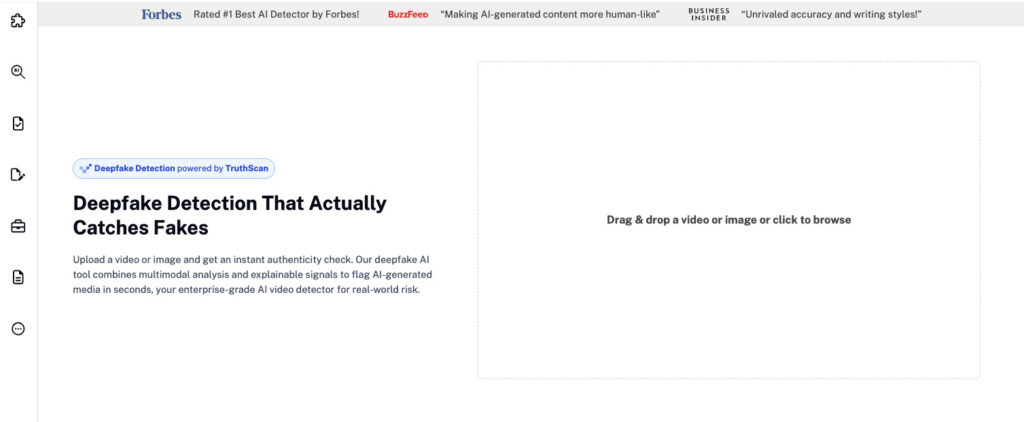
IA indetectable Detección de Deepfake is built to identify synthetic visuals that can look completely real to the human eye. It analyzes lighting consistency, pixel texture, motion irregularities, and facial alignment to flag convincing fake images or video.
Whether you’re verifying media authenticity, protecting brand assets, or trying to stop misinformation from spreading, this kind of detection has become a genuine business necessity rather than a nice-to-have.

For enterprise-grade analysis of synthetic images and video, TruthScan’s Detector de imágenes AI offers deeper scanning built specifically for organizations that need to verify media at scale before it’s published or shared.
Together, text and visual detection cover the two fronts where synthetic content does the most damage.
How Students and Content Teams Are Actually Using AI Detection Today
The scale of AI use in schoolwork and content production is a big part of why AI detection has become such a constant presence.
A recent Pew Research survey found that more than half of teens have used chatbots to help with schoolwork, with many also using them to summarize articles, books, or videos.
That volume is exactly why detection tools, and the strategies to work alongside them responsibly, have become mainstream rather than a niche concern.
For students specifically, Undetectable AI has become an una elección óptima para los estudiantes who want to use AI responsibly for brainstorming and drafting without submitting flagged, unedited machine output.
The same logic applies to content teams: the goal isn’t to hide AI use entirely, it’s to make sure whatever ships is genuinely well-edited, accurate, and worth a reader’s time.
How Students and Content Teams Are Actually Using AI Detection Today
The scale of AI use in schoolwork and content production is a big part of why AI detection has become such a constant presence.
A recent Pew Research survey found that more than half of teens have used chatbots to help with schoolwork, with many also using them to summarize articles, books, or videos. That volume is exactly why detection tools, and the strategies to work alongside them responsibly, have become mainstream rather than a niche concern.
For students specifically, Undetectable AI has become an una elección óptima para los estudiantes who want to use AI responsibly for brainstorming and drafting without submitting flagged, unedited machine output.
The same logic applies to content teams: the goal isn’t to hide AI use entirely, it’s to make sure whatever ships is genuinely well-edited, accurate, and worth a reader’s time.
Pruebe las herramientas AI Detector y Humanizer en el widget siguiente.
Preguntas frecuentes
¿Es posible eludir la detección de IA?
Yes, through a mix of careful editing, style adjustments, and tools built for this purpose. Always check the relevant policy first, whether that’s a school’s academic integrity rules or a publisher’s content guidelines, since the right approach depends heavily on context.
¿Por qué alguien querría eludir la detección de IA?
Common reasons include protecting privacy, improving how content flows and reads, and making sure AI-assisted work still reflects a professional, polished final product rather than a raw first draft.
¿Son legales estos métodos?
Legality depends on jurisdiction and context. Using Escritura AI tools is generally legal; what matters more is whether you’re following the specific rules of your school, employer, or platform, and disclosure requirements where they apply.
¿Qué riesgos existen al intentar eludir la detección de la IA?
Potential risks include reputational issues, factual errors slipping through, or content that reads as inauthentic if editing is rushed. Human oversight at every stage is the best way to manage these risks.
Can AI detectors tell the difference between AI-assisted and fully AI-generated content?
Not reliably. Most detectors score a whole piece rather than isolating which sentences came from a person versus a model, which is part of why hybrid writing, drafted with AI help and then heavily edited, can still get flagged. This is another reason detection scores work better as a signal than a final verdict.
Does using an AI humanizer guarantee content will pass every detector?
No tool can promise that, and any claim of one hundred percent guaranteed results should be treated with skepticism. What a strong humanizer can do is significantly reduce the patterns most detectors flag, which is why pairing it with manual editing and multi-detector checks gives the most consistent results.
Conclusión
AI detection isn’t going away, and treating it as a single pass-or-fail test misses what’s actually happening under the hood. The tools that matter most, real editing, varied sentence structure, credible sourcing, and genuine personal insight, are the same habits that make content good in the first place.
Layer in Undetectable AI’s detection and humanizing tools, its Watermark Remover, and Deepfake Detection for visual media, and you’ve got a workflow built for how content actually gets reviewed today, not how it worked when detectors first appeared.
The short version: use AI to move faster, edit like a human is going to read every word, because one will, and stay aware of the disclosure rules shaping what “acceptable AI use” even means going forward. Try IA indetectable‘s detector and humanizer to see exactly where your content stands before you hit publish.