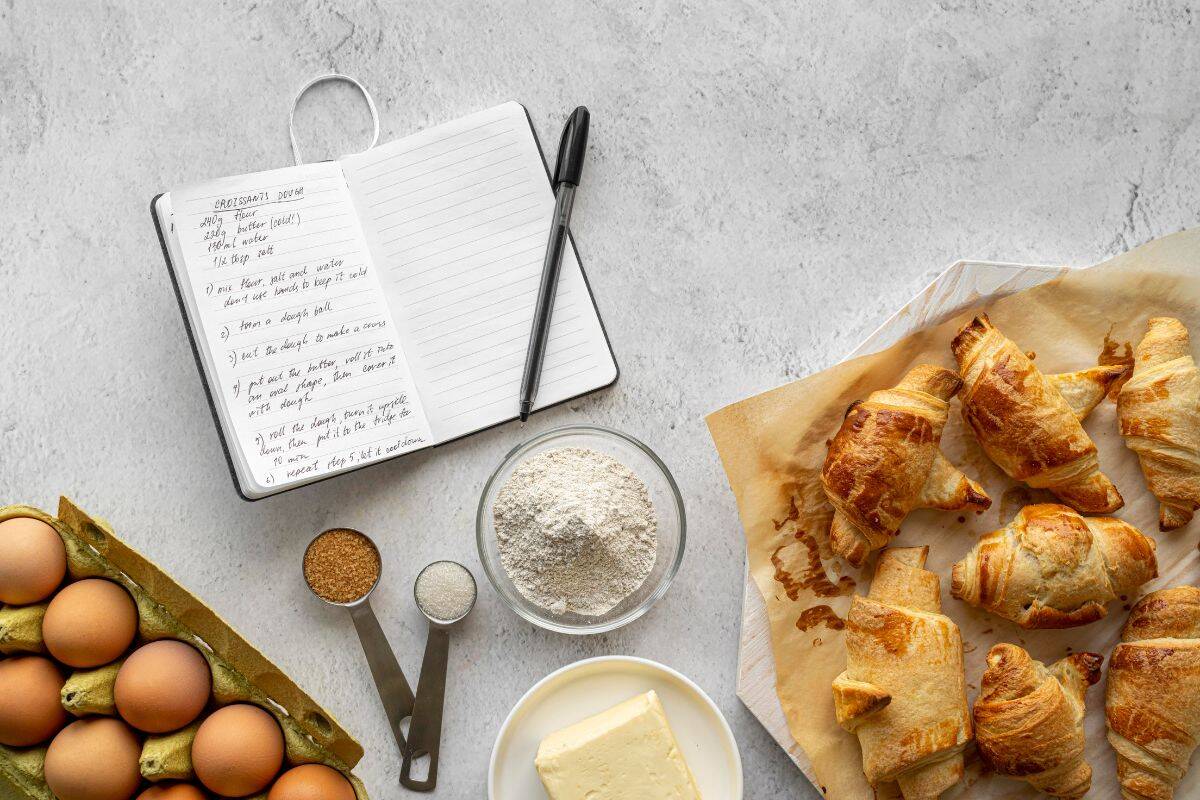
Imagine you’re on MasterChef.
Gordon Ramsay is 3 feet away.
Your soufflé batter needs exactly 1.5 cups of heavy cream, but your jug only shows ounces. Do you know how many ounces in a cup?
More importantly, do you know whether it’s fluid ounces or dry ounces?
Because those two are not the same thing, and in a professional kitchen (or your home one) mixing them up can destroy a dish entirely.
In this guide, we’ll break down how many ounces are in a cup for both dry and liquid ingredients.
You’ll get step-by-step conversion formulas, common mistakes to avoid, practical uses of ounce conversion in real recipes, and how you can use AI tools to solve any measurement problem.
Let’s dive in.
Key Takeaways
- 1 cup equals 8 fluid ounces. This rule applies to all liquid ingredients (water, milk, juice, oil, broth).
- Dry ounces are NOT the same as fluid ounces. Fluid ounces measure volume; dry ounces measure weight.
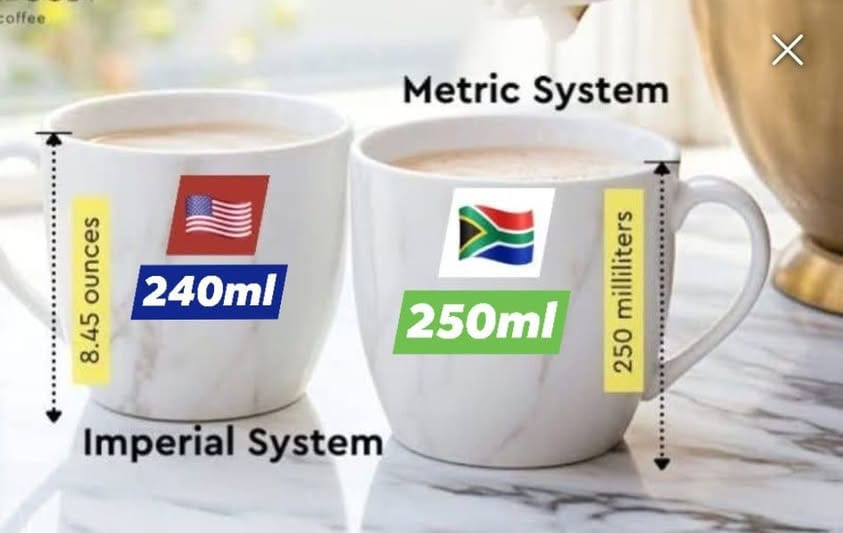
- US and UK cups are different. US cup = 240 ml (8 fl oz). UK cup = 250 ml (~8.45 fl oz).
- Always use the right type of measuring cup. Liquid measuring cups (with spout + markings) for liquids. Dry measuring cups (filled to brim and leveled) for dry ingredients.
- The formula for liquids: Cups × 8 = fluid ounces (works every time)
What are Ounces in a Cup?
An ounce (oz) is a small unit used to measure weight or volume. It is mainly used in the United States, Myanmar, and Liberia.
In cooking, there are two types of ounces:
| Fluid Ounce (fl oz) | Dry Ounce (oz) |
| Measures volume | Measures weight |
| 1 fluid ounce ≈ 30 milliliters | 1 dry ounce ≈ 28 grams |
| Example: liquids like water, milk, oil | Example: solids like flour, sugar, oats |
What is a cup?


Never Worry About AI Detecting Your Texts Again. Undetectable AI Can Help You:
- Make your AI assisted writing appear human-like.
- Bypass all major AI detection tools with just one click.
- Use AI safely and confidently in school and work.
A cup is a unit of volume used in cooking. It is not a regular mug. A measuring cup is a standard kitchen tool.
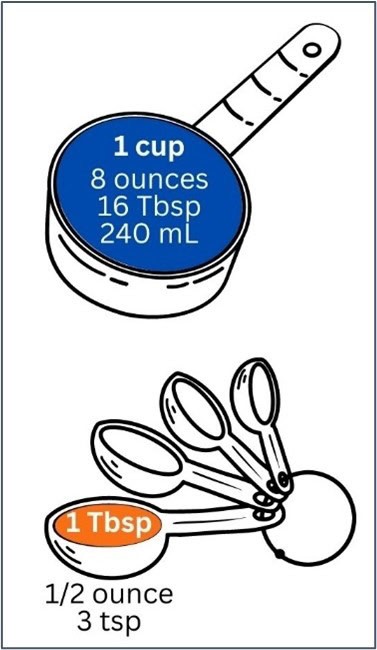
US system → 1 cup = 240 ml = 8 fluid ounces = 16 tablespoons = 48 teaspoons
UK/Metric system → 1 cup = 250 ml ≈ 8.45 fluid ounces
How many ounces in a cup?
For liquids: 1 cup = 8 fluid ounces (always).
This applies to every liquid ingredient: ounces in a cup of water is 8 fl oz. Same for milk, juice, oil, broth, cream, or any other liquid.
How many dry ounces in a cup?
| Ingredient | 1 Cup Equals |
| All-purpose flour | 4.25–4.5 oz |
| Granulated sugar | 7 oz |
| Powdered sugar | 4 oz |
| Brown sugar (packed) | 7.5–8 oz |
| Rolled oats | 3–3.5 oz |
| Chocolate chips | 6–6.3 oz |
| White rice (uncooked) | 6.5–7 oz |
| Brown rice (uncooked) | 7 oz |
| Cocoa powder | 3–3.3 oz |
| Cornstarch | 3.5–4.8 oz |
| Whole wheat flour | 5 oz |
| Butter | 8 oz (2 sticks) |
| Cream cheese | 9 oz |
| Chopped walnuts | 4 oz |
| Whole almonds | 6.7 oz |
Notice how butter happens to be 8 oz per cup, the same as how many fluid ounces in a cup of water.
Step-by-Step Conversion Formula Explained
Need to convert cups, ounces, grams, or tablespoons fast without doing the math yourself?
Try Undetectable AI’s Math Solver. Type your conversion problem in plain English, and it gives you step-by-step answers. No signup needed.
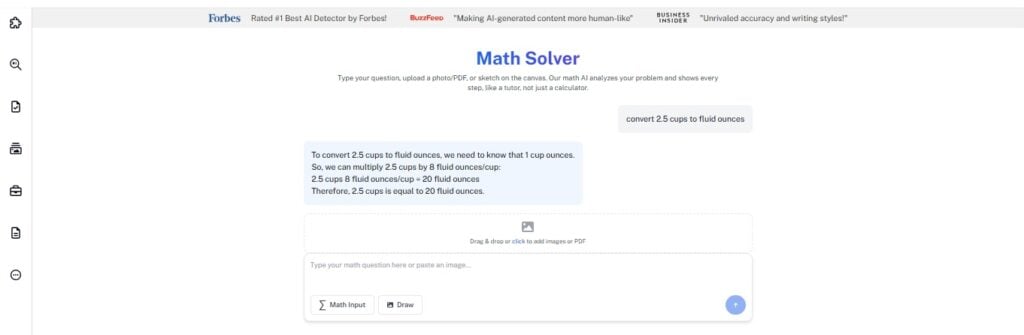
- Multiply cups by 8 for ounces
This formula applies only to liquid ingredients such as water, milk, juice, oil, broth, and cream.
Formula: Cups × 8 = Fluid Ounces
The number 8 is fixed in the US system because:
- 1 cup = ½ pint
- 1 pint = 16 fluid ounces
- Therefore, ½ pint = 8 fluid ounces
This is why how many fluid ounces in a cup always returns the same answer regardless of which liquid you’re measuring.
Conversion Examples
| Cups | × 8 | = Fluid Ounces |
| ¼ cup | × 8 | = 2 fl oz |
| ⅓ cup | × 8 | = 2.67 fl oz |
| ½ cup | × 8 | = 4 fl oz |
| ¾ cup | × 8 | = 6 fl oz |
| 1 cup | × 8 | = 8 fl oz |
| 1.5 cups | × 8 | = 12 fl oz |
| 2 cups | × 8 | = 16 fl oz |
| 4 cups | × 8 | = 32 fl oz (1 quart) |
Reverse Formula (Fluid Ounces to Cups)
Fluid Ounces ÷ 8 = Cups
Example:
24 fl oz ÷ 8 = 3 cups
Real Recipe Example
A banana bread recipe needs 1.5 cups of buttermilk, but your measuring jug shows only ounces.
1.5 × 8 = 12 fluid ounces
Measure 12 fl oz of buttermilk or use Undetectable AI’s Math Solver.
Larger Volume Reference
- 1 pint = 2 cups = 16 fl oz
- 1 quart = 4 cups = 32 fl oz
- 1 gallon = 16 cups = 128 fl oz
For full kitchen conversions (tablespoons, teaspoons, pints, quarts, gallons), check a complete measurement conversion chart for quick reference.
- Adjust for liquid or dry
This is where most people get the answer to how many ounces in a cup wrong.
The × 8 formula only works for liquids. For dry ingredients, you must account for the ingredient’s density.
The core rule is this:
- Liquid ingredients → measure in fluid ounces using a liquid measuring cup → formula: Cups × 8
- Dry ingredients → measure in weight ounces using a kitchen scale → no universal formula (depends on ingredient)
So, why can’t you use a single formula for dry ingredients?
Because density controls how much an ingredient weighs per unit of volume. Dense ingredients pack more mass into the same cup than light, airy ingredients:
- 1 cup of fresh spinach = ~1 oz (very light, lots of air)
- 1 cup of granulated sugar = ~7 oz (very dense, particles pack tightly)
- 1 cup of chocolate chips = ~6 oz (dense but not as compact as sugar)
Adjustment method for dry ingredients:
- Look up the specific ingredient’s weight-per-cup (use a trusted chart — King Arthur Baking’s Ingredient Weight Chart is the industry standard)
- Multiply: Cups needed × oz-per-cup for that ingredient
- Weigh on a kitchen scale for accuracy
Example — Adjusting a brownie recipe:
The recipe calls for 2 cups of all-purpose flour and 1.5 cups granulated sugar.
- 2 cups flour: 2 × 4.25 oz = 8.5 oz flour
- 1.5 cups sugar: 1.5 × 7 oz = 10.5 oz sugar
If you tried to use 8 fl oz as the baseline for both, you’d end up with way too much flour (16 oz instead of 8.5 oz), your brownies would come out dense, dry, and crumbly.
Tools to help adjust accurately:
- Kitchen scale (digital): Weigh ingredients directly in grams or ounces.
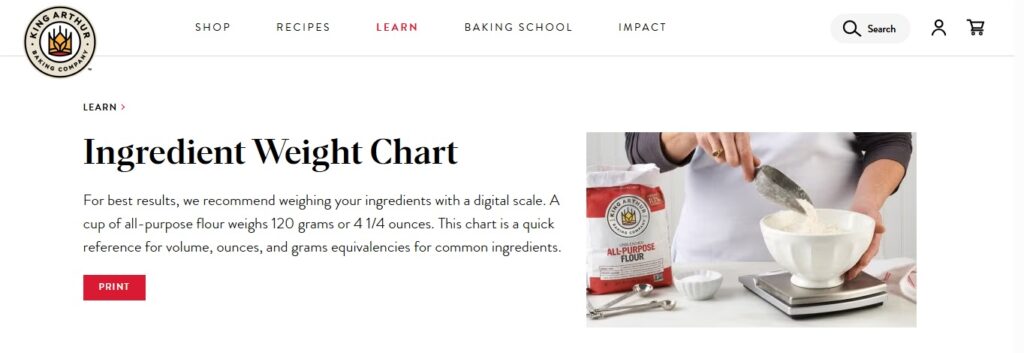
- King Arthur Baking Ingredient Weight Chart: Free online chart with weight-per-cup for 100+ ingredients.
- Undetectable AI’s Math Solver: Handles problems in plain English. Just type your requirement and it returns a step-by-step breakdown.
- Check with measuring tools
Having the right tool and using it correctly are two different things. Even with the correct formula, inaccurate technique leads to inaccurate measurements.
Liquid Measuring Cups
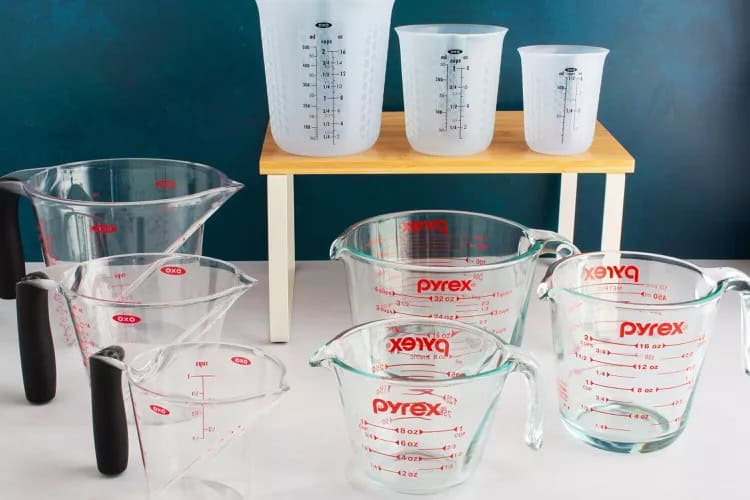
- Usually made of clear glass or plastic with a spout for pouring
- Available in 1-cup, 2-cup, 4-cup, and 8-cup sizes
- Markings show cups, fluid ounces, and milliliters on the side
- Pyrex is a well-known, reliable brand for glass liquid measuring cups
- How to read correctly: Place on a flat surface → pour liquid → bend down to eye level (meniscus level) → read at the bottom of the curve of the liquid surface (called the meniscus)
Reading while holding the cup at an angle will increase the chances of making a mistake. This gives a different reading than eye-level and can be off by ¼ to ½ oz.
Dry Measuring Cups
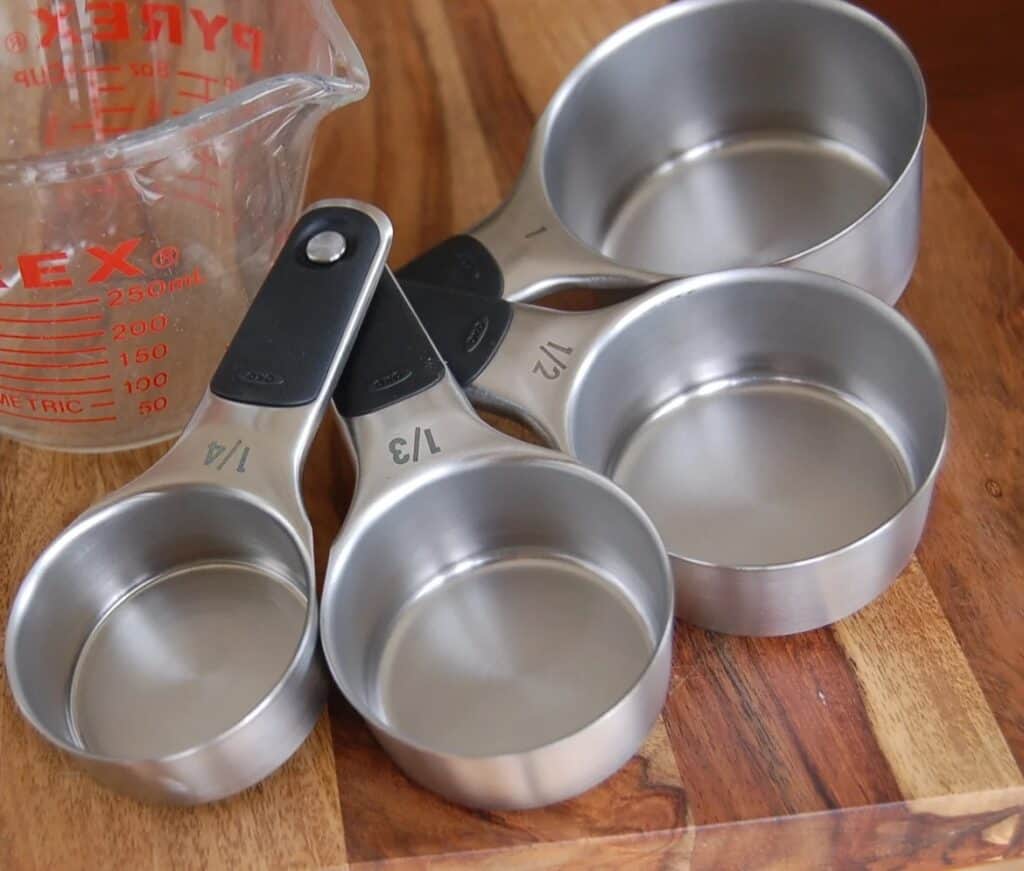
- Usually nested metal or plastic sets (1 cup, ¾ cup, ½ cup, ⅓ cup, ¼ cup)
- Designed to be filled to the brim and leveled off
- Used for flour, sugar, cocoa, oats, spices, and other dry/solid ingredients
- OXO Good Grips and standard stainless steel sets are reliable
Measuring Spoons
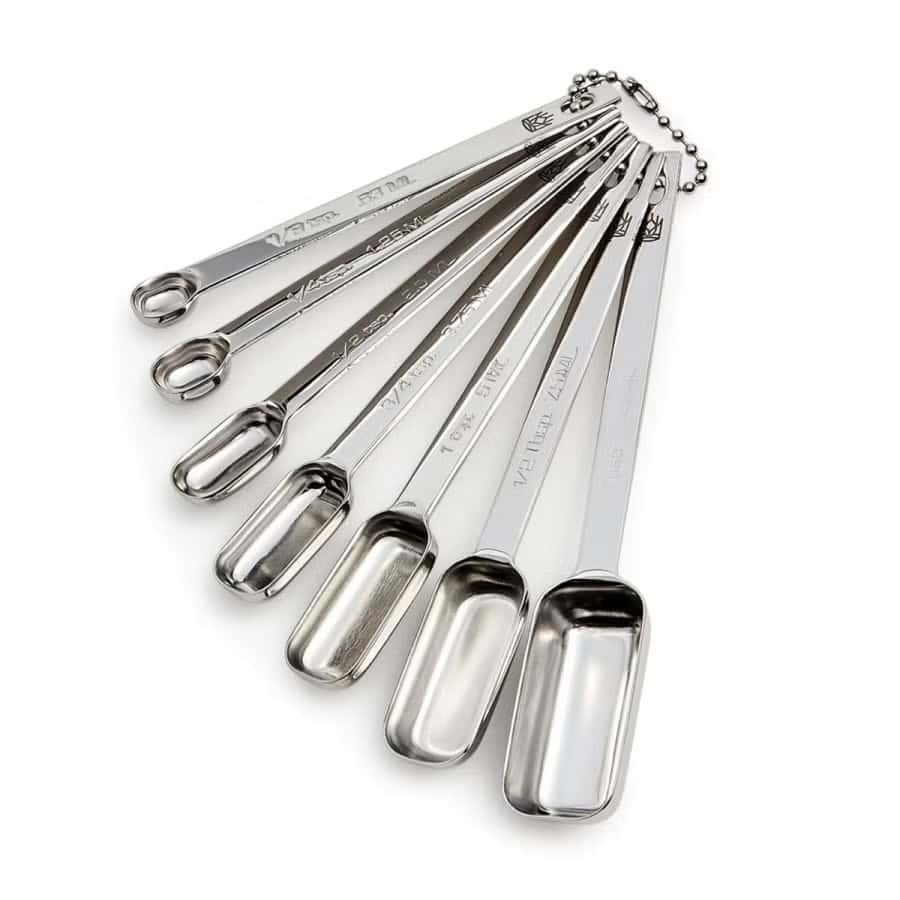
- Come in sets: 1 tbsp, 1 tsp, ½ tsp, ¼ tsp (sometimes ⅛ tsp)
- Used for both liquid and dry small amounts (vanilla extract, baking powder, salt)
- 1 tablespoon = 0.5 fl oz | 3 teaspoons = 1 tablespoon
Kitchen Scale (Digital)
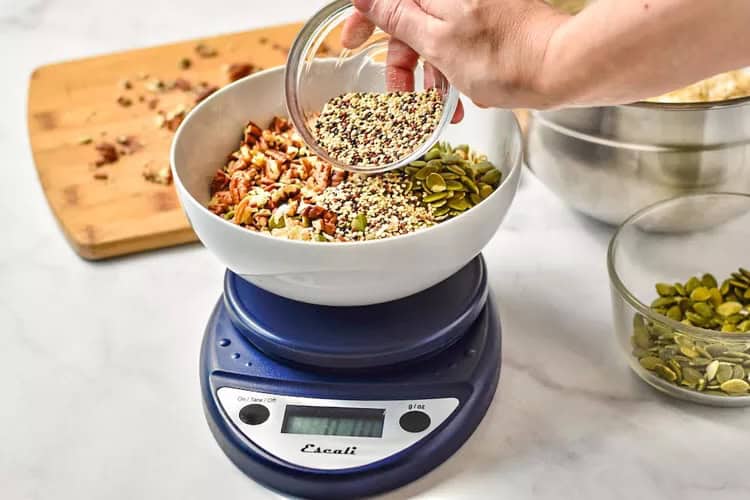
- Best tool for dry ingredients and professional/precise baking
- King Arthur Baking recommends weighing all dry ingredients for consistent results
- Target precision: at least 0.1 oz (or 1 gram) for baking
Common Errors in Measuring Ounces
Unsure which cup to grab or how to read a measurement? Undetectable AI’s AI Chat can answer any type of measurement question.
It’s your knowledgeable kitchen companion on call, available on any device.
- Forgetting liquid vs dry difference
For example: A baker reads a recipe that calls for “8 ounces of cream cheese.” They think: “8 ounces = 1 cup, easy!” and scoop 1 cup using a measuring cup without using a scale.
It’s wrong because 8 fluid ounces equals 1 cup in volume. But cream cheese weighs approximately 9 oz per cup (by weight), not 8 oz.
The baker ends up with less cream cheese than needed, which can affect the texture and density of a cheesecake or frosting.
Here’s the fix:
When a recipe says “8 oz cream cheese,” it means 8 ounces by weight. Use a kitchen scale, not a liquid measuring cup.
If you don’t have a scale, use the ingredient’s cup-to-oz chart to find the equivalent volume (8 oz ÷ 9 oz per cup ≈ 0.89 cup, or just under 1 cup).
- Using wrong measuring cup type
Someone needs ¾ cup of vegetable oil but only has dry measuring cups. They fill the cup roughly to the ¾ level and pour it in.
That’s inaccurate.
Dry measuring cups are meant to be filled to the top and leveled, and they don’t have clear lines for liquids. So when someone eyeballs a liquid inside them, the measurement can easily be off.
The opposite mistake also happens.
Using a liquid measuring cup for flour isn’t ideal either. Liquid cups have a spout and can’t be leveled properly, which can lead to compacted or overfilled flour.
The simple rule:
| Ingredient Type | Best Tool to Use |
| Liquids (water, oil, milk, juice) | Liquid measuring cup with spout and markings |
| Dry ingredients (flour, sugar, oats) | Dry measuring cups that can be leveled |
| Sticky ingredients (honey, maple syrup, peanut butter) | Liquid measuring cup (lightly spray with oil first) |
- Misreading cup markings
Someone tries to measure ⅔ cup of buttermilk using a 1-cup liquid measuring cup.
Since most cups don’t have a ⅔ line, they guess the amount between the ½ and ¾ marks, which leads to the wrong measurement.
Most liquid measuring cups only show these marks:
| Common Markings on Liquid Cups |
| ¼ cup |
| ⅓ cup |
| ½ cup |
| ¾ cup |
| 1 cup |
Because ⅔ isn’t marked, estimating between ½ cup (4 oz) and ¾ cup (6 oz) can easily create errors. For recipes like sauces or baking batters, even small measurement differences can affect the final result.
Simple ways to fix it:
- Use a cup with more markings. Some measuring cups (like certain Pyrex or OXO models) include ⅓ and ⅔ lines.
- Convert the measurement:
- ⅔ cup ≈ 5.33 fluid ounces
- Fill the cup to just above the 5 oz line.
- Use basic math:
- ⅔ × 8 = 5.33 fl oz.
- For maximum accuracy: weigh the liquid using a digital kitchen scale.
Another common mistake…
Reading the measuring cup from above. When you look down at an angle, the liquid appears higher than it actually is, which leads to under-measuring.
Correct method: Place the cup on a flat surface, bend down to eye level, and read the measurement at the bottom of the liquid curve (meniscus).
If you’re unsure about a measurement in a recipe, Undetectable AI Chat can answer questions such as “How do I measure ⅔ cup without markings?” or “How many fluid ounces in a cup of heavy cream?” and give practical guidance based on the ingredient.
Practical Uses of Ounce Conversion in Recipes
Have a recipe screenshot or photo of a cookbook page you don’t understand? Upload it to Undetectable AI’s AI Question Solver.
It reads the image, understands the question, and gives you detailed answers. Great for when recipes use unfamiliar measurement systems or you’re scaling quantities.
- Baking
In baking, ingredients must be in the right ratios for the recipe to work properly.
How many ounces in a cup matters here more than anywhere else, because even small measurement differences affect structure, texture, and rise.
Example: Scaling a recipe
| Ingredient | Original Recipe | Tripled Recipe |
| Whole Milk | 2 cups (16 fl oz) | 6 cups (48 fl oz) |
| Flour | 3 cups (~13.5 oz) | 9 cups (~40.5 oz) |
For dry ingredients like flour, using a kitchen scale is usually more accurate.
Example: Converting UK recipes
| UK Measurement | US Equivalent |
| 300 ml milk | ~1.25 cups (10 fl oz) |
| 200 g flour | ~1⅔ cups |
Sugar difference example
| Ingredient | Weight per Cup |
| Granulated sugar | ~7 oz |
| Brown sugar (packed) | ~7.5–8 oz |
- Cooking Liquids and Broths
Many soup and stew recipes measure liquids in cups.
Knowing how many fluid ounces in a cup lets you use standard grocery store containers without additional measuring.
| Container Size | Cups Equivalent |
| 32 fl oz broth (1 quart) | 4 cups |
| 14.5 fl oz can | ~1¾ cups |
Example: If a recipe says reduce by half, start with 2 cups (16 oz) and cook until 1 cup (8 oz) remains.
- Portion Control and Nutrition
Understanding how many ounces in a cup of water or milk helps with calorie tracking and portion accuracy.
| Food | Standard Serving |
| Milk | 1 cup = 8 fl oz |
| Dry oats | ½ cup ≈ 1.5–1.75 oz |
| Raw spinach | 1 cup ≈ 1 oz |
Meal prep example: If you want 6 servings of a protein shake at 1 cup each, you need 6 cups (48 fl oz) of liquid.
- Scaling Restaurant Recipes
Restaurant recipes often use fluid ounces instead of cups.
| Fluid Ounces | Cups |
| 24 fl oz heavy cream | 3 cups |
| 14 fl oz buttermilk | ~1¾ cups |
- Measuring Water for Rice and Grains
Grains usually follow simple water ratios.
| Grain | Ratio |
| White rice | 1 cup rice + 2 cups water |
| Brown rice | 1 cup rice + 2.5 cups water |
| Oatmeal | 1 cup oats + 2 cups water |
Example: 1 cup dry white rice (~6.5 oz) cooks into about 3 cups of rice.
How Undetectable AI Can Assist in Ounces Conversion
The Undetectable AI Math Solver is a free AI tool that solves typed, photo, or sketched math problems step-by-step.
Instead of only giving the answer, it shows the full calculation process, similar to a tutor.
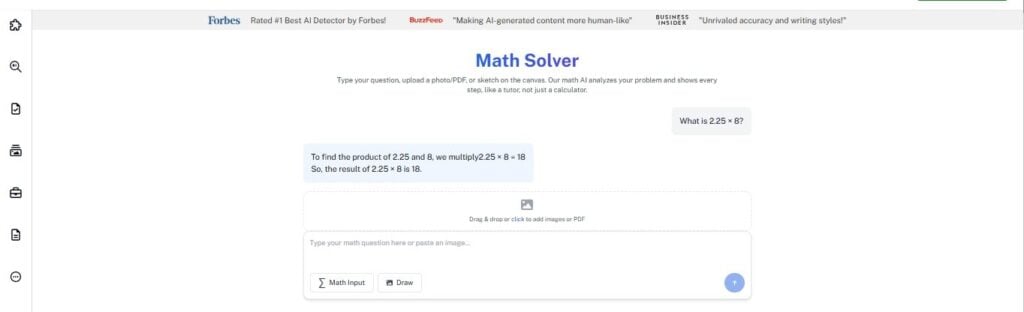
Example: Converting cups to ounces
You want to triple a recipe that uses 2¼ cups of milk, but your measuring jug only shows ounces.
Type:
“What is 2.25 × 8?”
Result:
Another example
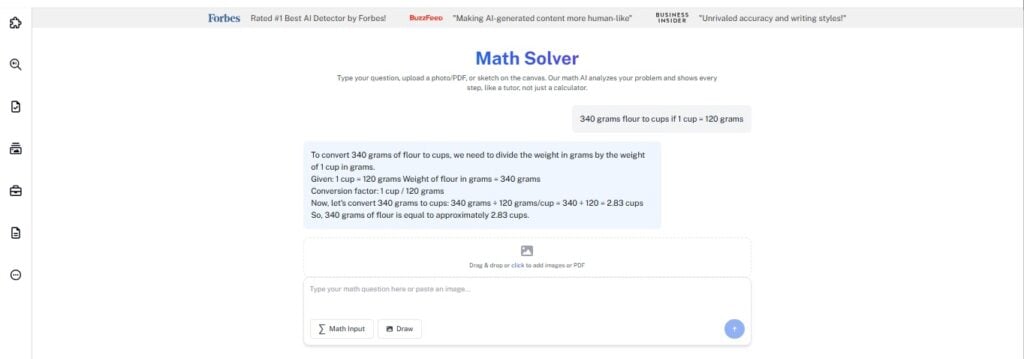
You have 340 grams of flour and want to convert it to cups.
Type:
“340 grams flour to cups if 1 cup = 120 grams”
Result:
The tool can also read photos of handwritten recipes, calculate the numbers, and explain the steps.
Other conversions it handles
| Conversion Type | Example |
| Tablespoons ↔ Cups | 16 tbsp = 1 cup |
| Milliliters ↔ Fluid ounces | 240 ml ≈ 8 fl oz |
| Grams ↔ Ounces | 28 g ≈ 1 oz |
| Metric ↔ Imperial | g, ml, cups, oz |
Sometimes the problem isn’t math, it’s understanding a recipe screenshot or cookbook page. The Undetectable AI Question Solver lets you upload an image and ask questions about it.
It supports JPG, JPEG, and PNG files (under 5MB) and uses OCR to read the text in the image.

Useful situations
- A cookbook page with unfamiliar measurements
- A screenshot of an online recipe
- A handwritten recipe card you want to convert to metric
This saves time because you don’t have to manually type the recipe and search for conversions separately.
Give our AI Detector and Humanizer a spin in the widget below!
Final Thoughts
So, how many ounces are in a cup? Here is the complete answer:
For liquids including milk, juice, oil, or any other liquid, the answer is always 8 fluid ounces.
Use the formula: Cups × 8 = fl oz. It works every time without exception.
For dry ingredients…
Answering how many dry ounces in a cup requires knowing your specific ingredient.
A cup of flour weighs ~4.5 oz. A cup of sugar weighs ~7 oz. A cup of oats weighs ~3 oz. The volume is the same; the weight changes with every ingredient.
The most important difference in all of kitchen measurement is this:
How many fluid ounces in a cup is a volume question (always 8), while how many dry ounces in a cup is a weight question (depends on density). Confusing the two is the root cause of most baking failures.
To measure accurately: use a liquid measuring cup for liquids, a dry measuring cup leveled off for dry ingredients, and a digital kitchen scale for precision baking.
When in doubt, visit and use Undetectable AI.