
Step 1: Record video ✅
Step 2: Upload video ✅
Step 3: Spend 3 hours on keyword research, get overwhelmed, eat a snack, open the tabs again ✅
Here’s the thing…
Step 1 already did Step 3 for you.
When you were recording your video, you recorded a high-intent, long-tail keyword farm.
Every time you explained a fix, answered a “how-to,” or went on a passionate rant about a specific industry pain point, you were speaking the exact language your audience is typing into Google.
So, how to use your transcripts for long-tail keywords?
Don’t worry, that’s what we’re covering in this blog.
In this blog, we’ll learn about the multimodal AI shift in 2026.
We’ll cover how to mine your transcripts for high-conversion long-tail phrases, the secret to turning video segments into individual blog topics, and the protocol for optimizing long-tail keywords without losing your human touch.
Let’s dive in.
Key Takeaways
- Transcripts convert spoken data into indexable text, helping you find long-tail keywords youtube tools often miss.
- Modern SEO focuses on search intent (Informational, Transactional) rather than just word volume.
- Accessible content (video + text) decreases bounce rates and increases dwell time.
- Structured data from transcripts helps Multimodal AI (like Gemini) summarize your content.
- Turning one video into multiple blog sections allows you to target one specific long-tail phrase per article section.
What Are Long-Tail Keywords in SEO?
Long-tail keywords are the conversational side of search.
They’re specific phrases (usually three words or more) that people use when they’re closer to making a decision.
Instead of browsing broadly, they know what they want. They just need the right answer.


Never Worry About AI Detecting Your Texts Again. Undetectable AI Can Help You:
- Make your AI assisted writing appear human-like.
- Bypass all major AI detection tools with just one click.
- Use AI safely and confidently in school and work.
Long-tail keywords examples:
| Normal Keyword | Long-Tail Keyword |
| SEO tools | best SEO tools for small businesses in 2026 |
| running shoes | best running shoes for flat feet women |
| coffee maker | affordable espresso machine for beginners |
| weight loss | how to lose weight after pregnancy safely |
Long-tail keywords usually have:
- Lower search volume
- Less competition
- Much higher conversion potential
Why Video Transcripts Are SEO Gold
Here is why transcripts have become the literal gold standard for SEO this year.
- The Indexability of the Specific Moment
Google displays Video Key Moments directly in the search results. A well-structured transcript provides the necessary context for these timestamps.
- Benefit: Instead of ranking for one broad topic, your video can rank for ten different specific sub-topics simultaneously because the AI knows exactly what you said at 04:12 vs. 08:45.
- Unintentional Keyword Diversity
When we talk, we naturally use industry jargon and specific long-tail keywords examples that we might forget when writing.
- Advantage: These unintentional keywords are often the ones with the lowest competition and the highest intent.
- Accessibility as a Ranking Signal
Google’s 2026 algorithm places a massive weight on inclusive design. A page that offers a video alongside a full text transcript is seen as a user-first resource.
- You’re catering to the person in a loud office who can’t turn on the sound, the hearing-impaired community, and the skimmer who just wants to read the main points. Search engines reward this level of accessibility with better positioning.
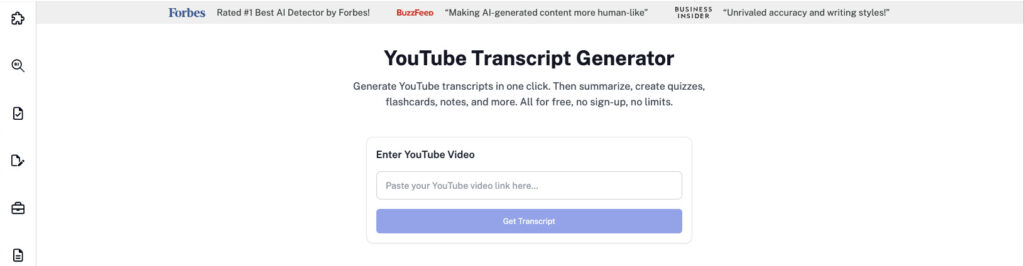
Raw captions are often a mess. If you want to turn that speech into actual data, use a YouTube Transcript Generator.
It cleans up the raw spoken data into a format that makes keyword discovery and formatting ten times easier.
Find Keyword Phrases Inside Your Transcript
If you know how to use long tail keywords in content correctly, you start by extracting them from your own voice.
Step 1: Scan for Question Patterns
Start by downloading your full transcript. Then look for question-style phrases, especially ones that begin with:
- How
- Why
- Can I
- What is
- Should I
These patterns often signal high informational intent.
For example: If your transcript says,
- “So how do you fix this issue without hiring someone?”
That sentence is practically a ready-made keyword. Search engines love question-based queries because they align perfectly with user intent.
Step 2: The “Umm/Ah” Gap (Hidden Trick)
When a speaker pauses to say “umm,” “ah,” or slow down to explain something, that usually signals a pain point. It often sounds like:
- Umm… so this is where most people get stuck…
That moment is gold. It means:
- The topic is confusing
- The audience struggles with it
- There’s emotional weight behind it
Turn that explanation into a keyword phrase. If you said,
- This is where most people get stuck with technical SEO audits,
You’ve just uncovered a strong long-tail opportunity.
Step 3: Use AI for Semantic Clustering
Now take your transcript to an AI tool and use a focused prompt like this:
Identify semantic clusters and conversational queries in this transcript that show high informational intent. Group them by topic.
This finds long-tail keywords youtube creators often overlook.
This does two things:
- Extracts related keyword themes (not just single phrases)
- Shows you how your content naturally organizes into topic clusters
Instead of random keywords, you now have structured opportunities.
Step 4: Study Competitor Caption Strategy
Look at how competitors structure their videos. Some creators now use keyword-driven captions directly inside the video frame. This can:
- Reinforce keyword relevance
- Improve engagement
- Increase dwell time
When viewers see their exact question highlighted on screen, they stay longer. And longer dwell time supports stronger rankings.
Turn Transcript Sections Into Blog Topics
- Use one long-tail phrase per article section
When creating blog content from video transcripts, focus each section on a single long-tail keyword or phrase. This is the core of understanding how to use long-tail keywords in content effectively.
Example:
| Long-Tail Phrase | Section Focus |
| How to optimize video transcripts for SEO in 2026 | Instead of sprinkling multiple keywords like “video SEO,” “transcripts,” and “AI tools,” dedicate the paragraph to explaining exactly how to optimize transcripts, using that long-tail phrase naturally in headings and body text. |
This approach ensures every section has a clear topic, and is easy for readers and AI to digest.
To make sure your blog topics and explanations stay accurate and human-like, highlight AI Detector and Humanizer when expanding transcript content. These tools help:
- Verify the topic aligns with search intent
- Ensure the explanation reads naturally for humans
- Keep your content fully AI-friendly without sounding robotic
- Expand short spoken lines into helpful explanations
When we talk, we’re brief. We say, “Use this tool, it’s great.” But search engines need to know why it’s great to rank you.
Take those short mentions and expand them into a features vs. benefits breakdown.
| Transcript (Spoken Line) | Expanded Blog Version |
| Use an SEO content writer to make things easier | AI-driven SEO content writers analyze real-time SERP data, allowing you to draft content 10x faster while maintaining a natural, human-like flow. |
- Answer questions clearly and directly
If your video has a Q&A or you’re simply answering common pain points, you’re sitting on a Featured Snippet goldmine.
Structure these as a clear FAQ section. Google’s 2026 algorithm prioritizes direct, conversation-based answers for its AI Overviews.
- Use a direct Question -> Direct Answer format.
| Question | Answer |
| Are long-tail keywords dead in 2026? | Not at all. In fact, they are more vital than ever because Multimodal AI and Voice Search prioritize natural, conversation-based queries over stiff, short-tail keywords. |
Structure Content Around Search Intent
When you structure your transcript-based content around search intent, your chances of ranking and engaging users skyrocket.
Before you move a single sentence from your transcript to your blog, you have to ask: What is the user’s goal?
| Intent Type | User Goal | Transcript Extraction Strategy |
| Informational | “I want to learn.” | Pull the “How-to” steps and “What is” definitions. |
| Navigational | “I want to find a specific page.” | Highlight brand names, specific tool mentions, and login/pricing page context. |
| Transactional | “I want to buy/do.” | Extract product comparisons, “best of” lists, and pricing mentions. |
| Commercial | “I am investigating options.” | Focus on your “Features vs. Benefits” and “Why us” segments. |
Use the Inverted Pyramid style to structure your paragraphs.
This means you give the most value-heavy answer in the first two sentences, then provide the supporting details and transcript context afterward.
Example:
If your transcript says: “The fastest way to improve video SEO is to optimize transcripts for keywords and context.”
Open your paragraph with that exact insight, then expand:
- Why it works
- Step-by-step methods
- Related tips or caveats
Optimize Long-Tail Keywords Naturally
If you use a long-tail keyword but ignore the words that naturally surround it, you’re telling the algorithm your content is thin.
To win, you have to optimize for LSI 2.0 (Latent Semantic Indexing), which focuses on the relationship between concepts, not just the frequency of words.
Here are the different ways to optimize long-tail keywords naturally:
- The 100-Word Rule: Place your primary long-tail keywords youtube phrase or main topic in the first 100 words.
- The H2/H3 Anchor: Use your keyword (or a slight variation) in at least one H2 and H3 heading. This breaks up the content and tells the AI that this specific section is the definitive answer to that query.
- Use Synonyms: Surround your main keyword with contextual synonyms. If you’re talking about a “Diet,” use terms like “Nutrition,” “Calorie intake,” and “Meal prep.”
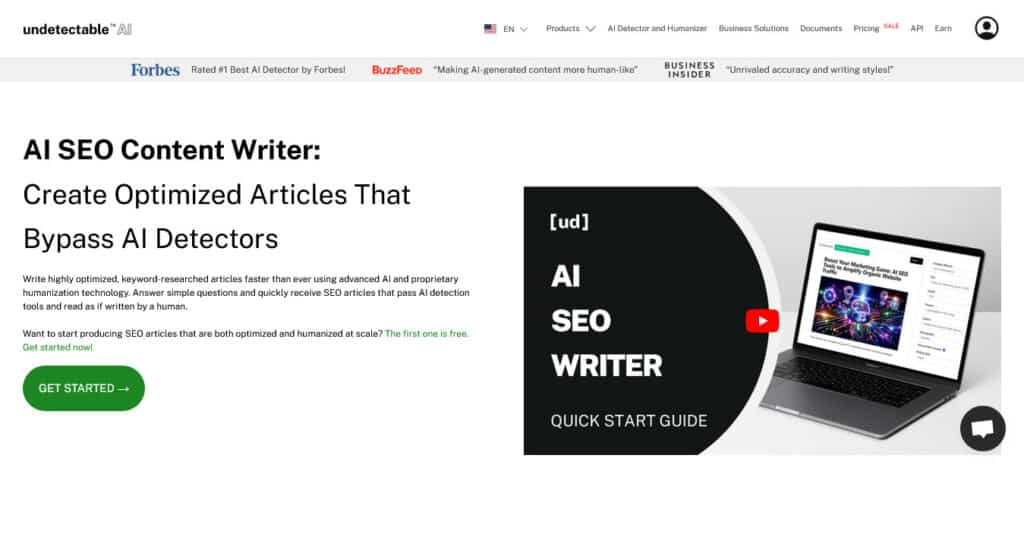
Manually mapping out every synonym for a transcript can be exhausting. This is where an SEO Content Writer becomes your secret weapon.
This tool can scan your transcript, extract the high-intent keywords, and automatically weave them into a natural flow.
This prevents keyword stuffing while ensuring your content stays semantically dense enough to rank.
Combine Multiple Videos for More Keywords
Start by building a topic cluster.
Take 3–4 videos that talk about the same subject but from different angles, and combine their transcripts into one master document.
Organize the content so it flows naturally, section by section.
When you do this, Google sees that your page covers the topic in depth and marks it as an authoritative resource.
Next, do a content gap analysis. Look at all your videos together and spot what’s missing.
For example, Video A might explain the theory, while Video B shows the step-by-step process.
By combining Video A’s “What” with Video B’s “How,” you create an Ultimate Guide that keeps readers on your page longer.
Longer dwell time signals to search engines that your content is valuable.
| Video A | Video B | Video C | Resulting Ultimate Guide |
| Beginner Tips | Common Mistakes | Advanced Tools | The Complete 2026 Roadmap |
| Intro to Topic | Case Study | Future Trends | The Expert’s Guide to [Topic] |
Use the widget below to test our AI Detector and Humanizer!
Final Thoughts
Every time you speak on camera, you are generating raw keyword data in your natural voice.
The phrases you stumble over, the questions your audience asks, the explanations you slow down to give, all of it contains exactly what people are typing into Google.
The strategy is simple: extract, structure, and optimize.
Use long-tail keywords examples from your own transcripts as a starting point.
Study the long-tail keywords YouTube approach by analyzing chapter titles and captions of top-ranking videos in your niche.
Then apply the techniques in this guide to boost your SEO rankings.
Start with one video. Pull the transcript. Find three long-tail phrases. Build from there.
That is how consistent organic growth happens in 2026.
Turn your video transcripts into polished, human-sounding SEO content with Undetectable AI.