
New technologies continue to shape and redefine diverse aspects of our lives, including how we generate and perceive online information. Among the most significant of these technologies is Artificial Intelligence, which has introduced an innovative way of creating content dynamically.
This shift has become a focal point for SEO agencies seeking to maintain their competitive edge, yet a central question remains: does google penalize ai content in search results?
One striking fact to consider is that, search engines have processed more machine-generated text than human-written text for the first time in history, forcing a massive shift in how quality is measured.
This guide explores the intricate dynamics between machine-written pages and search algorithms. We look at whether penalties actually exist, the myths surrounding these fears, and how using this technology affects your overall search presence.
Innovative services like Undetectable AI play a vital role in mediating these concerns by ensuring your strategy maintains its integrity.
As search algorithms continue to evolve, staying ahead of transformations and adjusting your approach forms the cornerstone of success.
This article is the guide you need to navigate the complex interplay between artificial intelligence and the web.
Merüljünk el benne.
A legfontosabb tudnivalók
- Google prioritizes high-quality information regardless of whether a human or a machine created it, provided it serves the user’s intent.
- Mass-produced low-value pages are the primary target for search engine crackdowns rather than the specific use of generative tools.
- Undetectable AI helps bridge the gap by refining robotic text into a more natural flow that resonates with both readers and algorithms.
- E-E-A-T principles remain the gold standard for ranking, meaning your content must demonstrate experience, expertise, authoritativeness, and trust.
Does Google Penalize AI Content? The Real Answer
The short answer is no, not directly. Google has made it clear that its systems are designed to reward helpful, high-quality content that demonstrates specific qualities.
The company’s stance is that using automation or AI to generate content with the primary purpose of manipulating search rankings is a violation of spam policies.
However, using these tools to assist in creating useful information is perfectly acceptable. The misunderstanding often comes from users who see a drop in rankings after posting thousands of unedited AI pages.
Soha többé ne aggódj amiatt, hogy a mesterséges intelligencia felismeri a szövegeidet. Undetectable AI Segíthet:
- Tegye láthatóvá az AI-asszisztált írást ember-szerű.
- Bypass az összes főbb AI-érzékelő eszköz egyetlen kattintással.
- Használja a címet. AI biztonságosan és magabiztosan az iskolában és a munkahelyen.
In these cases, the penalty is not for using AI, but for producing “thin” content that adds no unique value to the web.
What search engines actually care about is the end result for the user. If a person searches for a complex medical explanation and an AI-generated article provides the most accurate, clear, and well-structured answer, that article will rank.
The algorithm is blind to the “author” in the literal sense but highly sensitive to the “authority” of the information.
By focusing on the quality of the output rather than the means of production, you can use these tools to scale your work without fear. The risk only arises when quality control is ignored in favor of pure volume.
Észleli-e a Google az AI-tartalmat?
While search engines are incredibly sophisticated, their primary goal is not necessarily to “catch” AI, but to identify the hallmarks of poor writing that machines often produce.
Detection signals
Algorithms look for mathematical consistency that humans rarely achieve. This includes a lack of varied sentence length and a predictable use of common words.
Because AI models predict the “next most likely word,” the resulting text often has a statistical smoothness that sticks out to a machine-learning model trained to spot it.
Content patterns
Machine-generated text often follows a very rigid logical flow. It might use transitional phrases like “furthermore” or “in conclusion” with a robotic frequency.
These patterns help the algorithm categorize the text as potentially automated, especially if the facts presented are generic or widely available elsewhere without a new perspective.
Algorithm limits
Despite their power, algorithms are not 100% accurate. They can sometimes flag human writers who have a very formal or structured style, particularly non-native English speakers.
This is why search engines usually rely on a combination of signals rather than a single “AI detector” to determine a page’s fate.
Human vs AI signals
The most significant signal of human writing is the inclusion of unique experience and emotional nuance. AI struggles to replicate the way a human might describe a personal failure or a specific, niche observation.
By injecting these “human signals” into your work, you make it much harder for an algorithm to categorize it as purely automated.
Google’s Guidelines on AI and Automated Content

Adhering to official documentation is the safest way to ensure your site remains in good standing.
Spam policies
The primary guideline involves “Spammy Automatically-Generated Content.” This refers to text that is generated programmatically without adding any original value or sufficient manual oversight.
If your content is nonsensical or contains a high density of keywords just to rank, it will be flagged under these long-standing spam policies.
Helpful content system
This system is designed to promote content that people find satisfying. It looks for pages that feel like they were written by people, for people.
If your AI content feels like a “wall of text” designed only for search bots, the Helpful Content System will likely de-prioritize it in favor of more engaging material.
E-E-A-T principles
Experience, Expertise, Authoritativeness, and Trustworthiness are the pillars of modern SEO. When using AI, it is your job to provide the “Experience” part.
Adding personal anecdotes or proprietary data to an AI draft fulfills these requirements. You can find more about how to improve your site’s trust signals to stay ahead of the game.
What Triggers a Penalty or Ranking Drop
Low-quality content
If a page provides a surface-level answer that has been repeated millions of times across the web, it is considered low quality. AI often defaults to these “safe” and generic answers unless prompted otherwise.
Kulcsszótömés
Over-optimizing for a specific term is a relic of old SEO that modern algorithms easily spot. AI tools sometimes over-use the focus keyword in an attempt to be helpful, which can actually trigger a spam filter.
Over-automation
Publishing hundreds of pages a day without any human review is a major red flag. This behavior signals to Google that the site is a “content farm” rather than a legitimate source of information.
Thin content
“Thin” content doesn’t just mean short; it means content that lacks substance. An AI article that uses 1,000 words to say something that could be explained in 100 is often seen as thin and unhelpful.
Misleading information
AI models sometimes “hallucinate” or state incorrect facts with total confidence. If your site becomes a source of misinformation, your trust score will plummet, leading to a permanent ranking drop.
It is important to use an AI Detector to see how your drafts are perceived before they go live.
Examples of AI Content That Ranks vs Gets Penalized
| Tartalom típusa | Eredmény | Why it Happens |
| Helpful AI-assisted article | Ranks Well | A human edited the draft, added personal examples, and verified all facts. |
| Generic AI content | Struggles to Rank | It provides no new information and sounds exactly like every other page on the topic. |
| Human-edited AI content | Performs Better | The flow is natural, the sentence structure is varied, and it satisfies user intent. |
| Mass-produced pages | High Risk of Penalty | The volume is too high for human review, leading to errors and repetitive “thin” text. |
Tips to Use AI Content Without Getting Penalized
- Focus on value, not volume: It is better to publish one high-quality, AI-assisted article per day than fifty unedited ones. Take the time to ensure each piece provides a unique answer or a fresh perspective that isn’t found elsewhere on the web.
- Always edit and humanize AI output: Never take the first draft from a machine and post it immediately. Rewrite the introduction, change the conclusion, and move sections around to break the predictable machine rhythm.
- Add original insights and expertise: Use your own professional background to add “meat” to the AI’s “bones.” Mention a specific client story or a unique challenge you solved that the AI wouldn’t know about.
- Follow E-E-A-T principles: Ensure the author bio is real and the site has clear contact information. This builds the “Trust” part of the ranking equation that machines cannot create on their own.
- Avoid duplicate or thin content: Check your AI drafts against a plagiarism tool to ensure it hasn’t pulled too heavily from a single source. Make sure every paragraph serves a purpose and isn’t just filler text.
- Optimize for users, not just search engines: Write for the person who is actually reading the page. If the text is easy to read and helpful, the SEO results will naturally follow.
- Keep content accurate and updated: Regularly revisit your top-performing AI pages to ensure the data is still correct. Outdated information is a quick way to lose your authority in the eyes of an algorithm.
Tools and Frameworks to Improve AI Content Quality
Content optimization tools
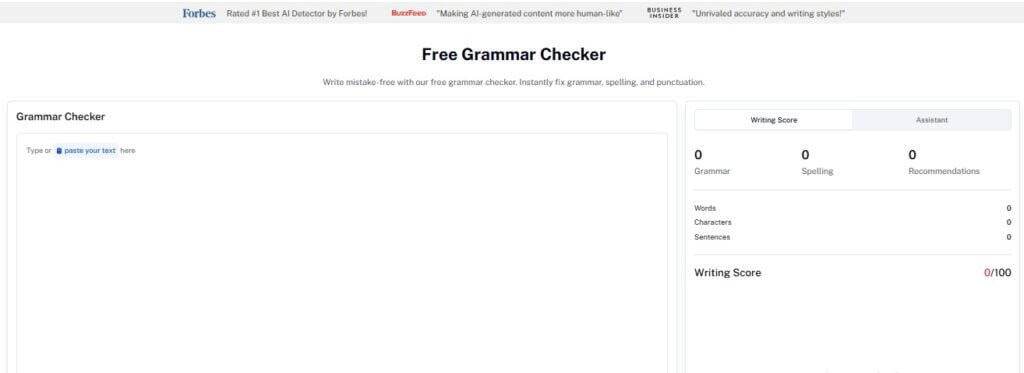
Using a tool like our Undetectable AI’s Nyelvtani ellenőrző ensures that your work is not only accurate but professionally polished.
These tools help remove the clunky phrasing that often plagues machine-generated drafts, making the final result much more appealing to both users and crawlers.
AI íróasszisztensek
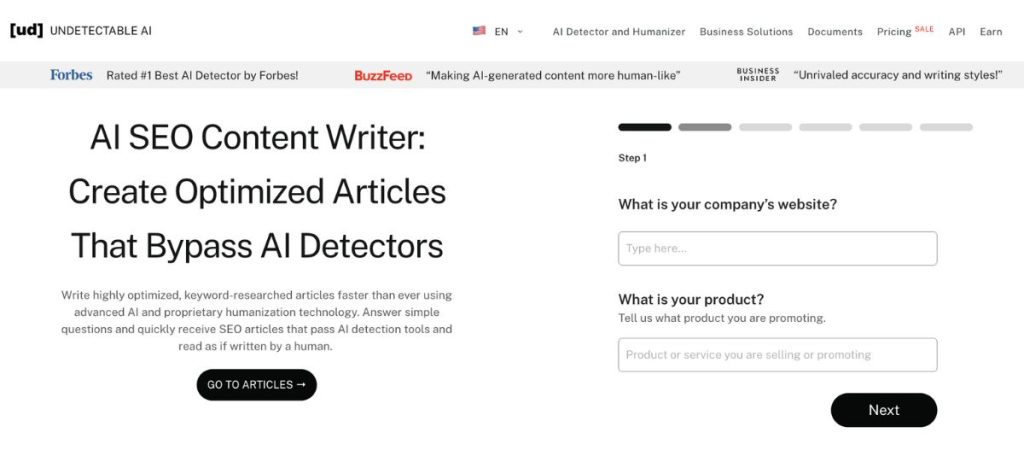
Kimutathatatlan mesterséges intelligenciánk AI SEO tartalomszerző can help you find the right balance between keyword density and natural language.
These assistants are designed to understand current ranking trends and can guide the AI to produce text that is structurally sound and ready for the SERPs.
LLMO framework basics
Large Language Model Optimization (LLMO) is the new frontier of search. It involves structuring your data so that AI models can easily summarize and reference it.
This includes using clear headings and providing direct answers to common questions within your niche.
Quality control process
Every piece of content should go through a three-step check: Fact-check, Tone-check, and Flow-check. This ensures that the machine’s efficiency is always guided by human judgment.
By maintaining this rigorous process, you turn a potential risk into a powerful competitive advantage.
AI Content vs Human Content: What Performs Better?
- Quality comparison: Human-written content often wins on depth and original research, while AI-generated content excels at broad summaries and basic “how-to” guides. The best performing pages in 2026 are almost always a hybrid of the two.
- User engagement: Readers tend to stay longer on pages that have a distinct voice and personality. AI content that has been humanized sees much lower bounce rates than raw machine output.
- Trust signals: Genuine human expertise is irreplaceable when it comes to high-stakes topics like health or finance. Users are more likely to trust a site that has a real person standing behind the information.
- Content depth: Humans can connect seemingly unrelated ideas in creative ways that machines haven’t learned yet. This depth is what often earns high-quality backlinks from other authoritative sites.
- Long-term SEO: A strategy based on pure AI volume might see short-term gains, but human-centered content is what survives algorithm updates over several years.
Can You Rank With AI Content in 2026?
- Current ranking trends: Search results are becoming more personalized. Content that directly answers specific, long-tail queries is ranking higher than broad, generic articles.
- AI content performance: Pages that use AI for data analysis and outlining but human editing for final prose are currently dominating the top spots in competitive niches.
- Role of human editing: Manual review is no longer optional. The “human touch” is what prevents your content from being categorized as low-value automation.
- Future expectations: Mint AI technology continues to advance, the gap between machine and human writing will close, making the “Helpfulness” of the content the only metric that truly matters.
- SEO sustainability: Building a brand, not just a site, is the key to longevity. Use AI to help you build that brand faster, but never let it take the driver’s seat of your creative direction.
How Undetectable AI Can Help Improve SEO Content
Undetectable AI is an essential partner for anyone looking to scale their content without losing their search engine rankings.
By analyzing the linguistic DNA of your text, the platform identifies the exact patterns that trigger “AI” flags in search algorithms.
Humanize AI text
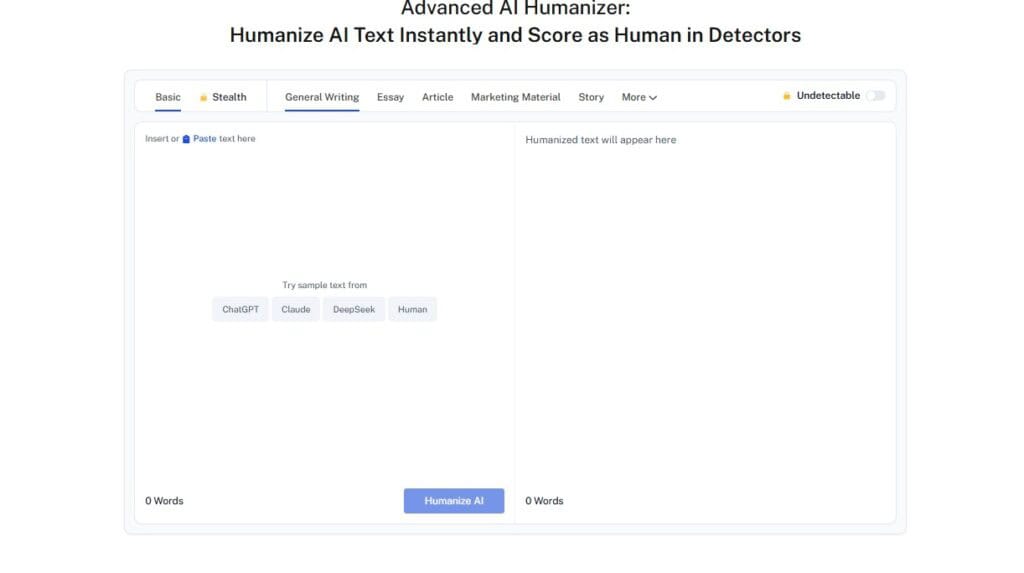
Kimutathatatlan mesterséges intelligenciánk AI Humanizer goes beyond simple word swapping. It reconfigures the rhythm and complexity of your sentences to match the natural “burstiness” of human speech.
This ensures that your work resonates with readers and maintains the engagement signals that search engines love.
Improve readability
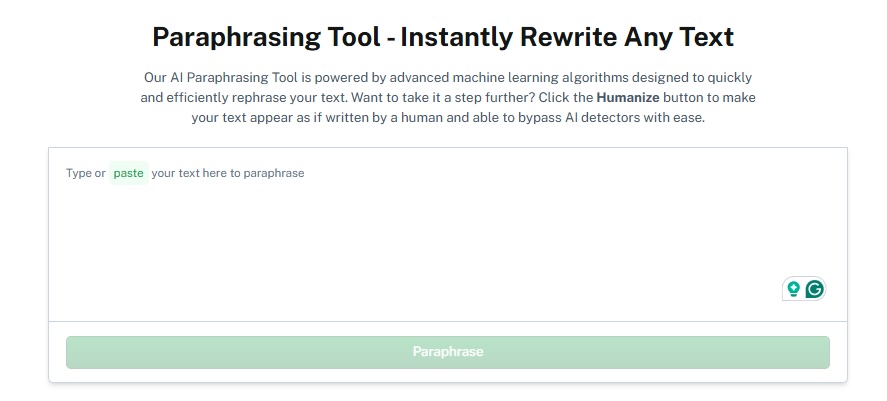
Machine-generated text is often dry and hard to scan. Our Parafrázis eszköz helps smooth out these clunky transitions, making your content more accessible to a wider audience. This leads to longer time-on-page and better overall SEO performance.
Reduce patterns
By breaking the predictable loops of machine language, you prevent your site from being flagged as “low-value automation.”
This allows you to leverage the speed of AI while maintaining the high standards of a human-led editorial team.
Tapasztald meg az AI Detector és Humanizer programunkat az alábbi widgetben!
GYIK
Does Google have an AI content detector?
While Google doesn’t have a public “AI detector,” its algorithms are designed to identify the hallmarks of low-quality, automated content that doesn’t help users.
Is it safe to use AI for my business blog?
Yes, as long as you review and edit the content. Using AI to help you write more clearly or brainstorm ideas is a standard practice in modern digital marketing.
Will my site get banned for using ChatGPT?
No, you won’t get banned for using a specific tool. You only risk penalties if you use those tools to generate spam or unhelpful, repetitive content.
How can I make AI content more helpful?
Add your own unique insights, include real-world data, and make sure the text is formatted for a great user experience with clear headings and bullet points.
What is the “Helpful Content” update?
It is an ongoing algorithmic shift that favors content created for people, rather than content created primarily for search engine rankings.
Következtetés
Google does not inherently penalize AI-generated content. The algorithm’s primary goal is to provide the most relevant, valuable, and high-quality results for users, regardless of whether the words came from a person or a machine.
However, the risk of a ranking drop is very real if you prioritize speed over substance. To succeed in 2026, you must find a balance between machine efficiency and human oversight.
By using tools to refine your drafts and ensure they remain helpful and unique, you can navigate the ever-evolving world of search with confidence.
Próbálja ki a címet. Kimutathatatlan AI to refine your writing and ensure your work stays human and impactful.