Claude AI can draft an essay, a press release, or a product page so smoothly that even seasoned editors do a double take. So how do you tell when the polished text on your desk came from Claude AI instead of a person?
A 2026 Pew Research Study revealed that about 49% of Americans use AI chatbots, with roughly 6% saying they use Claude. This popularity increases the risk that undisclosed AI-generated content will make its way into school assignments, official publications, and online content undetected.
If AI-generated content threatens your content integrity, learning effective detection strategies should be a priority. In this article, we discuss how Claude works, the signals it produces, and how to identify Claude content through a combination of manual review and AI detection.
Key Takeaways
- No method can definitively prove Claude wrote a text, so the most reliable approach is combining manual review with AI detection.
- Claude’s own watermark can’t help ordinary users, because only Anthropic holds the key, so third-party detectors can’t read it.
- Claude has recognizable habits, such as sentence fragments, colon or em dash reveals, stacked hedges, and filler announcements like “Here’s the thing”, but these shift with model updates and with the style a user requests.
- AI detectors estimate likelihood using signals like perplexity and burstiness, and they rarely identify which specific model wrote a text.
- TruthScan was the only detector to explain its scores with a short analysis and key indicators, while Originality AI and Pangram only highlighted sentences.
Is Claude Content Detectable?
As of writing, no method can definitively confirm whether Claude generated a piece of content. However, a combination of manual judgment and AI detection help you make informed judgments about a piece’s origins.
Claude reproduces enough recurring writing patterns for manual judgment to identify potential signs of AI-generated text. Meanwhile, AI detection can assess similarities between suspicious text and Claude-generated samples, which provides additional evidence for evaluating its likely origin.
It is worth noting that Claude plans on implementing an invisible watermarking system. However, only Anthropic and its official detection tools can access the key that uncovers these watermarks.


Never Worry About AI Detecting Your Texts Again. Undetectable AI Can Help You:
- Make your AI assisted writing appear human-like.
- Bypass all major AI detection tools with just one click.
- Use AI safely and confidently in school and work.
Can AI Detectors Identify Claude Content?
AI detectors can measure the likelihood that AI created or edited a piece of content. They calculate likelihood scores by scanning inputs for patterns common to AI-generated samples in their training data.
However, very few detectors can identify the specific model that produced an output. If model attribution matters, manually comparing text against Claude-generated samples might provide more clues, though neither method can provide reliable confirmation.
Does Claude Have A Watermark?
Yes. Anthropic plans on training future Claude models to produce invisible statistical watermarks in their text outputs. This is to comply with the transparency rules of the European Union’s AI Act, which require generative engine providers to make synthetic outputs identifiable and machine-readable.
How Does Watermarking Work?
Claude produces responses predicting continuations to a unit of text one-by-one until it forms a complete idea. The words or phrases it chooses come from the patterns that had frequently appeared in its training data.
For example, if the tool generates the phrase “The vanilla ice cream tastes…” more samples in training data are likely to say “sweet,” than “spicy,” which influences the generation tool’s overall choice.
However, there are times where Claude must choose between two or more near-equally probable choices. For example, the phrase “The vanilla ice cream tastes…” might prompt Claude to choose between the options “sweet,” “creamy” or “subtle.” Since all are appropriate responses, Claude selects the continuation at random.
Claude embeds its watermark within these low-stakes choices. Rather than selecting words at random, the model follows a statistical pattern encoded within a proprietary key. This subtly shifts the probability of certain word choices, creating a pattern that people with access to the corresponding key can detect.
Can AI Detectors Flag Claude Watermarks?
No. Claude produces watermarks through a statistical pattern that only Anthropic has access to. Third-party AI detectors cannot identify this pattern and instead rely on the patterns they have learned from training data.
Does Claude Have A Recognizable Writing Footprint?
Yes and no. While Claude does not follow a fixed writing template, its training and post-training processes have encouraged a tendency toward specific writing patterns for prompts that do not specify a style or tone.
Whether Anthropic deliberately encouraged these patterns is unclear, but they appear frequently enough for readers to recognize them.
A few writing patterns people have noticed in Claude include:
- Fragments: Claude may use short, incomplete sentences to emphasize a point or create a deliberate pause.
- Colon or em dash reveals: Claude sometimes introduces a concept with a short phrase followed by a colon or em dash, then provides a brief explanation or elaboration (e.g., “The explanation: compartmentalization”).
- Hedge stacking: Claude may combine several qualifying phrases in one sentence, such as “It may potentially suggest” or “This could perhaps indicate,” making statements sound overly cautious.
- Announcements: Often, Claude will add filler announcements before stating a point. (e.g. “Here’s the thing,” “Here’s why it matters.”)
These writing patterns can change as Claude’s models evolve and adapt through training and post-training. Users can also influence the output by specifying a particular style or tone in their prompts.
Manual analysis may work for the few samples with limited editing and prompt specifications, but it can miss outputs that use a different writing style.
Claude Signals AI Detectors Look For
Though AI detectors lack access to the private key that decodes Claude’s hidden watermarks, they can still calculate the likelihood that AI created a piece of content by scanning it for statistical and linguistic patterns common to Claude outputs. We go over common signals below.
Perplexity
As mentioned above, Claude selects words based on statistical probabilities. AI detectors work backward from this principle: they measure word predictability to estimate the likelihood that AI generated a piece of text.
This measure is called perplexity. Higher perplexity or word predictability implies that the writer could conceptualize creative new ways of expressing an idea. Meanwhile, lower perplexity indicates a tendency toward safer word sequence, a trait common to AI-generated writing.
Burstiness
Typically, human writers will vary sentence and paragraph length to convey emphasis, tone, or emotion. In contrast, AI tools lack an internal mechanism for subjectively understanding emphasis, tone, or emotion, and instead reproduce patterns from samples in training data.
The generation process will typically favor choices that fit familiar linguistic patterns, which results in predictable and consistent sentence structures.
Linguistic Patterns
As mentioned above, Claude produces recurring linguistic patterns that readers might be able to flag. AI detectors can also analyze submitted text for these patterns if exposed to Claude-generated samples in training.
However, AI detectors rarely differentiate the specific model used to produce an output. When running analyses, they compare text against patterns that appear across outputs from all models, rather than singling out patterns unique to each.
Examples of AI-generated linguistic patterns AI detectors typically look for include:
- Vocabulary
- Syntax
- Sentence structure
- Discourse structure
- Stylistic consistency
How Major Detectors Perform on Claude Text
To help you determine which AI detector to use on suspicious text, we tested a few of today’s top AI detectors: Originality AI, Pangram, and TruthScan. We used each detector to analyze one unedited Claude output, one lightly edited Claude output, and a human-written essay pulled from The Crimson’s 2020 list of successful Harvard essays. Each sample was around 400 to 600 words long.
Here are the results of the test:
| Sample | Originality AI | Pangram | TruthScan |
| AI Sample | 100% AI | 100% AI | 84% AI |
| Edited AI Sample | 100% AI | 100% AI | 80% AI |
| Human-Written Sample | 100% Human | 100% Human | 27% AI (Likely human) |
Originality AI
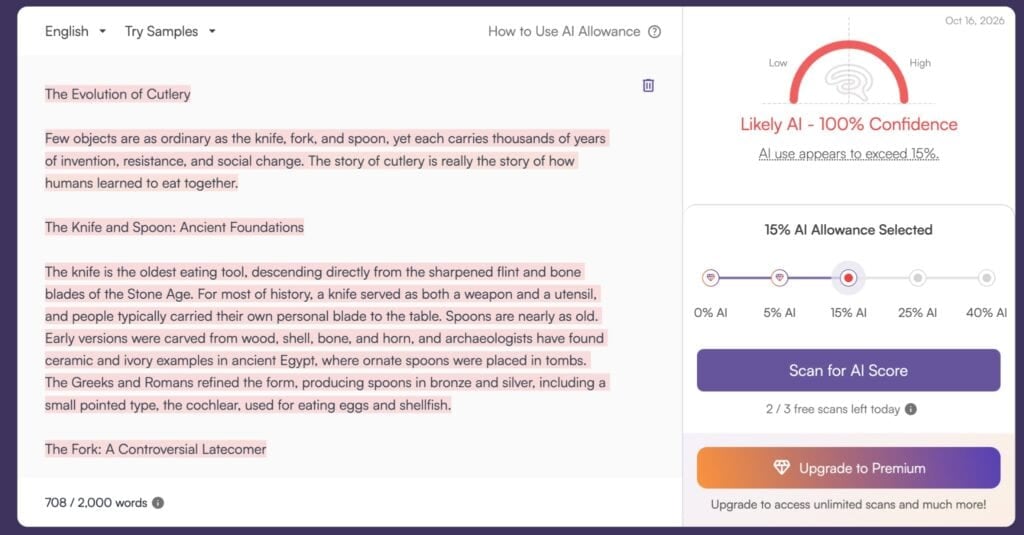
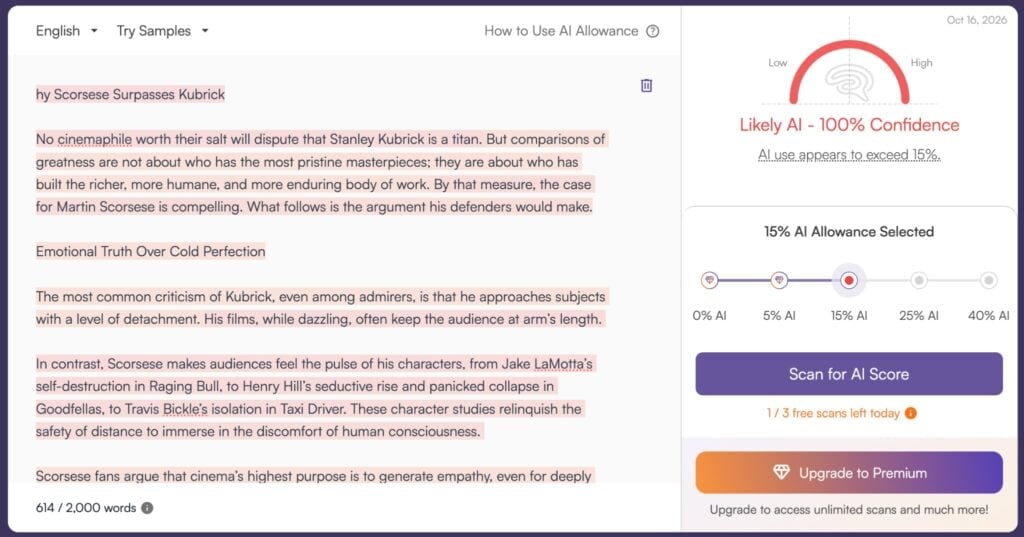
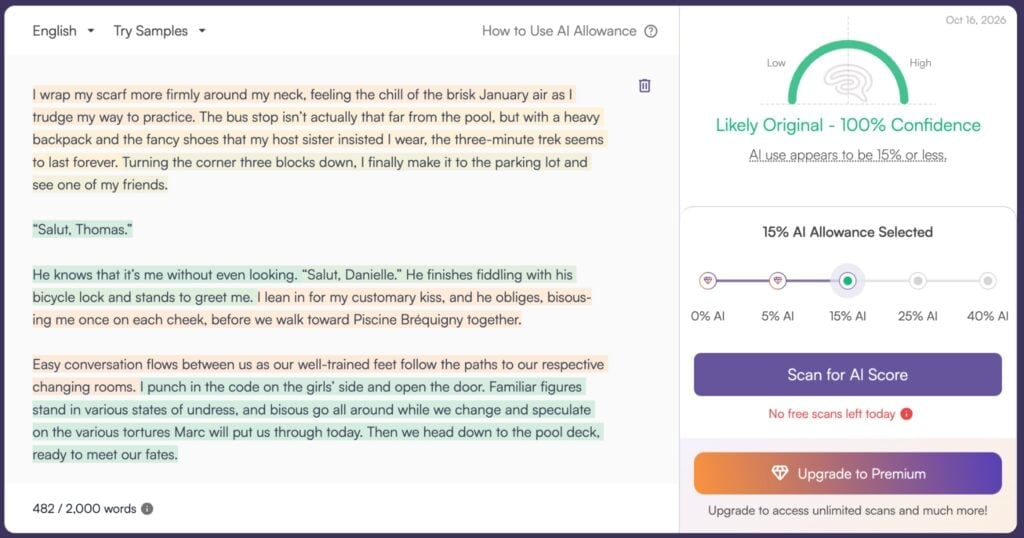
Originality AI accurately classified the AI samples as 100% AI written and the human sample as 100% original. However, it does not explain the reasoning behind its verdicts beyond highlighting suspicious sentences. The lack of information makes the evaluation process more opaque, leaving reviewers to guess the reasons each statement triggered suspicion.
Pangram
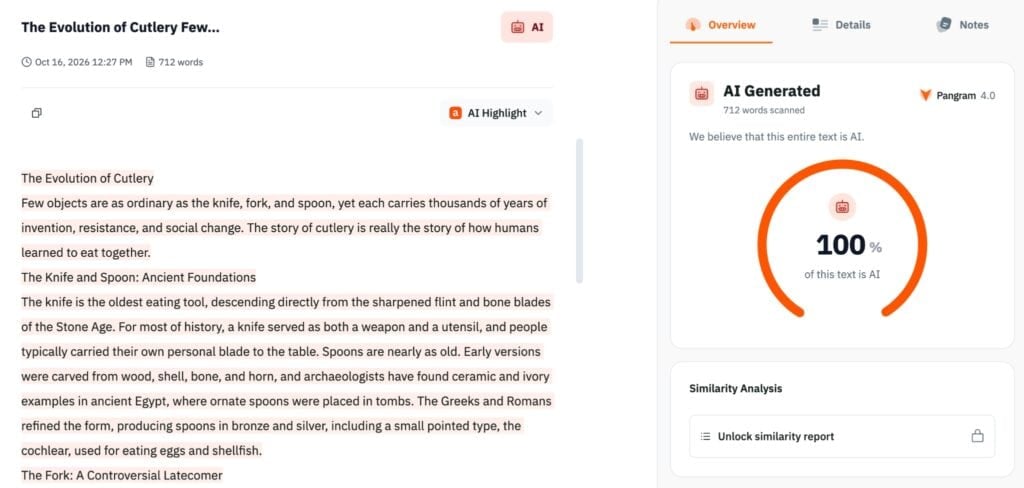
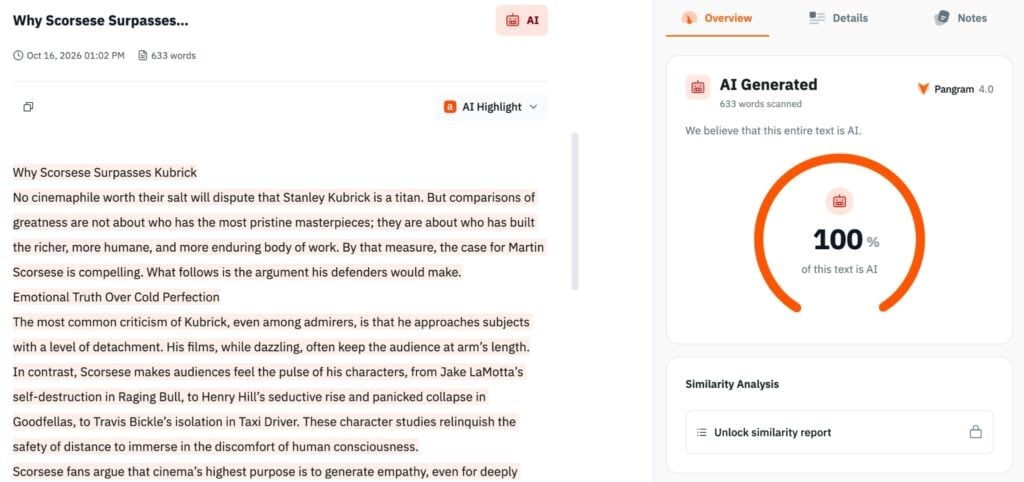
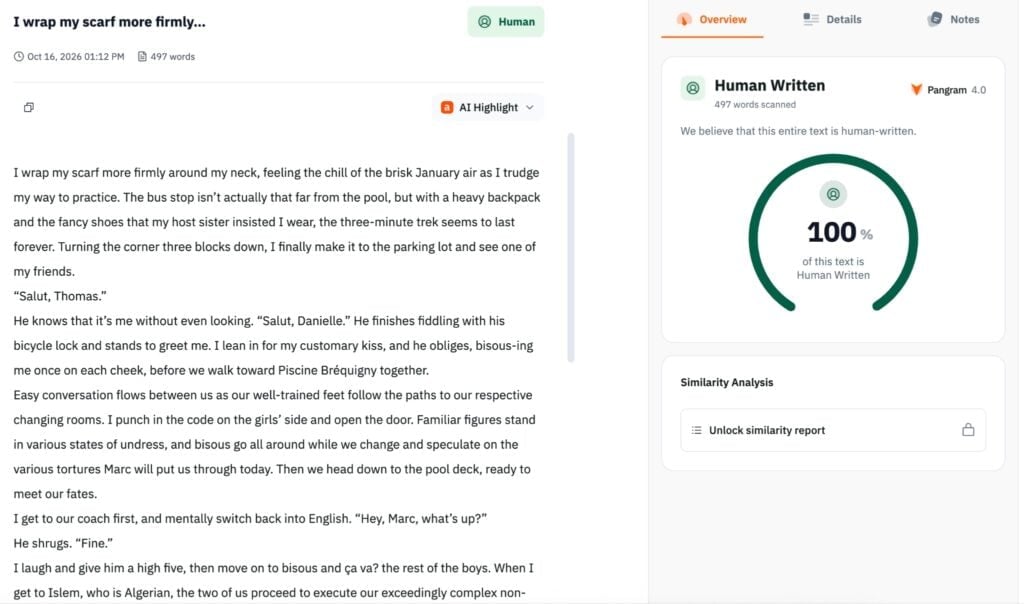
Like Originality AI, Pangram accurately classified all samples but did not provide insight into its decision-making process. However, Pangram’s sentence-level highlights provide less color variety, making it harder to isolate suspicious passages. The lack of information forces readers to infer how the detector came up with the score.
TruthScan
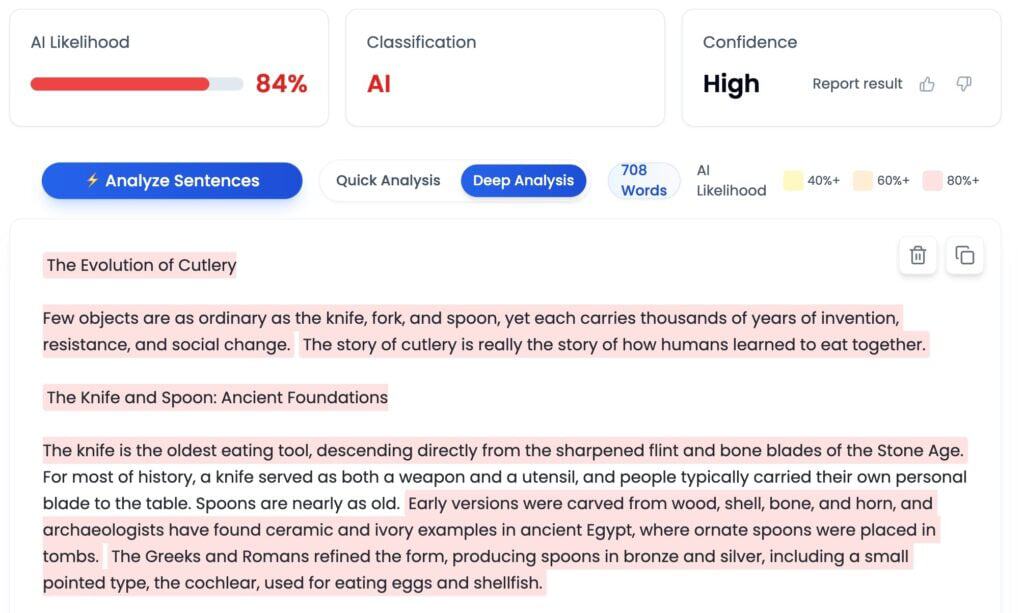
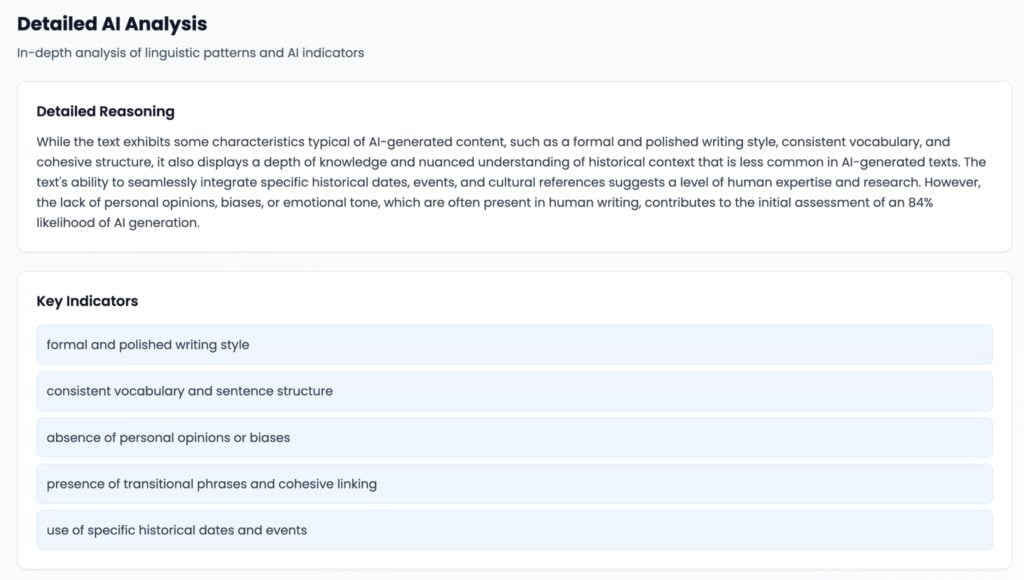
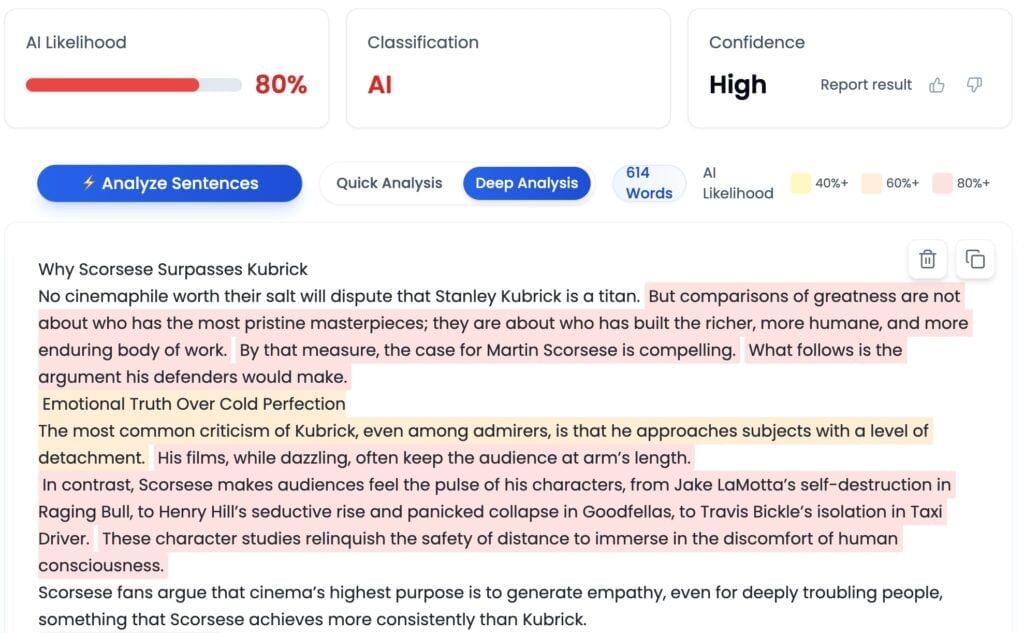
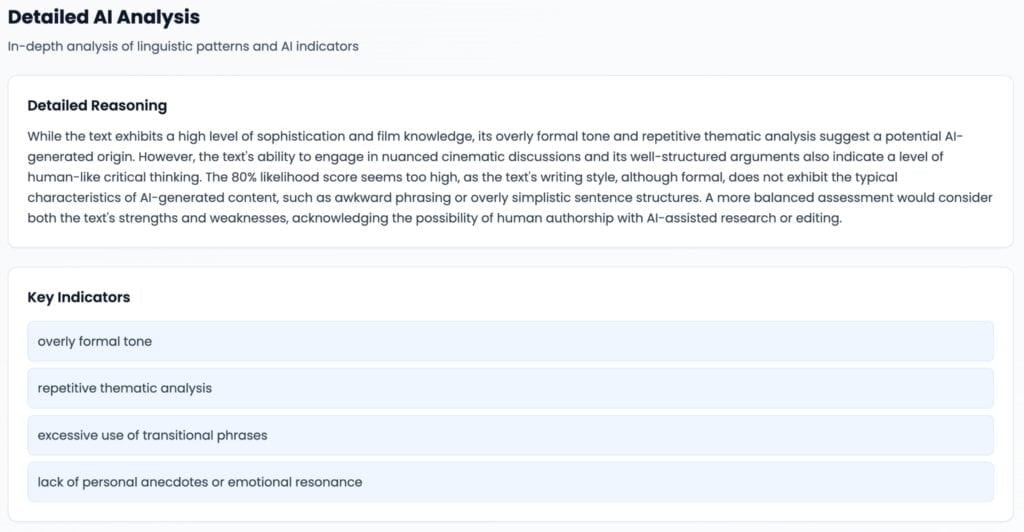
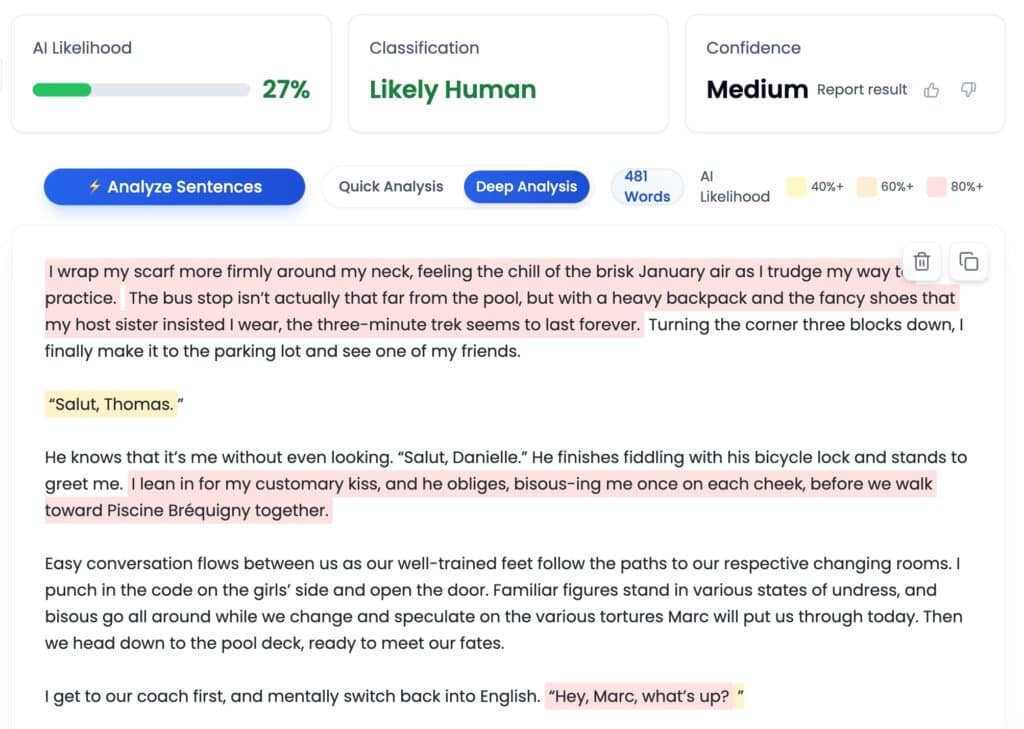
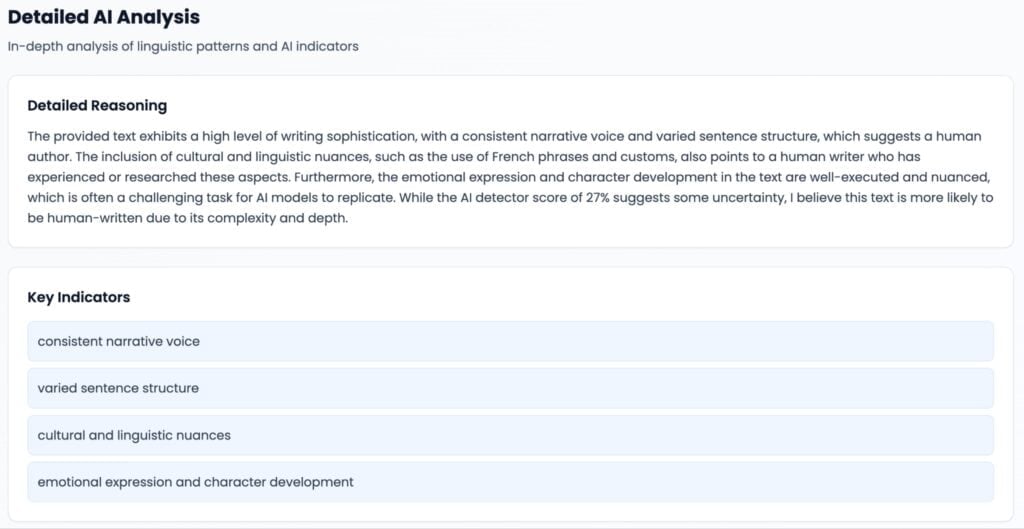
Like the other detectors tested, TruthScan correctly classified all samples. However, it also offered greater insight through its detailed analysis section. It explained the reasoning behind each detection score in a short paragraph, then listed the key indicators that suggested AI involvement or human authorship.
A Step-By-Step Guide to Detecting Claude Content
While no method can explicitly confirm that Claude generated an output, a strategic combination of manual investigation and AI detection can surface patterns common to AI writing. We outline how in the steps below.
Step One: Analyze the Sample Manually
The first step is to manually scan the suspected text for linguistic tells commonly associated with Claude and other generative engines. Examples of AI signals include repetitive sentence structures, predictable phrasing, and overuse of transition words.
AI-generated work will also lack depth and personal insight. They rely on broad generalizations, often scratching the surface of a point rather than building a well-supported argument.
In contrast, human written work will often support personal opinions through personal anecdotes and examples. They provide specifics rather than repeating arguments that already proliferate elsewhere.
Step Two: Compare Text With Past Writing
Stylistic differences can serve as a potential signal of AI use, especially when these differences occur across works published within short time-frames. Though these changes might arise from the author revising their approach or receiving editorial assistance, they warrant closer examination when combined with other indicators.
If you have access to the author’s previous work, compare it with the suspected sample. Look for noticeable differences in vocabulary, sentence structure, tone, paragraph organization, and level of detail.
Step Three: Consult an AI Detector
As mentioned, AI text detectors can help you quickly assess whether a sample contains patterns associated with AI-generated writing. Most detectors train on Claude models, studying outputs from the Haiku, Sonnet, Opus, and Fable tiers to identify patterns that distinguish them from human-written content.
Most tools will highlight passages, isolating the sentences that are most like AI-written outputs. Tools like TruthScan can also provide written explanations of the patterns that contributed to the overall detection score. You can compare these details with your manual observations to build a stronger assessment.
Frequently Asked Questions
Can AI detectors flag content rewritten by Claude?
AI detectors can analyze content for signals commonly associated with generative AI. However, they use these signals to calculate the likelihood that AI produced an output rather than to provide a definitive verdict. Additionally, very few AI detectors can explicitly identify the model used.
Does Claude have a watermark?
Yes. In compliance with the EU AI Act, Anthropic plans to embed watermarks in all text generated by Claude models launched on or after August 2, 2026. However, only Anthropic and its official detection tools can access the key that makes these watermarks detectable.
Will rewrites make Claude-generated text undetectable?
It depends on the extent of the rewrites. Heavy revisions may erase the linguistic and statistical patterns that AI detectors use to flag AI-generated content, thus reducing the likelihood of detection. In contrast, light rewrites might still maintain these patterns, making detection easier.
Do Claude rewrites remove watermarks?
As with the above question, it depends on the extent of the rewrites. A rewrite that replaces every word removes the patterns that make the watermark detectable. Meanwhile, light rewrites may preserve these patterns.
Final Thoughts
Claude outputs leave recurring patterns that both skilled reviewers and AI detection tools can recognize. When evaluating suspicious text, use a combination of manual investigation and AI detection to reach the most informed verdict.
Undetectable AI’s AI Detector is a great option for free text detection. Powered by TruthScan, it scans text for statistical and linguistic patterns common to AI outputs, then combines these signals to calculate the likelihood of AI involvement.