Many people assume that ChatGPT generates responses by copying phrases and sentences from stored material. However, the truth is more nuanced.
Below, we explain how ChatGPT generates text, when its output can create plagio risks, and how to use it responsibly without violating academic, professional, or publishing standards.
Entriamo nel merito.
Punti di forza
- By design, ChatGPT produces original wording. It generates responses based on learned predictions rather than copying from a bank of sources.
- However, using ChatGPT is not plagiarism-free because it still sometimes generates small amounts of text that resemble existing material, such as quotations, standardized language, or widely repeated content.
- Using ChatGPT to paraphrase ideas, frameworks, and data belonging to other sources also counts as plagiarism.
Does ChatGPT Plagiarize? The Straight Answer
ChatGPT does not plagiarize in the traditional sense. By design, generative AI models aim to produce content with completely original wording, rather than reproducing identifiable sources verbatim.
However, this distinction alone does not make AI writing risk-free. Using ChatGPT may be considered plagiarism in specific scenarios, such as the following:
- ChatGPT may still produce writing that resembles existing material. This usually happens when prompted to pull from well-known quotations, boilerplate language, or other widely repeated content.
- Some authors use ChatGPT to paraphrase ideas, frameworks, and data created by other sources. Failing to give these sources proper attribution makes the work plagiarism.
How ChatGPT Actually Generates Text
ChatGPT generates responses by applying learned language patterns to new prompts and conversation contexts. This process usually produces new wording instead of reproducing existing text, reducing the risk of plagiarism.
Non preoccupatevi più che l'intelligenza artificiale rilevi i vostri messaggi. Undetectable AI Può aiutarvi:
- Fate apparire la vostra scrittura assistita dall'intelligenza artificiale simile all'uomo.
- Bypass tutti i principali strumenti di rilevamento dell'intelligenza artificiale con un solo clic.
- Utilizzo AI in modo sicuro e con fiducia a scuola e al lavoro.
Training Data vs Verbatim Storage
ChatGPT doesn’t plagiarize by default because it’s not designed to return exact copies of stored content. Instead, it learns statistical patterns from training data.
When a user enters a prompt, it applies these learned patterns to the conversation’s context to predict the next unit of text, called a token. It generates responses one token at a time until the thought, sentence, or paragraph is complete.
Why Two People Get Different Answers to The Same Prompt
Because ChatGPT generates responses one token at a time rather than retrieving exact copies of existing phrases, answers typically vary from prompt to prompt.
Differences in conversation history, system instructions, model version, settings, or the model’s sampling process can lead ChatGPT to predict different responses, even when users phrase prompts the exact same way.
How Original are ChatGPT Outputs? A Demonstration
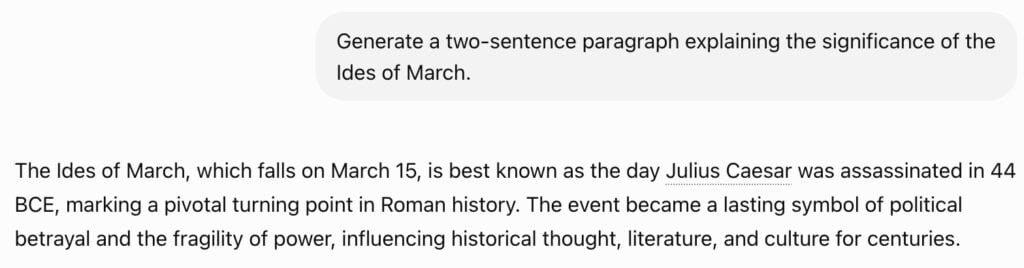
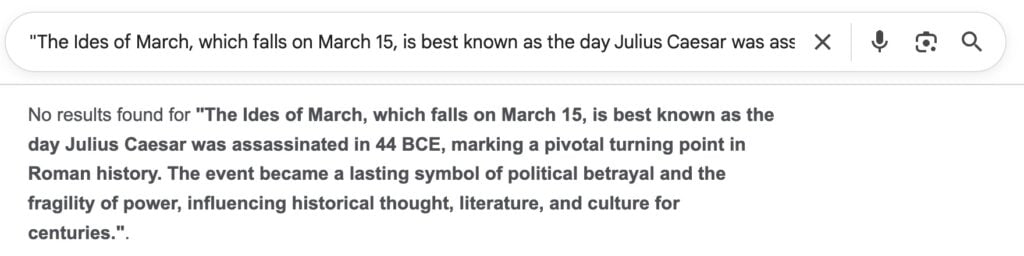
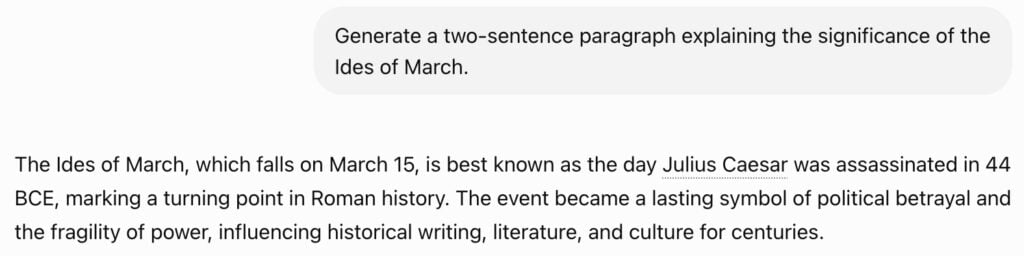
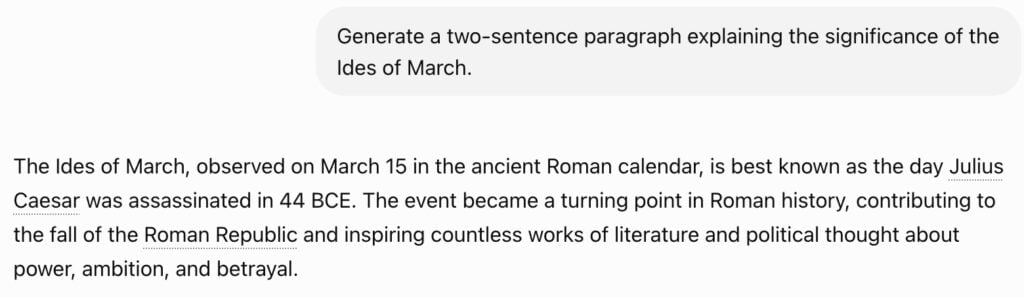
To measure how effectively ChatGPT produces novel responses, we decided to run a small test. Here, we fed ChatGPT three identical prompts across independent conversation threads.
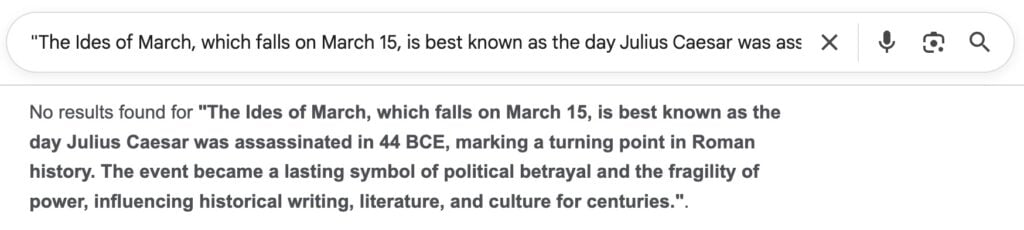
Then, we compared the outputs against the top SERPs for a similar keyword. We also ran exact match searches to see if similarly-worded content existed.
The prompt was “Generate a two-sentence paragraph explaining the significance of the Ides of March.”
- First Instance
2. Second Instance
3. Third Instance
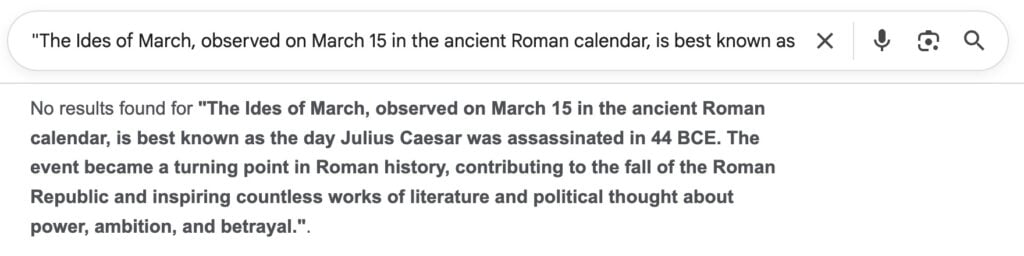
4. Top SERPs
Enciclopedia Britannica: Ides of March, day in the ancient Roman calendar that falls on March 15 and is associated with misfortune and doom. It became renowned as the date on which Roman dictator Julius Caesar was assassinated in 44 bce and was further immortalized in the tragedy Julius Caesar by English dramatist William Shakespeare. In the play, a soothsayer warns Caesar to “beware the Ides of March.”
Wikipedia: The Ides of March (/aɪdz/)[1] is the day on the Roman calendar marked as the Idus, roughly the midpoint of a month, of Martius, corresponding to 15 March on the Gregorian calendar. It was marked by several major religious observances. In 44 BC, it became notorious as the date of the assassination of Julius Caesar, which made the Ides of March a turning point in Roman history.
Dizionario.com: The Roman general and statesmen Julius Caesar became a dictator after causing a civil war. On March 15 in 44 BCE, Caesar was assassinated by conspiring members of the Roman senate, notably including Marcus Brutus. His rule, and murder, effectively ended the Roman republic—and changed the course of history. Caesar’s assassination would eventually lead to the founding of the Roman Empire by Caesar’s nephew Octavian, better known as Emperor Caesar Augustus.
As shown above, the outputs ChatGPT generates have substantial similarities, but are rarely exact matches. Each features slightly different wording while sharing similar sentence structures and main ideas.
None of the outputs reproduce existing sources verbatim, either. They borrow ideas and crucial phrases (most notably “a turning point in history” from Wikipedia) but have significant enough differences to not appear like complete copies.
What This Implies for AI Writing
ChatGPT can generate different wording for identical prompts, but variations between outputs are usually small. Having more specific prompts for style, tone, and sentence or paragraph length can help make an output more unique.
Additionally, while ChatGPT rarely copies full sentences or paragraphs, it may still sometimes produce phrases that resemble existing works.
Though these units of text are harmless in small amounts, too many similar phrases appearing in one work may constitute incremental plagiarism. It’s better to cross-check and correct problematic similarities.
When ChatGPT Can Still Get You In Trouble
Although ChatGPT outputs don’t automatically count as plagiarism, AI writing can still get you in trouble in certain situations and contexts. Understanding these contexts can help you leverage AI for efficiency without risking penalties.
Undisclosed Use as an Authorship Violation
Authoritative organizations, including the Committee on Publication Ethics (COPE) and the International Committee of Medical Journal Editors (ICMJE), consider undisclosed AI use a serious breach of research and publication integrity. In these settings, the concern is not that AI steals ideas, but that it allows authors to misrepresent themselves.
Readers expect writing to reflect an author’s own ideas, judgment, and abilities. When authors use AI without disclosure, they violate that expectation and make it difficult for readers, editors, and reviewers to assess the author’s actual contribution.
Paraphrasing Ideas Without Credit
Using ChatGPT to paraphrase ideas, frameworks, or data points pulled from another source counts as plagiarism, even if the wording is original. The main violation here is borrowing ideas without attribution, which steals credit from a more deserving source while also misrepresenting the capabilities of the author.
Institution-Specific Policies
Policies on AI use vary by institution. Organizations that value individual authorship, such as schools, academic journals, and writing competitions, often restrict or require disclosure of AI-generated content. These policies exist because they evaluate your own knowledge, reasoning, and writing, not an AI system’s output.
Settings that place less value on authorship, such as business writing, marketing, or advertising, take a more flexible approach to AI. This is because these contexts prioritize the quality and accuracy of the final work over who or what produced it.
However, authors who use AI to present another’s work as their own or to conceal plagiarism from existing sources may still face consequences, such as legal action from the sources they reproduced.
How to Check Your Own Writing for Academic Plagiarism
Although using ChatGPT does not always count as plagiarism, some plagiarism checkers may flag content that too closely resembles existing writing, be it AI-generated or human-written.
To avoid plagiarism accusations, it helps to review your content before submission.
Here are two ways to check your writing for academic plagiarism.
- Check drafts against sources: Always compare drafts to your research notes and sources to catch any problematic similarities that might have slipped through during the writing process. Should you catch any overlaps, make sure to add proper attributions.
- Request sources from ChatGPT: If you use AI to help draft your writing, ask it to cite the sources it relied on whenever possible. Then compare the output with those sources to identify any substantial overlap and add proper citations where needed.
- Run drafts through a plagiarism checker: An efficient way to check work for plagiarism is to run your drafts through a plagiarism checker. These tools compare your text against published sources and highlight passages that closely match existing content.
Once you identify substantial similarities, edit your drafts to correct wording, deepen engagement with borrowed ideas, and add appropriate citations and attributions.
Domande frequenti
Does ChatGPT Plagiarize?
Not by design. ChatGPT generates responses from patterns it learned during training rather than copying sources verbatim.
In very rare cases, it may generate text that closely matches well-known quotations, boilerplate language, or other widely repeated content. However, it is more likely to produce new wording.
Is ChatGPT plagiarism-free?
No. Although ChatGPT does not fit traditional definitions of plagiarism, using it still comes with the risk of plagiarism. As mentioned above, it is possible for ChatGPT to generate content that closely resembles existing sources. ChatGPT also counts as plagiarism if used to paraphrase material without attribution.
How does ChatGPT generate content?
ChatGPT is essentially an advanced form of predictive text. It uses statistical patterns it learned from training data and past interactions to calculate what unit of text is most likely to come next within the context of a prompt. It assembles the response piece by piece until it arrives at a complete sentence, paragraph, or thought.
Can ChatGPT lead to plagiarism if I edit the output?
No, editing ChatGPT output does not guarantee the complete elimination of plagiarism.If the output closely resembles existing material or borrows common phrasing, light rewrites may not suffice in removing similarities to the original.
For important work, substantially revise the content, add your own insights, and check the final draft with a plagiarism detector.
Is paraphrasing with ChatGPT considered plagiarism?
Yes. In most contexts, using ChatGPT to paraphrase someone else’s ideas counts as plagiarism. If the underlying ideas are not your own, providing proper attribution is necessary.
Conclusione
While ChatGPT typically generates original wording, it can still contribute to plagiarism in certain situations.
To avoid the risk, request original sources when prompting, then correct any phrases or sentences that too closely resemble the original. You can also use a plagiarism checker to more quickly flag problematic similarities.
AI non rilevabile is an online AI detection and humanization platform. Our tools help you detect and rewrite AI-generated text to resemble human writing.