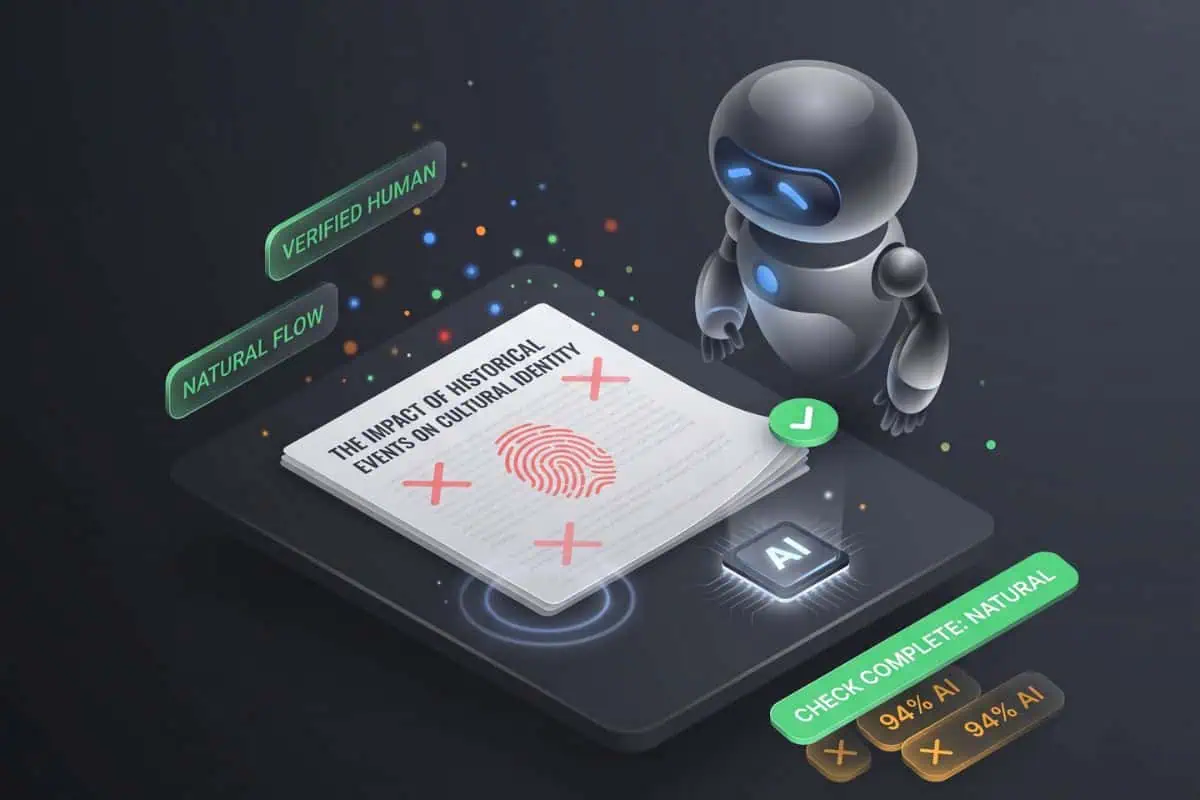
A teacher’s worst moment isn’t catching a cheater. It’s falsely accusing a student who didn’t cheat at all. Students pour hours into original work, only to watch it get flagged by a tool that can’t actually prove anything, it can only guess.
That guess is exactly what an ai detection false positive is. And the guess is wrong far more often than most people assume, especially for students who write in a second language.
A University of Chicago Booth research review found that today’s leading commercial detectors keep false positive rates below 1% across most genres of writing. That is a real improvement over where the industry started.
Back in 2023, a widely cited Stanford study found some detectors falsely flagged over 61% of essays written by non-native English students, compared to under 10% for native speakers, and that early bias is still the reference point most educators cite.
The tools have gotten better, but the underlying pattern, formal or predictable writing reading as more “AI-like”, hasn’t fully gone away, and it’s still the group most likely to get caught in a false flag today.
Teachers, academic institutions, and content teams all need to understand how these tools actually work, because the cost of getting it wrong falls on real people with real consequences.
Entriamo nel merito.
Punti di forza
- An AI detection false positive happens when human-written content gets wrongly flagged as machine-generated, usually because of predictable phrasing or formal sentence structure, not because AI was actually used.
- Even a 1% error rate can mean hundreds of false accusations every year, which is exactly why several major universities stopped relying on these tools.
- Non-native English speakers face the highest risk, since clear, structured, textbook-style writing statistically resembles AI output more than casual native writing does.
- No single detector score should ever count as proof on its own. Cross-checking results across tools and keeping a paper trail of your drafts is the strongest protection you have.
- Undetectable AI’s Detector, Humanizer, and Grammar Checker are built to catch these risks before you submit anything, cross-referencing multiple detection models and smoothing out the stiff phrasing that tends to trigger false flags in the first place.
Cosa sono i falsi positivi del rilevamento dell'intelligenza artificiale?
An AI detection false positive happens when an automated scanner wrongly flags original, human-written content as machine-generated text, turning an honest student or professional submission into an unfair subject of investigation.
It’s worth sitting with that word “false positive” for a second, because it captures the whole problem: the tool isn’t lying on purpose, it’s just wrong, and it doesn’t know it.
Detectors rely on mathematical algorithms rather than factual proof. They measure statistical traits like perplexity (how predictable your word choices are) and burstiness (how much your sentence length varies) to estimate authorship.
Non preoccupatevi più che l'intelligenza artificiale rilevi i vostri messaggi. Undetectable AI Può aiutarvi:
- Fate apparire la vostra scrittura assistita dall'intelligenza artificiale simile all'uomo.
- Bypass tutti i principali strumenti di rilevamento dell'intelligenza artificiale con un solo clic.
- Utilizzo AI in modo sicuro e con fiducia a scuola e al lavoro.
When human writers naturally use formal phrasing, structured arguments, or predictable word choices, especially in academic essays or technical reports, those patterns overlap with what AI training data looks like.
The result is that a detector mislabels genuine human effort as synthetic output, simply because the math looks similar.
Why AI Detection False Positives Matter
- Impact on students: An unfair cheating accusation can tank a student’s grade, shake their confidence, and trigger disciplinary action that’s genuinely hard to undo, even after the mistake is caught.
- Risks for professionals: Content creators, copywriters, and journalists face lost contracts, damaged client relationships, and reputational hits if an automated tool mislabels work they wrote themselves.
- Challenges for publishers and businesses: Leaning on faulty detectors creates legal exposure, slows editorial workflows, and quietly breeds distrust between management and the people actually doing the writing.
Real Examples of AI Detection False Positives
The Turnitin controversy
When Turnitin rolled out its AI-detection feature, institutions quickly found it lacked context and produced numerous false accusations. For students who had written every word themselves, the stress that followed was very real and, frankly, avoidable.
Vanderbilt University’s response
Teachers and academic institutions at Vanderbilt University disabled Turnitin’s AI detector after running the numbers. With roughly 75,000 annual paper submissions, even a conservative 1% false positive rate meant approximately 750 innocent students would be wrongly flagged every single year.
Lessons learned from early AI detectors
Educational institutions learned quickly that AI detectors should never serve as sole proof of misconduct. Major platforms, including OpenAI, shut down their own early classifier tools due to low accuracy and high false-positive rates.
The Human Cost Behind the Statistics
Numbers like “1% false positive rate” sound small until you attach a name to them. In one widely reported Bloomberg Businessweek investigation, a pregnant student working toward a teaching degree submitted a weekly reading summary and received a zero.
Her professor said an AI detector flagged the work as machine-generated. The student explained that her writing style, shaped by autism spectrum disorder, tends to be structured and direct in a way that can look mechanical to a statistical model. She eventually got her grade reviewed, but she also got a warning: if it happened again, there would be no second look.
That’s the part statistics alone don’t capture. A false flag isn’t just a wrong number on a dashboard. It’s a real conversation a student has to have, defending work they actually wrote, against a tool that can’t be cross-examined.
Faculty writing in academic circles have raised similar concerns in higher education settings, questioning whether unappealable, automated gatekeeping belongs anywhere near grading decisions at all.
Cause comuni di falsi positivi
- Complex sentence structures: Elaborate academic prose with multi-clause sentences, passive voice, and balanced parallel phrasing often mirrors the smooth, mathematically optimized flow of large language models. Because these sentences follow strict syntactic rules, detectors treat their high coherence and lack of natural “human messiness” as a machine signature.
- Repetitive phrasing: Technical documentation, legal briefs, and research papers require consistent terminology and repeated keywords to stay accurate. That necessary repetition lowers the text’s perplexity, which leads algorithms to mistake deliberate, precise vocabulary for predictable AI output.
- Highly formal writing: Standardized professional writing lacks the casual conversational markers, personal pronouns, emotional qualifiers, idioms, that scanners look for. That stiff, impersonal cadence flattens the text’s burstiness profile, making it look statistically identical to an AI executing a formal prompt.
- Common expressions and clichés: Standard transitional phrases like “in conclusion,” “furthermore,” and “it is important to note” make up a huge share of the web-based datasets used to train language models. When human authors lean on these familiar connectors, they unintentionally trip the exact pattern-matching rules detectors are built to catch.
- Writing by non-native English speakers: Non madrelingua inglese often use careful, textbook-aligned grammar, shorter sentences, and a more concise vocabulary to communicate clearly. Studies show that this “safe,” structured style overlaps heavily with AI output, pushing false-positive rates up to 61% higher for non-native speakers compared to native writers.
- Over-reliance on grammar checkers: Heavy editing through grammar tools to “clean up” a draft can strip away a writer’s unique stylistic quirks. The resulting text becomes so grammatically uniform that it drops below the threshold of expected human variance, and that uniformity is exactly what triggers a detector flag.
Perché i rilevatori basati sull'intelligenza artificiale generano falsi positivi
Probability, not proof
AI detectors don’t trace text back to a source file. They generate a statistical guess based on word placement. A 90% score simply means the text shares 90% of the traits common in LLM output, not that AI was actually used to write it.
Differences between detection models
Different detectors use different mathematical thresholds and training data. A draft that scores 0% AI on one platform might register as 80% AI on another, which says a lot about how little industry standardization actually exists.
The limits of statistical analysis
Statistical models cannot evaluate a writer’s intent, effort, or subject knowledge. They only evaluate word patterns, which makes them completely blind to the actual creative process behind a piece of writing.
Why detectors often disagree
Language keeps evolving and generative AI models keep updating, but static detection algorithms lag behind real-world writing styles. That lag is a big part of why two detectors can look at the same paragraph and disagree completely.
Which AI Detectors Have the Most False Positives?
Different platforms show different error rates depending on document length, subject matter, and the writer’s background.
| Strumento | Relative False Positive Risk | Primary Limitation |
| Turnitin | Moderate to High | Often flags formal academic prose and non-native English writers |
| GPTZero | Variabile | Highly sensitive to uniform sentence lengths and standard transitions |
| Copyleaks | Moderato | Struggles with short submissions or heavily structured technical writing |
| Originalità.ai | Alto | Uses an aggressive model optimized for web content that frequently flags human drafts. |
Why comparing multiple detectors matters
Relying on a single scanner creates a single point of failure. Cross-referencing text across multiple tools gives you a broader perspective and helps surface false alarms caused by one flawed algorithm.
How the Rankings Look in 2026
The landscape shifts fast enough that it’s worth checking current data rather than trusting a tool’s own marketing claims.
In independent 2026 testing across raw AI, humanized AI, human, and mixed writing samples, most major detectors performed well on clean samples but split sharply on mixed human-and-AI passages, exactly the gray area where false positives tend to live.
Several independent studies have echoed the same finding: detectors that minimize false positives while maintaining sensitivity are still the exception, not the norm, and results can shift every time a new model ships.
How to Reduce AI Detection False Positives

Check your content with multiple tools: Running your draft through a combination of platforms gives you a broader perspective than any single scanner can. If only one detector flags a passage while three others mark it as 100% human, that’s immediate cross-tool evidence the single flag is a statistical anomaly, not proof of anything.
Add personal examples: Large language models are great at summarizing general knowledge, but they can’t replicate your lived experience, class-specific discussions, or workplace-specific insight. Inserting a personal anecdote, a lab observation, a lecture reference, breaks the generic statistical pattern detectors are trained to spot.
Rewrite repetitive sections: AI models lean heavily on formulaic transitional phrases to connect thoughts. When human writers overuse the same connectors, it lowers the text’s perplexity, triggering detector flags that have nothing to do with actual authorship.
Swap stiff transitions for direct, conversational phrasing, or merge sentences to build more natural momentum.
Verify facts and sources: Machine-generated text tends to speak in broad generalities because it operates on probability rather than real comprehension. Anchor your major points with primary source citations, specific dates, and direct data. A documented, specific trail of original synthesis signals genuine intellectual labor to both human reviewers and automated tools.
Review your writing manually: The best way to evaluate your text’s burstiness is to read it out loud. If every sentence follows the same subject-verb-object rhythm, it will look statistically uniform to a detector. Place a short, punchy sentence right after a long, descriptive one to introduce the natural rhythm of human speech.
Limit over-editing with generative AI grammar tools: While basic spell-check tools are fine, using AI-powered “rephrase,” “rewrite,” or “improve tone” features in grammar apps can inadvertently strip away your natural stylistic quirks.
Over-polishing your prose flattens the unique “messiness” of human writing, making it so grammatically uniform that detectors mistake your polished draft for autogenerated text. Keep your original phrasing intact whenever it clearly communicates your point.
How AI Humanizers Help Reduce False Positives
Research shows that humanizing AI-assisted or overly formal text significantly reduces false positive triggers by reintroducing natural sentence variation.
How AI humanizers work
An AI humanizer analyzes text for robotic signatures, flat sentence structures, low-perplexity vocabulary, and reconfigures the prose to read like authentic human speech.
Breaking predictable writing patterns
By varying sentence length and swapping out generic word choices, humanizers strip away the statistical markers that trigger false alarms in the first place.
Improving readability and flow
Humanization also removes stiff, corporate jargon, which makes the final piece easier and more enjoyable for actual readers, not just detectors, to get through.
When to use an AI Humanizer
Usa un Umanizzatore AI whenever your human-written content sounds overly formal, or when you want to refine an AI-assisted draft so it reflects a natural voice and passes scanner checks smoothly.
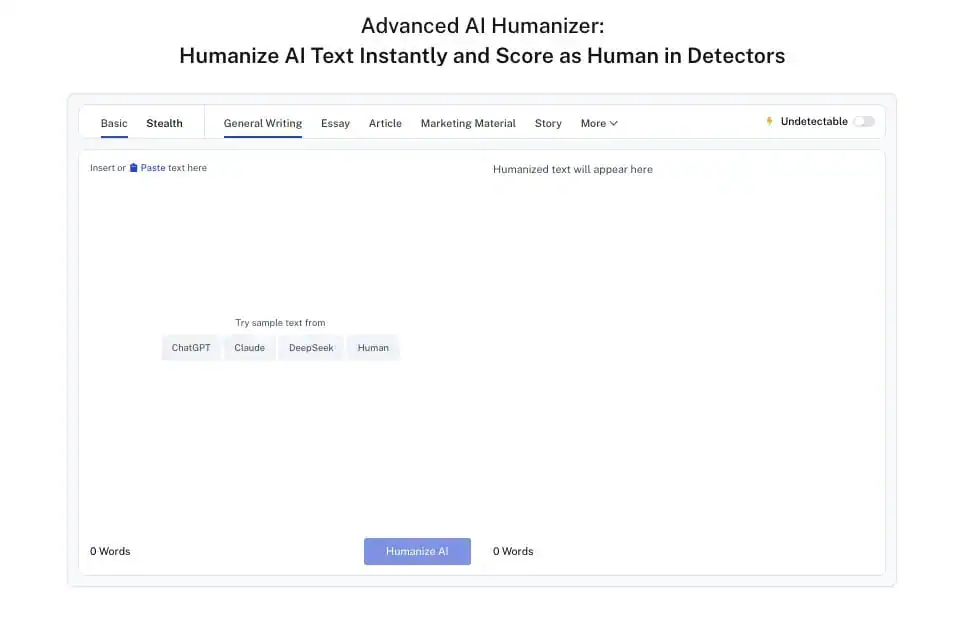
Proof It Works: Independent Test Results
Claims about humanizer accuracy are easy to make and hard to verify, so it’s worth checking published test results across multiple detectors rather than taking any single company’s word for it.
Across repeated tests, humanized text scored near-zero on tools like GPTZero and Copyleaks, while the detector side correctly separated AI-written samples from human ones with a high degree of consistency.
That kind of cross-tool verification is exactly what you want to see before trusting a humanizer with something that actually matters, like a graded assignment or a client deliverable.
What to Do If Your Writing Is Incorrectly Flagged
Don’t rely on one detector
If an instructor or client flags your work using one platform, politely ask them to run it through alternative tools, including the tools teachers actually use for a second opinion, to demonstrate the lack of consensus between platforms.
Save drafts and revision history
Keep Google Docs version history, timestamped drafts, research notes, and outlines. This step-by-step paper trail is close to undeniable proof of your human creative process.
Provide supporting evidence
Walk your reviewer through your research sources, explain your main arguments out loud, and share your rough notes to demonstrate you genuinely understand the material you submitted.
Best Practices for Using AI Responsibly
- Use AI for brainstorming: Lean on tools to generate outlines, research questions, or topic ideas rather than full paragraphs.
- Add your own analysis: Make sure the core arguments, evidence, and conclusions reflect your own intellectual effort.
- Edit before submitting: Never copy and paste raw AI output. Manually refine every sentence so it fits your voice.
- Follow school or workplace policies: Always check the specific guidelines around permitted AI assistance for your assignment or project.
- Ask for manual review: If software flags your work, request an in-person conversation with your teacher or editor to walk through your process history.
How Undetectable AI Helps Prevent False Positives
Undetectable AI is built as an all-in-one platform to evaluate, refine, and authenticate writing before you ever hit submit.
Comprehensive Quality Suite
By analyzing structure, syntax, and stylistic markers, Undetectable AI checks text against multiple algorithms to flag potential risk early.
It also reworks formal or robotic phrasing into natural prose, restoring the human variation that detectors look for.
- Rivelatore AI: Cross-checks your text against multiple algorithms for a clear, consensus-based risk score.
- Umanizzatore AI: Restructures robotic prose to give your content natural flow and rhythm.
- Parafrasatore AI: Rephrases repetitive or stiff sections while preserving your original meaning.
- Writing Style Replicator: Learns your unique voice so AI-assisted edits still sound like you.
Domande frequenti
What is an AI detection false positive?
An AI detection false positive occurs when an automated scanner incorrectly flags original, human-written text as AI-generated.
Perché i rilevatori di IA segnalano i testi scritti da esseri umani?
Detectors rely on statistical predictability. Formal language, repetitive vocabulary, or uniform sentence lengths can all trigger false flags, even in fully human-written work.
I rilevatori di intelligenza artificiale sono accurati?
No AI detector is 100% accurate. Independent studies consistently show elevated error rates, especially when evaluating non-native English writing or short passages.
How can I prove my work is original?
Maintain a clear paper trail using Google Docs version history, timestamped outlines, research notes, and draft iterations you can walk a reviewer through.
How do I reduce false positives?
Vary your sentence structure, avoid overusing formal clichés, weave in personal insights, and check your work with a tool like Undetectable AI before you submit.
Can AI detectors be trusted as the sole basis for an accusation?
No. Because these tools estimate probability rather than confirm fact, most major platforms, including several detector companies themselves, recommend against using a single score as standalone proof of misconduct.
What should I do if my teacher won’t accept that a flag was wrong?
Ask them to cross-check your work with a second detector, and bring your revision history and notes as supporting evidence. If the conversation stalls, most institutions have a formal appeals or academic integrity process you can request in writing.
Conclusione
AI detection false positives are an unfortunate reality of automated content analysis, and they create real stress for students, educators, and professionals alike.
Because these detectors evaluate probability, not absolute truth, they should never serve as sole proof of academic misconduct or professional dishonesty.
By understanding how these algorithms actually analyze text, and by using humanization strategies where they genuinely help, writers can protect their work and keep their credibility fully intact.
Esplorare AI non rilevabile today to polish your paragraphs and make sure your content stays authentic, engaging, and confidently human.