
Many business owners come in hot with capital and ideas, only to end up cold with negative cash flow.
Those who do their due diligence, however, rarely run into this problem. One of the most important steps in preparation is effective market research.
Market research sounds simple enough. You want to learn about your customers or potential clients, so you start conducting surveys, collecting data, and testing products. But even after doing all of that, you might still struggle to get concrete, actionable insights.
We’re not saying these market research methods aren’t valid. They are, but that doesn’t mean they’re right for you.
There are dozens of ways to find the answers you need, and picking the wrong one will ultimately waste your time, money, effort, and, did we already mention money?
Some teams run long surveys when all they needed was a quick interview. Others spend weeks on competitive analysis when a simple customer call would have answered the question.
It’s not that they didn’t work hard—it’s that they picked the wrong tool.
Choosing the right market research is all about doing the right research for what you actually need to know.
Here’s what you need to know.
Key Takeaways
- Market research methods fall into two buckets: primary (data you collect yourself) and secondary (data that already exists).
- The best method depends on your goal, not your budget or preference.
- Biased questions produce biased data. How you ask matters as much as what you ask.
- Simple, focused research beats complicated, sprawling research every time.
- AI tools can speed up and streamline the process, from writing survey prompts to presenting findings.
What Are Market Research Methods?
A market research method is simply how you collect information about your market. That includes data on your customers, competitors, industry trends, and demand for your product or service.
There are two main categories.
Primary research is data you gather yourself, such as surveys, interviews, focus groups, and observations. You design the questions, collect the responses, and own the data.


Never Worry About AI Detecting Your Texts Again. Undetectable AI Can Help You:
- Make your AI assisted writing appear human-like.
- Bypass all major AI detection tools with just one click.
- Use AI safely and confidently in school and work.
Secondary research is data someone else already collected (e.g., industry reports, census data, competitor reviews, or published studies). You’re interpreting what’s already out there.
Neither is better as they serve different purposes. Most solid research plans use a mix of both.
Primary research gives you fresh, specific data, but it takes time and effort to collect. Secondary research is faster and cheaper, but it may not answer your exact question (and it might be outdated).
The tricky part isn’t understanding the categories, but knowing which specific method fits the question you’re trying to answer. That’s where most people overthink it.
Matching Research To Business Goals
Before you pick a method, get clear on your goal.
While that might sound obvious, most people skip this step.
Ask yourself: What decision does this research need to support? Are you validating a new product idea? Trying to understand why customers are churning? Figuring out how to price something? Each of those needs a different approach.
For example, if you’re validating a new idea, you want exploratory research. Interviews and open-ended surveys work well here, as they help you discover what people actually think and feel.
If you’re measuring something specific, like whether a new feature improved satisfaction, you want quantitative research. Structured surveys with rating scales give you numbers you can track over time.
Getting this step right early saves you from collecting a ton of data that doesn’t answer your actual question.
One thing that helps is writing a clear research question before you build anything.
It sounds basic, but it forces you to be specific. “Understanding our customers better” is not a research question. “Why do first-time buyers not return for a second purchase?” is.
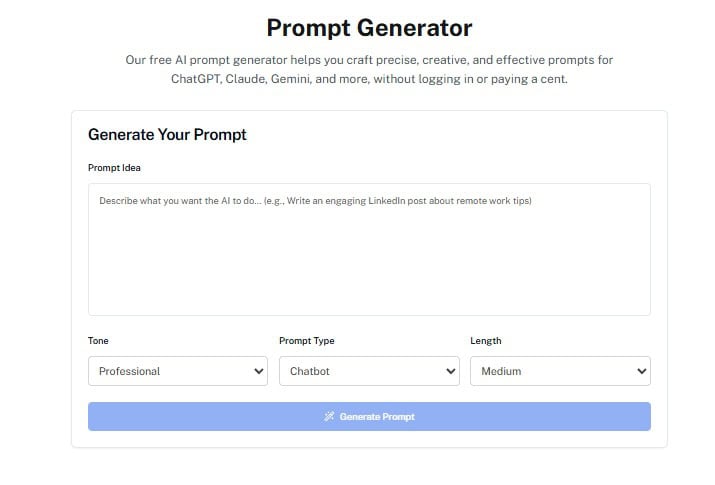
If you’re struggling to write tight, clear research questions or prompts for a survey, Undetectable AI’s Prompt Generator is genuinely useful here.
It helps you frame questions in a way that actually pulls meaningful data, instead of vague answers that go nowhere.
Exploring Common Research Method Types
Here’s a quick rundown of B2B market research methods you’ll actually use.
- Surveys are the most common. They scale easily and provide quantitative data quickly. The downside is that badly written questions produce useless answers. Keep them short and avoid leading questions.
- Interviews go deeper. One-on-one conversations surface things a survey never would. People explain their reasoning, share context, and go off-script in ways that reveal real insight. They take more time, but for understanding the why behind behavior, nothing beats them.
- Focus groups bring 6 to 10 people together to react and discuss. They’re great for testing messaging, packaging, or early-stage concepts. Just watch out for groupthink (one loud voice can skew the whole room).
- Observational research means watching how people actually behave, not listening to how they say they behave. These two things are often very different. Usability testing is a classic example.
- Competitive analysis is strategic secondary research. You’re looking at what competitors offer, how they position themselves, and what customers complain about in their reviews. Negative reviews on competitor products are basically a free focus group telling you exactly what the market wants and isn’t getting.
- Social listening involves monitoring what people say about your brand, category, or competitors online. It’s passive, but it catches honest, unfiltered opinion. People on Reddit and in comment sections say things they’d never say in a survey.
Each method has tradeoffs. Interviews are rich but slow, surveys are fast but shallow if you’re not careful, and competitive analysis can be cheap but indirect.
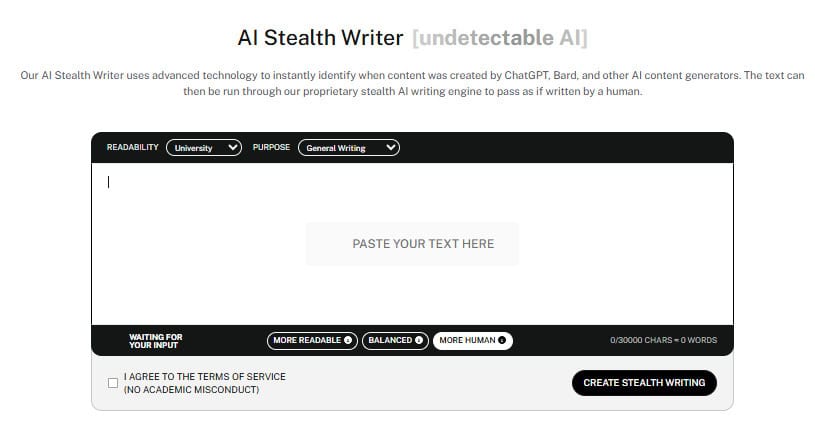
Once you’ve collected your data, presenting it clearly is its own challenge. Research findings written in dense, analytical language lose people fast.
Undetectable AI’s AI Stealth Writer is helpful at this stage. It takes research summaries and rewrites them into natural, readable explanations that non-technical stakeholders can actually engage with.
Turning Research Into Smart Decisions
Data doesn’t make decisions. People do.
Research just improves the quality of those decisions.
After collecting your data, look for patterns and don’t just report what respondents said. Interpret it. What does it mean for your business? What should you do differently? The goal is a clearer path forward.
A few habits help here:
- Triangulate your findings: If your survey data, your interview notes, and your social listening all point to the same thing, that’s a strong signal. If they conflict, dig deeper before drawing conclusions.
- Separate facts from assumptions: It’s easy to read data and see what you already believe. Stay skeptical of your own interpretations and share findings with someone who wasn’t involved in collecting them.
- Prioritize action: Research that sits in a folder helps nobody. Ask: What’s the one thing this data tells us to do right now? Start there.
Avoiding Mistakes in Research Planning
Most research errors happen before a single data point is collected, and they happen in the planning stage.
Recognizing Biased or Incomplete Data
Bias sneaks into research quietly, leading questions to steer respondents toward a particular answer. Sampling the wrong group yields data that doesn’t reflect your actual market.
So asking about hypothetical behavior is unreliable because people don’t know what they’d actually do.
Watch for confirmation bias, too. If you’re only looking for evidence that supports your existing idea, you’ll find it (whether it’s real or not).
Lastly, incomplete data is a problem in itself. A 20-response survey for a major product decision isn’t enough. Know what sample size your conclusions require before you start collecting.
Preventing Over-Complicated Research Setups
More research is not always better research. A 60-question survey gets abandoned halfway through. A focus group with 15 people is just chaos.
A research plan with five methods running simultaneously produces conflicting data and headaches.
Start simple with one clear question and one method that fits it. Expand from there if needed.
Adjusting Methods When Results Feel Unclear
Sometimes you finish a round of research and still don’t have a clear answer.
If survey responses are all over the place, it might mean the question was unclear. Run a small round of interviews to understand why.
If interview feedback doesn’t match your quantitative data, explore the gap directly and ask respondents to explain their answers.
Smarter Research With Undetectable AI’s Support
AI tools have genuinely changed what small teams can do with research. You don’t need a dedicated research department to get useful, reliable insights anymore.
Here are a few places where Undetectable AI fits naturally into the process.
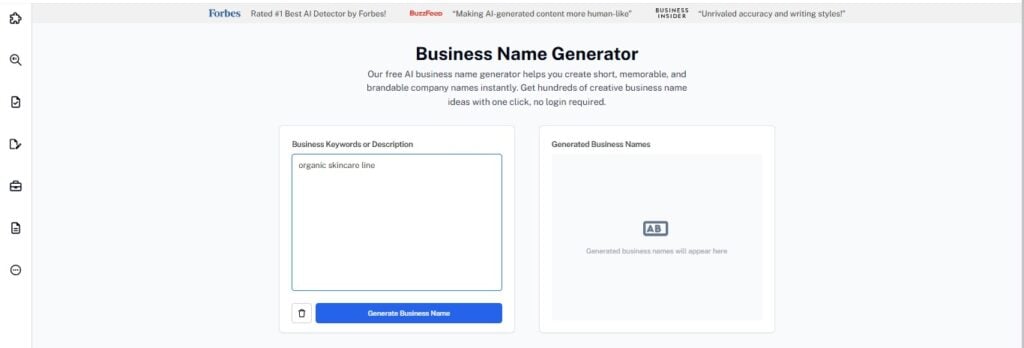
If you’re in market validation mode and exploring brand or product naming, Undetectable AI’s Business Name Generator helps you brainstorm and stress-test names quickly.
Instead of guessing, you can generate a list of options and take them directly into research. Show them to customers, measure reactions, then make a data-backed call.
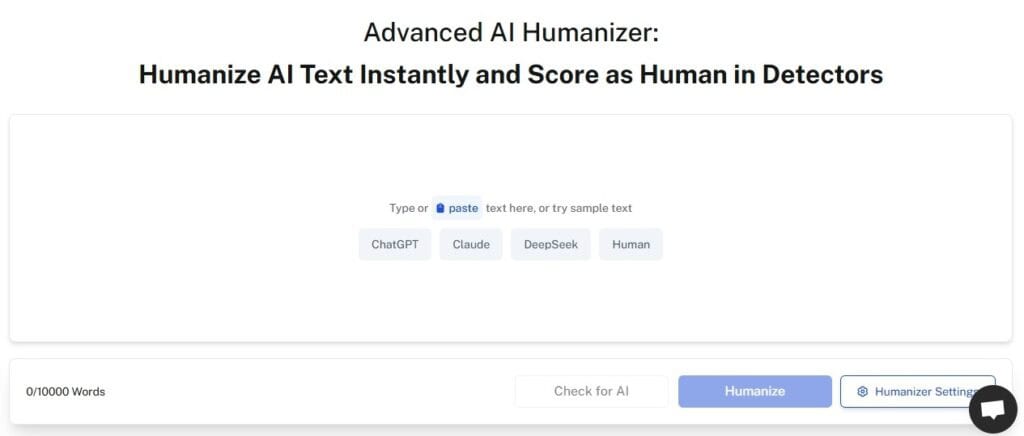
Once your research is done, and it’s time to share findings, polished communication matters more than most people think. A report full of bullet points and raw data doesn’t persuade stakeholders.
Undetectable AI’s AI Humanizer makes sure your research findings read naturally and clearly. Whether presentations, executive summaries, or client-facing documents, it takes your content from clinical to compelling.
Research is only as valuable if you act on it, so tools that help you act on it faster are worth using.
Check your content using our AI Detector and Humanizer below!
Stop Collecting Data Like Pokémon
There’s no single best market research method.
There’s only the method that best fits what you’re trying to find out.
Get clear on your goal first and write a focused research question. Pick the method that matches it. Collect carefully and interpret honestly. Finally, communicate your findings in a way people can actually use.
Teams that do this well aren’t the ones with the biggest research budgets. They’re the ones who stay focused, avoid overcomplicating it, and actually use what they find. They treat research as a habit, not a one-time event.
Build that habit. Stay curious. And don’t let data sit in a folder.
Turn your research insights into clear, human sounding reports with Undetectable AI.