
“Seriously funny,” “Bittersweet,” “Deafening silence.” What do all these words and phrases have in common?
They’re all oxymorons, which are two opposite ideas packed in one with a purpose.
These literary devices pop up everywhere, including novels, everyday speech, and even song lyrics. And they’re pretty intuitive once you understand them.
In this guide, we’ll go over what an oxymoron really is, check out a few classic and fun examples, and show how writers use them to make their writing more interesting or memorable.
Key Takeaways
- An oxymoron combines two contradictory terms to create a new, often paradoxical meaning
- Writers use oxymorons to highlight complexity, create tension, or add humor to their work
- Common examples include “bittersweet,” “deafening silence,” and “original copy”
- Oxymorons appear constantly in literature, film, advertising, and everyday speech
- Understanding oxymorons helps you spot intentional contradictions versus accidental awkwardness
What Is an Oxymoron?
An oxymoron is a figure of speech that combines two words with opposite or contradictory meanings.
The word itself comes from Greek: “oxy” means sharp or keen, and “moros” means foolish. So “oxymoron” literally translates to “sharp-foolish” or “clever-stupid.”
That’s kind of perfect, honestly.


Never Worry About AI Detecting Your Texts Again. Undetectable AI Can Help You:
- Make your AI assisted writing appear human-like.
- Bypass all major AI detection tools with just one click.
- Use AI safely and confidently in school and work.
The whole point of an oxymoron is to create meaning through contradiction. When you put two opposing ideas together, you force the reader or listener to pause and think.
That tension between the words generates something more interesting than either word could accomplish alone.
Oxymoron Definition
Here’s the technical definition: An oxymoron is a rhetorical device that juxtaposes two seemingly contradictory terms to reveal a deeper truth or create a specific effect.
But let’s make that simpler.
An oxymoron happens when you stick two words together that shouldn’t work, but somehow do.
The contradiction is the point. You’re not trying to confuse people, but rather capture something complex in a concise way.
Think about “bittersweet.” Bitter and sweet are opposites.
But when you combine them, you get a word that perfectly describes experiences that are simultaneously happy and sad.
A graduation. A breakup with someone you still care about. The last episode of a show you loved.
Oxymoron Examples
Let’s look at some classic oxymorons you’ve definitely encountered:
- Deafening silence – When a room is so quiet that the absence of sound feels overwhelming. You hear it in your ears.
- Living dead – Zombies, obviously. But also that feeling when you’re so exhausted you’re just going through the motions.
- Jumbo shrimp – This one’s funny because it’s accidental. Jumbo means large. Shrimp can mean small. Put them together, and you get a contradiction that people now use without thinking about it.
- Act naturally – How do you act naturally? If you’re acting, aren’t you being unnatural? This phrase shows up in director’s notes all the time.
- Organized chaos – Perfect for describing a messy desk that somehow makes sense to its owner, or a kitchen during Thanksgiving dinner.
- Only choice – If it’s the only option, is it really a choice? This phrase gets at the illusion of agency.
- Open secret – Everyone knows about it, but nobody officially discusses it. Think workplace drama or celebrity relationships.
- Seriously funny – When something is so funny it transcends just being entertaining. It’s comedy that makes you think.
The best oxymorons feel natural even though they’re contradictions. They’ve become part of how we communicate complexity.
Why Writers Use Oxymorons
Writers love oxymorons because they’re efficient.
When writing poetry or novels, you can communicate a complicated idea in two words instead of two paragraphs.
Here’s why they work so well:
- They capture nuance. Real life isn’t black and white. Emotions overlap. Situations are messy. Oxymorons let you show that complexity without getting wordy about it.
- They create memorable phrases. “Parting is such sweet sorrow” sticks in your brain way better than “I’m sad to leave but happy about what’s next.” Shakespeare knew what he was doing.
- They force readers to pause. When you encounter a contradiction, your brain has to work for a second to make sense of it. That pause creates engagement. The reader becomes active rather than passive.
- They add layers of meaning. Take “cruel kindness.” Maybe someone tells you a harsh truth that you needed to hear. It feels cruel in the moment but kind in intention. The oxymoron holds both meanings at once.
- They’re perfect for irony and humor. “Seriously funny” features a funny contradiction. The structure works because oxymorons naturally set up ironic situations.
Writers also use oxymorons to establish tone. A character who speaks in oxymorons might be philosophical, sarcastic, or caught between competing desires.
The device becomes characterized.
Common Types of Oxymorons
Oxymorons show up everywhere, but they tend to cluster around certain purposes.
Undetectable AI’s AI Paragraph Generator can help you group examples by purpose when you’re analyzing texts or crafting your own contradictions.
Here are the main categories:
Oxymorons for Humor
These are the fun ones. They point out absurdities in language or culture.
- Pretty ugly – Something that’s aesthetically unpleasant but fascinating to look at. Like a Cronenberg movie.
- Clearly confused – When someone is obviously lost but thinks they know what they’re talking about.
- Awfully good – That pizza at 2 a.m. that tastes amazing even though you know it’s objectively mediocre.
- Definite maybe – The most non-committal commitment possible. Peak passive-aggressive communication.
Oxymorons for Tension
Writers use these to create unease or highlight conflict.
- Controlled chaos – A battle scene that follows rules, or a protest that’s organized but feels wild.
- Violent peace – The aftermath of war when things are technically peaceful, but trauma lingers.
- Alone together – Being physically close to someone while feeling emotionally distant. Or scrolling through your phone in a crowded room.
- Silent scream – Internal anguish that can’t or won’t be expressed. Horror movies love this one.
Oxymorons for Romance
Love is contradictory by nature, so oxymorons fit perfectly here.
- Sweet agony – Longing for someone you can’t have.
- Loving hate – That thing where you’re furious at someone but still care about them deeply.
- Happily miserable – Being content in a situation that should make you unhappy, or vice versa.
- Cruel love – When loving someone means making hard choices that hurt in the moment.
Oxymorons for Irony
These highlight contradictions in society or language itself.
- Genuine imitation – A really good fake. Like synthetic leather that actually looks decent.
- Exact estimate – When a guess is suspiciously precise.
- Same difference – A phrase that makes no sense but everyone understands. The ultimate oxymoron.
- Minor crisis – Because not all problems are equal, but calling something a crisis and then downgrading it is inherently funny.
Oxymorons for Description
Sometimes you just need to describe something complex quickly.
- Old news – Information that’s outdated but still being discussed.
- Passive aggressive – A whole communication style captured in two words.
- Bittersweet – The gold standard of oxymorons that carries emotional complexity in one word.
- Dark light – Dim illumination, or the light in a noir film that creates more shadows than clarity.
Oxymorons in Literature, Movies, and Everyday Language

Oxymorons aren’t just academic concepts. They’re tools that writers, filmmakers, and regular people use frequently.
Shakespeare was obsessed with them. In “Romeo and Juliet,” Romeo says: “O loving hate! O heavy lightness! Serious vanity!”
He’s describing the chaos of being in love while caught in a family feud. The oxymorons pile up to show how contradictory his feelings are.
In “Hamlet,” the phrase “cruel to be kind” shows up. Hamlet must do terrible things (such as being harsh with Ophelia) for what he believes are good reasons. The oxymoron captures his moral struggle.
Modern literature uses them too. In “The Fault in Our Stars,” John Green writes about “the great and terrible blessing” of love.
That’s an oxymoron, illustrating how love can bring both joy and pain, especially when you know it can’t last.
Movies love visual oxymorons. Think about films noir with their “beautiful darkness” or horror movies that are “terrifyingly funny.”
The entire genre of horror-comedy exists because people figured out that fear and laughter can coexist.
In “The Shawshank Redemption,” Andy describes hope as “a good thing, maybe the best of things” while living in a place designed to crush hope.
The whole film is built on the oxymoron of “imprisoned freedom”, finding liberty within confinement.
Everyday language is full of them too. We have “virtual reality,” which is inherently contradictory. “Social distancing” became a massive oxymoron during the pandemic.
We describe fruit as “pretty ugly” or situations as “seriously funny.”
Advertising loves oxymorons. “New and improved” suggests something was already good but also needed fixing.
An “instant classic” is a claim that something has achieved timeless status. These contradictions grab people’s attention and stick in their memories.
How Oxymorons Create Meaning and Tone
The power of an oxymoron isn’t just in the contradiction. It’s in what that contradiction makes you feel or think.
When you read “deafening silence,” you don’t just understand that a room is quiet. You feel the weight of that quiet. You sense the tension. The oxymoron creates a mood.
Tone shifts depending on which contradictory words you choose. “Sweet sorrow” feels romantic and wistful. “Brutal kindness” feels harsh and cutting.
Both are oxymorons related to difficult emotions, but they convey them differently.
Writers can also use oxymorons to show a character’s state of mind.
Someone who describes everything in oxymorons might be:
- Intellectually sophisticated but emotionally confused
- Sarcastic or ironic by nature
- Caught between two competing desires or worldviews
- Trying to capture complexity they don’t fully understand
The oxymoron becomes a window into how that character processes the world.
In dialogue, oxymorons can create subtext.
If a character says, “That’s great,” but you’ve been writing them as trapped in an “open prison,” the reader knows they don’t actually think it’s great.
The contradiction you’ve established earlier gives depth to simple dialogue.
Oxymorons also control pacing. They make readers slow down for a beat. That can be useful before or after a major plot point, giving the audience a moment to process.
How to Identify an Oxymoron in a Sentence
Not every contradiction is an oxymoron. Sometimes things just don’t make sense.
Here’s how to tell if you’re looking at an actual oxymoron:
- Check if both words are modifying each other. In “bittersweet,” both bitter and sweet apply to the same thing. “The bitter man was sweet to the children” is not an oxymoron. That’s just a complex character.
- Look for intentional contradiction. Oxymorons are written on purpose. If someone writes “the happy sad clown” without realizing those emotions clash, that’s not an oxymoron. That’s unclear writing.
- See if the contradiction creates new meaning. “Cold fire” is an oxymoron because it makes you think about fire differently. Maybe it’s emotional fire. Maybe it’s a metaphor. “Cold hot” is just confusing unless there’s a really specific context.
- Distinguish from paradox. A paradox is a statement that seems contradictory but might be true. “Less is more” is a paradox. “Deafening silence” is an oxymoron. Paradoxes are usually full statements. Oxymorons are usually just a word or two.
When you’re analyzing texts, tools can help you spot patterns.
Undetectable AI’s AI Detector can flag stiff, overly constructed, or unnatural phrasing.
That’s useful when you’re trying to figure out if something is an intentional oxymoron or just awkward writing.

Students often confuse an oxymoron with general exaggeration or irony. If you write “literally dying” when you’re not actually dying, that’s hyperbole. If you write “living death,” that’s an oxymoron.
Once you’ve identified a potential oxymoron, ask: Does this make sense in a contradictory way? If yes, you’ve found one.
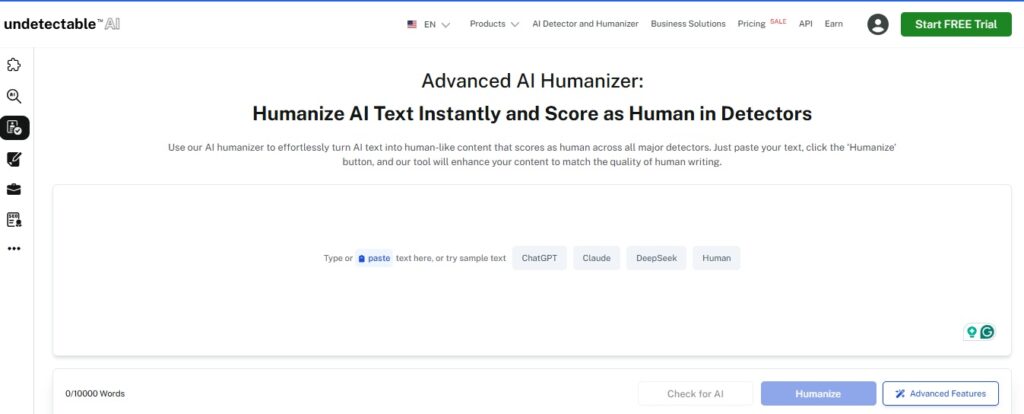
If you’re writing and your oxymorons feel forced, Undetectable AI’s AI Humanizer can help rewrite awkward examples so the oxymoron feels intentional and smooth.
The goal is for the contradiction to feel natural, not like you’re trying too hard to be clever.
Run a quick scan using the AI Detector and Humanizer in the widget below!
That Shouldn’t Work. But It Does
Oxymorons are everywhere once you start looking for them.
They’re how we communicate complexity without writing essays, how we capture contradictory emotions in a few syllables, and how we make language do more with less.
The best oxymorons feel effortless. They slip into conversation and writing without calling attention to themselves.
You don’t think “Wow, what a literary device!” when someone says they’re “awfully nice.” You just understand what they mean.
When you use an oxymoron in your writing, you’re acknowledging that complexity. Write about “organized chaos” and “controlled madness.”
Describe your character’s “sweet suffering” or the “thunderous silence” after a fight. Use oxymorons to show what a straight description can’t quite capture.
Just make sure the contradiction is pulling its weight, and use tools from Undetectable AI thoughtfully. Make sure it adds meaning rather than confusion.
And remember: the best oxymorons are the ones your reader doesn’t even notice until they stop and think, “Wait, that shouldn’t work… but it totally does.”