
The sunset isn’t putting on a show just for you. That glass of ice-cold margarita? It’s not calling your name, no matter how much you insist otherwise after a long day in the sun.
Except in writing, they absolutely can.
That’s personification. It’s a fun literary device that lets writers attribute human characteristics to things that aren’t human.
That traffic light doesn’t hate you (even though you feel that it’s been red for days), the seas aren’t angry, and Mondays aren’t your enemy.
But when we write about how all of these things are angry, or calling or conspiring against you, the world feels a little more alive.
That’s the magic of words, and personification is one of the most powerful tools in your arsenal. Let’s break down what it is, why it works, and how to use it to make your writing pop.
Key Takeaways
- Personification gives human traits to non-human objects, making abstract concepts tangible and relatable.
- It creates emotional connections by transforming objects and ideas into characters readers can understand.
- It’s different from anthropomorphism, where personification is figurative, while anthropomorphism makes things literally human.
- Personification is best used sparingly and purposefully to enhance mood, clarify meaning, or add personality to your writing.
- Common mistakes include overuse, mixing metaphors, and applying it to objects that don’t need humanizing.
What Is Personification?
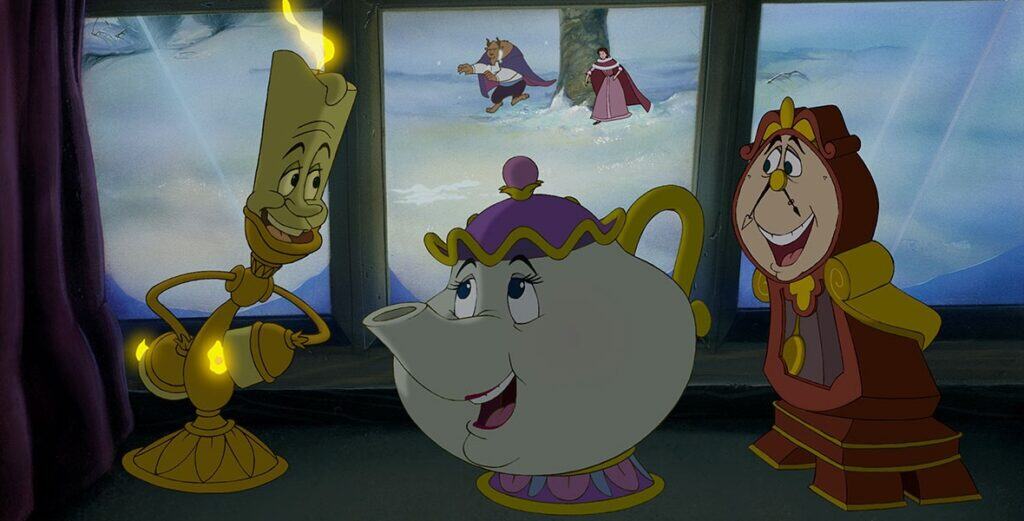
Personification is when you take something non-human and give it human qualities. Simple as that.
Unlike metaphors or regular adjectives, you’re not saying the object actually IS human but borrowing human characteristics to make your description more vivid.
Think of it as putting a human costume on an inanimate object, an animal, or an abstract concept.


Never Worry About AI Detecting Your Texts Again. Undetectable AI Can Help You:
- Make your AI assisted writing appear human-like.
- Bypass all major AI detection tools with just one click.
- Use AI safely and confidently in school and work.
The wind doesn’t have fingers, but when it “whispers through the trees” or “howls in anger,” it suddenly seems alive. It gains intention, becoming something your reader can connect with emotionally.
Writers have been doing this forever. It’s in ancient mythology, Shakespeare’s plays, and probably the last three songs you listened to.
Why? Because humans understand humans. When you describe something in human terms, you create an instant bridge between the reader and whatever you’re writing about.
Personification Definition
Personification is a figure of speech in which human characteristics are attributed to non-human entities, objects, animals, or abstract ideas.
The word comes from the Latin “persona” (person) and “facere” (to make), literally translating to “to make into a person.”
Metaphors say one thing IS another thing, whereas personification specifically gives human traits to the non-human.
You’re not saying the sunset is a person, but rather saying it behaves like one.
Personification assigns human emotions, physical characteristics, or actions to things that can’t actually possess them.
Opportunity knocks, time flies, and death comes calling are all examples of taking abstract concepts or natural phenomena and giving them human agency.
Examples of Personification
Let’s look at some examples to see how personification actually works in practice.
In Literature:
“The wind stood up and gave a shout.” – James Stephens
Wind can’t stand. It definitely can’t shout. But this line gives the wind agency and voice, making it feel almost threatening.
“Because I could not stop for Death, He kindly stopped for me.” – Emily Dickinson
Death becomes a polite gentleman in Dickinson’s poem. It transforms an abstract, terrifying concept into something oddly courteous.
“The stars danced playfully in the moonlit sky.” – Unknown
Stars don’t dance. They burn billions of miles away. But this personification makes the night sky feel joyful and alive.
In Everyday Writing:
“My alarm clock screams at me every morning.”
Your alarm doesn’t have vocal cords. But “screams” captures exactly how it feels to be jolted awake.
“The camera loves her.”
Cameras are machines. They don’t love anything. But this phrase perfectly captures how someone photographs well.
“Opportunity knocked, but I was in the bathroom.”
Opportunity doesn’t have hands to knock with. But we all understand this means a chance came and went.
In Marketing and Advertising:
“Let your taste buds dance.”
Taste buds can’t choreograph. But this makes eating sound fun and exciting.
“This car hugs the road.”
Cars don’t hug. But this explains handling and stability in a way that’s immediately understandable.
“Your morning coffee is waiting.”
Coffee doesn’t wait. It sits in a pot. Yet the wording creates anticipation, giving the product a sense of presence.
Why Writers Use Personification
Writers use personification to make words come alive. It adds depth, emotion, and connection to your writing.
Here are a couple of reasons that may inspire you:
- It makes abstract concepts concrete. Try explaining “time” without personifying it. It’s tough. When time flies, crawls, or stands still, suddenly everyone knows exactly what you mean. Abstract ideas are hard to grasp, and personification turns them into something tangible.
- It creates an emotional connection. Humans are wired to understand other humans. When you give human traits to non-human things, you activate the reader’s empathy. A “lonely streetlight” has more impact than “a streetlight.” One is just an object. The other has feelings you can relate to.
- It adds personality to your writing. Compare “The data showed a decline” to “The numbers told a grim story.” The second version has character. It’s more memorable. Personification is one of the fastest ways to inject voice into otherwise flat writing.
- It simplifies complex ideas. Science and tech writing love personification for this reason. “The virus hijacks your cells” is much clearer than “The virus enters cells and commandeers their reproductive mechanisms.” You’re taking something microscopic and complex and making it understandable through the lens of human behavior.
- It sets the mood and tone. A “friendly breeze” creates a very different atmosphere than “the wind stalked through the streets.” The same natural phenomenon, but with a completely different emotional impact. Personification is a mood-setting powerhouse.
How Personification Works In Communication
Personification sneaks into our daily communication more than you realize. It’s not just a literary device for novels and poetry.
It’s everywhere.
- In casual conversation: “My phone is dying.” “This meeting is dragging on.” “The project is breathing down my neck.” We personify constantly without thinking about it because it’s efficient. It conveys feeling and urgency in fewer words.
- In business writing: “The market responded favorably.” “Our sales figures are telling us to pivot.” “The algorithm learned from user behavior.” Corporate communication uses personification to make data and trends feel active rather than passive.
- In journalism: “The storm battered the coastline.” “Wall Street held its breath.” “The bill faces an uphill battle.” News writing personifies to create a narrative and maintain reader interest. It turns events into stories with characters.
- In technical writing: “The system refuses to boot.” “The code is fighting you.” “Your browser is trying to access this feature.” Even instruction manuals use personification because it makes troubleshooting feel less mechanical.
Personification works as a communication shortcut. It taps into shared human experience to convey meaning faster and more effectively than literal description.
When you say “my laptop is thinking,” everyone knows you mean it’s processing, but the personified version also conveys your impatience.
Personification vs. Anthropomorphism
Here’s where people often get confused.
Personification and anthropomorphism both involve giving human characteristics to non-human things. But they’re not the same.
- Personification is figurative. You know the thing isn’t actually human. When you say “fear gripped my heart,” you’re not suggesting fear has hands. It’s a figure of speech. The non-human thing is being described in human terms, but it remains what it is.
- Anthropomorphism is literal. The non-human thing actually takes on human form or behavior within the story world. Mickey Mouse walks, talks, wears clothes, and has human emotions. Within that fictional universe, he IS humanized.
If you say “the forest welcomed us with open arms,” that’s personification. The forest is still a forest.
But if you write about a forest where the trees literally have arms and welcome travelers, that’s anthropomorphism.
The line can blur. Some writers use heavy personification that approaches anthropomorphism.
The key test: Is this a figure of speech, or is the thing actually behaving as a human within your story’s reality?
Here’s a practical example. Let’s say you’re writing about technology:
- Personification: “The AI learned quickly and adapted to user preferences.”
- Anthropomorphism: “The AI named itself Steve, preferred jazz music, and asked for Tuesdays off.”
See the difference? One describes machine behavior in human terms. The other makes the machine literally human.
Now, sometimes you write something literal and realize it would have a greater impact with personification. Or you’ve written personified descriptions that don’t quite land.
AI writing tools can swoop in and help.
Undetectable AI’s Paragraph Rewriter can transform literal statements into personified versions while keeping meaning clear.
Here’s how it works:
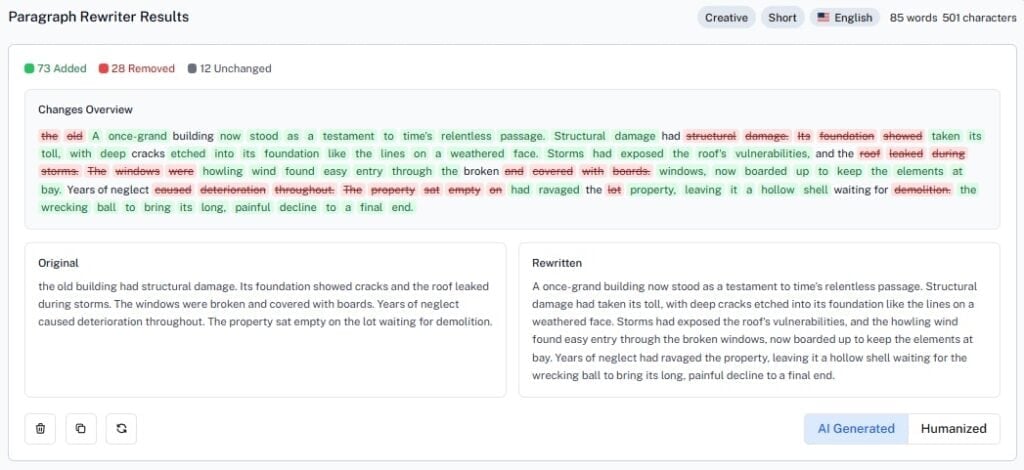
The tool helps you experiment with different levels of personification without starting from scratch.
You can adjust the intensity, try different human characteristics, and find what fits your piece’s tone.
How To Use Personification Effectively In Your Writing
Personification is powerful, but like some hot sauces, a little goes a long way.
Here’s how to use it without overdoing it.
- Match the personification to your tone. Serious academic writing? Keep personification subtle and infrequent. Creative marketing copy? You can go wild. A playful blog post can handle “the deadline tap-danced on my calendar,” but a research paper should probably stick with “the deadline approached rapidly.”
- Stay consistent with your personified traits. If you describe your brand as “friendly and approachable,” don’t suddenly make it “aggressive and demanding” two paragraphs later. Pick human characteristics that align with your message and stick with them.
- Use it to clarify, not confuse. The point of personification is to make things clearer and more relatable. If your reader has to stop and figure out what you mean, you’ve failed. “The data whispered its secrets” works if you’re building mystery. “The data performed gymnastics while juggling chainsaws” is just confusing.
- Don’t personify everything. Not every noun needs human traits. Use personification strategically to emphasize the things you want to highlight. If everything in your piece is personified, nothing stands out. It’s like using all caps, where it loses impact.
- Make it fresh. “Time flies” is personification, but it’s also a cliche. Try to find new ways to personify common things. Instead of time flying, maybe it “sprints past your to-do list” or “slips through your fingers like sand at the beach.”
- Consider your audience. Kids’ writing can handle more obvious personification. Adult readers often prefer subtlety. Business audiences might find heavy personification unprofessional. Know who you’re writing for and adjust accordingly.
- Test it out loud. Read your personified phrases aloud. If they sound awkward or overwritten when spoken, they’ll read that way, too. Your ear is a good guide.
- Use strong verbs. Personification works best with active, specific verbs. “The storm raged” is better than “the storm was angry.” “Opportunity knocked” beats “opportunity was available.” Give your personified subjects something concrete to do.
Common Mistakes When Using Personification
Let’s talk about what NOT to do.
- Overusing it. When every sentence has personification, it stops being effective and starts being exhausting. “The sun smiled while the clouds danced and the trees waved as the wind sang and the road beckoned…” One or two personifications per paragraph makes more sense.
- Mixing incompatible metaphors. If you personify something, commit to the human trait you’ve chosen. Don’t say “the project is breathing down my neck while tap-dancing on my last nerve.” Pick one. The project can’t simultaneously breathe and tap-dance. It’s anatomically impossible, even by metaphorical standards.
- Forcing it where it doesn’t belong. Some things are better described literally. “The table was sturdy” doesn’t need to become “the table stood confidently” unless that confidence matters to your point.
- Using cliches. “Time flies.” “Opportunity knocks.” “Duty calls.” These are technically personifications, but they have become so overused that they’ve lost all impact. Your reader may skip right over them, so use fresh ways to personify.
- Making it too abstract. Personification should make things more understandable, not less. “The concept wrestled with paradigmatic shifts in the zeitgeist” sounds fancy but means nothing. Keep it simple and clear.
- Personifying the wrong thing. In any piece of writing, some elements matter more than others. Personify the important stuff. Don’t waste your personification budget on throwaway details.
- Getting too weird. Personification should feel natural, even when it’s creative. “The spreadsheet yodeled its quarterly results while moonwalking through the fiscal year” is trying too hard.
- Sound forced or robotic. If you’re using AI to generate content or if English isn’t your first language, give it a couple of passes before publishing.
Undetectable AI’s AI Humanizer can help figurative phrasing stay natural and avoid awkward or overdone personification.
The tool analyzes your personified descriptions and smooths out anything that reads as unnatural or excessive by using multiple LLMs.
For example, if you’ve written, “The solution aggressively attacked the problem while simultaneously embracing alternative methodologies and dancing through implementation phases,” the AI Humanizer would flag this as overdone and suggest something cleaner like: “The solution tackled the problem head-on, adapting as needed during implementation.”
It’s like having an editor who specifically watches for personification that’s too much or doesn’t land right.
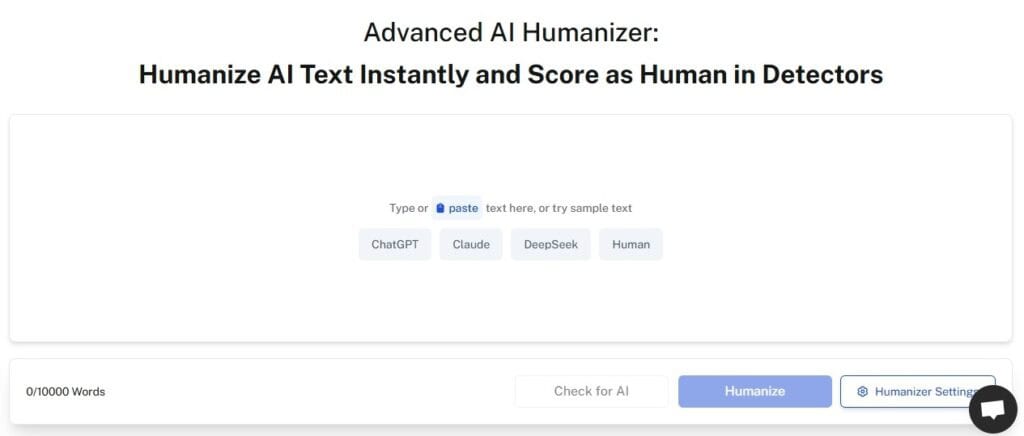
Give our AI Detector and Humanizer a try in the widget below!
When Objects Start Talking Back
Personification transforms writing from flat description into something alive.
It bridges the gap between abstract concepts and human understanding. It adds personality, clarifies meaning, and creates emotional resonance.
What’s interesting is that you’re probably already using it without realizing. Every time you say your car is “cranky” or your code is “being stubborn,” you’re personifying. The trick is learning to do it intentionally.
Start paying attention to personification in the writing you read. Notice when it works and when it doesn’t.
Then experiment in your own work and use tools from Undetectable AI to write more effectively. Try personifying one key element in your next piece and see how it changes the impact.
The sunset still isn’t performing for anyone. But give it emotion, intention, and human traits in your description, and suddenly your readers are invested.
Now go make some inanimate objects come alive.