
Play it by ear is a commonly used idiom in English with a history that dates back to centuries ago.
Long before printed sheets were standard, musicians used to learn melodies by listening to the sound and repeating after them, i.e., playing music by ear and memory instead of written notes.
Years after the play-it-by-ear origin in music, the phrase found its way into everyday situations.
As an idiom, it means your willingness to adjust your decisions according to circumstances instead of committing to a strict plan. It shows your readiness to be flexible in situations and being able to respond to unexpected moments.
In this article, we’ll discuss how to use the phrase ‘play it by ear’ in casual and professional settings, with lots of examples!
Let’s jump in.
Key Takeaways
- To ‘play it by ear’ means to decide your action in the moment according to the circumstances rather than having it planned beforehand.
- The verb form of play needs to be modified as per the subject and the tense of the sentence.
- It is very commonly used in uncertain situations when we don’t have it figured out.
- Like all idioms, it is best used in conversations and casual write-ups. It is recommended to avoid using it in professional settings.
What Does Play It by Ear Mean?
To play it by ear is an idiom (a phrase that has a different meaning in the literal sense but is used in a different context) in the English language.
It means deciding how to act without having it all figured out beforehand. And since you don’t have a pre-determined plan, your actions are subject to change moment by moment based on your instinct and circumstances.
When someone says they’ll “play it by ear,” they mean that their behavior will depend on the circumstances. It essentially serves to show you are flexible in making your decisions.


Never Worry About AI Detecting Your Texts Again. Undetectable AI Can Help You:
- Make your AI assisted writing appear human-like.
- Bypass all major AI detection tools with just one click.
- Use AI safely and confidently in school and work.
Definition and Origins
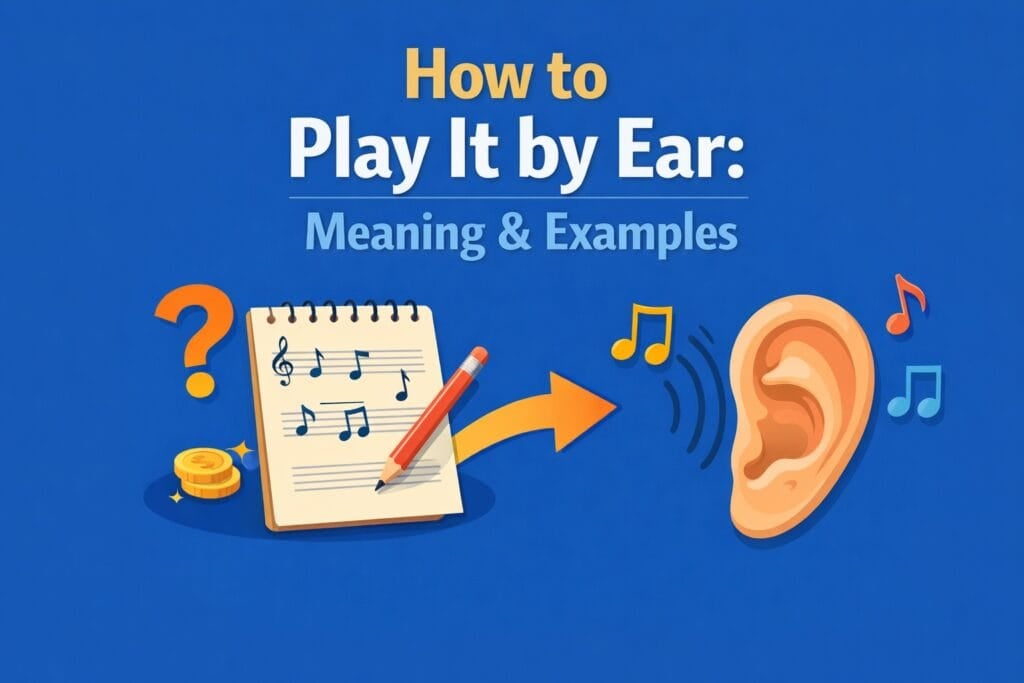
John Playford wrote about learning “to play by rote or ear without book” in his 1658 book, A Brief Introduction to the Skill of Musick. It was the first recorded use of the expression “to play it by ear” in history.
In his book, Playford wrote about musicians who learned music by listening to it instead of reading from a written notation.
Playing music by ear requires close attention to the sound so you can mimic it without the need for written instructions. Simply by listening to it, you almost instinctively pick up on the tempo, pitch, timing, tone, etc.
The expression also refers to having a good ear for something, that is, a keen ear that picks up on minute variations in voices. This holds true for both everyday language and music; for example, someone who has a good ear for accents can detect linguistic variations.
The phrase’s meaning became applicable to almost everything as it entered contemporary, everyday language.
Just as a musician reacts to a melody they listen to, a person reacts to circumstances they encounter when they ‘play it by ear.’
When People Play It by Ear
The idiom is used very frequently. Here are some casual and work-related scenarios when you hear it.
- Daily Situations
Playing it by ear is almost second nature for people in everyday conversation. Certain situations are too uncertain to make firm decisions.
For instance, a group of friends may decide to get together at a later time, but the specific plan’s itinerary can be left undecided at the moment.
Such informal invitations are free of pressure, which is precisely what true, close friends anticipate.
Examples of people playing it by ear, depending on their moods, include a quick coffee that turns into a lunch, a lunch plan that extends into an afternoon walk, spontaneous trips, etc.
- Work Scenarios
The expression “play it by ear” is by its very nature informal, as you may already be aware.
In formal writing, such as reports, academic papers, or official emails, idioms should generally not be used carelessly. However, since that’s how native people communicate, you can still use them in professional conversations.
For instance, you might hear entrepreneurs discussing how they will “play it by ear” in the event of abrupt shifts in supply and demand.
The phrase may also pop up during brainstorming sessions at work, where the structure of the conversation is intentionally loose.
Playing it by ear is a social skill for business owners in client meetings since they have no idea what the client will say. They have to adjust to the meeting’s direction.
Why Play It by Ear Is Useful
The phrase play it by ear is useful in many different circumstances because it captures a way of thinking that fits real life better than rigid planning.
It allows you to leave room for last-minute change in casual plans without panic or apology expected from anyone.
It can also be used to show that you maintain composure in uncertain situations. Tight commitments during uncertain times lead to unnecessary stress.
When your supervisor says, “Let’s play it by ear during the rollout,” it means that you shouldn’t worry about the future because the team will make any necessary adjustments to the plan.
Because playing it by ear requires making decisions based on the situation at hand rather than having everything figured out, it also promotes better decision-making in the moment.
Play It by Ear in Sentences
Now, here are some example sentences that use the phrase, ‘play it by ear’:
- We didn’t set a return time for the hike and decided instead to play it by ear
- The manager suggested we play it by ear during the presentation, since the client’s reactions would likely tell us how deep we went into the details
- I told her we could play it by ear tonight, grab dinner if we felt social, or just walk around.
- She entered the meeting prepared to play it by ear, depending on how open the discussion became.
- I’ll play it by ear tomorrow since I have no idea how drained I’ll feel after work.
- The coach said they’d play it by ear during the game based on the moves of the opposing team.
- Rather than commit too early, he chose to play it by ear and wait for more signals before making a move.
- Dinner plans depend on when everyone arrives, so we’re playing it by ear tonight.
- We’ll play the launch by ear since feedback could change everything.
- The professor wants to play the lesson by ear and follow the students’ pace instead of the outline.
Tips and Common Mistakes
The phrase ‘play it by ear’ is used like a regular verb expression, so the forms of the verb ‘play’ will change based on the subject and the tense of the sentence.
- I’m playing it by ear: first person, present continuous
- She played it ear: third person, simple past
And if you are referring to the future, you will have to add will or going to before the idiom, as in “We will play it by ear tomorrow.”
Also, the word it in ‘play it by ear” is a placeholder that can be replaced for whatever situation hasn’t been locked down yet.
You can use the phrase as is, i.e., “Let’s play it by ear,” or swap it for a specific activity/event, i.e., “We’re going to play the road trip by ear.”
Be very vigilant of your spellings, because play it by air or play it by year are two similar sounding variations of the idiom with no meaning.
If you use the phrase in any written piece of text, make sure to always run it through Undetectable AI’s Sentence Rewriter or Paragraph Rewriter, depending on your text’s length. It will ensure that you don’t end up using it incorrectly.
Synonyms for Play It By Ear
It’s very natural for a phrase or idiom to develop multiple variations with the same meaning as a language continues over the years. Different phrases get used by different groups in different settings.
Here are some examples of synonyms and idioms with the same meaning as ‘play it by ear.’
| Synonym / Idiom | Example Sentence |
| Take it as it comes | I’m not locking in any decisions about the project yet. I’ll take it as it comes. |
| Go with the flow | We stopped arguing over details and just went with the flow for the rest of the day. |
| Wing it | His slides wouldn’t load during the presentation, so he winged it by speaking from memory and answering questions instead. |
| Improvise | When the power cut out halfway through the event, the organizers improvised by moving everyone outside and continuing by daylight. |
| Stay flexible | The construction timeline depended on permit approvals, so the team stayed flexible. |
| Feel it out | She wanted to feel it out before committing to a long-term plan. |
| Make it up as you go | We made it up as we went on the trip and chose our stops based on what looked interesting from the road. |
| Play it safe and see | With the policy still under review, they chose to play it safe and see how leadership responded before making changes. |
Boost your writing quality with our AI Detector and Humanizer below!
Final Thoughts
Spoken English tends to feel more natural when idioms and other literary devices are added to the conversation. That’s how native speakers actually talk.
Idioms, however, are sensitive to their structure and spellings. If you use them incorrectly, the meaning won’t stay the same, and the person listening to you will be confused trying to understand what you meant.
To make sure you’re using play it by ear correctly, you can refer to Undetectable AI’s AI Chat to confirm that the wording in your head is grammatically accurate.
Alternatively, use the Undetectable AI’s AI Humanizer to fix the flow of the text.
Try out Undetectable AI today.