
Idioms are literary devices in the English language that are not used in their literal sense. Each of them has a history, where it may have been used in the literal context. But their modern-day usage is entirely metaphorical.
“Pound of flesh” is an idiom first used to ask for the said amount of human flesh by the character Shylock in Shakespeare’s play, The Merchant of Venice.
Using it in its literal meaning today would probably get you in jail!
In this article, we’ve discussed the meaning and origin of “pound of flesh” in detail. There are lots of example sentences to help you understand the grammatical implications for its usage.
Let’s get started.
Key Takeways
- Pound of flesh is a metaphor initially used for its literal meaning, i.e., to demand a piece of human flesh to get lent money back, in a Shakespeare play.
- It means an unreasonable demand that puts someone in a difficult condition to complete it. The demand is not illegal, but it is unfair in comparison to what the other person owes you.
- It is preceded by a verb (take, demand, extract) and the indefinite article ‘a’ when used in a sentence.
What Does Pound of Flesh Mean?
The first time “pound of flesh” was used in the literature, it was to demand an actual pound of human body flesh. Crazy, right?
On the literal level, the concept of someone demanding a pound of flesh is almost psychotic, something straight out of a nightmare.
The way it is used today is different, though.


Never Worry About AI Detecting Your Texts Again. Undetectable AI Can Help You:
- Make your AI assisted writing appear human-like.
- Bypass all major AI detection tools with just one click.
- Use AI safely and confidently in school and work.
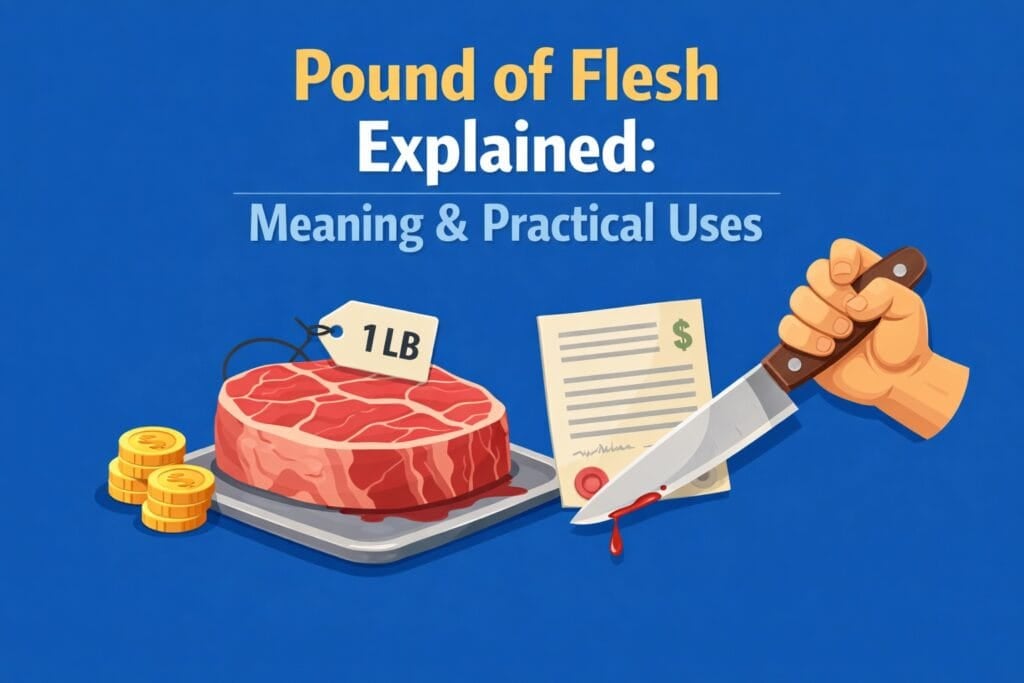
A “pound of flesh” has come to mean an unreasonable demand from one person to another, except that it is not an illegal call.
The demand does expect compliance, no matter the personal cost. It is so cruel in spirit that the person asked to meet it is expected to bleed for the privilege.
Here are some examples of such demands:
- A government policy due to which poor people are taxed high amounts on everyday utilities
- Extremely high fines for breaking a minor rule
- Strict attendance rules for students at an educational institute that don’t even allow emergency leaves
- Toxic workplaces with very long working hours and minimal pay
- Predatory loans, on which compound interest keeps increasing, no matter what you pay back
Origins
The phrase “pound of flesh” is lifted from William Shakespeare’s play, “The Merchant of Venice.”
To give you some context, it was spoken by Shylock, who is a Jewish moneylender living on the margins of Venetian society.
Shylock lends some money to Antonio, a merchant whose wealth is currently tied up in ships that are late returning to port.
To make it more complicated, Antonio, the merchant, did not borrow the money for himself but for his friend, Bassanio, who wants some money to court Portia, a very wealthy woman.
Antonio approaches Shylock with insults already on his tongue because he’s confident that his ships will arrive in time. Shylock agrees to the loan.
However, he mentions the chilling phrase to mean that if his debt is unpaid, he would take a pound of Antonio’s flesh from any part of the body that pleases him.
Here’s what the text reads:
“If you repay me not on such a day, In such a place, such sum or sums as are expressed in the condition, let the forfeit be nominated for an equal pound Of your fair flesh, to be cut off and taken In what part of your body pleaseth me.”
Over time, the literal horror of the phrase subsided as it is obviously not normal to ask for human flesh in exchange for money. The phrase began to be used in everyday conversations to denote a harsh demand about which you can’t deliberately say that it is illegal.
Pound of Flesh in Real Life
The phrase “a pound of flesh” has many uses in professional and everyday life environments.
Any situation that is technically allowed but is far beyond what feels humane is said to be taking off someone’s pound of flesh.
- Business and Contracts
Predatory lending in business contexts is the classic example of demanding someone’s pound of flesh.
In the beginning, the money is lent with the promise of easy approval and immediate help, so the borrower receives it at a moment of stress.
But its repayment terms are deliberately set to trap them such that the interest on the lent amount keeps growing. The borrower can spend years paying it back without ever getting close to repaying it fully.
Similarly, businesses may raise the prices of their products sharply during times of financial instability. If there’s no realistic alternative to the product, the customers have no choice but to buy it no matter the prices.
Foreclosure in debt collection practices can also be harsh enough that it takes a ‘pound of flesh.’
You may have a history of years of stable payments, but if you miss a payment for any emergency, say, illness or layoff, the company will pressure you through relentless, sometimes even threatening, communication. In the worst cases, your property may be seized, too!
Some companies include clauses in their contracts that restrict their former employees from working in their field for extended periods.
A worker may leave a job for a valid reason and then find out later that they are legally not allowed to earn a living from elsewhere for some time.
- Everyday Situations
Unhealthy physical relationships are one of the most common settings that demand a pound of flesh from the person suffering in the relationship.
They may be under constant mental pressure to carry the emotional weight of both people.
Some workplaces are too toxic for their employees. They require people to go beyond their job descriptions without any additional recognition.
Substance abuse or compulsive behavioral patterns are continuously detrimental to a person’s health and may be described as taking a pound of flesh from your body.
Journalists often use it while commenting/criticising government policies that unfairly put the underprivileged individuals at a disadvantage.
You must be careful while using this phrase in conversations, though. You definitely don’t want your boss to hear you saying that the work culture is demanding a pound of your flesh.

So, any time you feel like it fits the situation, always turn to the Undetectable AI’s Grammar Checker to confirm that it is grammatically correct.
Tips and Common Mistakes
The indefinite article “a” is used before the phrase “pound of flesh,” as in to demand a pound of flesh.
It can also take a possessive adjective like “its” or “their,” for example, its pound of flesh or their pound of flesh. The possessive adjective makes it more specifically targeted at a certain individual/group, depending on the context.
Names and specific nouns can replace possessive adjectives when you’re talking about someone in third-person, e.g., the bank took John’s pound of flesh.
The idiom is used as a noun, and in most sentences, you need a verb before it. The verb can be “takes, demands, extracts, and the likes of it.”
Similar Idioms and Expressions
For almost every expression in the English language, there are several other words and phrases with the same meaning. These similar versions help us be more creative in expression. It is possible to avoid repetition while talking about similar circumstances.
Here are some similar idioms and expressions with the same meaning as a “pound of flesh.”
| Similar Expression | Example Sentence |
| Pay the price | We thought the shortcut would save us time, but we ended up paying the price when we got lost on our way. |
| Exact a toll | The long hours and constant pressure at the new workplace exacted me a toll that no paycheck could undo. |
| Bleed dry | The fees kept coming until the account was bled dry. |
| Squeeze for all it’s worth | The landlord squeezed the property for all it was worth, repairs ignored, and rents climbing. |
| Drive someone into the ground | That schedule drove her into the ground, even though it was praised as dedication. |
| No mercy shown | The rules were enforced with no mercy shown, and even the appeals made no difference. |
| Demand everything | The project was so intense that it demanded everything he had. |
| Leave nothing behind | By the end of the dispute, the settlement left nothing behind but resentment. |
How to Use Pound of Flesh in a Sentence
The phrase pound of flesh functions as a noun in a sentence, and it nearly always follows a verb. As mentioned previously, it also needs the indefinite article ‘a.’
Here are some example sentences that use it:
- The legal settlement gave the corporation its pound of flesh, even though the employee was resentful because he was left with nothing.
- He understood the apology would not satisfy her because she still wanted a pound of flesh.
- The criminal justice system claimed its pound of flesh through hefty fines over minimal charges.
- By the time the non-compete clause expired, the company had taken her pound of flesh by blocking employment in her field for two full years.
- The mortgage bank took a pound of his flesh as it proceeded with foreclosure after one missed payment.
- Cuts to housing assistance programs extracted a pound of flesh from low-income families who were forced to choose between rent and utilities.
It is a little difficult for English learners to put idioms and metaphors in sentences accurately because their grammar rules aren’t very predictable.
We recommend using the Undetectable AI’s Sentence Rewriter the first few times you want to use it until you are confident enough to use it independently.
See your results instantly with our AI Detector and Humanizer below!
Final Thoughts
Phrases like “pound of flesh” that evoke sensory reactions in the reader, i.e., the feeling of discomfort thinking about a piece of flesh, are very important in literature. Without these, our expressions won’t be as impactful.
Try out forming a few example sentences using a pound of flesh in your head, and use Undetectable AI’s AI Chat to verify that you’re doing it right.
After only a couple of tries, you’ll get as good at it as native speakers.
Check out Undetectable AI today!