
“The pun is the lowest form of wit.” — John Dennis.
“The pun is the highest form of literature.” — Alfred Hitchcock.
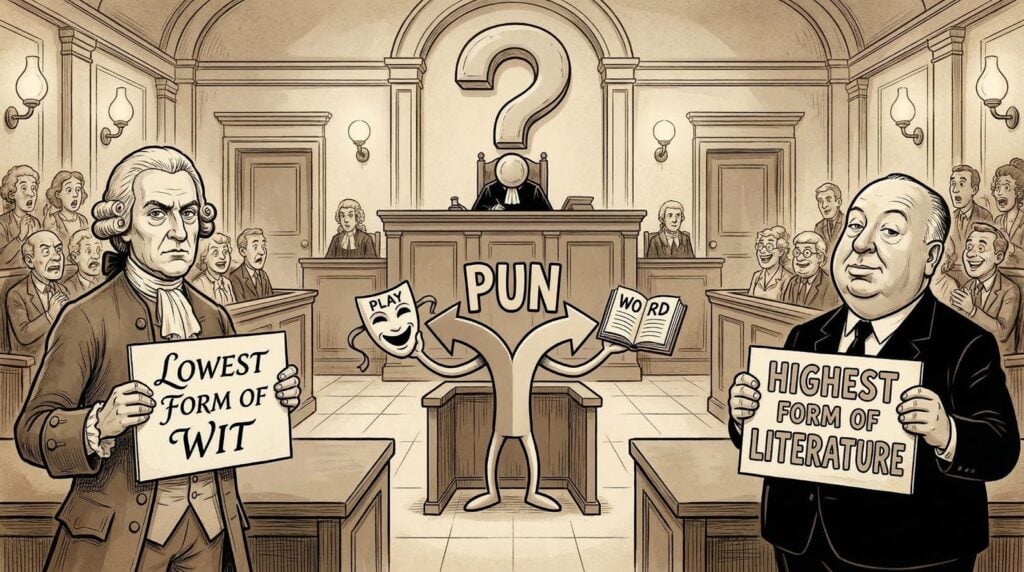
So, who is right? Is a pun just a cheap trick for lazy writers, or is it a sign of a genius mind?
The truth is, we probably like them more than we admit.
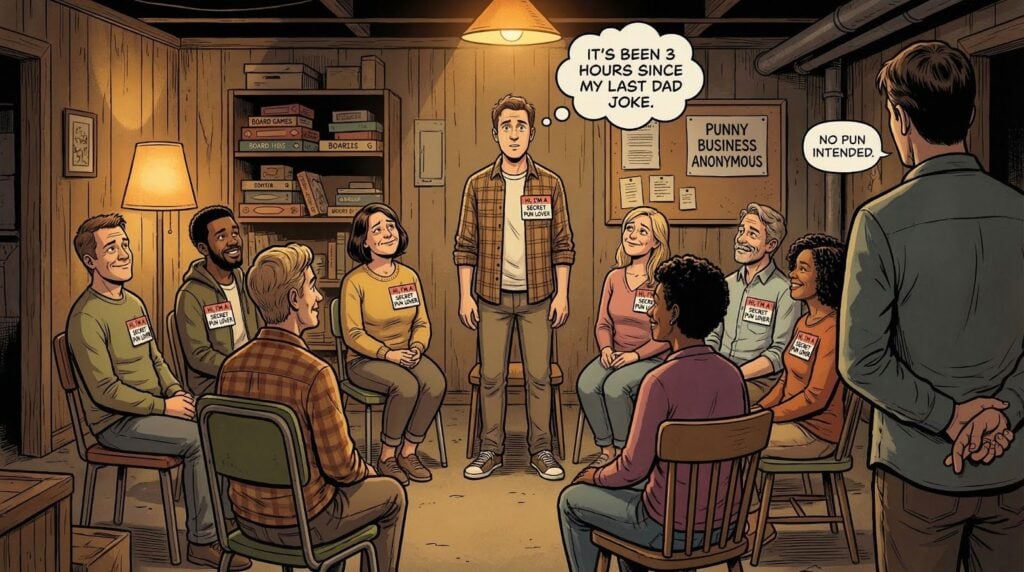
We might roll our eyes at a “dad joke,” but let’s be honest: there is a 99% chance that when someone says “no pun intended,” they are lying. We secretly love them.
In this blog, we are going to learn everything about puns.
We’ll learn what is a pun, classic pun examples, how and why writers use them in their writings and communication.
Let’s dive in.
Key Takeaways
- The word originates from puntiglio (a fine point), meaning puns began as sharp arguments, not just dad jokes.
- Puns cause a “prediction error” in the brain, and the groan is a social signal that you’ve solved the puzzle.
- From Shakespeare to Big Pun, effective wordplay is a sign of dominance and technical skill.
- The phrase “no pun intended meaning” has shifted from a sincere Victorian apology to a modern spotlight for cleverness.
- The best puns are “stealth puns.” These are ambiguous enough to be discovered by the reader without being pointed out.
What Is Pun?
When we ask “What is a Pun?”, we look at two different worlds colliding: ancient history and 90s Hip Hop.
Historically, the word “pun” is a bit of a mystery. It likely appeared in the 1600s as a short version of the Italian word puntiglio, which means a “fine point” or a specific detail.
- Pun Definition
Here is a clear pun definition:


Never Worry About AI Detecting Your Texts Again. Undetectable AI Can Help You:
- Make your AI assisted writing appear human-like.
- Bypass all major AI detection tools with just one click.
- Use AI safely and confidently in school and work.
A pun is a form of wordplay where one word or phrase has two meanings, creating humor or clever effect through ambiguity or similar sounds.
In the modern world, however, you cannot talk about pun without mentioning Christopher Lee Rios, better known as Big Pun.
Why is a rapper in a linguistic report?
Because Big Pun treated words like complex puzzles. In his famous song “Twinz (Deep Cover 98),” he delivered one of the most technical lines in rap history:
“Dead in the middle of Little Italy, little did we know that we riddled some middlemen who didn’t do diddly.”
He attacks the listener’s brain with repeating sounds (Middle, Little, Riddled, Diddly) that shift meaning every time they land.
- Classic Examples of Pun
Let’s look at some of the classic pun examples across history and pop culture:
- The Tragic Pun (Romeo and Juliet)
In Shakespeare’s play, the character Mercutio is stabbed in a fight. As he bleeds to death, he tells his friends:
“Ask for me tomorrow, and you shall find me a grave man.”
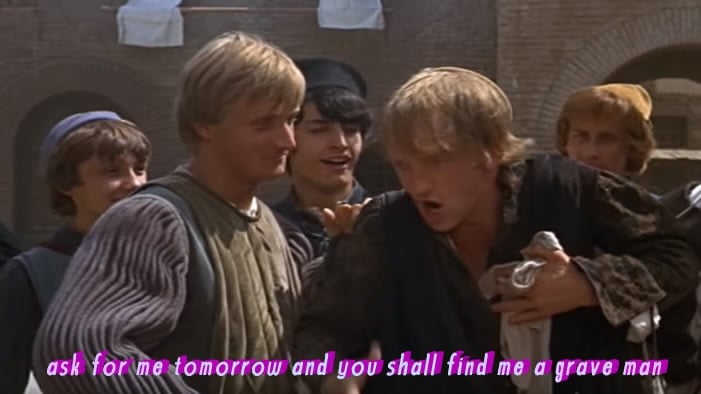
This uses the double meaning of “grave” (being serious vs. being in a grave).
It shows that Mercutio is witty to the very end, using a pun to accept his own death with a dark smile.
2. The Visual Pun (Alice in Wonderland)
Lewis Carroll loved playing with words that sound the same (homophones).
In the book, the Mouse tells Alice his “long and sad tale.” Alice, looking at the Mouse’s actual tail, asks why it is sad.
Carroll takes the joke further by printing the words on the page in the shape of a winding mouse tail.

3. The Cool Pun (James Bond)
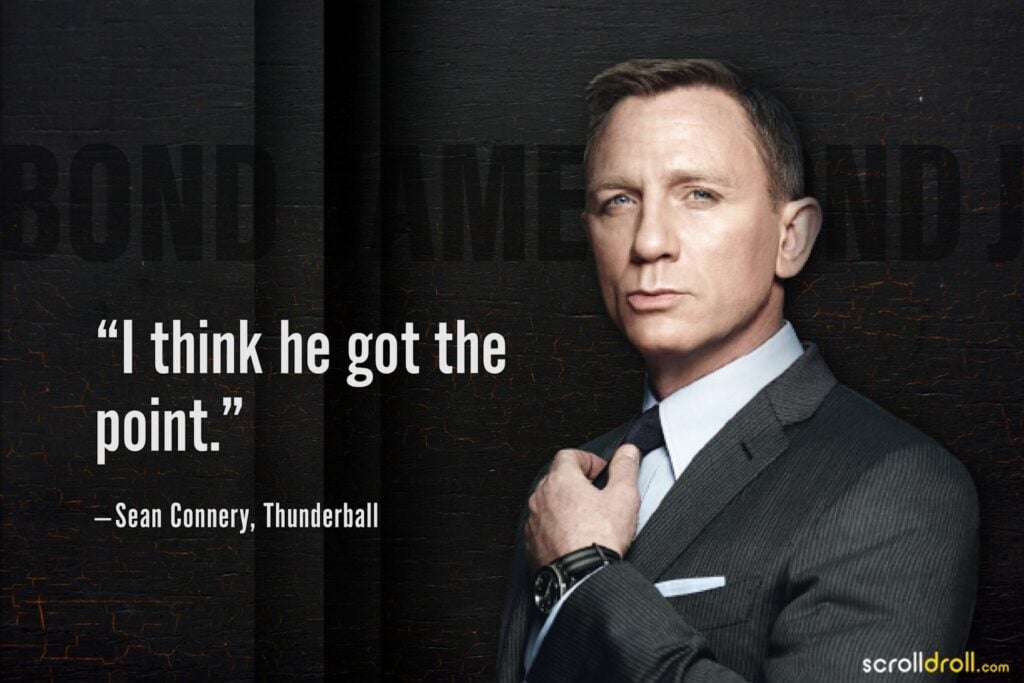
In the movie Thunderball, James Bond shoots a bad guy with a speargun, pinning him to a tree. Bond looks at him and casually says:
“I think he got the point.”
This is a Situational Pun. “Point” refers to the sharp tip of the spear and the message of defeat.
4. The Tabloid Pun (New York Post)
In 1983, a newspaper ran a headline about a gruesome crime where a bar owner was beheaded. The headline read:
“HEADLESS BODY IN TOPLESS BAR”
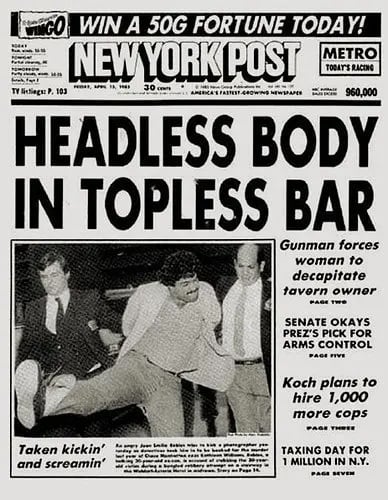
It became famous because it used rhythm and wordplay to turn a horror story into a catchy phrase. It plays on “Topless” (a type of club) and “Headless” (the state of the body).
- Types of Puns
Here is a breakdown of eight different types of puns:
| Type | How It Works | The Example | Why It’s Funny |
| Homophonic | Words that sound the same but have different spellings. This is the most common spoken joke. | You can tune a guitar, but you can’t tuna fish. | Your brain hears “tuna,” but has to quickly switch between the fish and the verb phrase “tune a.” |
| Homographic | Words that look the same but sound different or mean different things. These work best in reading. | The wind was too strong to wind the sail. | You have to read the first one as moving air (/wɪnd/) and the second as coiling a rope (/waɪnd/). |
| Homonymic | The “pure” pun. The word looks and sounds exactly the same but has two distinct meanings. | I used to be a banker, but I lost interest. | “Interest” works perfectly for both meanings: financial profit and personal curiosity. |
| Compound | A dense joke that uses two or more puns at the same time. | Never trust an atom, they make up everything. | It puns on two things at once: atoms making matter (physics) vs. people making up lies. |
| Recursive | You need outside knowledge (like a movie quote) to understand the joke. | May the Fourth be with you. | It only makes sense if you know the Star Wars line “May the Force be with you.” |
| Visual | Using an image instead of words to create a double meaning. Common in logos or crests. | A drawing of a castle turning coins into gold for a town named “Batenburg.” | The town name translates to “Profit Castle.” The image spells out the name visually. |
| Bilingual | Jokes that mix two languages to create a bridge between sounds. | Un œuf is enough. | “Un œuf” is French for “one egg,” which sounds almost exactly like the English word “enough.” |
| Syllepsis | Using one single word to control two completely different thoughts. | She lost her keys and her temper. | The verb “lost” applies physically to the keys and metaphorically to her emotion at the same time. |
Why Writers Use Puns
If puns make people groan and roll their eyes, why do the world’s best writers keep using them?
It is because the pun is a tool for efficiency. It allows a writer to do more work with fewer words.
- To Say More With Fewer Words
A pun as a form of data compression. It allows a writer to pack two different meanings into the tiny space of a single word.
- Example: When Mercutio says he will be a “grave man,” he is conveying the double information without taking up extra room: “I am a serious man” and “I will be a dead man.”
- For The Dopamine Hit
Cognitive research shows that puns make the brain pause and “solve” the meaning. That small mental win releases dopamine, which helps the phrase stick in memory.
- Example: This is exactly why Volkswagen’s “Think Small” campaign became legendary. It challenged the American habit of “Thinking Big” while literally describing the small Beetle. The brain loved solving that contradiction.
- To Use Humor to Break the Tension
In heavy drama or tragic news, puns become a release valve.
If a story is 100% a tragedy for too long, the audience goes numb. A well-placed pun gives them a moment to breathe.
- Example: Shakespeare used this in Macbeth by cracking jokes about a “hell-gate” while the king lay murdered upstairs. This contrast humanizes the tragedy.
- To Show Skill Through Wordplay
Finally, for many writers and rappers, the pun is a flex. It is a way of signaling, “I am in total control here.”
- Example: In Hip Hop, this is the primary function of wordplay. When Big Pun rapidly rhymes “middle,” “Little,” “riddled,” and “diddly,” he is proving to the listener, and his rivals, that he has mastered the language enough to bend it to his will.
How Puns Work in Communication
Usually, the goal of communication is to kill ambiguity. We want to be clear.
Pun meaning do the opposite on purpose. They introduce ambiguity and serve an important social function.
Here’s what happens in your brain:
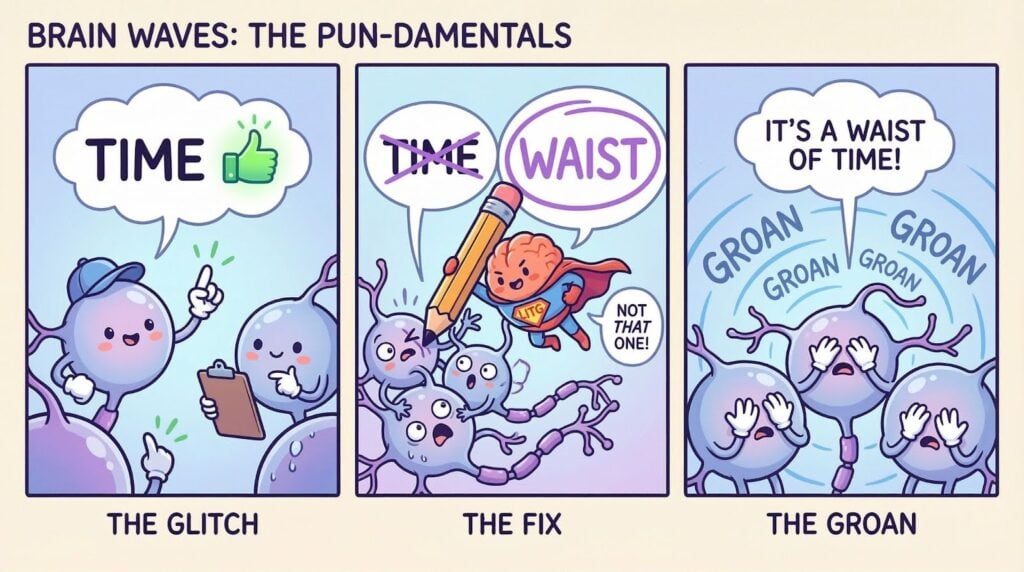
The Prediction Error (The Glitch): Our brain is a powerful “autocomplete” engine. It is constantly guessing the next word you are going to hear. If I say “That was a total waste of…”, your brain guesses the word “time.” If I say “waist,” your brain experiences a “prediction error.” It trips.
The Re-evaluation (The Fix): A specific part of our brain called the Left Inferior Temporal Gyrus (LITG) kicks into gear. It has to suppress the word you expected and activate the secondary meaning (the waist of a body).
The Release (The Groan): Once the conflict is resolved, the tension drops. The groan is a signal that says, “I understand the rule you just broke.” It bonds the “insiders” who get the joke against the “outsiders” who don’t.
No Pun Intended Meaning
One of the weirdest quirks of using puns is the phrase “no pun intended.”
Back in the 1800s, this was a sincere apology.
If a writer described a turkey’s bad behavior as “fowl play,” they would say “no pun intended” to clarify they weren’t trying to be funny during a serious topic. It was about good manners.
Today, this phrase has become a humblebrag. We almost never use it for accidents.
Instead, we use it to point a giant neon sign at a joke we made on purpose, just in case you missed it.
It is a trick that says, “Look how clever I was, but let’s pretend I wasn’t trying.”
Writing a good pun is a delicate balancing act. If you push too hard, it sounds forced (and not in a good way). If you are too subtle, no one gets the joke.
Instead of staring at a blank page trying to force the wordplay, you can use the Paragraph Rewriter to speed up the process.
This tool is designed to help you take a single plain idea and generate multiple pun variations.
It allows you to experiment with different angles until you find the one that lands perfectly.
It ensures you preserve the comedic intent (the funny part) without sacrificing clarity (so your readers actually understand what you mean).
Common Mistakes When Using Puns
A bad pun example can derail a serious moment or make a writer seem unprofessional. If you want to use them effectively, you have to know where the traps are.
- Too Many Bad Jokes
The most common mistake is using too many simple, obvious puns that fatigue the reader. If a pun is too easy, it feels cheap. Pun Example:
“I’m reading a book on anti-gravity, it’s impossible to put down”
The mistake here is prioritizing the joke over the message. A pun should be the cherry on top of the content, not the entire meal.
- Pointing Out the Joke
Perhaps the biggest sign of an amateur writer is the tendency to highlight the pun.
Writers often get nervous that the reader might miss the joke, so they use quotation marks, italics, or bold text to say, “Look! I made a funny!”
- The Bad Pun Example: The cat was “purr-fect”.
This fails because humor requires discovery. By visually flagging the pun, you rob the reader of the “aha!” moment.
You are essentially explaining the joke before they have even read it.
- Using Puns at the Wrong Time
Puns are inherently playful, which means they can be dangerous in the wrong setting.
Using them in highly serious contexts like a crisis email, a firing letter, or a legal document, signals a lack of empathy and respect.
- Trying Too Hard to Be Clever
Finally, avoid the forced pun. This happens when a writer twists a sentence into an unnatural pretzel just to make the wordplay fit.
- The Flop: “I wanted to buy a camouflage shirt but… uh… I couldn’t find one.”
If the sentence structure feels clumsy or the delivery has to be awkward to set up the joke, the reader will notice the effort more than the wit.
A good pun should feel inevitable, not forced.
How to Use Puns Effectively
Here’s how to use the pun examples without annoying your reader:
- Find the Balance
The best puns feel natural. Good puns sit in a sweet spot where both meanings work at the same time.
Nothing feels stretched or awkward. Take the famous headline “Headless Body in Topless Bar.”
It works because both meanings are true:
- It happened in a strip club.
- The body was literally headless.
Because neither meaning is forced, the pun feels clever instead of cheap.
- Keep It Subtle
Let readers find the joke themselves. Never point out your pun. No italics. No quotation marks. No “get it?”
When readers discover a pun on their own, they enjoy it more, and they credit you for the cleverness.
- Make Sure It Serves a Purpose
A pun should do real work. A pun shouldn’t just decorate the sentence. It should support the idea.
Volkswagen’s “Think Small” has challenged the culture of “thinking big” while perfectly describing the car. The pun was the strategy.
If your pun doesn’t strengthen the message, cut it.
- Set the Scene First
Context makes the joke work. Puns need setup. You have to guide the reader’s brain in one direction before switching meanings.
If you want a “tuna” / “tune a” pun, you first need to talk about music. Once the reader expects one meaning, the second meaning becomes funny.
Puns in Different Writing Genres
Let’s take a look at how different genre writers use puns to get what they want.
| Genre | Main Job | How It Works | Example |
| Journalism & News | The Hook | It stops your eyes from scanning and forces you to read the story. It uses humor to disrupt your day. | “Super Caley Go Ballistic, Celtic Are Atrocious” (A legendary sports headline punning on Mary Poppins after a team named Caledonian won). |
| Ads & Marketing | The Memory Glue | It turns a slogan into an “earworm” that you can’t forget. It links the brand name to a benefit. | “Shave Time. Shave Money.” (Dollar Shave Club uses this to promise you will save time and cash while describing the actual act of shaving). |
| Books & Stories | Deep Meaning | It adds layers to a character. These aren’t usually “funny,” they are often tragic or symbolic. | Wolfsheim (The Great Gatsby) (His name puns on “Wolf’s Home,” hinting that he is a predator, not a friend). |
| Hip Hop & Music | Rhythm & Skill | Rappers use puns to show off speed and dominance over language. | Big Pun’s “Twinz” (He uses the “Little Italy / Diddly” pun to create a machine-gun rhythm. It proves he is a master of the craft). |
Writing a pun is easy but making it sound natural is hard. If your wordplay feels forced, stiff, or “too smart for its own good,” it will push readers away.
Don’t let a bad delivery ruin a good joke. Use the AI Humanizer to smooth out the edges.
It analyzes your text and adjusts the rhythm, ensuring your puns flow like a real conversation rather than a logic puzzle.
It transforms “technically correct” wordplay into “naturally funny” writing.
Test our AI Detector and Humanizer with the widget below!
Conclusion
Whether you are analyzing a Shakespearean tragedy or nodding along to Big Pun, the verdict is in: the pun is much more than just a “groan-worthy” dad joke.
It is a sign of a sharp mind.
From the ancient definition of puntiglio to the modern “no pun intended” humblebrag, these word puzzles have survived for centuries because they hack our brains in the best way possible.
They force us to stop scanning and start thinking. They allow us to pack double the meaning into half the space.
So, don’t be afraid to use them in your own writing. Just remember the golden rule: keep them subtle and keep them natural.
Because at the end of the day, language is meant to be played with.
And if you can make your reader smile, or even groan, you have already won.
Ensure your wordplay stays sharp and human with Undetectable AI.