
The explosion of AI detectors and humanizers has been unmistakable. Many are leaning on AI tools to improve their writing and “humanizers” so they won’t get flagged.
But let’s be honest, not all tools deliver what they promise.
AI detection is a highly technical process, and one platform that claims to excel in it is Real-Write.
However, are these just more claims designed to hook you in?
Before you make the jump, let’s talk about Real-Write AI, what it promises, what it actually delivers, and whether you should trust it with your content.
Just so you know, it might be wise to have a backup plan.
Key Takeaways
- Real-Write AI claims to detect and humanize AI-generated content.
- Testing showed major accuracy issues.
- It flagged 26% of human-written text as AI-generated.
- It detected only 24% of pure ChatGPT output as AI.
- Accuracy is too low for reliable detection or humanization.
- Tools like Undetectable AI deliver far more consistent results at 99% accuracy.
What Is Real-Write AI?
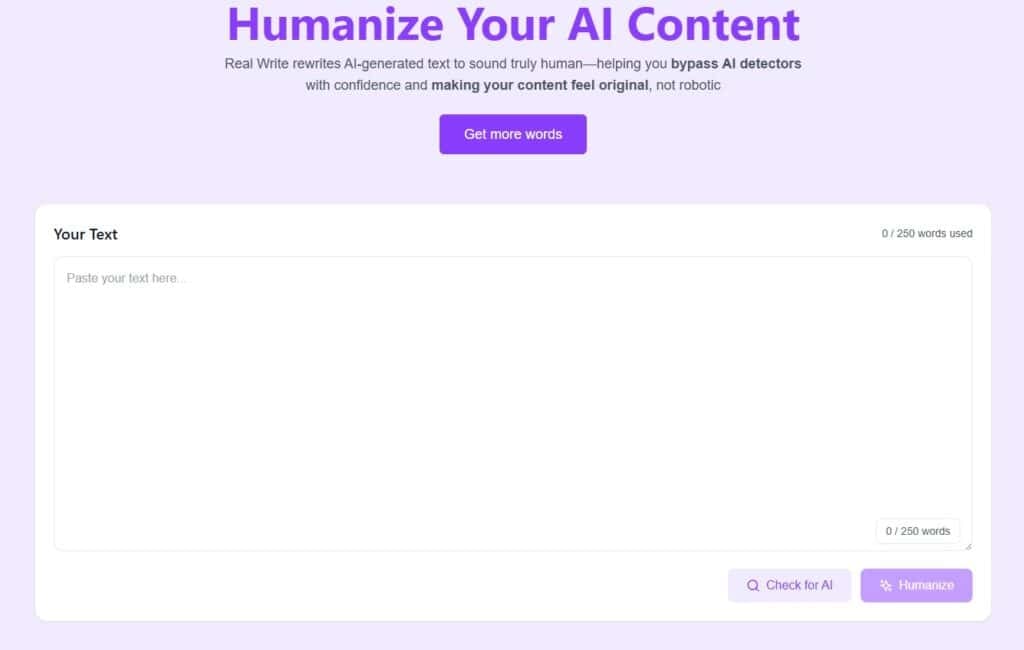
Real-Write AI is a web-based tool that does two main things. First, it detects AI-generated content.
Second, it claims to humanize that content so it passes AI detection tools.
The whole pitch is pretty straightforward.


Never Worry About AI Detecting Your Texts Again. Undetectable AI Can Help You:
- Make your AI assisted writing appear human-like.
- Bypass all major AI detection tools with just one click.
- Use AI safely and confidently in school and work.
Upload your text, get a percentage score showing how much AI was detected, then use their humanizer to make it sound more natural.
The website is clean and simple. You don’t need to create an account to test the detector, which is honestly refreshing.
You just paste your text into a box and hit “Analyze.”
Within seconds, you get a percentage breakdown of what the tool thinks is AI versus human-written.
On paper, it sounds great. It’s quick, accessible, and designed for anyone worried about AI detection, such as students, content creators, marketers, and anyone playing the “will this get flagged” game.
Core Overview of Real-Write AI
The interface isn’t complicated. There’s a text box, a button, and results.
The detector gives you a percentage score that supposedly indicates how much of your content appears to be AI-generated. Lower percentages mean more human, higher percentages mean more AI.
Simple enough.
Their humanizer feature works similarly. You paste your AI-generated text, click “Humanize,” and the tool rewrites it to sound more natural.
The goal is to lower that AI detection score so your content flies under the radar.
Real-Write AI positions itself as a solution for people who need to verify that their content won’t get flagged.
They market both the detection and humanization features pretty heavily with promises of accuracy and reliability.
Therefore, you should be able to trust the tool to tell you what’s AI and what’s not.
But this is when things start to get juicy.
How Real-Write AI Claims to Work
Most AI detection tools use similar methods.
They analyze patterns in text that are common in AI-generated content, things like predictable sentence structures, repetitive phrasing, and vocabulary choices that feel a little too polished or generic.
The detectors compare your text against these patterns and spit out a score.
Real-Write AI doesn’t go into massive detail about their specific methodology.
Their marketing focuses on two key features: the AI detector and the humanizer.
They emphasize that their detector can catch AI-generated text, and their humanizer can rewrite it to pass detection.
The detector is supposed to identify AI fingerprints in your writing. The humanizer takes flagged content and makes it sound more organic, more like something an actual person would write.
That’s the pitch.
Yet marketing promises and actual performance are two very different things.
Real-Write AI Accuracy & Detection
Let’s get into the actual testing. We wanted to see if Real-Write AI lives up to its claims, so we used a testing methodology inspired by ZDNet’s widely referenced benchmark for AI detectors.
ZDNet tested multiple tools to see which ones could accurately identify AI text, and their approach gave us a solid framework.
In fact, Undetectable AI ranked #8 in that ZDNet benchmark. We’re transparent about where we stand.
Our Detector and Humanizer consistently score high for accuracy, and we wanted to see how Real-Write AI compared.
So we ran two tests.
First test: 100% human-written content. We wrote an original piece from scratch. No AI involvement whatsoever.
Actual human thoughts, actual human phrasing, typed out by actual human fingers.
Then we ran it through Real-Write AI’s detector.
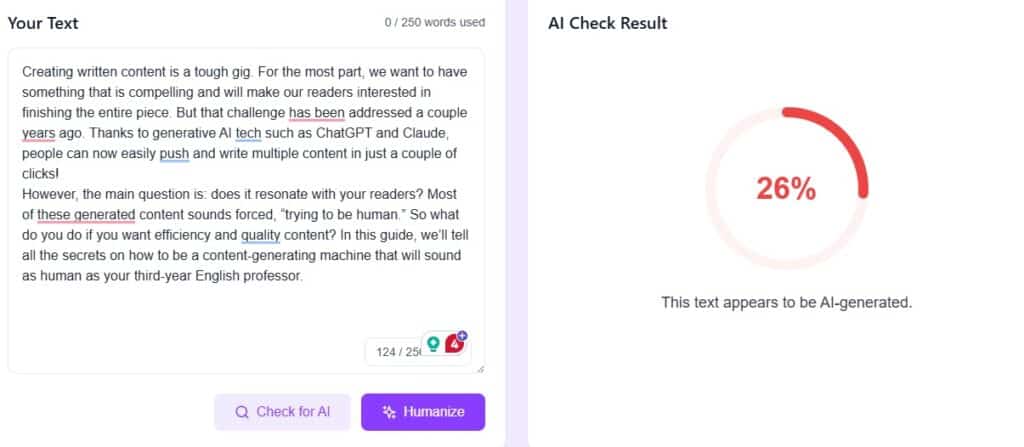
The result? 26% AI.
This content was entirely human-written. There was zero AI involved.
But Real-Write AI flagged over a quarter of it as potentially AI-generated. That’s not just a minor error.
That’s a false positive that could seriously mislead someone who relies on accurate results.
Second test: 100% ChatGPT content. We took a prompt, fed it to ChatGPT, and copied the output verbatim.
No edits. No human touch. Pure, unfiltered AI text. Then we ran it through Real-Write AI.
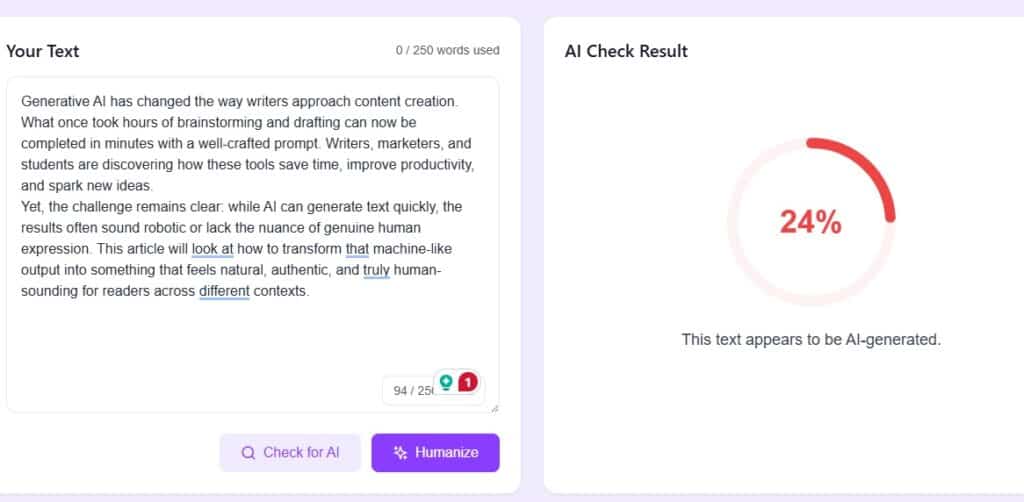
The result? 24% AI.
Hold on. The human-written content scored higher for AI detection than the actual AI-generated content.
The tool performed worse than flipping a coin.
This isn’t just inaccurate—it’s like a metal detector that beeps at plastic but stays silent when you wave a steel pipe in front of it.
If you’re relying on Real-Write AI to verify whether your content will pass AI detection, you’re basically gambling. And those aren’t odds you’d want to bet on.
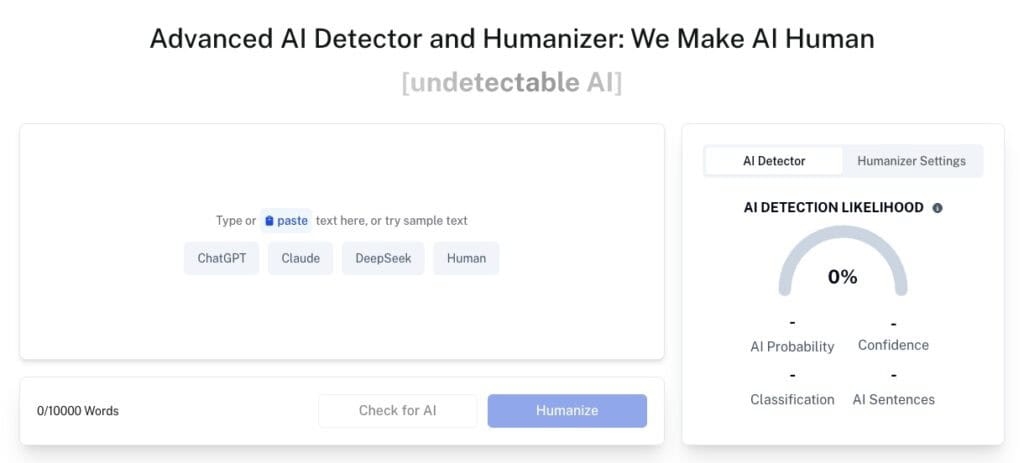
If you need reliable detection, Undetectable AI’s AI Detector and Humanizer can verify if your content genuinely appears human and rewrite any parts flagged as AI.
You get accuracy and solutions in one place.
Pros and Cons of Real-Write AI
Let’s break down what Real-Write AI does well and where it falls short.
Pros:
- The interface is super easy to use. You don’t need a tutorial or a manual. Paste text, click the button, get results. That simplicity matters when you just want quick answers.
- No account required for basic detection. You can test content without signing up or providing your email address. That’s a nice touch for people who want to try before making a commitment.
- Fast results. The tool processes text quickly, so you’re not waiting around for minutes. It’s almost instant.
Cons:
- The accuracy is all over the place. Our testing showed it can’t reliably distinguish between human and AI content. That’s the core function of the tool, and it doesn’t work consistently.
- False positives are a real problem. Flagging human-written content as AI can cause serious issues for students, writers, and professionals who need trustworthy results.
- False negatives are equally concerning. Missing actual AI-generated content defeats the entire purpose of using a detector in the first place.
- Limited transparency about methodology. We don’t really know how their detection works, which makes it hard to trust the results.
- The humanizer’s effectiveness is questionable if the detector itself can’t accurately identify AI content to begin with.
The tool has potential in terms of usability, but the accuracy issues are too significant to ignore.
Real-Write AI vs. Other AI Detectors
When we tested the same content using Undetectable AI’s detector, the difference was night and day.
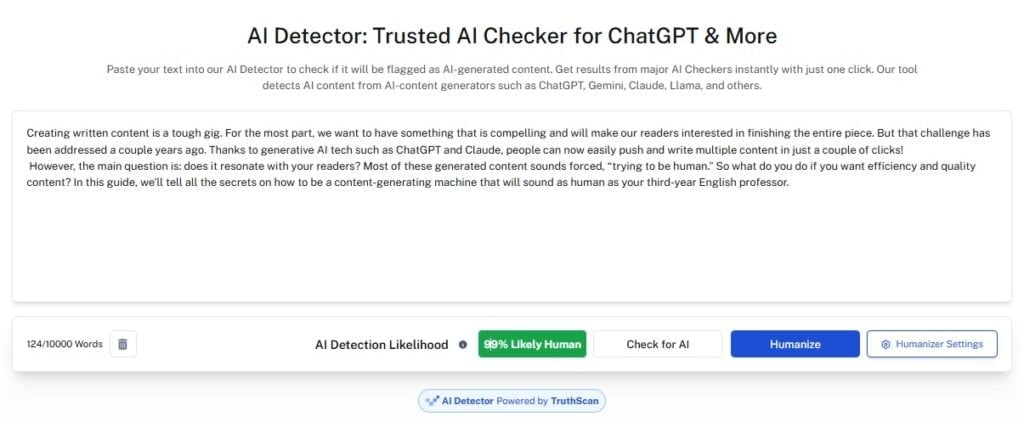
The human-written content? Flagged as 99% human. Accurate.
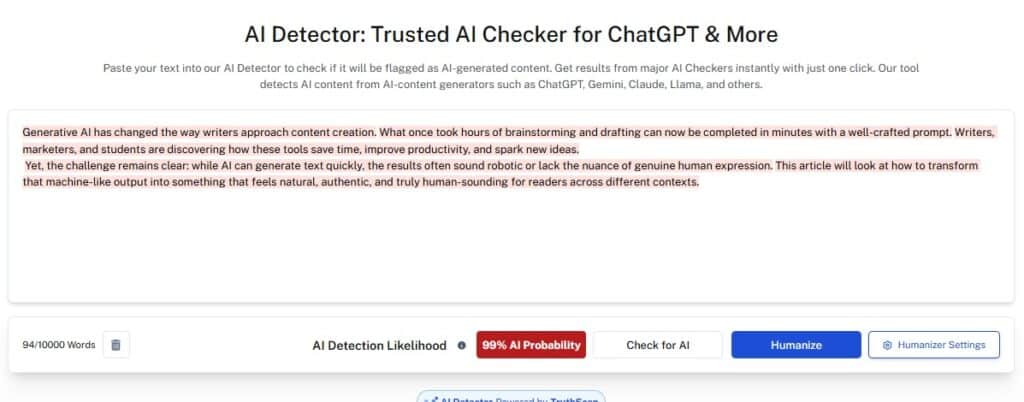
The ChatGPT-generated content? Flagged as 99% AI. Also accurate.
These are the results you actually need. When you use an AI detector, you want it to tell you the truth.
Not a vague guess. Not a coin flip. The actual truth about whether your content is AI-generated or not.
Undetectable AI’s detector consistently identifies AI patterns correctly. It doesn’t confuse human writing for AI.
It doesn’t give AI content a pass. It does exactly what it’s supposed to do.
Can Real-Write AI Detect AI-Edited or Paraphrased Text?
Not really.
We tested this by running the same ChatGPT-generated content we used earlier through Undetectable AI’s Humanizer.
This tool rewrites AI text to sound more natural and human, which means it’s specifically designed to help content pass AI detection.
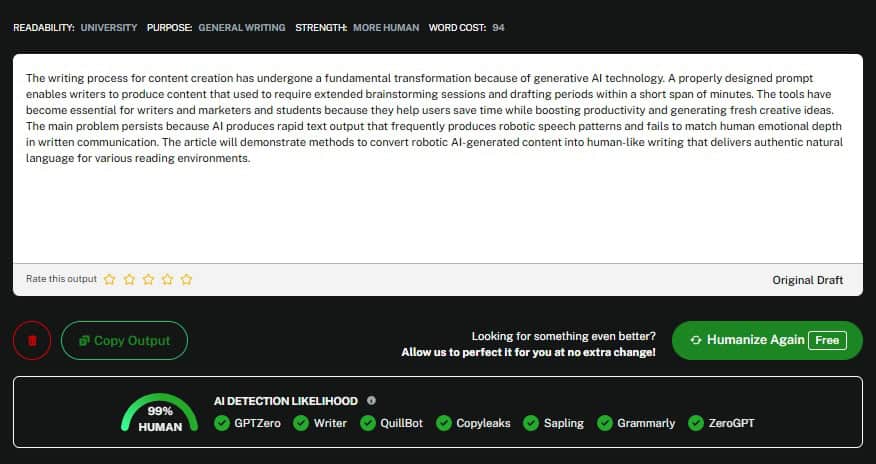
After humanizing the text with Undetectable AI, we fed it back into Real-Write AI’s detector to see what would happen.
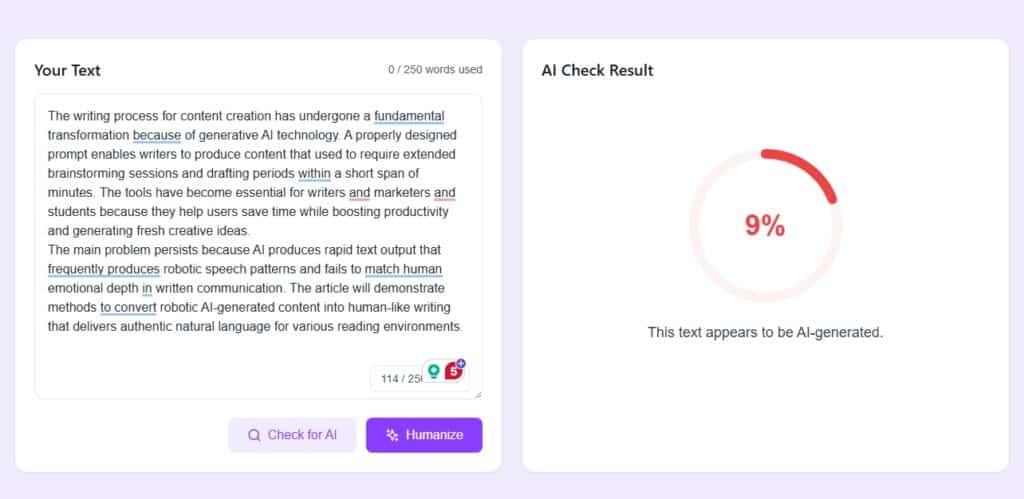
The result? 9% AI.
Not 100% AI like it should have flagged before humanization. Not 0% AI like you might expect if it thought the content was fully human.
Just 9%.
A weird middle ground that doesn’t really tell you anything useful.
This suggests Real-Write AI struggles with content that has been edited or paraphrased.
It can’t definitively determine whether the text is AI-generated or human-written when someone has taken the time to rework it.
That’s a massive blind spot.
If you’re using Real-Write AI to check whether your humanized content will pass detection elsewhere, you’re not getting reliable intel.
The tool simply doesn’t handle edited AI content well.
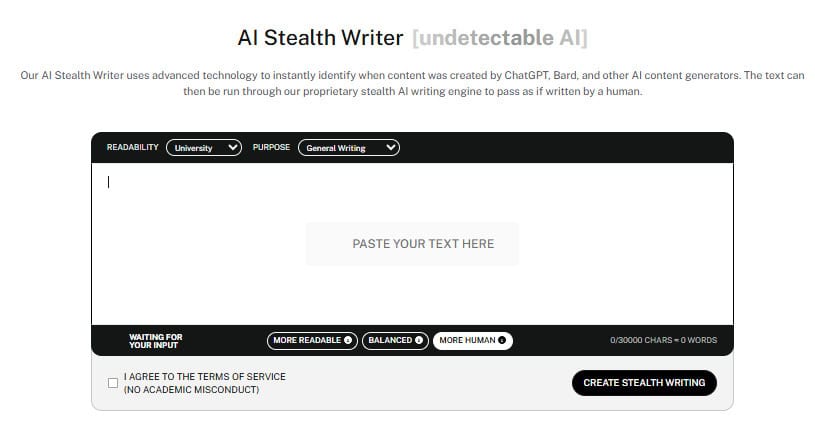
On the flip side, Undetectable AI offers multiple solutions for this exact scenario.
The AI Paraphraser rewrites content to sound more natural. The AI Stealth Writer creates content designed to evade detection from the start.
And the standard Humanizer handles the heavy lifting of making AI text read as genuinely human.
These tools work together. You can generate content, humanize it, and verify that it all passes detection.
That’s the kind of workflow you need if you’re serious about avoiding AI flags.
Real-Write AI tries to do some of this, but the accuracy issues mean you can’t trust the results. And if you can’t trust the results, what’s the point?
Check out our AI Detector and Humanizer in the widget below!
Can You Rely on Real-Write?
We wanted to like Real-Write AI. The concept is solid. But execution matters more than ideas.
When a detector indicates that human writing is AI-generated and AI writing is human-written, it’s not just inaccurate. It’s potentially harmful.
Students could get falsely accused of cheating. Content creators could waste time rewriting perfectly good work.
Professionals could lose trust with clients over flagged content that was never AI to begin with.
The tool has a clean interface and fast processing. That’s great.
But accuracy is non-negotiable. And based on our testing, Real-Write AI doesn’t deliver the reliability you need.
If you’re looking for a tool you can actually trust, Undetectable AI offers consistent, accurate detection and humanization.
Real-Write AI might improve with updates and refinements. But it’s currently not up to the task.
Save yourself the headache and use something that actually delivers what it promises.