Repetition is bad. Repetition is bad. Repetition is bad.
Wait, are you still reading?
Good. Because we just proved a point. Your eyes didn’t skip that repetition, they got stuck on it.
Your English teacher probably marked your essays with a red pen every time you used the same word twice.
She called it “lazy.” But in reality, it’s a “mind control.”
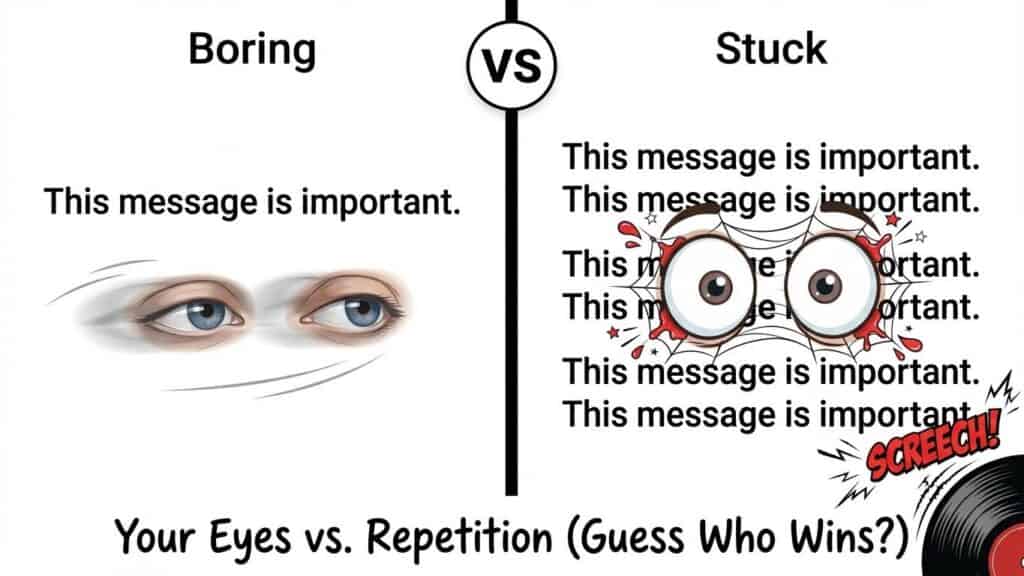
Today, we are going to unlearn the rules of grammar and learn the rules of rhythm.
In this blog, we’re going to cover everything you need to learn about repetition.
From the core repetition definition to powerful repetition examples in poetry and modern copywriting, we’ll see how hitting the same note twice makes your message impossible to ignore.
Let’s dive in.
Key Takeaways
- Repetition comes from the Latin roots, repetere means “to strike again”).
- It is the intentional restatement of sounds, words, or ideas to create rhythm and drive messages deep into your reader’s consciousness.
- Effective repetition (like Anaphora and Epistrophe) strengthens persuasive writing, while poor repetition (Tautology) weakens it.
- Techniques like “Spaced Repetition” leverage the brain’s forgetting curve to cement information in long-term memory.
- Master writers like Dickens, Morrison, and MLK used repetition to create powerful phrases.
What Is Repetition?
At its core, repetition is the intentional act of restating a sound, a word, or an idea to create a rhythm. It is the pulse of your writing.
Now, let’s look at exactly what is repetition means in practice.
Definition of Repetition
The word “repetition” comes from the Latin repetitio. It combines two parts:


Never Worry About AI Detecting Your Texts Again. Undetectable AI Can Help You:
- Make your AI assisted writing appear human-like.
- Bypass all major AI detection tools with just one click.
- Use AI safely and confidently in school and work.
- Re- (meaning “again”)
- Petere (meaning “to strike”)
So, quite literally, the repetition definition is “to strike again.”
Based on this, we can define repetition not just as “saying things twice,” but as the act of striking the reader’s mind with the same idea until it breaks through.
Repetition is the heartbeat of high-converting copy.
It’s because you cannot build a house by hitting a nail just once. You have to strike it again, and again, and again.
Good repetition is that hammer. It drives your message deep into the reader’s consciousness until it sticks.
Example:
- “Work hard. Play hard.” (The structure repeats to create a sense of balance and speed).
- “Location, location, location.” (The word repeats to prove that it is the only thing that matters).
How Repetition Strengthens Your Writing
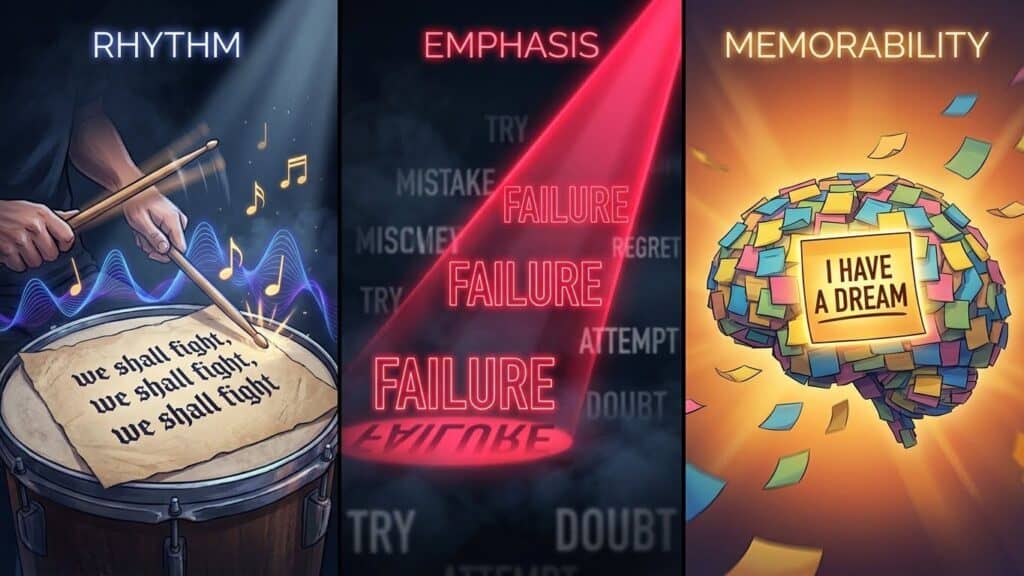
Repetition upgrades our writing in three ways:
- Rhythm (The Beat)
Writing without rhythm feels like reading a manual. It’s dry. Repetition adds a musical beat that pulls the reader down the page.
- Without Repetition: We will fight on beaches, landing grounds, fields, and streets. (Boring).
- With Repetition: We shall fight on the beaches, we shall fight on the landing grounds, we shall fight in the fields and in the streets.
The repetition of “we shall fight” creates a drumbeat. It makes the sentence feel unstoppable.
- Emphasis (The Spotlight)
In a wall of text, repetition acts like a neon sign. It tells the skimmers to stop and pay attention.
- Without Repetition: The project was a total failure. (Weak).
- With Repetition: The project was a failure. A complete, total, heartbreaking failure.
By repeating the concept of failure, you force the reader to feel the weight of it.
- Memorability (The Glue)
Readers forget 80% of what they read within minutes. Repetition is the glue that makes ideas stick. If you hit the same note in the intro, the body, and the conclusion, it becomes impossible to ignore.
- Example: Martin Luther King Jr. didn’t just say “I dream of equality.” He said “I have a dream” eight different times in one speech.
You might not remember the whole speech, but you definitely remember that one phrase. That is the power of repetition.
Common Forms of Repetition
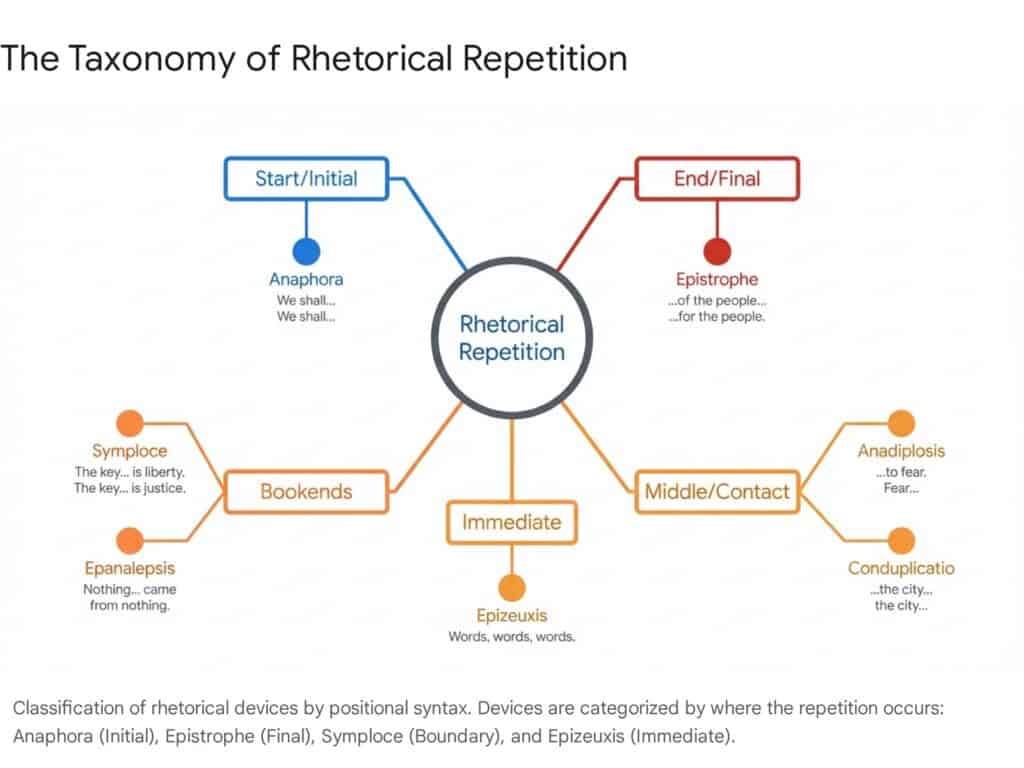
Here are the four common repetition forms used in writing:
| Rhetorical Device | What It Is | Famous Example |
| Anaphora (The Opener) | Repetition of a word or phrase at the start of successive clauses | “We shall fight on the beaches, we shall fight on the landing grounds…” — Churchill |
| Epistrophe (The Closer) | Repetition of a word or phrase at the end of successive clauses | “Of the people, by the people, for the people.” — Lincoln |
| Symploce (The Frame) | Combination of Anaphora + Epistrophe | “When there is talk of hatred… talk against it.” — Bill Clinton |
| Anadiplosis (The Chain) | Last word of one clause starts the next | “Fear leads to anger. Anger leads to hate.” — Yoda |
These forms of repetition in poetry and prose create effects depending on placement.
Struggling to find the right rhythm?
You don’t have to guess where the emphasis belongs. Use the AI Essay Writer to draft arguments that flow naturally.
It helps you structure your repetition to enhance memorability and rhythm, ensuring your essay sounds authoritative rather than repetitive.
Generate Your Essay with Perfect Flow!
Repetition in Practice
We’ve talked about the theory. Now, let’s see two powerful examples of how repetition works in the wild.
- Public Speaking (The Pebble Hack)
Repetition examples from history prove its effectiveness.
Take the story of Demosthenes. Today, he is remembered as one of the greatest orators of Ancient Greece (around 300 BC).
But he wasn’t born that way. In the beginning, he actually suffered from a terrible speech impediment.

To cure it, he famously practiced speaking with a mouth full of pebbles.
Since he couldn’t rely on clear pronunciation, he forced himself to rely on rhythm. He used the heavy repetition of syllables and phrases to keep his flow moving.
- Songwriting (The Hook)
Ever wonder why you can’t get a song out of your head? That’s repetition doing its job.
If you pick up almost any hit song, you will see that modern lyrics rely on Anaphora (repeating the start of a line) and repetition in poetry techniques to create a “hook.”
Look at Marvin Gaye’s classic, “Ain’t No Mountain High Enough.”
He doesn’t just say “I will come to you.” He builds a ladder of obstacles:
- Ain’t no mountain high enough,
- Ain’t no valley low enough,
- Ain’t no river wide enough.
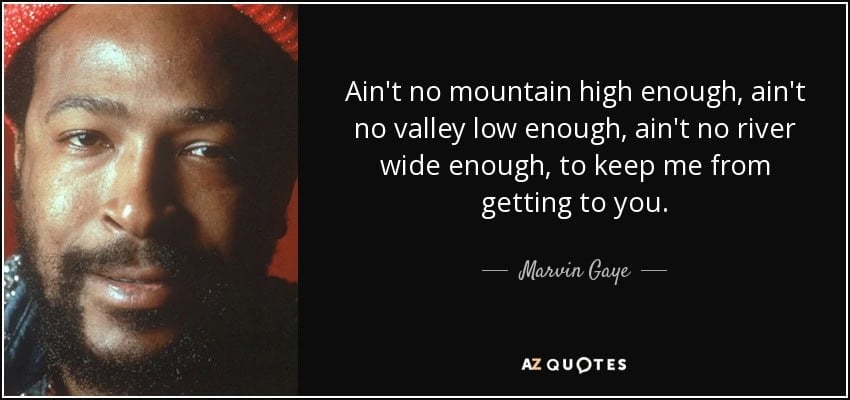
By repeating the phrase “Ain’t no,” he creates a pattern. The listener knows exactly what is coming next.
This satisfying predictability is what makes the lyrics memorable.
Pitfalls to Avoid
Repetition is a superpower, but it has a dark side.
When you use it on purpose, it creates rhythm. When you use it by accident, it creates redundancy. There is a fine line between a hypnotic beat and an annoying broken record.
Here are the three traps that turn good writing into bad noise.
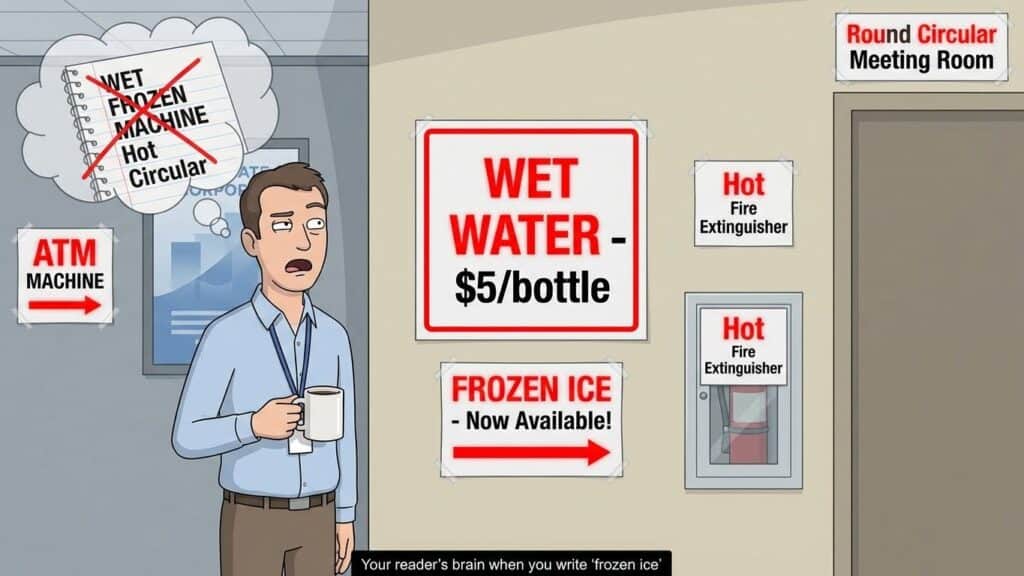
- The “Duh” Moment
This happens when you repeat the meaning rather than the word. You are essentially defining a word that doesn’t need a definition. It wastes the reader’s time by telling them what they already know.
- The Trap: The frozen ice slipped under his feet.
- Why it fails: Ice is frozen water. You don’t need to tell us it’s frozen. It’s like saying “wet water.”
- The Trap: I need to go to the ATM machine.
- Why it fails: The “M” in ATM already stands for Machine. You are saying “Automated Teller Machine Machine.”
2. The Clutter
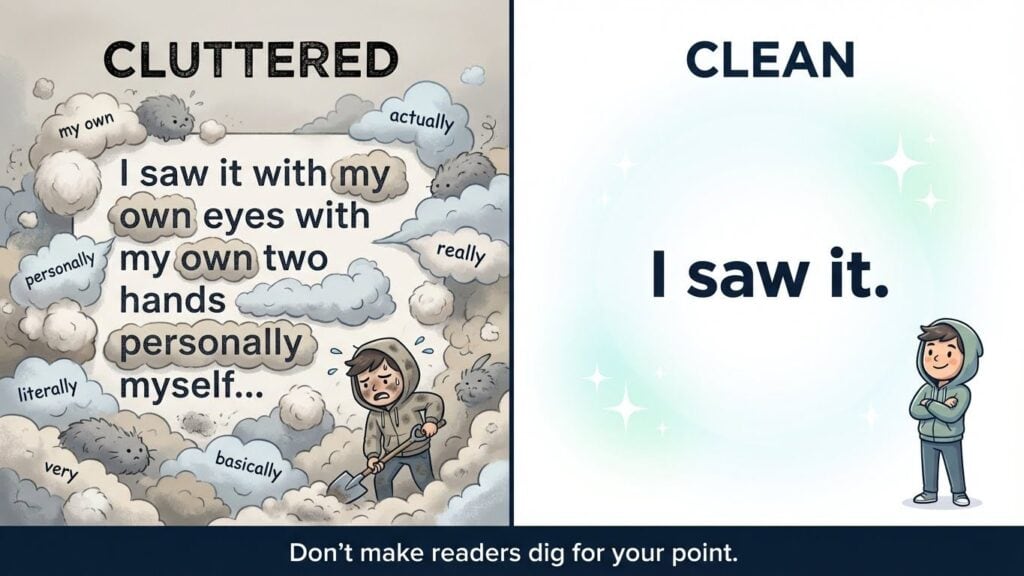
This is the fancy term for using more words than you need. Writers often do this because they think it sounds dramatic, but usually, it just feels like fluff.
- The Trap: I saw it with my own eyes.
- Why it fails: Of course you used your own eyes. You can’t see with someone else’s eyes. Unless you are writing a very specific sci-fi novel, just say “I saw it.”
The Nuance: Occasionally, you can break this rule for emphasis (e.g., “I heard it with my own ears!”), but 90% of the time, cut it.
3. The AI Trap
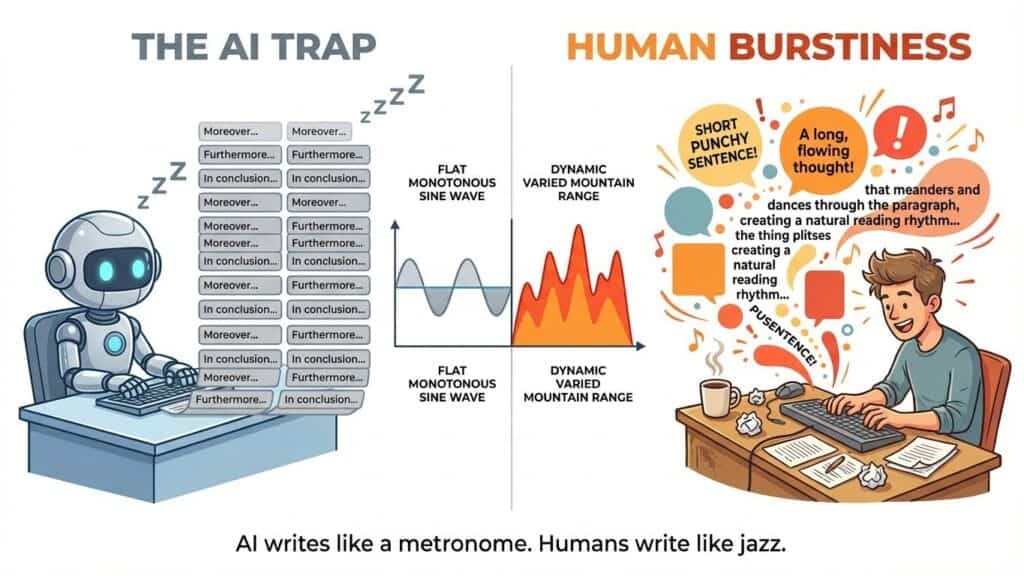
If you use AI tools for writing, watch out for this. AI loves structural repetition.
Humans write with “burstiness.”
Some sentences are short, some are long and winding. AI, however, tends to use the exact same sentence length and transition words over and over again.
Why it fails: It creates a monotonous rhythm. It puts the reader to sleep because the brain stops paying attention to the pattern. If your writing feels flat, check if every sentence has the same beat.
The Trap: Starting every paragraph with “Moreover,” “Furthermore,” or “In conclusion.”
Notable Examples of Repetition
Let’s examine some of the repetition examples:
- Charles Dickens (A Tale of Two Cities)
“It was the best of times, it was the worst of times…”
This repetition example is a classic mix of contrast and repetition.
- Dickens is balancing a scale. By repeating the structure “It was the…”, he proves that two opposite things can be true at the exact same moment. It creates a rhythm that feels like a pendulum swinging.
- Toni Morrison (Beloved)
“124 was spiteful. Full of a baby’s venom.”
Throughout the novel, Morrison repeats the phrase “124 was…” to describe the house.
- It turns the setting into a character. By the third time you read it, the house stops being just a building and starts feeling like a living, breathing villain.
- Martin Luther King Jr. (I Have a Dream)
King repeats the phrase “I have a dream” eight separate times.
- If he had said it once, it would have been a wish. By repeating it eight times, he turned a wish into a manifesto. The repetition creates a sense of inevitability.
When a basic AI generates text, it often mimics these forms poorly. It creates patterns that feel like a glitch rather than a style.
Undetectable AI’s AI Humanizer helps fix this. It restructures the text to ensure the repetition sounds intentional (like King or Dickens) rather than mathematical (like a calculator).
It increases the “burstiness” of the writing, ensuring that repeated phrases land with an emotional punch rather than a robotic thud.
Try out our AI Detector and Humanizer right below!
Final Thoughts
So, what’s the repetition?
Nobody likes a nag.
If you repeat yourself aimlessly, you aren’t a writer; you’re a broken record. But if you do it right? You’re a hypnotist.
Repetition is the difference between making a point and leaving a scar.
Remember that Latin definition we talked about? “To strike again.” That is the secret sauce. You can’t build a house by hitting a nail just once. You have to strike it until it stays.
Just look at the greatest repetition examples in history.
Dickens didn’t have a stutter. Martin Luther King Jr. didn’t run out of ideas. They knew that the first time you say something, it’s information. The third time, it’s a manifesto.
But, understand that there is a fine line between a powerful mantra and a robotic glitch. AI tools love to repeat things, but they usually do it with all the grace of a malfunctioning toaster.
If you want to master repetition without sounding like a bot, you need the human touch.
Ready to turn your writing from robotic to remarkable? Try Undetectable AI’s Humanizer tool. It polishes your prose to ensure every repeated phrase lands like a drumbeat.
Try Undetectable AI for Free.