
The letter “s” has a particular musical quality of sound. If you use successive words that contain “s” repeatedly, you end up with what’s called sibilance, a sound device.
Sibilance is very often used in poetry. You also find it in prose sometimes, especially when the situation calls for it, as in, describing the dangerous hiss of a moving snake, or the soft silence of a room as you wait for something to happen.
The sharp property of the “s’ sound takes a little more time to pronounce compared to words starting with any consonant.
That lingering effect is very useful for writers in the context of establishing danger or secrecy in a sentence, for example.
In this article, you will find sibilance definition, a lot of classic and everyday examples, some mistakes to avoid, and how to use it in a sentence perfectly.
Key Takeaways
- Sibilance is the use of words that produce the “s” or “sh” sounds in neighbouring words that, when read together, produce a hissing sound quality.
- It has been used in classic literature and poetry for a long time. The characteristic high-pitched sound is used best in situations of threat, secrecy, hesitation, danger, etc.
- Every word that uses the letter “s” is not sibilant. For it to qualify for sibilance, the sound must be high-pitched, so words like “always” or “business” are not sibilant.
What Is Sibilance?
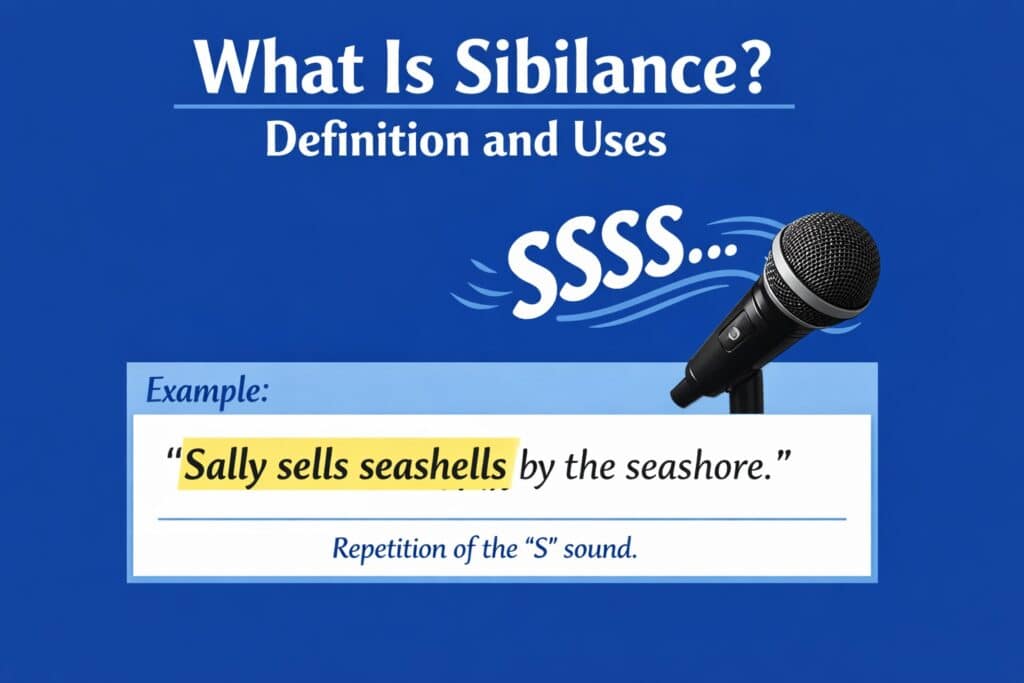
Sibilance definition as per Merriam-Webster is “having, containing, or producing the sound of or a sound resembling that of the s or the sh in sash.”
In simple terms, sibilance is a sound device in which a characteristic high-frequency hissing sound is produced in multiple consecutive words.
The word “s” does not qualify for being sibilant if it does not have the characteristic high-pitched, hissing sound, as in “always”, “does”, “business”, “design”.


Never Worry About AI Detecting Your Texts Again. Undetectable AI Can Help You:
- Make your AI assisted writing appear human-like.
- Bypass all major AI detection tools with just one click.
- Use AI safely and confidently in school and work.
Also, consonants other than “s” can be sibilant if they produce that sound effect, like “c” in “cilantro”, x and c in combination in “excellent,” you get the point.
The following consonant sounds in repetition can create that particular auditory effect:
- The “s” sound
- The “sh” sound
- And occasionally, “c” or “x” sounds
All of these consonants are pronounced by forcing air through a narrow channel in the mouth where your tongue is positioned close to your teeth.
The effect of sibilance is a hissing or shushing sound quality, which is a high-frequency sound.
The sound has to be repeated in a series of neighboring words to create the desired sibilant effect. A single “s” sound is not sibilant.
Only when it is repeated in every consecutive word, a sensual sound quality is produced.
Classic Examples of Sibilance
There are many, many sibilance examples in classic literature.
Wilfred Owen describes a battlefield scene in his work, ‘Exposure‘ as,
“Sudden successive flights of bullets streak the silence.”
Read it out loud to notice the repeated “s” sound that, largely by itself, builds a tense environment of bullets being thrown around in the eerie silence of warzone.
Shakespeare, in Hamlet, writes,
“Sit down awhile;
and let us once again assail your ears,
That are so fortified against our story,
What we have two nights seen.”
In the poem, Bernardo is asking Francisco, his fellow sentry, to listen to his experience of seeing the ghost of King Hamlet.
Another example of sibilance is poetry comes from the poem ‘A Quoi Bon Dire‘ (1916) By Charlotte Mew:
“Seventeen years ago you said
Something that sounded like Good-bye;
And everybody thinks that you are dead,
But I.”
This is a poem about a woman thinking about her partner who’s no more. It conveys the lingering feeling in her that can not believe he is not here anymore when everybody around her believes otherwise.
Why Writers Use Sibilance
The primary use of sibilance is to make the reader imagine a sensory experience through the sounds certain words make.
The most instinctive associations we have with sibilant sounds are of danger. The narrow airflow that produces the “s” sound produces an uncomfortable sense of predation waiting to attack you.
Sibilance is also used deliberately in certain scenes that are important to the plot. This is because sibilant sounds take a little longer to articulate compared to other sounds.
The reader spends more time reading through a sibilant sentence structure, and as you can already imagine, a slow reading rhythm leads to better comprehension.
Of course, sibilance is of great use in poetry because words that sound similar flow easily in poetry.
Also, Undetectable AI’s AI Essay Writer provides an efficient way to generate high-level drafts that balance these intricate sound devices with clear, logical arguments.
By starting with a structurally sound foundation, you can more easily identify where to swap in sibilant synonyms to create that specific “lingering effect” without disrupting the overall flow of your essay.
How Sibilance Works in Communication
Similar to written English, words that display sibilance take a little longer to pronounce than other, non-sibilant ones.
So, in verbal communication, that little extra time gives your words communicative weight.
We instinctively use it when sharing private or delicate information, for example, “So she said something sensitive.”
The successive s sounds in different words, by default, create a whispered quality of sound even if you are not explicitly whispering. The person you’re in conversation with will almost always respond to you by leaning in and lowering their own voice.
Again, the stretch of time that occurs using sibilance is great for situations that need calming.
“Let’s slow this situation slightly.”
“Just sit still for a second.”
You must have heard such sentence sequences in conflict management or parenting, for example. In such situations, sibilance applies restraint without force.
Also, the tension created by sibilance also hints at authority. Notice how the examples above are also kind of assertive in nature, even though they are not overly aggressive.
Common Mistakes When Using Sibilance
A lone word with an “s” or “sh” sound is not sibilance because it needs neighbouring reinforcement to form a sound pattern. You must have multiple successive words carrying sibilant sounds for continuity.
Now, at the opposite extreme, if you bring too many sibilant words together, you’ll probably end up with a tongue twister. (No shade at ‘She sells sea shells by the sea shore.’)
You should also not use sibilance in action scenes, since it tends to slow or stretch the moment. Doing so will completely undercut forceful action scenes.
A lot of writers also confuse sibilance with alliteration, which is the repetition of any consonant in successive words, and not necessarily any impact of the sound quality.
You could say that sibilance is a form of alliteration, but not all alliteration is sibilance. No matter how consistent your pattern is, it is not considered sibilance unless it uses hissing or whispering consonants.
The Undetectable AI’s Paragraph Rewriter tool is great for stylistically controlled use of sibilance in your text. If you feel like you’ve overused it, you could just rework your paragraph to improve the readability.
Alternatively, you could test our multiple variations of sibilant sentences until you get what sounds the best.
How to Use Sibilance Effectively
Do not write your first draft with sibilance because you’ll probably put too much effort into thinking of relevant-sounding words rather than the context of the text.
Keep your focus on the meaning first, and once done, swap a few words with close synonyms that form a pattern.
Make sure the action/emotion being described in your sentence is suitable enough for sibilance. Any discussion around secrecy, hesitation, caution, or stillness is a great use case for it because of the slowing effect of sibilance.
It is also better to place sibilance in the middle or towards the end of a sentence rather than the beginning. The point of it is to slow down the reader after their momentum has been established. It’ll also create a feeling of lingering thought, as in:
“The room was loud at first, but it slowly settled into soft, sustained silence.”
Probably the biggest takeaway is to ensure you don’t overdo it. Two to five consecutive sibilant words should be more than enough to create the effect you want, beyond that, the reader will lose focus of the sentence.
And don’t forget to read your text out loud after you’re done, and re-read it again. If you trip over your words, you probably need to cut down on them a little.
Run your text through Undetectable AI’s AI Humanizer for a final improvement in sentence structure and flow!
Try the AI Detector and Humanizer tools in the widget below!
Conclusion
Sibilance is a niche sound device that you won’t use too frequently. But in certain situations, it fits so well that you get the same effect in just a few words that would otherwise take multiple sentences to build.
Of course, it takes a lot of practice to do it with just the right sibilance frequency. If you overdo it, it’ll kill the purpose, and the reader may even stop altogether, getting frustrated as they trip over words.
The Undetectable AI Paraphraser and Paragraph Rewriters will be of great use to you as you use sibilance in your text.
Always run what you write through Undetectable AI to get feedback on what you’ve written already and get help whenever you get stuck.
Check out Undetectable AI today!