
If you Google “most accurate AI detector,” you’ll get a list of articles. The issue is that most of those articles present a list based on opinions rather than testing of the AI detectors.
I wanted to do something more honest than that.
I’ve spent years testing and building AI detection tools, and I wanted to see how the major detectors actually perform, not just how they’re marketed.
Using my knowledge and experience, I designed a comprehensive methodology to test five popular AI detectors. My test involved 18 text samples that I ran through the five AI detectors I had shortlisted.
The total number of AI scans I performed was 90, and I logged everything about each scan in a spreadsheet.
This article will walk you through what I found. You will learn which AI detector won on which content type and where each one stumbled.
Key Takeaways
- Four of the five detectors I tested (GPTZero, Undetectable AI, Copyleaks, and QuillBot) scored 100% accuracy across all 18 samples. Only Originality.ai produced false positives, on 2 of the 18.
- The AI detectors varied the most on mixed (human + AI) samples. Originality.ai flagged the mixed samples as 81% and 100% AI when the actual AI content was 36% to 38% only.
- Undetectable AI produced the most precise results on mixed passages, with scores of 43% and 35% against true values of 38% and 36%.
- No detector falsely flagged ESL writing as AI in this test.
- Grammarly’s AI humanizer failed against every detector in this test. All six humanized AI passages still scored as AI across all five tools.
What Is an AI Detector?
An AI detector is a tool that tries to figure out whether a piece of text was written by a person or generated by AI. It returns an AI-versus-human score for a piece of text.
Some AI detectors can also tell whether a piece of text is a mix of AI and human or a humanized version of an AI-written text.
Every AI detector’s verdict on a given text can have different meanings. For example, when a detector tells you a passage is 87% AI, it can either mean 87% of the words came from a model or that the tool is 87% confident about the text being AI.


Never Worry About AI Detecting Your Texts Again. Undetectable AI Can Help You:
- Make your AI assisted writing appear human-like.
- Bypass all major AI detection tools with just one click.
- Use AI safely and confidently in school and work.
The AI detectors normally specify how exactly you should interpret their verdict.
Who Uses AI Detectors & What Metric Matters to Them
Everyone uses an AI detector with a different intent. They are worried about a different AI detector metric compared to another person.
Here are a few common user groups of AI detectors and what metric usually matters to them.
- Educators: Teachers use AI detectors to check student submissions for AI. So they prefer an AI detector with a low false positive rate to avoid wrongly accusing an ESL student of using AI.
- Publishers/SEO teams: Publishers and SEO teams want to make sure their writers aren’t submitting them AI generated content that was humanized using a tool. For this purpose, AI detectors with high accuracy on AI-humanized content are the best for them.
- Students/self-checkers: Students want a free AI detector for obvious reasons. So they look for a free AI detector with high accuracy overall.
- Hiring/recruitment: Recruiters have to review short-form text (cover letters, application emails, etc) where neither good candidates get flagged nor undeserving ones slip through. The metric that balances these two is called the F1 score.
The meanings of these metrics will become clearer when we start testing.
How AI Detectors Actually Work
All AI detectors work in roughly the same way.
It breaks your text into statistical signals and compares those signals against its database of AI and human writing samples.
Speaking of statistical signals, two of the most common signals used by AI detectors are perplexity and burstiness.
- Perplexity measures how predictable each word is given the words around it. AI text usually has lower perplexity because it overuses a limited set of words and patterns. Human writing, by contrast, has higher perplexity because of unexpected/random writing choices.
- Burstiness refers to how much sentence length and complexity vary across a passage. Again, AI text generally has low burstiness because it produces sentences of similar length and structure throughout a piece. Humans, on the other hand, tend to write in random bursts.
Since all AI detectors have these two signals in common, you’ll see them perform similarly on the same text samples. However, their verdict won’t always agree perfectly.
That’s because different AI detectors look for slightly different feature distributions in the same text.
Secondly, an AI detector might have varying accuracy on different content types. It can be good at detecting raw AI text, but not humanized AI text. Or it might be fooled by mixed passages where human and AI sentences are stitched together.
In my testing of the AI detectors, I have accounted for all such nuances.
What I Tested and How
I wanted to run this test the way I’d want someone to test a product I shipped.
That’s why I first chose a controlled sample set from multiple LLMs and human groups. Then I applied the same rubric across every detector.
Let me explain my methodology.
The Methodology
I built two sets of text passages.
The first set was the base set, which contained 10 text passages, 300+ words each, drawn from five sources. This set had 6 AI text passages and 4 human-written text samples.
- 6 AI text samples: 2 from ChatGPT (GPT 5.5 model), 2 from Claude Sonnet 4.6, and 2 from Gemini 3.5 Flash model. I used default model settings without custom prompting tricks.
- 4 human-written samples: 2 from native English writers and 2 from non-native English (ESL) writers. I deliberately pulled the human samples from articles and forums from 2021, before the AI boom, to make sure there was no chance any of them could have been AI-generated.
The second set contained additional passes built from the base set to stress test the detectors.
Here’s more detail:
- 6 humanized AI passages: I ran each of the 6 raw AI passages from the base set through Grammarly’s AI humanizer once.
- 2 mixed passages: One mixed sample was built from interleaved sentences from a native English source plus an AI passage. The other mixed sample was built from interleaved sentences from an ESL source plus an AI passage. I maintained a roughly ~60/40 ratio (human-majority) in the mixed text samples.
As for the detectors that I tested, there were 5:
- GPTZero
- Undetectable AI Detector
- Originality.ai
- Copyleaks
- QuillBot
I logged the detector versions at the first run and spot-checked at the end of the test to confirm no version change happened mid-week. I also used incognito and the same browser the entire time to keep the tool environment stable.
Now, if you do the math, I had a total of 18 text samples. So I ran 18 AI detection scans on each of the 5 AI detectors. That makes 90 scans in total.
The details of each scan were logged in a single spreadsheet that you can find here.
The Results: What Is the Most Accurate AI Detector?
Let’s first start with the overall performance of each AI detector, and then we will go into the details, detector by detector.
Overall Accuracy Ranking
Below is the scoreboard across all 18 samples I tested for this article. The sample includes
- 6 raw AI passages
- 6 humanized AI passages
- 4 human passages
- And 2 mixed passages that interleave human and AI sentences at roughly a 60 to 40 ratio
A quick note on the mixed samples: Mixed samples (human + AI) needed a binary label so the metrics could be calculated, and we coded them as Human ground truth in this table.
Each mixed sample was 60 to 64 percent human-written by sentence count, and a publisher or editor reviewing a piece that is mostly someone’s own writing would treat it as human work.
Although this is a defensible choice, it is not the only one. That being said, I have explained the findings in detail in the Findings section later in the article.
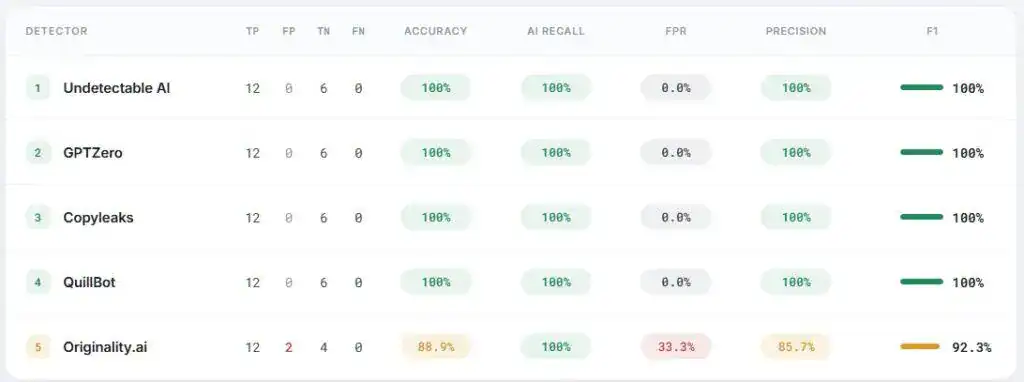
A tie at 100% makes it look like four detectors are basically the same tool. They’re not. That number only tells you whether the final yes-or-no call was right — it says nothing about how close the score actually was to the truth. And that gap is exactly where one detector pulls ahead of the other three.
Now I know what you might be thinking. Four detectors performing exactly the same is unrealistic. So, let me address that head-on.
The AI detectors didn’t perform 100% the same on all text samples. There were differences of a few percentage points, and sometimes more.
But those differences stayed on the same side of the 50 percent line that separates an AI verdict from a human verdict. That’s why the binary call came out the same, and hence the similar overall accuracy and false positive rates.
The most they varied on were the mixed samples, which is why the Originality.ai detector ended up at 88.9% overall accuracy, while the other four tied at 100%.
For the record, here’s what these metrics mean:
- Overall accuracy: the percentage of correct binary calls across all passages
- False positive rate (FPR): the percentage of human passages wrongly flagged as AI
- F1 score: the harmonic mean of precision and recall, which gives you a single number that balances false alarms against missed catches
The next section highlights the variance better, and we will discuss the findings of all our 90 scans in detail in the Findings section later on.
Detector-by-Detector Breakdown
1. Undetectable AI Detector
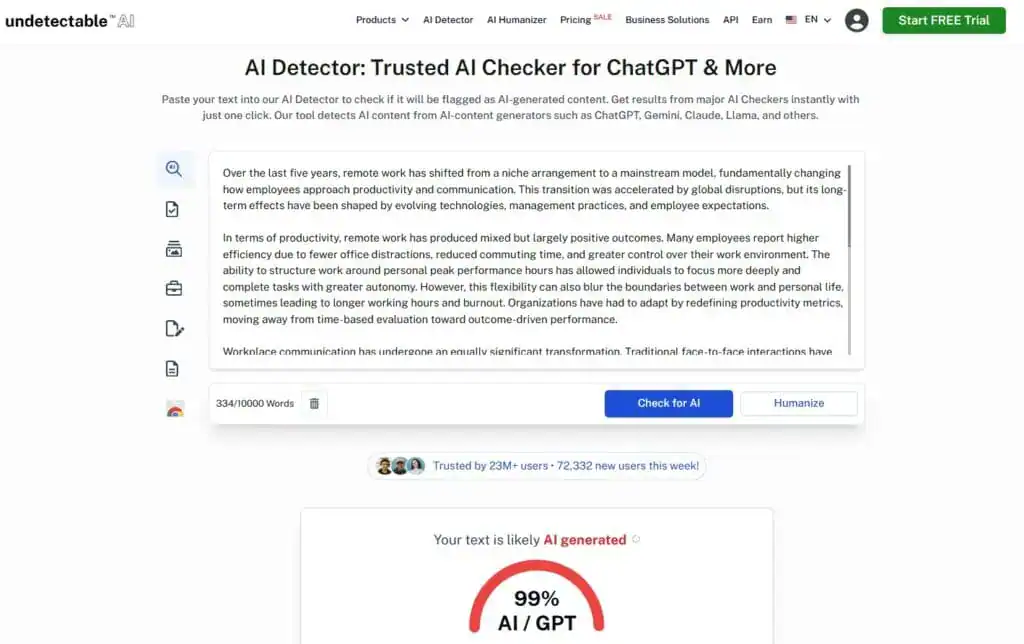
The Undetectable AI detector’s verdict was 100% correct on all 18 passages.
It gave a 97% to 99% AI score to the raw AI passages. All humanized AI content was given a 99% AI score. The human passages were called out as human with a 5% to 10% AI score.
On mixed passages, Undetectable AI was the closest to the truth.
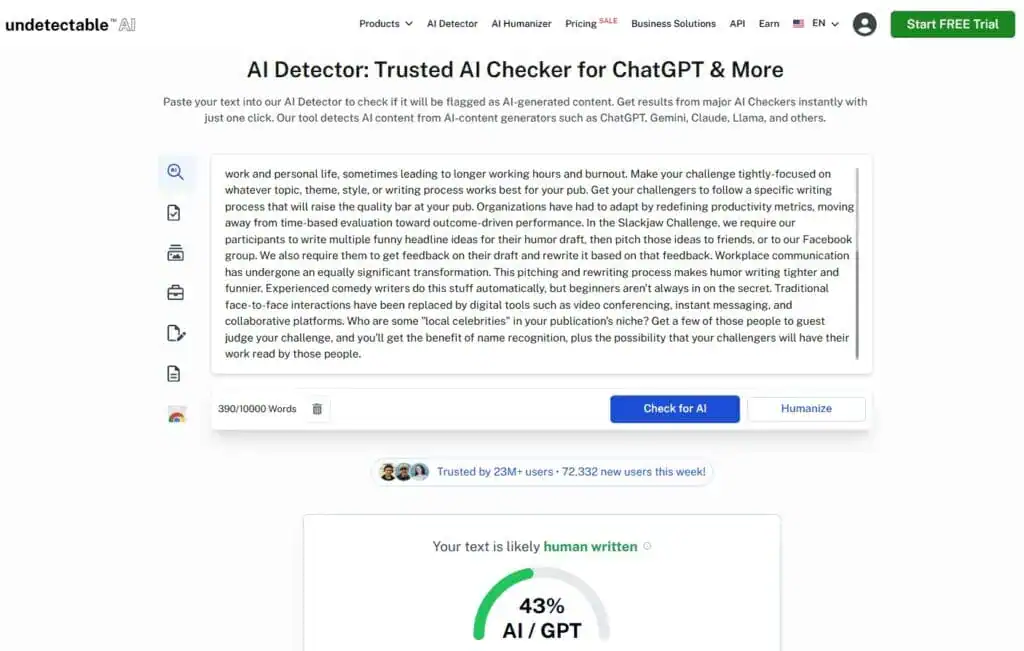
- The native English + AI passage was 38% AI by sentence count, and Undetectable AI gave it a 43% AI score.
- The ESL + AI passage was 36% AI by sentence count, and Undetectable AI gave it a 35% AI score.
This is the single most important result in the whole test. Every other detector either missed the AI content in these passages completely or overreacted and called real human writing “AI.” Undetectable AI was the only tool that got close to the real number both times.
AI sample: ChatGPT Prompt 1:
2. GPTZero
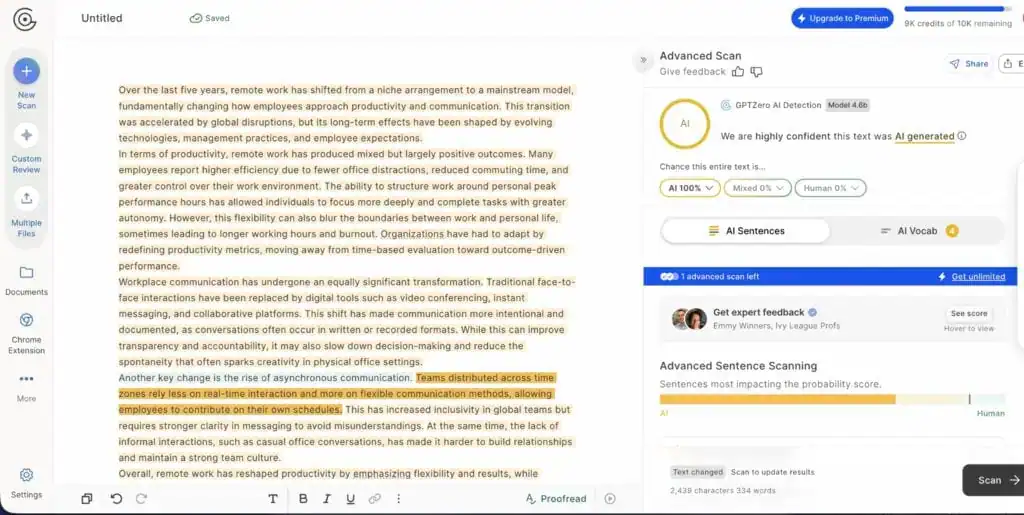
GPTZero detected raw AI and human samples with 100% accuracy. Even the humanized AI samples couldn’t fool GPTZero. All were flagged as 100% AI.
Regarding the mixed passages, it gave the native English + AI mix a 0% AI score. But it didn’t call it 100% human either. It was 56% sure the text was human and 44% sure it was a mix of AI and human.
The second mixed sample was given 14% AI score and 83% human score. The remaining 3% is mixed, meaning 3% of the text is a mix of AI and human.
AI sample: ChatGPT Prompt 1:
Exploring advanced techniques to identify and prevent AI-generated content effectively.
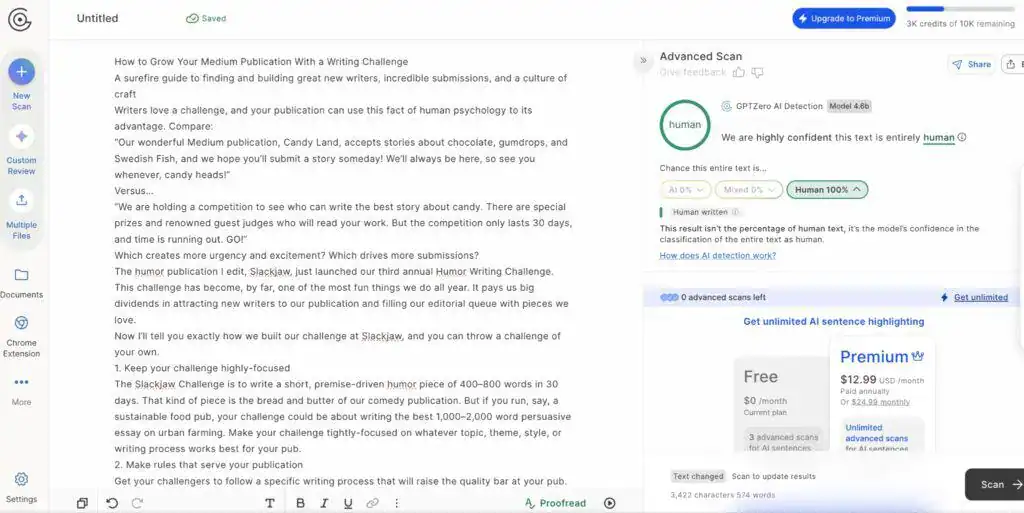
Human sample: Slackjaw article:
Mixed sample (AI + Human):
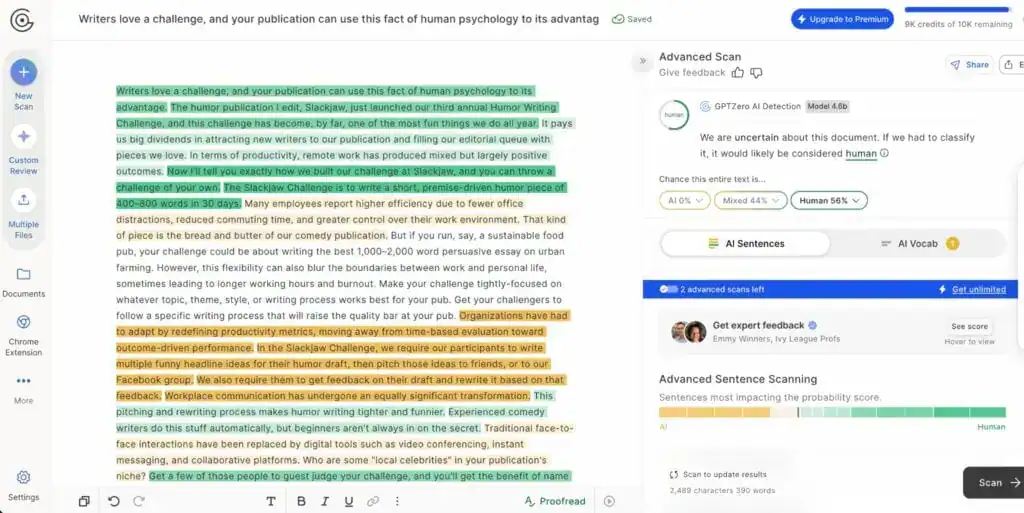
This shows GPTZero’s weakness on mixed text samples. It treats anything with substantial human writing as fully human, even when there’s a meaningful AI portion in there.
So, personally, I’d hand GPTZero to a teacher who wants a clean yes/no call on fully raw or fully human or humanized AI content.
Human sample: Slackjaw article:
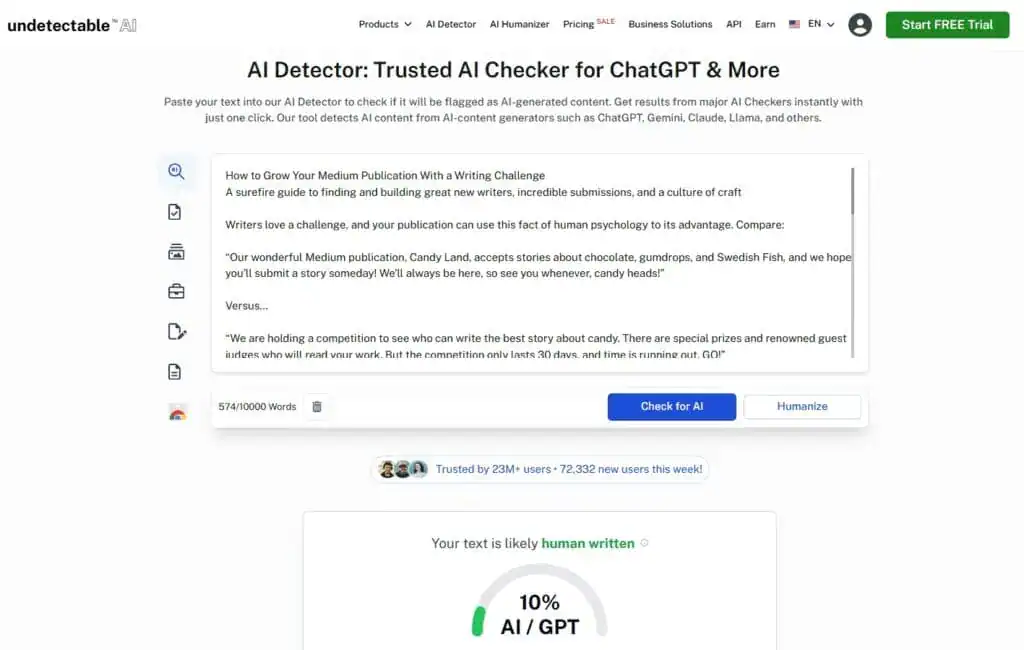
Mixed Sample (AI + Human):
3. Copyleaks
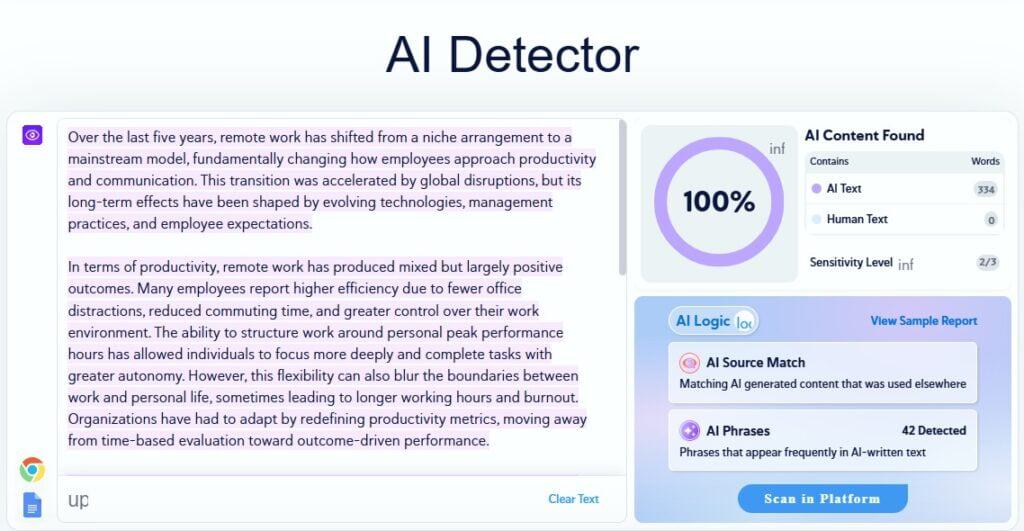
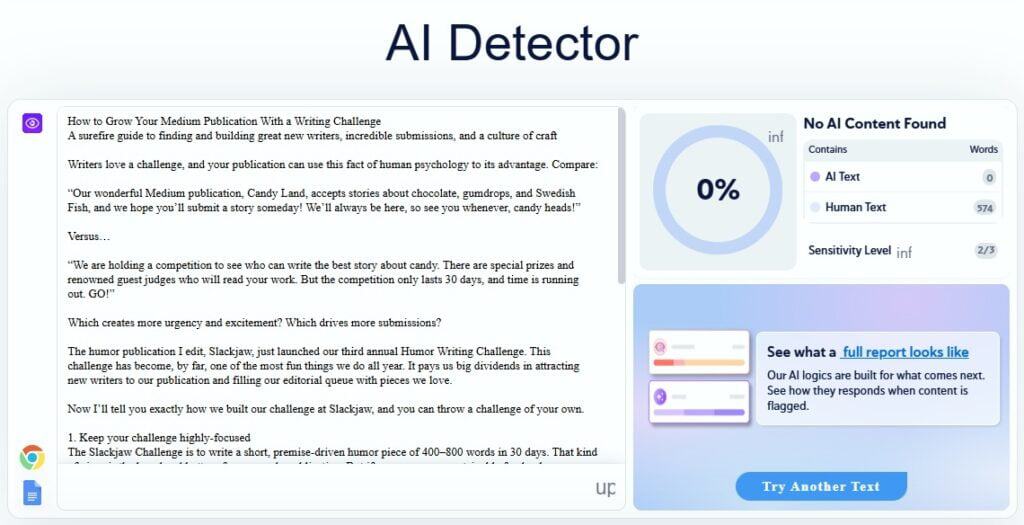
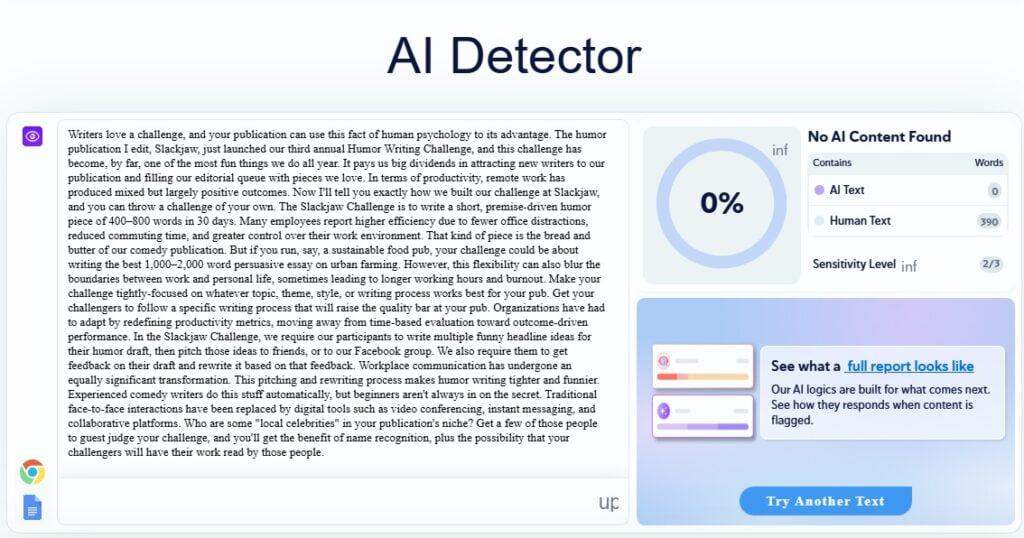
Copyleaks returned a 100% AI score on every raw AI passage and every humanized AI passage. On human passages, it returned 0% on all four, both native English and ESL.
However, it gave a 0% AI score to both mixed samples, even when around 40% of the text was AI in both of them. In other words, it calls these samples 100% human.
While the verdict that these samples were human is correct, these percentages were not nuanced at all. Copyleaks completely ignored the AI portion.
So, one should only trust Copyleaks with mixed samples if they just need a correct verdict and not a precise percentage.
AI sample: ChatGPT Prompt 1:
Human sample: Slackjaw article:
Mixed sample (AI + Human):
4. QuillBot
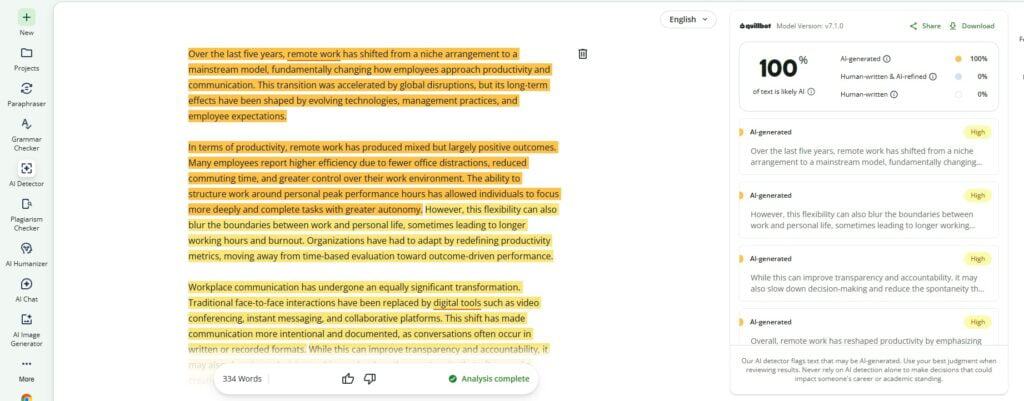
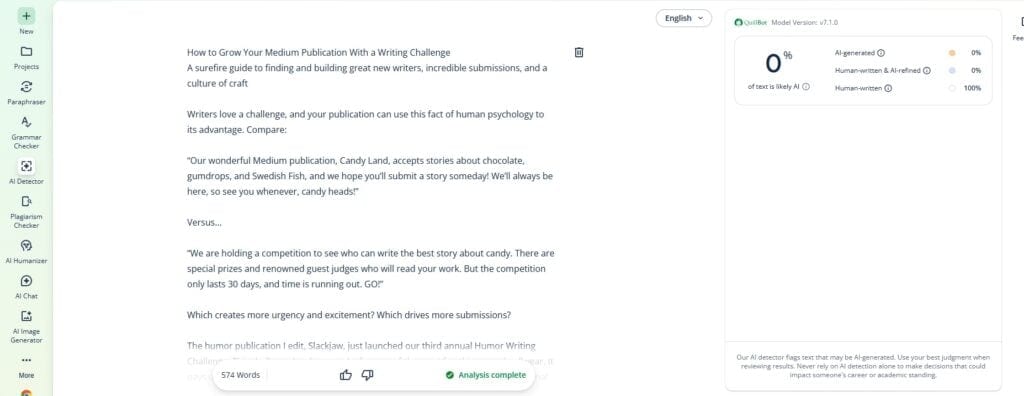
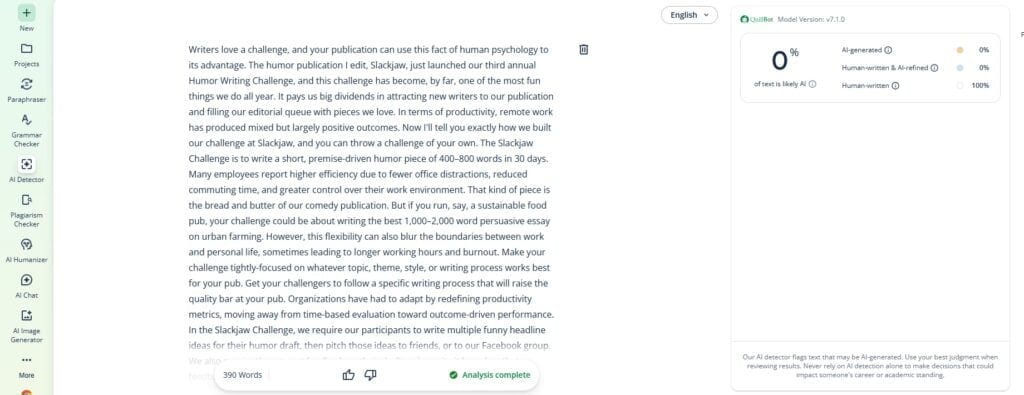
QuillBot’s verdict was correct on all human-written samples. In the case of mixed samples (approximately 60% human, 40% AI), it behaved exactly like Copyleaks and called them 100% human.
The percentages for one of the two Claude samples (a fully AI-generated one) and both Gemini samples were also off the mark, but still within an acceptable range (71%, 74%, 72%, respectively). One humanized passage also came in at 85% AI instead of 100%.
So, according to my tests, QuillBot makes correct calls on human text, but its confidence wavers on mixed samples and AI samples of Claude and Gemini content.
AI sample: ChatGPT Prompt 1:
Human sample: Slackjaw article:
Mixed (AI + Human):
5. Originality.ai
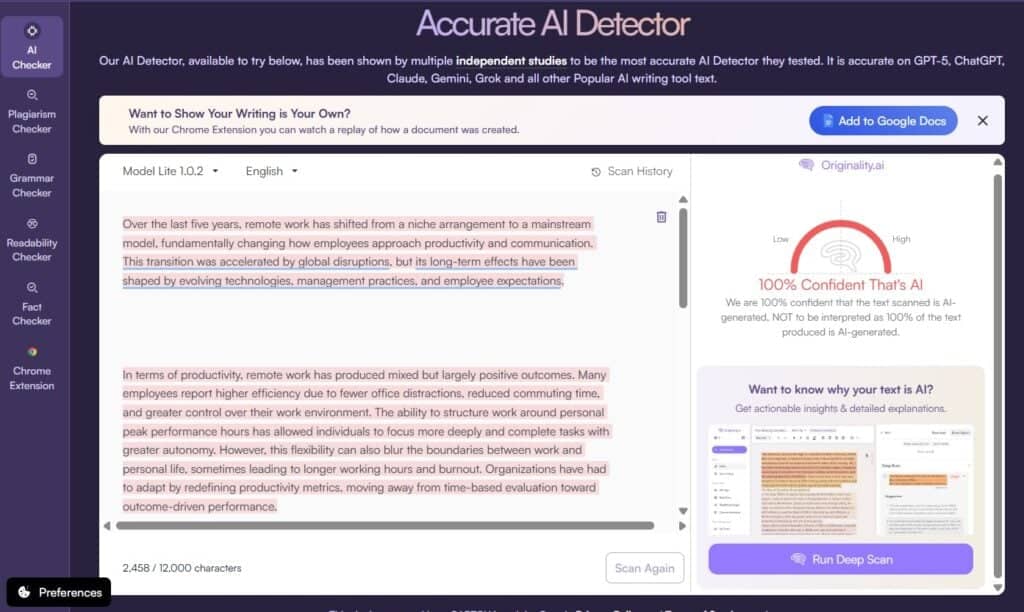
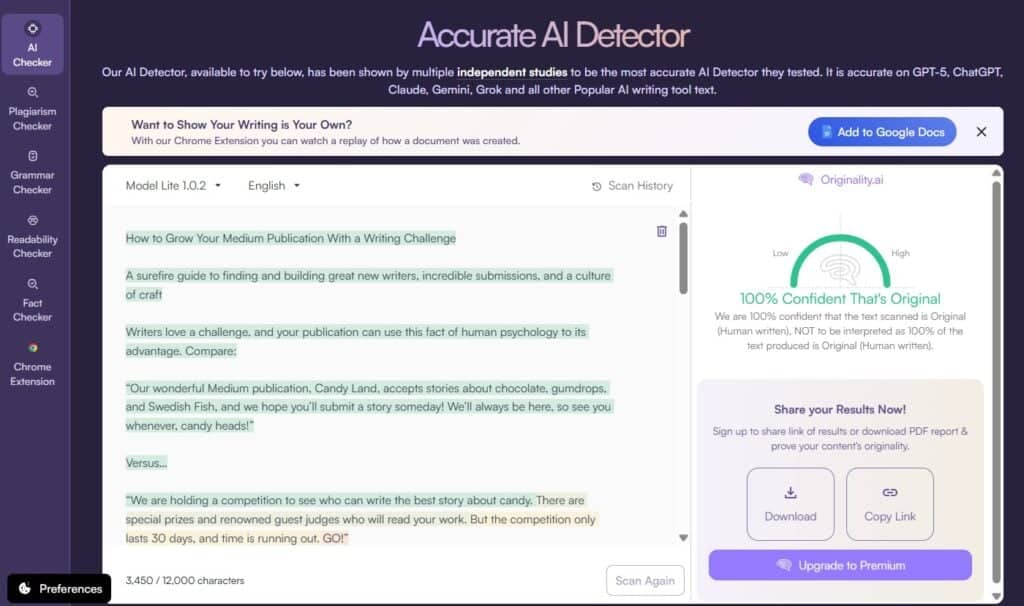
Originality.ai is the only detector that had wrong verdicts in this test (on mixed samples).
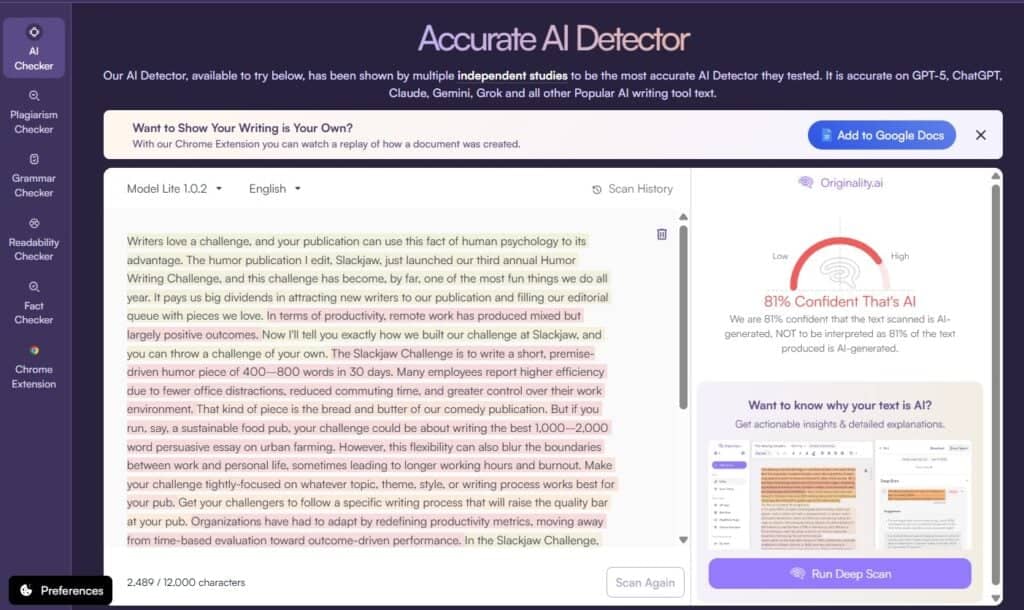
Its percentages were 100% accurate on all samples except the two mixed samples. It flagged the two mixed samples as 81% and 100% AI, respectively.
The two samples had ~60% human sentences, so they should have been classified as human. But Originality deemed them AI and became the only AI detector in my test to produce false positives.
Out of 90 total scans across all five tools, only two came back wrong — and both were from Originality.ai. Every other detector got every single verdict right. If a writer mixes their own writing with AI assistance, which is now common, Originality.ai is the one tool in this test most likely to falsely accuse them.
AI sample: ChatGPT Prompt 1:
Human sample: Slackjaw article:
Mixed sample (AI + Human):
Detailed Findings of AI Detectors’ Accuracy
The Overall Accuracy table that you saw at the beginning of the article showed Originality.ai at 88.9%, and the other four detectors tied at 100%.
But that table is only answering the question “Did each detector’s binary verdict (AI or Human) match the ground-truth label we assigned to each passage?”
It doesn’t tell you anything about how close each detector’s actual score was to the real AI content in the text.
For example, a detector that scores a fully AI passage at 71% and one that scores it at 100 percent both get credit for the same correct verdict, but they are not equally accurate.
To make you understand my testing results better, I calculated per-scan accuracy for every one of the 90 scans, using this formula:
Per-scan accuracy = 100% − the gap between the detector’s AI score and the actual AI percentage in the passage.
So a detector that scores a 100% AI passage at 71% counts as 71% accurate on that scan, and not 100%.
When we average this number by content type, it will show us where each detector is strong and where it is miscalibrated.
Per-Scan Accuracy By Content Type
| Detector | Pure AI (6) | Humanized AI (6) | Human (4) | Mixed (2) | Overall MAE (pp) |
| GPTZero | 100.0% | 100.0% | 100.0% | 70.0% | 3.33 |
| Undetectable AI | 98.5% | 99.0% | 93.0% | 97.0% | 2.72 |
| Originality.ai | 100.0% | 100.0% | 100.0% | 46.5% | 5.94 |
| Copyleaks | 100.0% | 100.0% | 100.0% | 63.0% | 4.11 |
| QuillBot | 86.2% | 97.5% | 100.0% | 63.0% | 9.56 |
Note: MAE stands for mean absolute error in percentage points, averaged across all 18 samples. The lower the MAE score, the better.
Three detectors are perfectly calibrated on every clean content type: GPTZero, Originality.ai, and Copyleaks.
Their entire calibration error arises in the Mixed column. QuillBot is the only one with calibration problems on clean inputs (the 71, 74, and 72 percent scores on the Claude and Gemini samples, plus the 85 percent on one humanized passage).
Undetectable AI is the only detector that stays above 93 percent on every content type. That’s why it has the lowest overall MAE at 2.72 points.
Making Sense of the Data
There isn’t one “most accurate AI detector” in this test. There are three answers, and which one matters depends on what you are checking:
- Best on clean inputs. Everyone ties on easy content. GPTZero, Copyleaks, QuillBot, and Undetectable AI all scored every sample correctly. A tie here tells you nothing about which tool to actually trust.
- Best calibrated overall. Undetectable AI wins where it counts. It was the only detector accurate on every content type, including the mixed passages that tripped up every other tool. Its error rate (2.72 points) was the lowest of all five — less than half of Copyleaks’ and a third of QuillBot’s.
- Most willing to flag any AI presence. Originality.ai is the one to avoid. It produced both wrong verdicts in the entire test and had the worst error rate of any tool (5.94 points) — more than double Undetectable AI’s.
Where Each Detector Wins (and Fails)
By now, you have a rough idea about the strengths and weaknesses of each AI detector.
But here are their strengths and weaknesses by content type.
Strengths by Content Type
- Raw AI: If you’re checking unmodified output from a major AI model, any of the 5 AI detectors will catch it. QuillBot may be a little off the mark in terms of precision, but the verdict will be correct.
- Humanized AI: We used Grammarly’s AI humanizer, and it couldn’t fool any of the five AI detectors. All samples were caught with high accuracy.
- Mixed passages: This is the content type where detectors vary the most. Undetectable AI delivered the closest-to-the-truth precision compared to others. Others gave correct verdicts but without being precise. Only Originality AI’s both verdict and percentages on the mixed samples were wrong.
- ESL writing: The ESL samples I used were a Substack article written by an Indian author writing in English and an IELTS essay, both published in 2021. All five detectors correctly identified them as human.
Pricing: Free vs. Paid AI Detectors
All AI detectors we tested offer either free use forever or a limited number of free scans.
Only Undetectable AI has a truly free AI detector. It allows you to scan as much as you want for free.
After Undetectable AI, Copyleaks, and QuillBot offer the most generous free trials before you hit the limit. Originality AI allows only 3 free scans per day, while GPTZero allows 4-5 scans.
To get past the daily limits and word caps per scan, you have to buy a subscription to these tools.
Here’s the least you have to pay for each:
- Undetectable AI: $19/month
- GPTZero: $23.99/month
- QuillBot: $8.33/month (Yearly subscription only)
- Copyleaks: $16.99/month
- Originality AI: $14.95/month
How to Choose the Best AI Detector for Your Use Case
There is no single “most accurate AI detector.” You have to pick an AI detector based on what you’re checking and the kind of mistake you can afford to make.
Here are four use case profiles based on this test’s data:
- Educators: Any of the five detectors will do, since all of them returned 8% or lower on ESL writing in this test. If you have a good budget, you can go with GPTZero. But if you’re working with a small school budget and need a free tool, Undetectable AI is your best friend.
- Publishers and SEO teams: Undetectable AI is the best choice here because, on mixed passages, it was the only detector that returned a score closest to the actual AI and human proportion. If you want a calibrated estimate of how much AI is in a piece (rather than a binary yes/no), it’s the strongest pick here.
- Students and self-checkers: Undetectable AI again because it has no signup wall and a generous daily limit.
- Hiring and recruitment: Ideally, Undetectable AI, but others are a safe pick as well, since in this use case, you just need a verdict. Avoid Originality AI if you’re checking mixed content.
How to Get the Best Results
Once you have chosen an AI detector, the way you use it also matters.
Here are four steps to use an AI detector to get the best results:
- Pick the perfect metric for your use case. The common metrics are accuracy, false positive rate, and F1 score.
- Use the AI detector on at least five passages whose origin you already know before you trust its score on someone else’s writing.
- Treat any AI detector score as a probability that the statistical features of the text resemble AI patterns. AI detectors can also make wrong calls.
- For high-stakes scans, require two or more detectors to agree before making a decision.
If you want to detect AI content with accuracy, you can give Undetectable AI’s AI Detector a try.
Frequently Asked Questions
Is there a 100% accurate AI detector?
No. Every AI detector returns a probability, which may turn out to be incorrect. Also, an AI detector’s accuracy can drop sharply on content types it wasn’t trained on.
What is the most accurate AI detector in 2026?
Undetectable AI. It tied for 100% accuracy across all 18 samples, and it was the only detector that stayed reliable on every content type, including the hardest case: mixed human-and-AI writing.
Its error margin (2.72 points) was the lowest of the five tools tested. Originality.ai, the only tool that got verdicts wrong in this study, had the highest error margin at 5.94.
Are free AI detectors as accurate as paid ones?
Yes, it’s true for most AI detectors. The score you get on the free tier is the same score you’d get on the paid tier because the detection model is the same.
Paying for an AI detector unlocks things like higher word caps, per-day limits, API access, batch uploads, and integrations.
Why do AI detectors flag human writing as AI?
This usually happens in the case of ESL writing because non-native writers tend to have a more polished style than native English writers.
This leads to the text having a low perplexity and low burstiness, which most AI detectors take for AI patterns. This is why I’d recommend running an ESL text through two AI detectors before acting on any high-stakes flag.
Final Thoughts
The most accurate AI detectors in 2026 depend on what you’re measuring. Four of the five AI detectors we tested performed accurately. Only Originality AI had two false flags.
But if we talk about precision at mixed passages (the trickiest text samples for an AI detector), then Undetectable AI was the most precise.
However, this test doesn’t solve everything. For example, ESL writing didn’t trip any detector in this round, but the ESL samples I used were articulate published writers. Had they been harder ESL samples, they could have produced false positives at industry-wide rates.
That’s why I’ll re-run this study quarterly as new LLMs and humanizers ship.
A detector that ties for “100% accuracy” can still fail you the moment real content gets messy.
If you’re a publisher or SEO team who needs to know how much AI is actually in a piece, not just whether it crosses some threshold, that’s exactly what Undetectable AI’s detector is built for.
Run your next borderline piece through it and see the real number. Try Undetectable AI today.