
A study by SearchTides discovered that 27% of adults in the United States prefer ChatGPT over google. Another 55% said that they expected AI-powered search to replace traditional search within two years.
Though Google and other traditional search engines remain relevant, the numbers prove that web content strategies need to accommodate the increasing popularity of AI-powered search engines like ChatGPT.
Key Takeaways
- ChatGPT cites websites that provide useful, original insights in clear, easy-to-read formats.
- Unlike SEO writing, writing for ChatGPT prioritizes clarity, authority, organization, and originality over keyword targeting and backlink acquisition.
- ChatGPT cites pages that don’t directly answer user queries if they provide useful supporting information.
What Makes Content Citation Worthy?
ChatGPT usually cites content that provides clear, reliable answers to a given user query. The pages it cites most often answer the question directly, support the claim with credible sources, and use elements like clear headings, bullet points, lists, and tables to make key points easier to find and understand.
Originality also matters. ChatGPT has little reason to cite pages that simply parrot ideas, information, and wording from other sources. To increase citation potential, content must provide useful original insights, such as firsthand experience, expert analysis, and unique data.
How is Writing For ChatGPT Different From Writing for Search Engines?
Search engine optimization (SEO) writing considers several factors beyond content structure. SEO teams can improve a page’s visibility by targeting relevant keywords, building backlinks, optimizing technical elements, and improving the overall user experience.


Never Worry About AI Detecting Your Texts Again. Undetectable AI Can Help You:
- Make your AI assisted writing appear human-like.
- Bypass all major AI detection tools with just one click.
- Use AI safely and confidently in school and work.
Meanwhile, generative engine optimization (GEO) focuses on giving AI tools a reason to cite your pages. It places greater emphasis on clear answers, authoritative information, original insights, and easy-to-extract content.
We Looked At Three Pages ChatGPT Cited — Here’s What We Noticed
To further look into what makes content citation-worthy, we searched X different topics and inspected the websites ChatGPT cited.
The topic we looked up was “how to travel Iceland on a budget.” ChatGPT returned a pretty comprehensive guide with a bullet point list of tips, a table of typical daily expense targets and approaches, and an itinerary.
It built this guide using a combination of official travel information pages, government websites, and independent blogs.
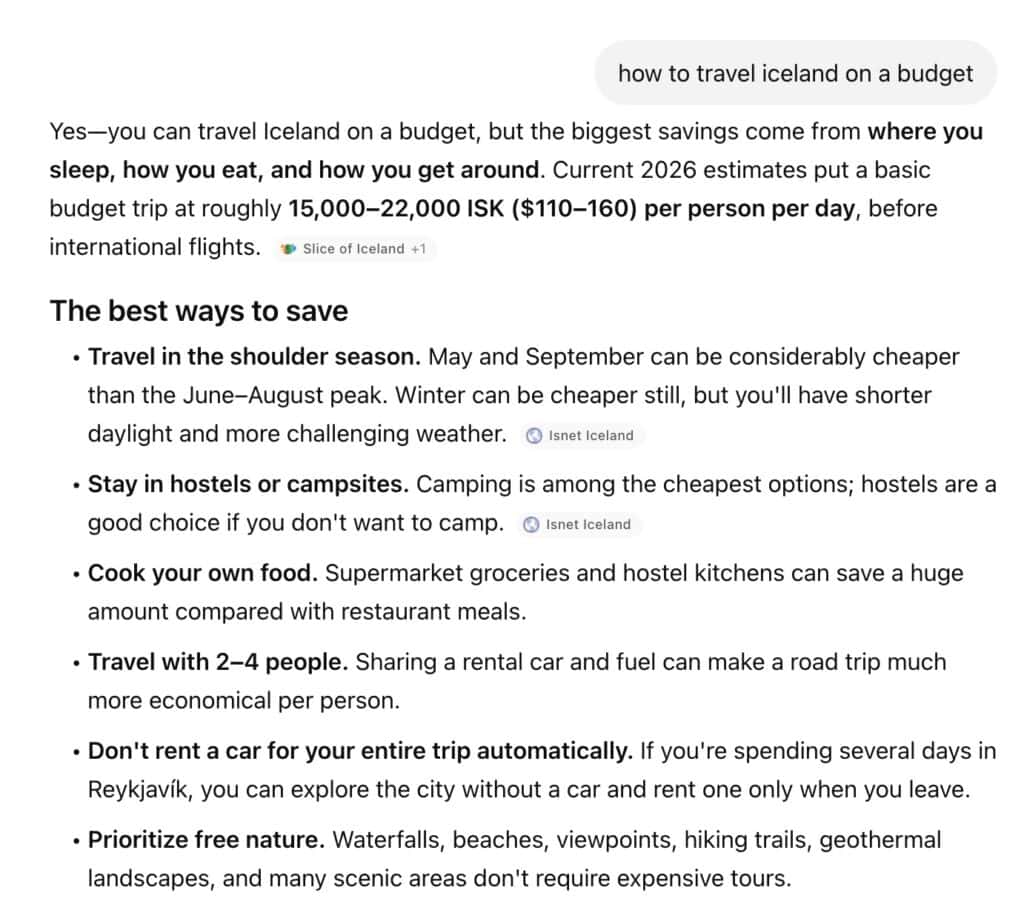
Website 1: Isnet Iceland
The first website ChatGPT cited was an independent travel resource platform called Isnet Iceland. The page offers a comprehensive guide to Iceland travel costs, separated into three budget tiers, with specific costs breakdowns per tier.
What immediately caught our attention was its specificity. Rather than offering vague money-saving tips, the guide provides a clear estimate of daily costs per person based on common travel expenses. It tells readers how much they can expect to spend, where their money will go, and which factors could push their budget higher.
This level of specificity likely gave the page a competitive edge. ChatGPT could easily identify and extract concrete cost information from the guide, making it more useful as a source than pages that offered only general budgeting advice.
Website 2: RV Iceland
Another website ChatGPT cited was RV Iceland, an independent travel resource platform with a specific focus on campervan travel. Similar to Isnet Iceland, the page breaks down what tourists should expect to spend when visiting.
Again, like Isnet Iceland, the website’s biggest strength is specificity. It provides price ranges for typical tourist expenses, including accommodations, food, gas, and taxes. While it doesn’t sum up daily expenses, it also provides concrete tips for saving money.
Aside from specificity, where this website excels is formatting.
Its headers are clear and descriptive to make information easier for AI and readers to locate. It also uses bullet points to break down costs into easy-to-scan sections, helping ChatGPT quickly identify and extract specific information.
Website 3: Icelandic Environment and Energy Agency
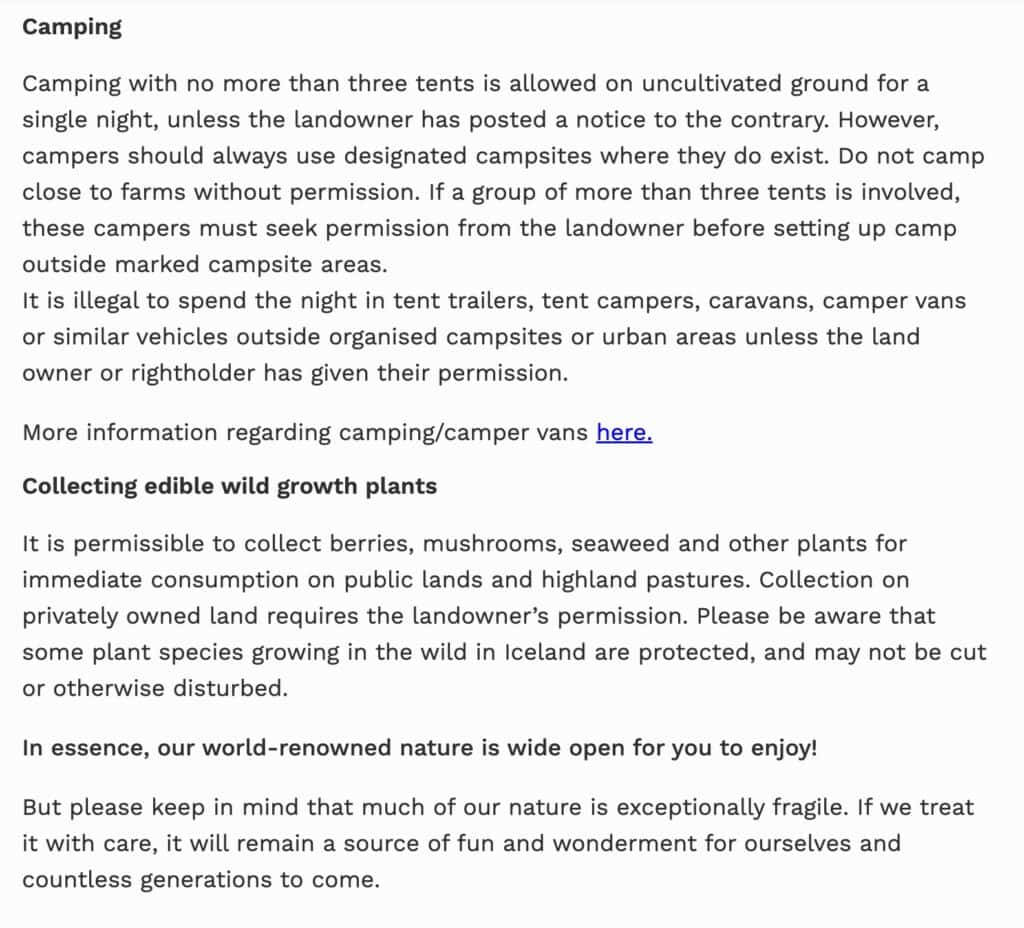
Not all websites directly answered the original query. ChatGPT also pulled from sources that provided useful supporting information.
In particular, it cited the Icelandic Environment and Energy Agency’s guide to access rights in the Icelandic countryside, since unfamiliarity with camping restrictions is a common reason tourists run into unexpected costs.
When it comes to content strategy, the Icelandic Environment and Energy Agency’s access rights page ticks the same boxes as Isnet Iceland and RV Iceland. It provides practical insights and organizes information for easy reading.
However, its inclusion as a cited source despite not reveals another useful GEO insight: AI search engines can cite pages that provide relevant supporting information, even when they do not directly address the user’s question.
This means your ChatGPT strategy should not focus solely on answering high-volume queries. Building authoritative pages around closely related topics can also increase your chances of appearing in AI-generated answers.
Practical Tips for Writing Content ChatGPT is More Likely To Cite
Optimizing content for ChatGPT citations is a matter of providing information that is useful, accurate, original, and easy to extract. This means supporting your claims through good arguments, writing habits, and structures.
Make Key Information Easy to Extract
While ChatGPT and other LLMs are skilled at understanding human text, they operate faster when writers purposefully make information easier to locate. For this reason, AI search engines tend to favor content with clear, organized, and easy-to-read formats.
Structural elements that improve extractability include:
- Clear, descriptive headers: Stating exactly what each section covers makes it easier for both AI tools and readers to find the exact information they need.
- Short paragraphs: ChatGPT has an easier time parsing short, to-the-point strings over dense blocks of text.
- Bullet points, numbered lists, and tables: Breaking information into small, related chunks makes it easier to process, especially when these formats present clear relationships or hierarchies.
Put Important Answers Near the Top
Another way to make information easier to extract is to place the statement that best answers the user’s query near the beginning of each section. Supporting details, examples, and nuances can follow.
This structure gives ChatGPT a clear passage to reference while easing readers into deeper information.
Cut Generic Filler and Get to the Point
The more economical you are with words, the easier it will be for ChatGPT to mine your content for useful information. Generic introductions, vague statements, and unnecessary transitions can make your most useful takeaways harder to find, so make sure to only include information that the reader needs.
Back Up Claims With Specific Evidence
Once you’ve made a claim, support it with specific facts, data, examples, or credible sources. While direct answers make information easier to locate, supporting evidence gives ChatGPT stronger arguments to point to when it builds its answers. It also makes your argument more solid and believable.
Add Original Insights and Examples
The most effective way to give your content a competitive advantage is to provide unique information, such as original research, firsthand observations, expert analysis, or specific examples that support your main points. By providing something other websites do not offer, you give ChatGPT a stronger reason to cite your page.
Run Your Draft Through a Humanizer Before Publishing
Using generative AI to produce content has become a widespread practice. Though efficient, this means that many websites are recycling similar points, structures, and phrasings.
If you use AI to write, you can use an AI Humanizer to make your content more unique and engaging. These tools can help remove overly formulaic language, improving flow and readability.
Build Authority Within Your Niche
Building a network of high-quality content around your core topics is more effective than targeting individual queries in isolation. ChatGPT frequently pulls information from sources that provide useful context even if they do not answer the user’s query directly.
To give ChatGPT more opportunities to discover and cite your website, cover related questions, supporting topics, and niche-specific information.
Frequently Asked Questions
How is GEO different from traditional SEO?
Traditional SEO focuses on helping web pages rank higher in search engine results. In contrast, GEO focuses on helping AI search tools understand, retrieve, and cite content in their answers.
While the two often overlap, traditional SEO strategies require optimization beyond the page copy, including keyword targeting, backlink acquisition, and technical SEO. Meanwhile, GEO strategies place greater emphasis on the quality and structure of the information, particularly its clarity, authority, originality, and extractability.
Does humanizing AI content actually improve its chances of being cited?
AI humanization can make content more engaging, but does not guarantee citations. AI search tools look for content that provides clear, accurate, useful information. They prioritize substance over style, rewarding original insights, firsthand experience, and expert analysis.
How long does it take for new content to start showing up in AI search results?
There is no fixed timeline. AI search tools need to discover, crawl, and process your content before they can cite it. Well-established websites with strong crawlability and authority may see their content appear relatively quickly, while newer sites may take longer.
You can improve your chances by making your content easy to crawl, updating it regularly, and building relevant authority.
What are the biggest mistakes people make when trying to get their content cited by AI tools?
Many websites focus too heavily on meeting keyword quotas and overlook the factors that make content useful to both readers and AI systems.
Common mistakes include publishing generic AI-generated content, failing to provide original insights, burying direct answers in long introductions, and using unclear page structures. Focus instead on creating clear, authoritative content that directly answers the questions your audience asks.
Final Thoughts
Optimizing content for AI search engines like ChatGPT means providing useful insights that are easy to parse and extract. Give readers direct answers to their questions, support the arguments with original insights or evidence, and organize the information for extractibility.
You can also increase your chances of getting cited by building authority within your target niche.
If you use AI to assist with drafting, humanizing content can serve as a useful final flourish.
Our Undetectable AI Humanizer can rewrite AI-generated writing to remove repetitive phrasing, correct formulaic language, and make content more engaging for readers.