
An unintended consequence of schools’ efforts to regulate AI use is an increased risk of false accusations against students who submit human-written work. If you’ve been falsely accused of using AI, knowing how these accusations happen can help you understand your options and defend your work.
This article teaches you why these accusations happen, what factors human review and AI detectors evaluate, and how to defend your work.
Let’s dive in.
Key Takeaways
- Human-written work can be falsely flagged because common writing patterns associated with AI can also appear in genuine student writing.
- AI detectors are not definitive proof and should be treated as signals that require additional evidence and human review.
- Version history, drafts, research notes, and source materials can help demonstrate how a paper developed and support claims of genuine authorship.
- Understanding your paper matters because being able to explain your arguments, sources, and reasoning can help establish that you genuinely wrote and engaged with the work.
- Use Undetectable AI’s Text Detector as supporting evidence to assess whether your paper’s writing patterns resemble AI-generated content alongside your writing history and research materials.
What Factors Make Writing Look AI-Generated?
Generative AI systems produce text by predicting the likeliest sequences of words based on patterns learned from vast amounts of training data.
Because these systems tend to favor statistically probable language, most AI-generated writing shares common characteristics, such as a lack of tone variation, predictable word choices, and repetitive sentence structures.
These patterns have become recognizable enough for most people to associate them with AI-generated writing.


Never Worry About AI Detecting Your Texts Again. Undetectable AI Can Help You:
- Make your AI assisted writing appear human-like.
- Bypass all major AI detection tools with just one click.
- Use AI safely and confidently in school and work.
However, they are not unique to AI-generated content. Human writers may also use formal language, consistent sentence structures, or common phrases. This overlap can cause people to mistake ordinary characteristics of human writing for signs of AI use, leading to false accusations.
How Effective Is Human Judgment at Detecting AI-Generated Work?
Generally, most humans cannot reliably distinguish between AI-generated and human-written work.
In a 2025 International Review of Economics Education study that asked a participant pool of 63 lecturers across engineering, economics, and social science departments to label 200- to 300- word excerpts, participants could only correctly identify 57% of AI-generated excerpts and 64% of human-written excerpts.
Fewer than 20% could correctly classify professional-level AI-generated writing.
How Do AI Text Detectors Work?
AI content detectors scan text for statistical and linguistic patterns commonly associated with AI-generated writing.
Based on these signals, the detector assigns the text an AI-generated or human-written label, calculates the likelihood that a piece of text contains AI-generated content, or produces a similar assessment indicating how strongly the text resembles the patterns associated with AI-generated writing.
The two main factors text detectors look for are perplexity and burstiness.
- Perplexity refers to the predictability of word choices
- Burstiness refers to the variation in sentence structure
The lower the perplexity and burstiness, the more inclined the text detector would be to flag the text as AI-written.
AI detectors use forensic analysis to identify patterns associated with AI-generated writing that human reviewers might miss. However, because these tools merely estimate likelihood, their results are better treated as signals for further investigation rather than definitive evidence.
Testing AI Text Detection on School Papers
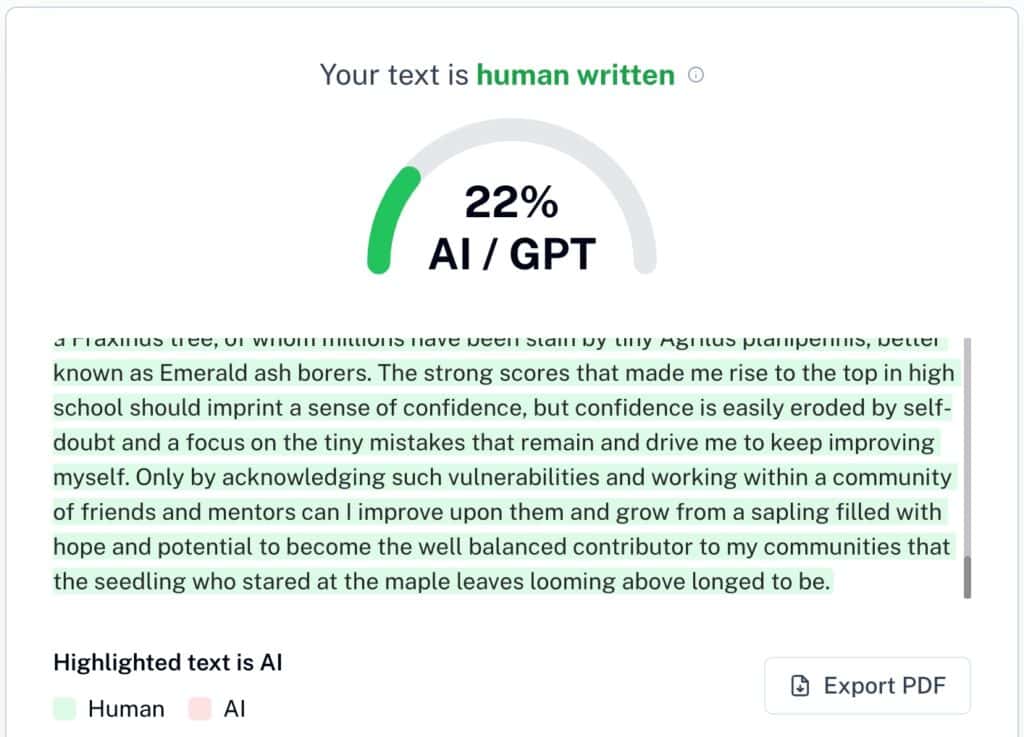
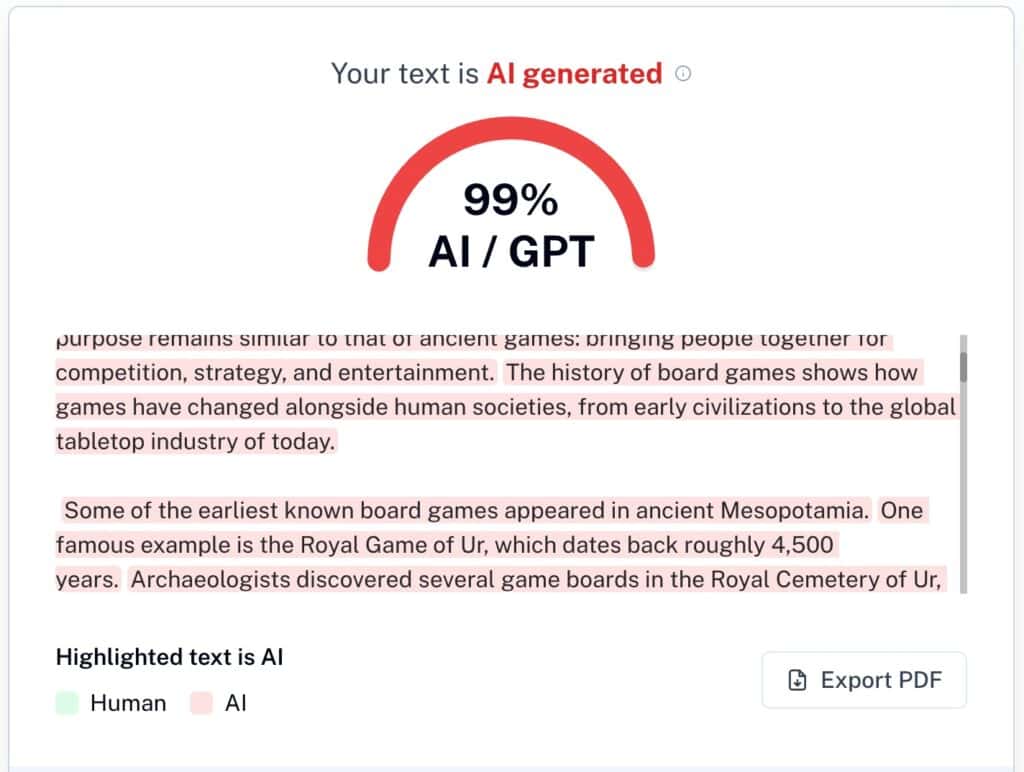
To demonstrate how AI detectors work, we ran two samples through the Undetectable AI text detector. The first was a human-written student submission pulled from a selection of undergraduate essays published on the John Hopkins University website. The second was an essay generated through ChatGPT. Both were about 650 words long.
As predicted, the text detector correctly labeled both the human-written sample and the AI-generated sample. The first sample displayed greater variation in sentence structure and word choice, resulting in less predictable language overall.
In contrast, the second sample showed lower perplexity and burstiness, reflecting more predictable word patterns and consistent sentence structures.
How to Prove Your Paper Is Human-Written
A thorough writing process will usually create natural evidence of genuine authorship. The version history feature, saved drafts and research notes, and your own understanding of your work can help you prove that you put your paper together independently.
Show Your Version History
If you use cloud-based writing software to draft papers, you’ll likely have access to a version history feature. Tools like Google Docs and Microsoft Word preserve previous versions of a document, saving evidence of how your paper developed over time.
The version history lets you show the work that preceded the final text. It may demonstrate that you created an outline, added paragraphs, revised sentences, reorganized sections, and corrected mistakes throughout the writing process.
The main limitation of this feature is that it does not establish who made every change. AI tools can also be used to generate or revise content within a document, so version history alone cannot prove that every part of a paper was written by a person.
However, a history showing consistent outlining, drafting, revision, and editing can provide useful evidence of a genuine writing process, particularly when it aligns with the writer’s research materials and final paper.
Show Your Research Materials
Research materials can help demonstrate the progression from research to final paper. They also give you something concrete to discuss if someone questions how you developed a particular argument or conclusion.
For example, if your paper makes an argument based on several academic sources, your notes can show which sources you consulted and how you used them to develop your position.
Useful research materials include:
- Research notes
- Outlines
- Source lists
- Highlighted articles or books
- Annotations
- Bibliographies
- Handwritten notes
- Early drafts
- Brainstorming documents
- Calculations or other supporting work
Prove Your Understanding of the Topic
The main reason AI writing is controversial in academia is that it can obscure the author’s level of involvement in their work and, consequently, how well they understand the topic. Demonstrating familiarity with your research, arguments, sources, and reasoning can help establish that you engaged with the material and understand the work you submitted.
Be prepared to explain why you chose your topic, how you developed your argument, why you selected particular sources, and how you reached your conclusions. You should also be able to explain unfamiliar terminology, summarize the main points of your sources, and defend the reasoning behind your claims.
Use an AI Text Detector as Supporting Evidence
You can also check your paper with an AI text detector. If the result indicates that your writing is likely human-written, you may use that result as additional evidence when discussing an accusation.
However, as mentioned above, text detectors present likelihoods rather than explicit verdicts. To strengthen your case, combine the detector result with evidence such as version history, research notes, drafts, and your ability to explain the paper.
Frequently Asked Questions
How Can I Tell If a Paper Is AI-Generated?
If you need to investigate whether a paper was AI-generated, consider multiple forms of evidence, including the student’s writing process, document history, sources, drafts, and understanding of the material. An AI detector can help you scan for patterns associated with AI-generated writing.
Can Teachers Prove You Used AI?
A teacher may have evidence that raises legitimate questions about AI use, but a writing style or AI detector score alone does not necessarily prove that AI generated a paper.
The strength of any evidence depends on the circumstances and the policies of the school or institution. If you are accused of using AI, ask what evidence supports the accusation and provide documentation of your writing process where available.
How Can I Avoid False AI Accusations?
The best way to protect yourself is to preserve evidence of your writing process while you work. Your research notes, outlines, drafts, source materials, and document version history can help you demonstrate how you developed your paper. It also helps to understand your work well enough to explain your arguments, sources, and reasoning.
Final Thoughts
Evaluators can misidentify human-written writing, especially when it shares characteristics commonly associated with AI-generated text.
To defend your work, preserve evidence of your writing process, such as version histories, drafts, and research notes. You can also support your authorship by demonstrating your understanding of the arguments, sources, and choices behind your paper.
AI detection scores can provide additional supporting evidence. Run your paper through the Undetectable AI text detector to assess whether its writing patterns resemble AI-generated content and use the result alongside evidence of your writing process.