Most advice on this topic is wrong, and here’s why.
It tells you to swap in synonyms, shuffle a few words around, and call it done. But that’s not what AI detectors actually measure.
Detectors look at three signals: perplexity (how predictable your word choices are), burstiness (how much your sentence length and rhythm vary), and structural patterns (repeated phrasing, uniform paragraph shapes, and the stock words AI tools default to).
Swapping “fix” for “rectify” doesn’t touch any of these. The sentence is still built the same way, still moves at the same pace, still reads with the same flat rhythm a machine produces.
This guide covers how to make AI writing undetectable using methods that actually change those signals, including before and after examples so you can see the difference instead of just reading about it.
Key Takeaways
- Common AI writing flaws, like repetition, generic tone, and flat sentence structure, are the main red flags detectors and readers both pick up on.
- Detectors measure perplexity, burstiness, and structural patterns, not vocabulary. That’s why synonym swaps rarely work on their own.
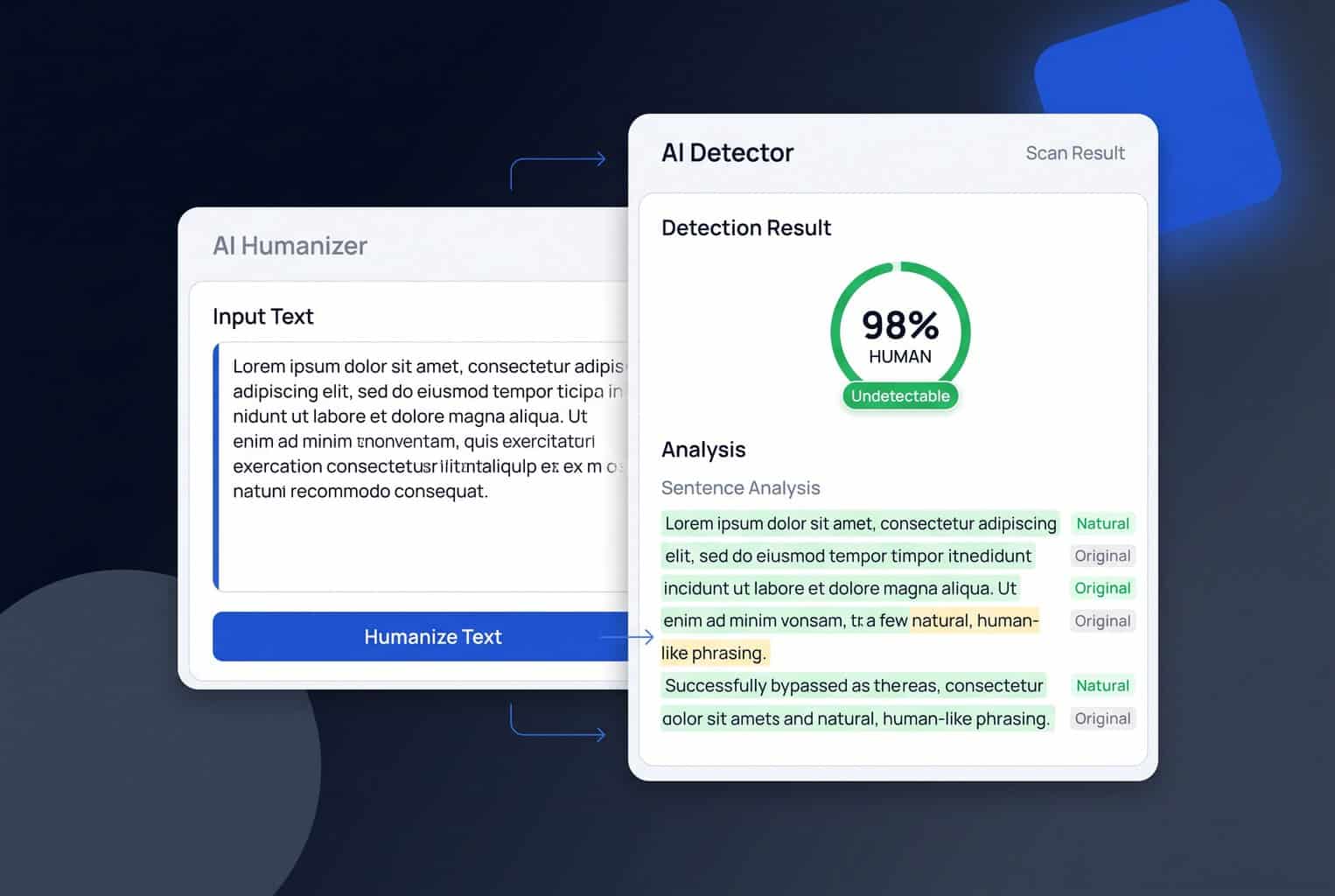
- Humanizing tools like Undetectable AI can transform robotic text into natural-sounding content that reads well and clears detection.
- The strategies that actually work: varying sentence structure, adding primary material AI can’t produce, and rewriting with a specific voice in mind.
- Testing through peer review, AI Detectors, and self-review catches what you’ll miss on your own.
How Is AI Writing Detected?
Understanding how AI-generated writing gets flagged helps you fix the actual problem instead of guessing at it.
Before you can avoid detection, you need to understand what detection tools are actually built to notice.
They’re trained to spot patterns that are common in machine-generated text but rare in human writing: predictable word choices, uniform sentence rhythm, and phrasing that repeats across paragraphs. Once you know what they’re looking for, the fixes get a lot more obvious.


Never Worry About AI Detecting Your Texts Again. Undetectable AI Can Help You:
- Make your AI assisted writing appear human-like.
- Bypass all major AI detection tools with just one click.
- Use AI safely and confidently in school and work.
What Mistakes Make Your AI Writing Detectable?
Most of these mistakes aren’t complicated. They just get skipped over because it’s easy to focus on getting AI tools to produce content fast and forget to check what that content actually looks like once it’s done.
Here’s what to watch for:
1. Repetition and Redundancy
AI tools like ChatGPT tend to repeat phrases or reword the same idea more than once in a row. This breaks the flow of a piece and makes it obvious something isn’t quite right, even to a reader who couldn’t tell you why.
2. Lack of Context or Nuance
AI models can access a huge amount of data, but they miss cultural context and lived experience. A human writer already has that instinct built in and can write about something with weight behind it, not just facts.
3. Inconsistency in Tone or Voice
AI-generated content often shifts tone mid-piece. That inconsistency makes the writing feel choppy, and it’s one of the clearest signals detection tools pick up on. It also makes for a bad reading experience even when it slips past a checker.
4. Over-Complexity
AI tools tend to overload sentences with extra clauses or reach for elevated phrasing instead of just saying the thing plainly.
5. Generic Responses
AI content leans generic more often than not, which reads as flat and forgettable. Content that actually solves a problem will always beat generic filler, no matter how polished the filler sounds.
The AI Tells Editors Actually Look For
“Vary your vocabulary” is vague advice. Here’s what editors and experienced readers are actually trained to spot, with real examples of each.
- The “it’s not just X, it’s Y” construction. This phrasing shows up constantly in AI output because it’s a low-effort way to add emphasis. One or two uses is fine. Five uses in one article is a dead giveaway.
- The tricolon habit. Lists of exactly three things, especially three adjectives or three short phrases in a row, appear far more often in AI writing than in how people naturally talk or write.
- Stock vocabulary. Words like “delve,” “leverage,” “robust,” “landscape,” “unlock,” and “elevate” show up disproportionately in AI-generated text. None of these are wrong on their own, but a cluster of them in one piece is a signal.
- Heavy em dash use. AI models default to em dashes to link related ideas. Humans use them too, but far less often, and usually for a specific effect rather than as a default connector.
- Hedge stacking. Phrases like “it’s worth noting that” or “it’s important to remember” pile up in AI drafts as filler transitions rather than actual content.
- Uniform paragraph blocks. Every paragraph running 3 to 4 sentences, every section structured the same way, is a pattern real writing rarely follows.
- Conclusions that just restate the intro. AI models tend to wrap up by repeating the opening point in slightly different words instead of adding anything new.
Once you can spot these in your own drafts, editing gets a lot faster because you’re not guessing what to change.
How to Test If Your AI Writing Is Detectable?
Once your content avoids the mistakes above, it’s worth testing before you publish. Three checks catch most problems:
1. Peer Reviews
Ask a colleague to read the piece without telling them it was AI-assisted. Their honest reaction, and any spots where they stumble, tells you more than a checker score will.
2. AI Detectors
Online tools can scan your text and estimate the odds it was AI-written. AI Detectors checks your text against common detection tools and flags the sections most likely to trip them.
3. Self-Analysis
The more you edit AI drafts by hand, the better you get at spotting what sounds robotic versus what sounds like you. This skill compounds fast once you know what to look for.
How to Make AI Writing Undetectable

Here’s a practical, step-by-step approach to producing AI-assisted content that reads like it came from a person and holds up under both human and automated review.
1. Use Tools to Make Your AI Text Not Detectable
Using a dedicated tool is the fastest way to fix a robotic draft before you start manually editing line by line.
Undetectable AI is built for exactly this. Select your desired “Readability” and “Purpose” settings, paste your draft into the editor, and choose a target: “More Readable,” “Balanced,” or “More Human.” From there you can either humanize the text directly or run it through the checker first to see where it’s likely to get flagged.
The AI Rewording Tool works well when a draft only needs a light touch rather than a full rewrite. It rephrases AI-generated text with a more natural tone and smooths out sentence flow without changing the meaning.
The AI Text Watermark Remover strips invisible digital markers some detectors rely on, while keeping your tone and meaning intact. Running it alongside a humanizer adds another layer of confidence that your final draft reads clean.
2. Change Sentence Syntax
Repetitive sentence structure is one of the clearest signs of AI writing. Three fixes handle most of it:
- Vary sentence length. Mix short, punchy sentences with longer ones. AI tools default to a steady rhythm; people naturally don’t.
- Rearrange word order. Flipping a sentence’s structure makes it read more naturally and throws off detectors trained on common AI patterns.
- Use conjunctions. Words like “and,” “but,” “so,” and “because” make writing sound less formal and closer to how people actually talk.
Writing experts increasingly point out that audience-first, personality-driven content performs better than polished but flat writing. Sentence variation and word choice are two of the easiest ways to add that personality back in.
3. Use Different Vocabulary
AI models have a wide vocabulary but tend to lean on the same words repeatedly. A few fixes:
- Synonyms. If a word like “fix” shows up three times in one piece, swap one or two instances for “resolve” or “correct.”
- Idioms and informal phrases. Use them where they fit naturally. Force one in where it doesn’t belong and it’ll stick out worse than the problem it was meant to solve.
- Cut unnecessary jargon. Unless you’re writing for an audience that expects it, swap in the plainer version of a term.
Worth noting: vocabulary changes alone rarely clear detection on their own. More on why in the next section.
4. Remove Excessive Commas and Use Shorter Sentences
Comma-heavy sentences read unnaturally, even when every comma is grammatically correct.
- Limit commas. Stick to two or three per sentence at most. Split longer sentences instead of stacking clauses.
- Cut extra detail. If a phrase doesn’t add anything, remove it. Say the thing directly.
5. Add Primary Material AI Can’t Produce
The old advice here was to ask the AI to rewrite its own output. That helps a little, but it doesn’t solve the underlying problem, since you’re still working with the same model’s habits and blind spots.
What actually works is adding something the AI has no access to: your own data, a quick interview, a screenshot, a specific example from your own experience. This does two things at once.
It makes the piece harder to flag, because detectors struggle with content built around specifics a model couldn’t have generated. And it directly supports the kind of content Google says it wants to rank: material that shows real experience and expertise, not just accurate information.
A close second option is writing your own outline and argument first, then using AI only to help draft around that structure. The thinking stays yours. The AI just helps you get words on the page faster.
Why Synonym Swapping Doesn’t Work
This deserves its own explanation because it’s the single most common piece of bad advice on this topic.
Detectors don’t scan for specific words. They measure perplexity and burstiness, both statistical properties of how the text is built. Perplexity measures how predictable each word is given the words before it.
AI models tend to pick the statistically likely next word, which produces smooth, low-perplexity text. Burstiness measures how much sentence length and complexity vary across a piece. Human writing tends to be bursty, meaning it swings between short and long, simple and complex. AI writing tends to stay level.
Swapping “fix” for “rectify” changes one word’s predictability for a moment, but it doesn’t touch sentence length, rhythm, or structure. The paragraph is still built the same way underneath. That’s why a document can pass a casual read-through after a synonym pass and still get flagged the moment it’s run through a proper detector.
The fixes that actually move these numbers are structural: changing sentence length variation, breaking up predictable phrasing patterns, and adding content a model wouldn’t generate on its own.
Before and After: Real Examples
Abstract advice like “vary your sentence length” is hard to apply without seeing it in action. Here are real examples, each with the changes marked.
Example 1
Before: “It is important to note that customer feedback plays a crucial role in shaping product development. Companies that actively listen to their customers are more likely to succeed. Additionally, gathering feedback helps businesses identify areas for improvement.”
After: “Customer feedback shapes product development, full stop. Companies that actually listen tend to win. Skip the surveys nobody reads and just ask people what’s broken.”
What changed: Cut the hedge opener (“it is important to note”). Broke the uniform sentence length. Added a blunt, specific closing line instead of a generic summary.
Example 2
Before: “In today’s fast-paced digital landscape, businesses must leverage innovative strategies to stay ahead of the competition and maximize their online presence.”
After: “Most businesses are still doing digital marketing the way they did in 2015. That’s the gap you can exploit.”
What changed: Removed stock phrasing (“fast-paced digital landscape,” “leverage,” “maximize”). Replaced a vague claim with a specific, arguable one.
Example 3
Before: “The results were not just impressive, they were transformative. Not just for the team, but for the entire organization.”
After: “The results surprised everyone, including us. Three months later, two other departments had copied the approach.”
What changed: Removed the “not just X, it’s Y” construction. Added a concrete, checkable detail instead of an abstract claim.
Example 4
Before: “It’s worth noting that proper time management is essential. It’s also important to remember that consistency matters more than intensity.”
After: “Time management beats motivation every time. Show up consistently and the results follow, even on the days you don’t feel like it.”
What changed: Cut both hedge phrases. Combined two flat sentences into one with actual rhythm.
Example 5
Before: “This approach offers numerous benefits, including increased efficiency, improved accuracy, and enhanced overall performance.”
After: “This cuts your review time in half. It also catches errors the old process missed twice last quarter.”
What changed: Broke the tricolon list pattern. Replaced vague benefits with specific, verifiable outcomes.
By Content Type
The right approach shifts depending on what you’re writing. Here’s how to adjust for the most common formats.
Blog Posts
Readers expect personality here more than anywhere else. Lean into first-person examples, opinions, and a conversational tone. This is also where the “add primary material” method pays off most, since a personal anecdote or original data point does more for both readability and detection than any rewriting trick.
Academic Essays
Structure and precision matter more than voice. Focus on varying sentence complexity to match the source material you’re citing, and make sure every claim is backed by something checkable. Avoid vocabulary padding that just adds word count without adding substance.
Email and Outreach
Keep sentences short and drop the formal tone entirely. Cold emails that read like a press release get ignored. The goal is to sound like a real person wrote a real message to one specific reader, not a template blasted to a list.
Product Copy
Specificity beats persuasion. Instead of generic claims like “high quality” or “industry-leading,” name the actual feature and the actual outcome it produces. This reads as more human and also converts better.
Technical Documentation
Consistency matters more than variety here. Keep terminology exact and repeat it deliberately when precision requires it. The goal isn’t to sound casual, it’s to be unambiguous. Vary sentence structure where you can without sacrificing clarity.
The Benefits of Making Your AI Text Undetectable
Learning how to do this well pays off in a few concrete ways.
First, it keeps your content aligned with what search engines reward. Google has stated that AI-assisted content is fine to publish as long as it’s genuinely helpful and written for people first, not for search rankings.
Second, content that feels personal and specific gets more engagement. Readers respond to writing that sounds like it came from someone who actually knows the subject, not a template.
Third, the process of refining AI text, tightening sentence structure, cutting redundancy, adding real examples, makes the piece better regardless of whether a detector ever touches it.
Ethical Considerations When Using AI Writing Tools
Humanizing AI text matters for readability and detection, but it also raises questions worth taking seriously, especially in academic, legal, or journalistic work.
The Harvard Bok Center points out that transparency, disclosure, and responsible use of AI are central to maintaining trust with readers and avoiding misrepresentation.
If you’re working on something high-stakes, like a graded assignment, that trust matters more than usual, and it’s worth checking your institution’s policy on AI use before you submit anything.
AI Writing and Google Rankings
Google’s position on AI content has shifted a few times since 2022, but the current guidance is fairly clear: AI-assisted content is not automatically penalized. What gets penalized is content produced at scale primarily to manipulate rankings, regardless of whether a human or a model wrote it.
Google’s spam policies specifically target what the company calls scaled content abuse: large volumes of low-value, unedited, or auto-generated pages built to game search rather than help readers. A single AI-assisted article that’s been edited, fact-checked, and built around real expertise doesn’t fall into that category.
What Google actually rewards is content that demonstrates experience, expertise, authoritativeness, and trustworthiness, usually shortened to E-E-A-T. Of those four, trust matters most. Content earns trust by being accurate, specific, and clearly written by someone who understands the subject, whether that person used AI as part of the process or not.
The practical takeaway: don’t treat “avoiding detection” and “ranking well” as the same goal. A piece can clear every detector and still rank poorly if it’s generic. Conversely, a piece with light AI involvement but real expertise behind it will usually outperform a purely human-written piece with none.
A Repeatable Workflow
Here’s an end-to-end process that covers everything above, from first prompt to publish.
- Draft your own outline first. Decide the argument and structure before AI touches the piece.
- Generate a first draft with AI, working section by section rather than asking for the whole piece at once.
- Add primary material. Insert your own data, examples, or quotes the model couldn’t have generated.
- Edit for sentence variation. Break up uniform paragraph lengths and rhythm.
- Cut stock phrasing. Remove hedges, tricolons, and overused words flagged earlier in this guide.
- Run it through a humanizer if the draft still reads flat after manual edits.
- Check it against a detector and revise any flagged sections.
- Get a peer read. A second set of eyes catches what you’ve gone numb to after multiple passes.
- Publish.
Common Mistakes When Humanizing
Over-correcting causes its own problems. Watch for these:
- Over-humanizing into incoherence. Pushing too hard for a “natural” voice can produce rambling, unclear sentences that are technically more human but harder to read.
- Losing accuracy in the rewrite. Heavy rewriting sometimes drops a qualifier or changes a number by accident. Always fact-check after a humanizing pass, not just before it.
- Breaking citations. Rewording a sentence that includes a citation or attribution can accidentally misrepresent the source. Check that quoted or cited material stays intact.
- Drifting off-brand. A humanizer tuned for casual tone can pull formal or technical content too far in that direction. Match the setting to the piece, not just the goal of “sounding human.”
The Best Tool to Detect AI Content and Then Make It Undetectable
Manually applying every method above works, but it’s slow, and it’s easy to miss something when you’re editing your own writing. A dedicated tool speeds up the process and catches what a manual pass tends to miss.
Undetectable AI covers most of what this guide walks through in one place. Here’s a quick breakdown of which tool fits which job:
| Tool | Best For |
|---|---|
| Humanizer | Rewriting a fully robotic draft into natural-sounding text |
| AI Rewording Tool | Light touch-ups on specific paragraphs, not a full rewrite |
| AI Text Watermark Remover | Stripping invisible markers some detectors rely on |
| AI Essay Rewriter | Academic work that needs depth and original phrasing |
| AI Detector | Checking flag risk before you publish or submit |
Run your draft through the AI Detectors tool first to get a probability score, then use the suggested edits or the humanizer to fix what’s flagged.
Frequently Asked Questions
Does using AI detection tools guarantee my content will pass every checker?
No tool guarantees a pass on every detector, since different tools use different models and thresholds. What a good humanizer does is address the actual signals most detectors look for, which improves your odds significantly across the board.
Is it against Google’s rules to use AI to write content?
No. Google has stated that AI-assisted content is fine as long as it’s genuinely helpful and not produced primarily to manipulate search rankings.
Will synonym swapping alone get my content past a detector?
Rarely. Detectors measure sentence rhythm and predictability, not individual word choice, so swapping words without changing structure usually isn’t enough.
How many AI detectors should I check my content against?
Checking against two or three different detectors gives a more reliable picture than relying on just one, since detection models vary in what they flag.
Can I use AI writing for academic assignments?
That depends entirely on your institution’s policy. Some allow AI as a drafting aid, others prohibit it outright. Check your school’s guidelines before using AI on graded work.
What’s the difference between humanizing and paraphrasing?
Paraphrasing changes wording. Humanizing changes the underlying structure, rhythm, and pattern of the writing, which is what actually affects both readability and detection.
Does adding personal anecdotes really help avoid detection?
Yes. Specific, personal details are something a model can’t generate on its own, which makes that section of text naturally harder to flag and more engaging to read.
How long does it take to humanize a typical article?
With a dedicated tool, a few minutes per article. Doing it entirely by hand can take significantly longer, depending on how much rewriting the draft needs.
Should I disclose that I used AI to write something?
In academic, legal, or journalistic contexts, disclosure is often expected or required. For general content marketing, it’s less standardized, but transparency tends to build more trust with readers over time.
Can over-humanizing make my content worse?
Yes. Pushing too hard for a casual tone can make technical or formal content read as sloppy or unclear. Match the tone to the piece.
Do AI detectors ever flag human-written content by mistake?
Yes, false positives happen, especially with writing that’s naturally simple or repetitive in structure. That’s part of why peer review and self-analysis matter alongside any detector score.
What’s the single most effective method in this guide?
Adding primary material AI can’t produce, your own data, examples, or first-hand experience. It improves both detection odds and content quality at the same time.
Conclusion
Avoiding AI detection isn’t about tricking a checker. It’s about fixing the actual patterns, flat rhythm, predictable phrasing, generic claims, that make writing sound like a machine wrote it in the first place.
Vary your sentence structure, cut the stock phrases, and add something real that only you could have written.
Want to skip the manual work? Try Undetectable AI and see the difference for yourself.