
What is more dangerous? Air-travel or travelling by road in your car? I won’t be surprised if you thought of air travel because we all have seen plane crashes making headlines so often.
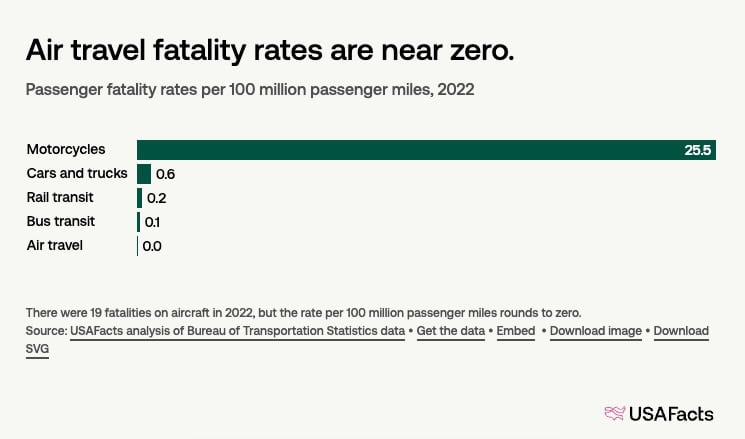
However, statistics say that the rate of injury for airline passengers in the United States is almost nonexistent when measured per 100 million passenger miles.
A question where we have to think of relative risk or danger, the human brain tries to think of examples it can pull from memory.
A plane crash stays in the news for days (even weeks) after the accident. And since you can think of multiple such examples, you naturally believe they happen much more frequently.
The availability heuristic describes this phenomenon, our natural tendency to form opinions and make decisions based on how easily we recall similar examples from memory.
This article talks about the availability heuristic with numerous examples, explains why it happens, and how to make decisions backed by data instead of relying on memory.
Key Takeaways
- The availability heuristic is the human tendency to make decisions influenced by the information we can most easily recall.
- Recent incidents or instances that affect your emotions in any way are more likely to be remembered by the brain.
- Decisions based on easily recalled memories rather than real facts and stats can be wrong.
- Unbiased decision-making comes from critical thinking that comes from intentional education about the situation before you form an opinion.
What Is Availability Heuristic?
Heuristics are mental shortcuts your brain uses, so it doesn’t have to stop and carefully analyze everything all the time. Because honestly, who has the energy for that?
You walk through life making hundreds of decisions a day, and your brain just wants to keep things moving. So, it just goes with the information already stored in your head.
The availability heuristic is one of the shortcuts we constantly use, every single day, without noticing.


Never Worry About AI Detecting Your Texts Again. Undetectable AI Can Help You:
- Make your AI assisted writing appear human-like.
- Bypass all major AI detection tools with just one click.
- Use AI safely and confidently in school and work.
In 1974, Daniel Kahneman and Amos Tversky described the concept of availability heuristic as:
“If you can think of it, it must be important.”
Or common.
Or likely to happen to you next.
The formal availability heuristic psychology definition, as defined by Tversky and Kahneman, is the likelihood of an event occurring “by the ease with which instances or associations come to mind.”
You could say it’s our tendency to think how common or important something is based on how easily examples of it come to mind.
For example, if you watch a lot of news about crime, your worldview changes such that you feel like it’s becoming a lot more unsafe out there.
Now, the crime stats may not actually have changed in recent years. It’s just your brain remembering recent examples to form certain opinions like common sense.
Emotional and dramatic events are easier to remember too. How many times have you seen a news headline saying millions of cars reached their destination safely today?
None, right?
It’s something so common you do not need a headline for it. However, if you’ve followed a few recent news reports of road traffic accidents, you may become skeptical of driving on busy roads.
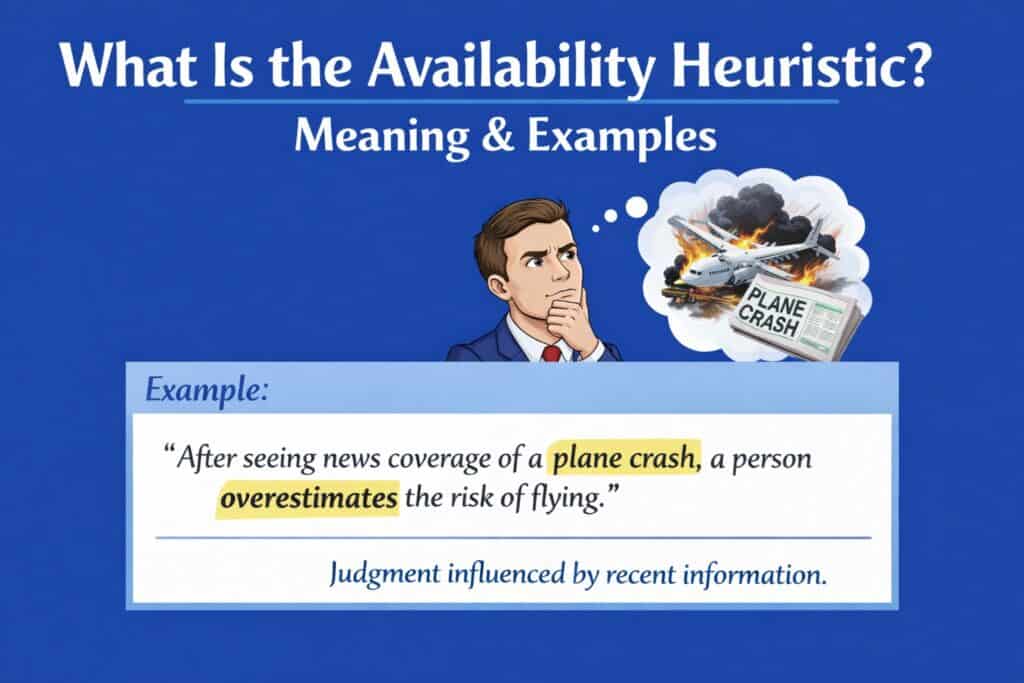
Common Example of Availability Heuristic
If you watch the news for a week and it’s wall-to-wall stories about burglaries, you find yourself double-checking the locks at night.
Although nothing has actually changed in your neighborhood, the fear of a burglary is just amplified in your own head.
One plane crash makes headlines everywhere for days, sometimes weeks. Statistically speaking, air travel is the safest mode of transportation.
In a research article, “Transportation Safety Over Time: Cars, Planes, Trains, Walking, Cycling” the rate of death per billion miles traveled for different modes of transport is:
- Air travel: 0.07
- Motorcycles: 212.00
- Cars: 7.30
Despite the facts, travelling by air induces a spike of anxiety if you have recently heard about a plane crash.
The reason is simply that your brain pictures that one incident. It does not recall the millions of safe flights that happened that same week.
Similarly, if you hear about someone your age getting a serious or rare illness, every strange sensation in your body gives you shivers.
Or, if the last few relationships you saw around you ended badly, you begin to believe that relationships always go wrong.
All these examples are just the experiences your brain recalls, regardless of the data and statistics that may be very different in reality.
How It Shows Up in Real Life
The availability heuristic affects almost every aspect of society.
Politicians pick one issue, crime, immigration, inflation, whatever fits the moment, and repeat it so over and over that it sounds like the defining problem of daily life.
The average person may not have actually encountered it firsthand in months or ever. But you hear about it so many times that you do believe it is your problem.
Brands deliberately put pillboards at just the right intersections so you get to see the advertisement again and again. When you finally need to buy something, the brand you see more often pops up first in your mind.
It may not have the best products, but you just saw their name so recently that it was the easiest to recall.
During epidemics, both doctors and patients become primed to see one diagnosis everywhere. During COVID-19, any respiratory symptom was a danger sign for that particular disease.
Since COVID dominated the news and medical conversations, it became the first thing people would think of, sometimes at the expense of other, more common explanations.
When you commonly hear about layoffs in tech, your own job feels unstable even if your company is doing fine.
You see viral videos of bad behavior and start thinking that society as a whole is falling apart.
All of it is the availability heuristic. Certain memories just flood your memory until they feel representative of the whole world.
The Psychology Behind It
Your brain works with incomplete information most of the time. It is natural for humans to not know real facts and, in turn, cling to the recently available information to base their decisions on.
Recency of experiences makes them available.
Any incidents that happened 10 minutes ago, today, yesterday, last week, etc, sit right at the front of your mind. They obviously carry more weight than older information, even if the older stuff is more accurate.
Also, emotionally charged information is more likely to be remembered. Things tied to fear, shock, excitement, outrage, happiness, you name it, any emotion affects your brain more strongly than plain facts.
Simple ignorance, though that sounds harsher than it is, is a major contributor towards availability bias.
Often, we just don’t know the real numbers, the background facts about things.
And when we don’t know, the mind fills the gap with examples instead, so one vivid example stands in for thousands of alternatives that we simply don’t know even exist.
Mistakes Caused by the Availability Heuristic
Think about how quickly our view of certain groups shifts when the only stories we see are extreme ones.
When the media keeps showing the same narrow, negative angle about a certain demographic, let’s say transgender people, it leads an average person to believe ‘trans people must be dangerous.’
In reality, transgender individuals are statistically much more likely to be victims of violent crime than perpetrators.
The availability heuristic makes us anxious about rare events rather than focus on more common issues.
Parents, for example, become terrified of rare dangers because of viral, one-in-a-million tragedies like child abductions, freak accidents, etc.
Such emotionally charged news impacts them so much that they end up underestimating much more common risks and overrestricting their kids’ lives.
People also make impractical money mistakes due to it. You must have encountered at least someone panic-selling their investments after hearing about market crashes.
One bad experience with one person affects your judgment of others who vaguely remind you of them. It’s not even intentional. Just memory doing its thing. Isn’t that wild?
Strategies to Reduce Its Impact
Now, how do you reduce the impact of the availability heuristic? If we’re being honest, you’re not going to turn it off in your head. No one does.
You can, however, slow it down and make it less convincing when it shows up, acting like the voice of reason.
Intentional education about people, risks, big social issues, etc., is very important before you form a strong opinion about it.
Before making any decisions, evaluate if you actually know the facts here, or do you just remember a few stories.
On a related note, do not form opinions in the heat of recency. If an incident just happened and you’re in the high of emotions, your judgment about it is probably distorted.
Expose yourself to a broader range of perspectives. Social media algorithms love repetition so much that they keep feeding you more of what you’ve already seen.
Such exposure keeps certain examples permanently available in your mind.
Try to break that social media loop by reading different sources and listening to people with different experiences. It will dilute the dominance of any single narrative.
Practical Applications
The availability heuristic is so, so useful when life doesn’t give you time to sit down to thoroughly analyze everything.
It’s a wise decision, for example, if you come across a street and remember that cars drive through the corner far too quickly, and you hesitate before crossing it.
Everyday decisions, such as which grocery store to trust, which route to take, and which habits improve your mood, all call for sound judgment. You get that from availability!
What we need to distinguish is:
- Does your judgement come from experiences you’ve had over and over?
- Or, is it clouded by an incident you only recently encountered?
It’s a skill that requires practice, of course.
You would have to stop yourself in your tracks and ask yourself, “Why did that example come up first?” Or, ‘if I hadn’t just seen the news yesterday, how would I feel?’
Undetectable AI’s AI Chat is a great adjunct for critical thinking. Ask it to come up with counterexamples for your ideas, such as “This incident feels really common to me, give some examples where the opposite is true”
It’s also very helpful for guided practice exercises, such as walking through the factors that influenced your decision and simulating brief decision-making scenarios.
And, use it to comprehend the other viewpoint, such as how a person with a different background would interpret the same circumstance.
Try the AI Detector and Humanizer tools in the widget below!
Final Thoughts
We know that the availability heuristic is one of our inherent mental biases. Research, however, says that the awareness of such biases does not guarantee that our decisions will not be influenced by them.
While we realize that our decisions should not be based on recent or memorable instances, we can only prevent it from happening with intentional effort.
Undetectable AI Chat is a great assistant to help you think through your choices. It can help you get real statistical information about things and show you all kinds of evidence, good and bad, before you make any decisions.
Check Undetectable AI out today!