
If Thor were a modern American superhero, he would carve the word “ax” on his handle.
But if he followed his old European roots, or wrote for a British newspaper, he would use “axe.”
Confusing?
It doesn’t have to be.
Ax and axe mean the same thing.

Source = Pinterest
They look the same, work the same, and describe the same tool.
The only real difference is where you are writing. Both spellings are correct, but using the wrong one for your audience can make your writing look careless.
In this blog, we’re going to see if it’s an axe or axe?
We will cover why the spelling split happened, which one you should use based on your region, and how to avoid common mistakes so your writing remains sharp.
Let’s dive in.
Key Takeaways
- “Axe” is the preferred spelling in British English and is widely used in Australian, Canadian, and other Commonwealth countries.
- “Ax” is the standard American English spelling, though “axe” is also accepted in the US.
- Both spellings refer to the same tool and have the same meanings in literal and figurative contexts.
- The choice between axe or ax depends on your target audience and regional writing preferences.
- Consistency within a single document is more important than which variant you choose.
What Is the Difference Between Axe or Ax?
Is it ax or axe?
There is no difference in meaning.
The difference between “axe or ax” is purely regional and stylistic.


Never Worry About AI Detecting Your Texts Again. Undetectable AI Can Help You:
- Make your AI assisted writing appear human-like.
- Bypass all major AI detection tools with just one click.
- Use AI safely and confidently in school and work.
Both words refer to the same chopping tool and the same action of cutting or eliminating something.
The difference lies in where you live and which dictionary you prefer.
Look at this simple table comparing Axe and Ax.
| Feature | Axe (The “E” Version) | Ax (The Short Version) |
| Where is it used? | UK, Canada, Australia, and Global English. | Primarily in the USA. |
| Is it standard in the US? | Yes, it is very common in the US now. | Yes, it is the traditional American spelling. |
| Meaning | Noun (Tool) or Verb (To cut). | Noun (Tool) or Verb (To cut). |
| Plural Form | Axes | Axes |
| Verb (Ing form) | Axeing (or Axing) | Axing |
| Idioms | Preferred: “An axe to grind” | Less common: “An ax to grind” |
| Recommendation | Safest choice everywhere. | Use only for informal American writing. |
- Definition and Origins
The word traces its roots back to Old English “æcs” (pronounced “aks“).
Interestingly, while some people today consider the pronunciation “aks” to be modern slang, it is actually the original, ancient pronunciation of the word.
- Proto-Indo-European: h₂egʷsih₂- (meaning “cutting tool“).
- Proto-Germanic: akwisī.
- Old English: æcs.
During the Middle English period, English ax or axe spelling was the wild west. There were no standardized dictionaries, so scribes spelled words however they felt like it.
The word appeared in various forms in medieval manuscripts, including “axe,” “ax,” and even “exe.”
The letter “e” at the end was often added or dropped inconsistently, simply to make the handwriting look better on the page or to fill space.
For centuries, both spellings coexisted. But by the 16th and 17th centuries, a split began to form:
- Britain: Began favoring the longer “Axe.”
- America: Gradually adopted the shorter “Ax.”
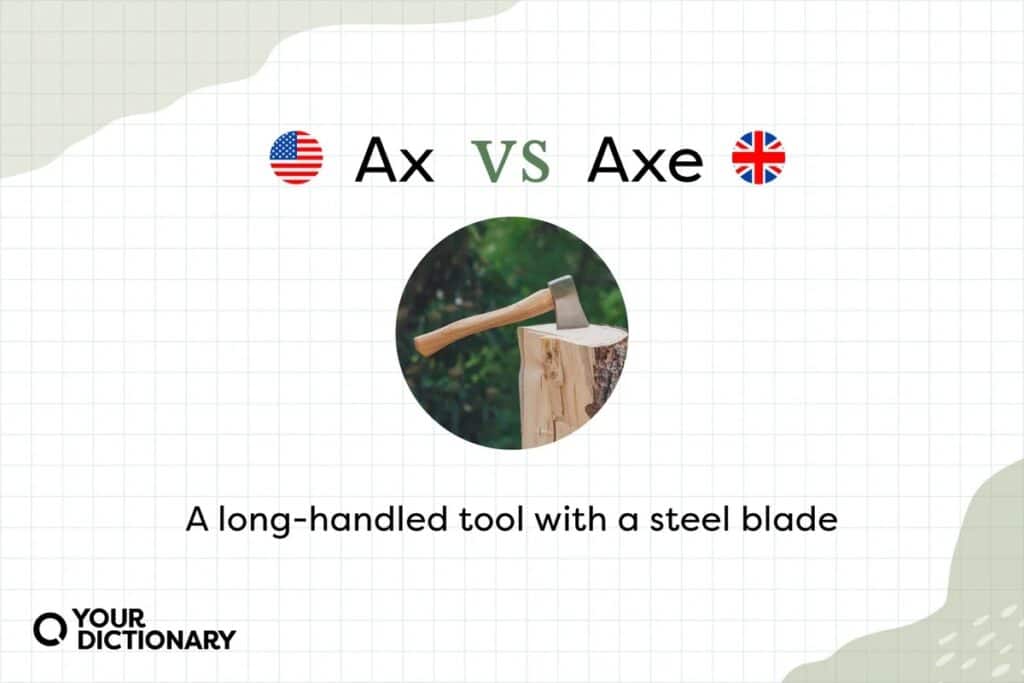
This divide was solidified in 1828 by Noah Webster (the man responsible for most American vs. British spelling differences).
Source = Your Dictionary
In his famous American Dictionary, Webster promoted “Ax” as the superior spelling because he believed in simplifying the language and removing silent letters.
When to Use Axe
If you are wondering is it axe or ax for global or formal contexts, the answer is usually “Axe.”
Axe is the preferred spelling in:
- British English Contexts: Used in the United Kingdom, Ireland, and most Commonwealth countries.
- Example: The axe hung on the wall of the Scottish cottage for decades.
- Australian and New Zealand Writing: Standard spelling in all formal and informal Australian and New Zealand publications.
- Example: The bushman carried his axe through the Australian outback.
- Canadian English: While Canadian English sometimes adopts American spellings, “axe” remains the dominant form.
- Example: The Canadian lumberjack competition required participants to bring their own axes.
- International English Publications: Many international style guides, including Oxford, recommend “axe.”
- Example: The Times published an article about medieval axes in European museums.
- Academic and Historical Writing (UK-focused): When writing for British academic institutions or about British history.
- Example: The Viking battle-axe was a formidable weapon in medieval warfare.
- Figurative Expressions in British Media: British newspapers and media use “axe” in headlines and idioms.
- Example: The government plans to axe funding for several arts programmes.
- Literary Works by British Authors: When quoting or emulating British literary style.
- Example: In the novel, the character wielded an axe against the locked door.
When to Use Ax
If you are asking is it ax or axe in the United States, the preference shifts to the shorter version.
Ax is the preferred spelling in:
- American English Contexts: Standard spelling across the United States in all formal writing.
- Example: The ax blade needed sharpening before the competition.
- US Business and Corporate Communications: American companies use “ax” in reports, memos, and official documents.
- Example: The CEO announced plans to ax the underperforming division.
- American Journalism and Media: US newspapers, magazines, and news websites consistently use “ax.”
- Example: The Washington Post reported that the studio would ax three film projects.
- US Academic Writing: American universities and scholarly publications prefer “ax.”
- Example: The research examined the efficiency of different ax designs in colonial America.
- Technical and Product Specifications (US): American manufacturers use “ax” in tool specifications and manuals.
- Example: This 36-inch ax features a fiberglass handle and forged steel head.
- American Legal Documents: US legal writing, contracts, and official forms use “ax.”
- Example: The contract allowed the publisher to ax chapters that exceeded the word limit.
- Casual American Writing: Blogs, social media, and informal writing by American authors often favor brevity, a reason why “Ax” is also a popular play in ax or axe scrabble games.
- Example: I need to grab my ax from the garage before we go camping.
Is your American spelling consistent?
Even when you know the rules, it is easy to accidentally slip a British “axe” into an American document, or make simple sentence errors.
To be absolutely sure your writing is polished, run your draft through the Undetectable AI’s Grammar Checker.
It ensures your examples are accurate, grammatically correct, and readable for your specific audience.
[Check Your Grammar for Accuracy and Readability]
Common Mistakes to Avoid
Even though the difference is just one letter, the choice between axe or ax can make your writing look inconsistent or unprofessional if used incorrectly. Here are the top pitfalls.
Mistake 1: Inconsistency
Writers often flip-flop between spellings in the same paragraph. This signals carelessness.
| Incorrect | Correct (American) | Correct (British) |
| The lumberjack grabbed his ax and began chopping. After hours of work, he finally put down the axe. | The lumberjack grabbed his ax… put down the ax. | The lumberjack grabbed his axe… put down the axe. |
Mistake 2: Ignoring Audience Expectations
While “axe” is accepted in the US, “ax” is virtually never used in the UK. If you are confused about is it ax or axe for a British audience, the answer is strictly the longer version. Using the American short form for a British reader looks like a typo.
| Incorrect (for UK audience) | Correct (for UK audience) |
| The company plans to ax 50 jobs. | The company plans to axe 50 jobs. |
Mistake 3: The Plural Trap
Because “Ax” ends in x, people sometimes forget how to pluralize it properly. Whether you use the ax or axe spelling, you cannot just add an ‘s’.
| Incorrect | Correct |
| The museum displayed several ancient axs. | The museum displayed several ancient axes. |
Note: The plural “axes” looks identical to the plural of “axis” (as in math graphs), but they are pronounced differently.
- Axes (tools): AK-siz
- Axes (graphs): AK-seez
Mistake 4: The “Ax/Ask” Confusion
Confusing the verb “ask” with “ax” due to dialectal pronunciation. While “aks” was the original Old English pronunciation of “ask,” in modern standard writing, they are distinct words.
| Incorrect | Correct |
| He axed me a question. | He asked me a question. |
Mistake 5: Verb Form Clashes
Mixing American and British rules when adding suffixes like “-ing.”
| Incorrect | Correct (American) | Correct (British) |
| The producer is axeing the show. | The producer is axing the show. | The producer is axeing the show. |
Usage Examples in Sentences
Using “Axe” (British English)
- The ancient battle-axe was displayed in the Tower of London museum.
- The forest ranger taught us how to properly swing an axe for maximum efficiency.
- Parliament voted to axe the controversial infrastructure project.
- Her grandfather’s rusty axe still hung in the barn after all these years.
- The television network decided to axe the series despite its loyal fanbase.
- Medieval executioners often used a heavy axe rather than a sword.
- The council plans to axe funding for community centres across the borough.
- He buried the axe in the tree stump with a single powerful swing.
- The documentary explored how stone axes were manufactured in prehistoric times.
- Management threatened to axe bonuses if quarterly targets weren’t met.
Using “Ax” (American English):
- The firefighter used his ax to break through the apartment door.
- Budget cuts forced the university to ax several graduate programs.
- She picked up the ax and began splitting logs for the fireplace.
- The splitting ax worked better than the traditional felling ax for this job.
- Corporate headquarters sent word they would ax the regional office.
- Paul Bunyan’s giant ax became a symbol of American frontier mythology.
- The editor had to ax three chapters to meet the publisher’s word count.
- A sharp ax makes the work go twice as fast as a dull one.
- The streaming service decided to ax its most expensive original series.
- He learned to throw an ax at targets during the lumberjack competition.
- Context and audience matter
Spelling choice tells about your reader where you are from and who you are writing for.
If you are writing for a British or international audience, the safest choice is always “Axe.” In the UK, Canada, and Australia, this is the standard spelling.
Conversely, if your primary audience is in the United States, “Ax” is the standard for business and journalism, though “Axe” remains an acceptable, slightly more formal alternative.
When your readership is mixed globally, or you are unsure is it axe or ax that is preferred, default to the longer “Axe” as it is the most universally recognized form.
The formality of your writing should also dictate your choice. In academic and journalistic circles, you should follow the specific style guide of your institution or publication.
American Institutions: Universities and newspapers like The New York Times prefer “Ax.”
British Institutions: Universities and papers like The Guardian require “Axe.”
Sticking strictly to style guides can make your writing feel stiff or overly academic, especially if you are writing a blog or a casual article.

To ensure your writing connects with readers rather than just lecturing them. Use the Undetectable AI’s AI Humanizer to rephrase your tips. It helps adjust the tone to be more conversational and relatable.
[Humanize Your Writing for Better Engagement]
How to Apply Axe or Ax in Writing
Mastering the use of “axe or ax” requires understanding of how to implement them effectively across different writing contexts.
Strategy 1: Establish Your Style Guide Early
Before beginning any writing project, determine your spelling convention based on your target audience and stick to it. This prevents the seesaw effect where spellings mix and confuse the reader regarding the correct ax or axe spelling.
- Example (American Business Report): The company will ax its underperforming retail division in Q3. This decision follows a comprehensive analysis showing that the retail operations have become a financial burden.
- Example (British Academic Paper): This research examines how budget constraints have forced universities to axe humanities departments across the UK. The trend reflects broader economic pressures on higher education.
Strategy 2: Match Regional Publication Standards
Align your spelling with established publications in your target market. Readers subconsciously trust content that looks like the media they consume daily.
- Example (American Magazine Style): The show’s cancellation came as a shock to fans. Network executives decided to ax the series despite strong social media engagement.
- Example (British Newspaper Style): The government’s decision to axe the programme has sparked protests among environmental activists who argue that climate initiatives should be expanded.
Strategy 3: Context-Specific Application in Literary Writing
In fiction, spelling is about vibes. Use the spelling to subconsciously reinforce the setting, time period, and character voice.
- Example (American Western Setting): Jake pulled the ax from his belt and examined the blade. The tool had served him well during his years in the Montana wilderness. (The shorter spelling feels rugged, American, and practical).
- Example (British Historical Fiction): The executioner raised his axe as the crowd fell silent. In medieval England, this was the fate of those who betrayed the Crown. (The longer spelling feels traditional, historic, and formal).
For expert guidance, use the Undetectable AI’s Essay Writer.
It provides actionable writing advice, helping you adjust your spelling and tone to match specific contexts, whether you are writing a rugged American novel or a formal British report.
Strategy 4: SEO and Digital Content Optimization
If you are writing for the web, your spelling choice can affect whether people find your content. American users search for “ax” more frequently, while British users search for “axe.”
- Example (American Blog Post):
- Title: How to Sharpen an Ax: Complete Guide for Beginners
- Meta Description: Learn proper ax sharpening techniques to keep your blade razor-sharp for efficient wood chopping.
- Example (British Blog Post):
- Title: How to Sharpen an Axe: Complete Guide for Beginners
- Meta Description: Master the art of axe sharpening with our comprehensive guide. Maintain your axe for optimal performance.
Axe or Ax vs Figurative Expressions
When it comes to idioms, the meaning stays the same regardless of whether is it axe or ax.
| Expression | British English (Axe) | American English (Ax) | Meaning |
| Get the axe/ax | The redundant employees got the axe last Friday. | Three departments got the ax during restructuring. | To be fired, eliminated, or cancelled |
| Axe/Ax to grind | He has an axe to grind with the management team. | She’s got an ax to grind about the promotion process. | To have a personal grievance or hidden agenda |
| Axe/Ax falls | When the axe finally fell, nobody was surprised. | We all knew the ax would fall eventually. | When something anticipated and negative happens |
| Take an axe/ax to | The editor took an axe to my manuscript. | Budget cuts took an ax to our research funding. | To drastically reduce or cut something |
| Bury the axe/ax | After years of feuding, they finally buried the axe. | The rival companies decided to bury the ax and merge. | To end a conflict (variation of “bury the hatchet”) |
| Battle axe/ax | His mother-in-law is a real battle axe. | The new supervisor is a battle ax who doesn’t tolerate mistakes. | A domineering, aggressive person (often considered offensive) |
| Give someone the axe/ax | The producer gave the show the axe after two seasons. | Management gave the project the ax before completion. | To cancel, terminate, or fire |
| Swing the axe/ax | The new CEO is swinging the axe across all departments. | When she swings the ax, nobody’s job is safe. | To make severe cuts or eliminations |
| Under the axe/ax | Several programmes are currently under the axe. | The entire division is under the ax pending review. | At risk of being eliminated or cancelled |
| Sharpen the axe/ax | Before firing people, he’s sharpening the axe with consultants. | The committee is sharpening the ax for budget discussions. | To prepare for difficult actions or confrontations |
Do Your Idioms Sound Human?
Using idioms like “bury the ax” or “swinging the axe” adds flavor to your writing, but they are also the ultimate test for AI.
Robots often struggle with metaphors, sometimes interpreting them too literally or placing them awkwardly in a sentence.
Run your draft through the Undetectable AI’s AI Detector. It spots the subtle patterns that make text sound generated rather than crafted.
Give our AI Detector and Humanizer a spin in the widget below!
Final Thoughts
So, there you have it. The battle of axe or ax is less of a war and more of a polite disagreement between two sides of the ocean.
If you are a Scrabble player, you now know that ax or axe scrabble rules allow both (though “Ax” is easier to fit on a crowded board).
If you are a writer, you know that audience is king.
You can drop the ‘e’ in New York, but you better keep it in London.
Just make sure that whatever you choose, you stick to it.
Because nothing ruins a good metaphor like a spelling inconsistency that hits you like a blunt… well, you know.
Before you publish, run your text through Undetectable AI to keep your writing smooth, natural, and confidently human.