
New technologies keep reshaping how we create and consume information online, and artificial intelligence sits at the center of that shift. AI has changed how fast content gets made, how it gets structured, and, for a lot of marketers, how nervous they feel about publishing it.
This has become a real question for SEO teams trying to stay competitive: does Google actually penalize AI content in search results, or is that just a myth that refuses to die?
Industry estimates suggest AI Overviews now show up in a meaningful share of Google searches, and that number keeps climbing. That alone is forcing a shift in how “quality” gets measured, both by search engines and by the people writing for them.
This guide breaks down the real relationship between AI-written pages and Google’s algorithm. We’ll cover whether penalties actually exist, the myths that keep circulating, and what all of this means for your search visibility going into the rest of 2026.
Tools like Undetectable AI play a real role here too, helping teams keep their content polished and natural instead of robotic and flagged.
Staying ahead of these changes, rather than reacting to them after a ranking drop, is what separates sites that keep growing from sites that stall out. Let’s get into it.
Let’s dive in.
Key Takeaways
- Google rewards high-quality, helpful content no matter who or what wrote the first draft, as long as it genuinely serves the reader.
- Search engines go after mass-produced, low-value pages, not the use of AI writing tools themselves.
- E-E-A-T (Experience, Expertise, Authoritativeness, and Trustworthiness) is still the standard Google uses to judge whether content deserves to rank.
- Thin, repetitive, or fact-checked-never AI content is the real risk, not AI as a category.
- Undetectable AI helps close the gap between “obviously machine-written” and “genuinely readable,” giving your drafts a natural flow that holds up with both readers and algorithms.
Does Google Penalize AI Content? The Real Answer
The short answer is no, not directly. Google has said plainly that its systems are built to reward helpful, high-quality content, regardless of how it was produced.
Where Google draws the line is intent. Using automation or AI specifically to manipulate search rankings breaks its spam policies. You can read Google’s own guidance on automated content straight from the source if you want the full policy language.
Using AI to help you write something genuinely useful is a different story entirely, and it’s completely fine. The confusion usually starts when someone dumps a thousand unedited AI pages onto their site and watches rankings tank a few weeks later.


Never Worry About AI Detecting Your Texts Again. Undetectable AI Can Help You:
- Make your AI assisted writing appear human-like.
- Bypass all major AI detection tools with just one click.
- Use AI safely and confidently in school and work.
In that scenario, the penalty was never about the AI. It was about publishing thin content that added nothing new to a topic that’s already been covered a hundred times.
What Google actually cares about is the end result for the person reading it. If someone searches for a detailed explanation and an AI-assisted article gives them the clearest, most accurate answer available, that article has a real shot at ranking.
The algorithm doesn’t check a byline. It checks whether the content behaves like it was written by someone who actually knows the subject.
Common Myths About AI Content Penalties
A few myths keep circulating and they’re worth clearing up directly.
“Any AI content gets flagged automatically” is false. Google has repeated for years that automation itself isn’t the problem, spam intent is.
“Using an AI writing tool once means my whole site is at risk” is also false. Google evaluates pages and patterns, not individual tools in your workflow.
“There’s a secret AI detector baked into Google’s ranking algorithm” isn’t accurate either. Google looks for the hallmarks of low-value content, not a binary “AI or not” flag.
Believing these myths tends to push teams toward two bad outcomes: either avoiding AI assistance entirely and losing a real efficiency advantage, or assuming AI content is risk-free and skipping the editing step that actually protects rankings.
Can Google Detect AI Content?
Search engines are sophisticated, but their real goal isn’t catching AI for the sake of it. It’s spotting the traits of weak writing that AI tends to produce when nobody edits it.
If you want a deeper technical breakdown, this piece on how AI detection actually works walks through the mechanics in more depth than we can cover here.
Detection Signals
Algorithms look for a kind of statistical smoothness that humans rarely produce naturally. That includes flat sentence length variation and a predictable rotation of common words.
Because AI models predict the next most likely word, the output often has a rhythm that machine-learning systems are specifically trained to notice.
Content Patterns
AI-generated text tends to follow a rigid, almost templated logical flow. Overused transition phrases like “furthermore” or “in conclusion” show up with a frequency real writers rarely hit.
These patterns help systems flag text as likely automated, especially when the facts presented are generic and add no new angle to the conversation.
Algorithm Limits
Detection isn’t perfect. Formal or highly structured human writing, particularly from non-native English speakers, can sometimes get mistakenly flagged.
That’s exactly why Google leans on a combination of signals rather than a single AI detector to decide a page’s fate.
Human vs AI Signals
The clearest signal of human writing is specific, lived experience. AI tends to struggle with the kind of detail a person picks up from actually doing something, like describing a very particular mistake or a niche observation nobody else would think to include.
Working those human signals into your content makes it much harder for any system to categorize it as purely automated.
Google’s Guidelines on AI and Automated Content

Following the official documentation is still the safest way to keep your site in good standing.
Spam Policies
The core guideline covers what Google calls “scaled content abuse,” meaning text generated programmatically without adding original value or real human oversight.
Nonsensical text or content stuffed with keywords purely to rank falls under these long-standing spam policies, whether AI made it or not.
Helpful Content System
This system promotes pages that feel genuinely written for people, not for search bots. If your AI content reads like a wall of text assembled to hit a word count, this system will likely push it down the results.
What Google’s Quality Rater Guidelines Say
Google’s human quality raters don’t directly control rankings, but their evaluations train and validate the systems that do. Recent updates to the Quality Rater Guidelines added specific direction for how raters should judge AI-assisted pages, focusing on whether the content demonstrates real expertise rather than a plausible-sounding summary.
That distinction matters. A rater, and by extension the algorithm it helps train, is looking for evidence that someone with actual knowledge shaped the page, not just evidence that the page sounds confident.
E-E-A-T Principles
Experience, Expertise, Authoritativeness, and Trustworthiness remain the backbone of how content gets judged. When you’re using AI, your job is to supply the “Experience” piece it can’t fake.
Adding real anecdotes or proprietary data to an AI draft goes a long way here. It also helps to actively improve your site’s trust signals beyond just the content itself, since trust is built site-wide, not page by page.
What Triggers a Penalty or Ranking Drop
Low-quality content
A page that repeats a surface-level answer already sitting on a thousand other sites counts as low quality. AI tends to default to these safe, generic answers unless you specifically push it not to.
Keyword stuffing
Over-optimizing for a single term is an old-school SEO habit that modern algorithms catch easily. AI tools sometimes overuse a focus keyword trying to be “helpful,” which backfires and trips a spam filter instead.
Over-automation
Publishing hundreds of pages a day with zero human review is a major red flag. It tells Google the site behaves like a content farm rather than a legitimate source.
Thin content
Thin doesn’t just mean short. It means content with no real substance. A 1,000-word AI article that could have said everything useful in 100 words reads as unhelpful padding.
Misleading information
AI models occasionally state incorrect facts with total confidence. If your site becomes a source of bad information, your trust score drops, and that kind of damage tends to stick around.
Running drafts through an AI Detector before publishing gives you a useful gut check on how a piece might read to both readers and algorithms.
Examples of AI Content That Ranks vs Gets Penalized
| Content Type | Outcome | Why it Happens |
| Helpful AI-assisted article | Ranks Well | A human edited the draft, added real examples, and verified every fact. |
| Generic AI content | Struggles to Rank | It adds nothing new and reads like every other page on the topic. |
| Human-edited AI content | Performs Better | The flow feels natural, sentence structure varies, and it actually satisfies search intent. |
| Mass-produced pages | High Risk of Penalty | Volume outpaces review, which leads to errors and repetitive thin text. |
Tips to Use AI Content Without Getting Penalized
- Focus on value, not volume: One high-quality, AI-assisted article per day beats fifty unedited ones. Give each piece a genuinely fresh angle instead of repeating what’s already ranking.
- Always edit and humanize AI output: Never publish a first draft straight from a machine. Rewrite the intro, change the conclusion, and rearrange sections to break the predictable machine rhythm.
- Add original insights and expertise: Use your own professional background to give the AI’s structure some real substance. A specific client story or a problem you personally solved is something AI simply can’t invent convincingly.
- Follow E-E-A-T principles: Keep author bios real and contact information visible. That’s the “Trust” piece of the equation that machines can’t build on their own.
- Avoid duplicate or thin content: Run AI drafts through a plagiarism check to confirm they haven’t leaned too heavily on one source. Every paragraph should earn its place.
- Optimize for users, not just search engines: Write for the person actually reading the page. When the content is genuinely easy to read and useful, the SEO results tend to follow on their own.
- Keep content accurate and updated: Revisit your top-performing AI pages regularly to confirm the information still holds up. Outdated content is one of the fastest ways to lose authority.
Tools and Frameworks to Improve AI Content Quality
Content optimization tools
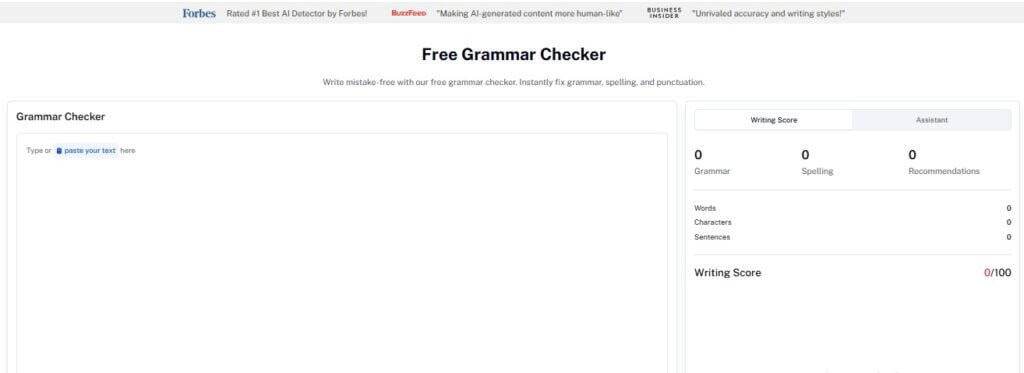
A tool like Undetectable AI’s Grammar Checker makes sure your work is accurate and polished before it ever goes live.
Tools like this help remove the clunky phrasing that tends to plague unedited machine drafts, making the final piece far more appealing to readers and crawlers alike.
AI writing assistants
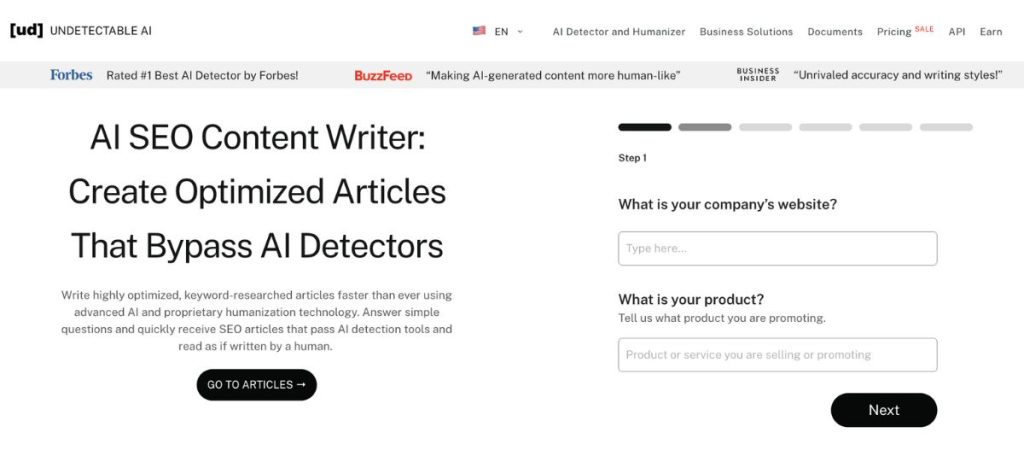
Undetectable AI’s SEO Content Writer can help you strike the right balance between keyword relevance and natural, readable language.
These assistants are built around current ranking behavior, guiding output that’s structurally sound and genuinely ready for the SERPs, not just technically “optimized.”
LLMO framework basics
Large Language Model Optimization (LLMO) is quickly becoming a core part of modern search strategy. It’s about structuring your content so AI systems can easily summarize and reference it accurately.
That means clear, descriptive headings and direct answers to the specific questions your audience is actually asking.
Quality control process
Every piece should go through a simple three-step check: fact-check, tone-check, flow-check. That process keeps AI’s speed in check with human judgment, every single time.
Stick with that process consistently and a potential risk turns into a genuine competitive advantage.
AI Content vs Human Content: What Performs Better?
- Quality comparison: Human writing tends to win on depth and original research, while AI content is strong at broad summaries and basic how-to explanations. The best-performing pages right now are almost always a hybrid of both.
- User engagement: Readers stick around longer on pages with a distinct voice and personality. Humanized AI content sees noticeably lower bounce rates than raw, unedited machine output.
- Trust signals: For high-stakes topics like health or finance, genuine human expertise is hard to replace. People are more likely to trust a site with a real, identifiable person standing behind the information.
- Content depth: Humans connect ideas in ways machines haven’t fully learned to replicate yet, and that kind of depth is often what earns quality backlinks from other authoritative sites.
- Long-term SEO: A pure AI-volume strategy might produce a short-term spike, but human-centered content is what tends to survive algorithm updates over the following years.eral years.
Can You Rank With AI Content in 2026?
- Current ranking trends: Search is becoming more personalized, and content that directly answers specific, long-tail questions is consistently outperforming broad, generic articles.
- AI content performance: Pages that use AI for outlining and data analysis, then bring in human editing for the final prose, are currently holding the top spots in competitive niches.
- Role of human editing: Manual review isn’t optional anymore. That human touch is exactly what keeps your content from being categorized as low-value automation.
- Future expectations: As AI technology continues to advance, the gap between machine and human writing will keep narrowing, making genuine helpfulness the metric that matters most.
- SEO sustainability: Building a real brand, not just a site full of pages, is what drives longevity. Use AI to build that brand faster, but keep it out of the driver’s seat on creative direction..
AI Overviews and Generative Search: What It Means for AI Content Rankings in 2026

Search results themselves have changed shape. AI Overviews and similar generative features now sit above traditional blue links for a growing share of queries, and that’s shifted what “ranking well” even means.
Here’s the part that matters most: Google has confirmed its generative AI features pull from the same core index and quality systems as regular search. There isn’t a separate set of rules to game. Google’s newest guide for AI-powered search makes this explicit, tying AI Overview visibility directly back to the same E-E-A-T fundamentals covered earlier in this guide.
What’s changed is emphasis. Content built for extractability, meaning clear structure, direct answers, and genuinely unique perspectives, has a much better shot at being cited inside an AI-generated summary. Generic, commodity content tends to get synthesized and skipped rather than linked.
For a broader look at how agencies are adapting content strategy around this shift, a 2026 industry breakdown of generative search strategy is worth a read if you want the wider industry context beyond Google’s own documentation.
The practical takeaway for your content: the fundamentals in this guide, quality, originality, real expertise, aren’t just about avoiding a penalty anymore. They’re increasingly the deciding factor in whether AI search features cite you at all.
How Undetectable AI Can Help Improve SEO Content
Undetectable AI is a genuinely useful partner for anyone trying to scale content production without tanking their search visibility in the process. To understand what makes Undetectable AI different from a basic paraphrasing tool, it helps to look at how it analyzes the actual linguistic patterns that trigger AI flags in the first place.
Humanize AI text
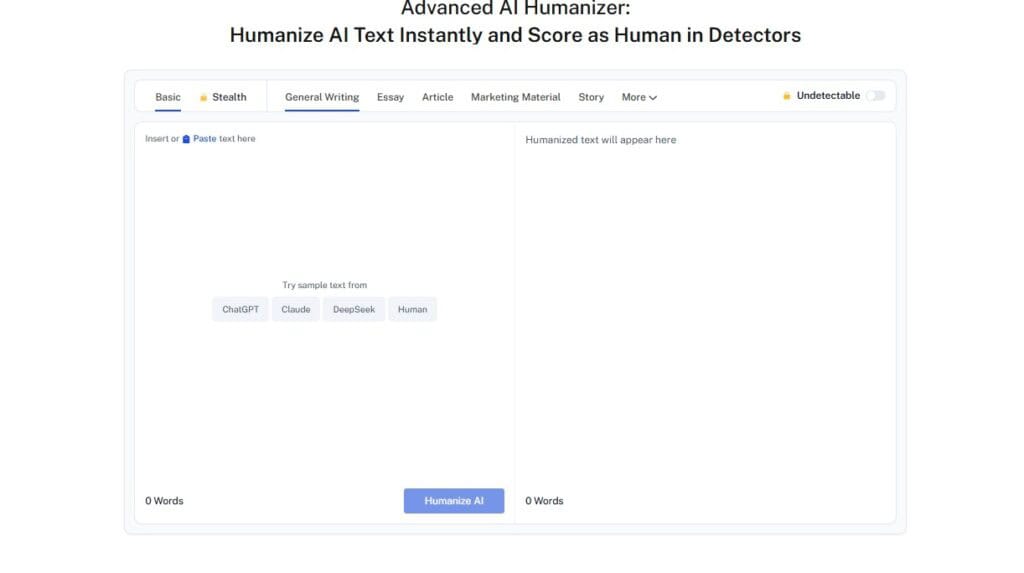
Our Undetectable AI’s AI Humanizer goes beyond simple word swaps. It reworks sentence rhythm and complexity to match the natural variation, or “burstiness,” of how people actually write.
That keeps your content resonating with readers while preserving the engagement signals search engines are built to reward.
Improve readability
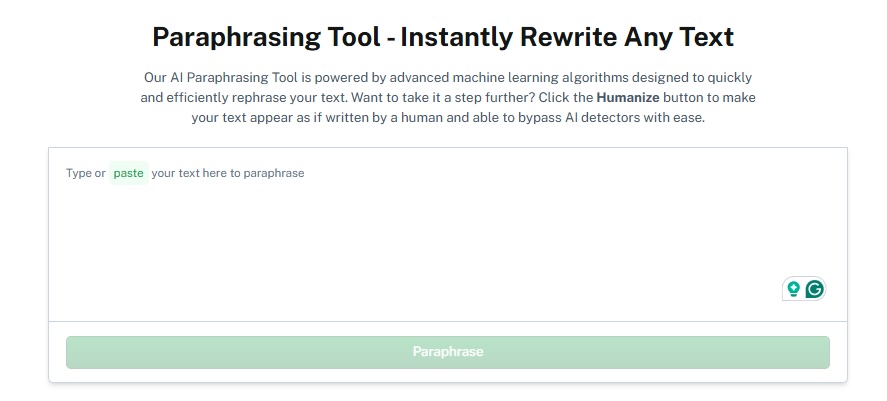
Machine-generated text can read dry and hard to scan. Our Paraphrasing tool smooths out clunky transitions, making content more accessible to a wider audience. That tends to translate into longer time on page and stronger overall SEO performance.
Reduce patterns
Breaking the predictable loops of machine-generated language keeps your site from being flagged as low-value automation, giving you the speed of AI without sacrificing editorial quality.
Experience our AI Detector and Humanizer in the widget below!
FAQs
Does Google have an AI content detector?
Google doesn’t publish a public “AI detector,” but its systems are built to recognize the hallmarks of low-quality, automated content that fails to help users.
Is it safe to use AI for my business blog?
Yes, as long as you review and edit the output. Using AI to write more efficiently or brainstorm ideas has become a completely standard practice in modern digital marketing.
Will my site get penalized for using ChatGPT or similar tools?
No, using a specific tool isn’t the issue. Penalties come from using those tools to generate spam or unhelpful, repetitive content at scale.
How can I make AI content more helpful?
Add your own insights, include real data where possible, and format the piece for genuine readability with clear headings and scannable sections.
What is the “Helpful Content” update?
It’s an ongoing part of Google’s ranking systems that favors content created for people first, rather than content built primarily to game search rankings.
Do AI Overviews create a new kind of penalty risk?
Not a new penalty exactly, but they raise the bar. Since AI Overviews pull from the same quality systems as regular search, thin or generic content that might have quietly ranked on page two now has even less chance of being cited or seen at all.
Should I be worried about Google’s Quality Rater Guidelines?
Only if your content wouldn’t hold up to a knowledgeable human reading it closely. The guidelines exist to catch pages that sound plausible but lack real expertise, so genuinely well-researched AI-assisted content has nothing to worry about.
Conclusion
Google does not inherently penalize AI-generated content. The algorithm’s real priority is delivering the most relevant, valuable, and high-quality results for users, regardless of whether the words started with a person or a machine.
That said, the risk of a ranking drop is very real if speed gets prioritized over substance. Succeeding through the rest of 2026 means finding the balance between machine efficiency and genuine human oversight.
By using the right tools to refine your drafts and keep them useful and original, you can navigate this shift with a lot more confidence than most of your competitors currently have.
Try Undetectable AI to refine your writing and keep your content human, accurate, and genuinely worth reading.