
A study found that there are three rules behind how thousands of starlings fly together in the mesmerizing formations that we sometimes see in the sky.
There’s no leader, and they do not have a plan either, but even then, individual birds follow their basic instincts and somehow create something extraordinary.
This is exactly what scientists call emergent behavior. And it’s not just a bird thing because we humans also indulge in this behavior all the time without even knowing.
This same phenomenon shapes your daily commute, your office politics, and even the trends you scroll through on social media.
In this article, you’ll learn what emergent behavior actually means, where you can spot it in everyday life, and how understanding it can change the way you make decisions.
Let’s dive in.
Key Takeaways
- Emergent behavior takes place when simple individual actions combine to create complex, unplanned patterns.
- You can observe emergence in your daily life in traffic jams, workplace culture, and neighborhood vibes.
- Your small daily actions contribute to larger patterns more than you probably realize
- Understanding emergence helps you see that complex outcomes don’t always need complex planning behind them
What Is Emergent Behavior?
Emergent behavior definition says that it is a kind of behavior that changes our understanding of cause and effect.
It happens when relatively simple things that follow simple rules, but somehow they end up creating something complex and unexpected together.
Each individual part of the behaviour has no clue about the “big picture.” But when many of them interact with each other, particular patterns or behaviors show up that nobody planned for.


Never Worry About AI Detecting Your Texts Again. Undetectable AI Can Help You:
- Make your AI assisted writing appear human-like.
- Bypass all major AI detection tools with just one click.
- Use AI safely and confidently in school and work.
You can take an example of a flock of birds. As you might have an idea, each bird of a flock only follows three basic rules:
- Don’t fly in a manner that you crash into your neighbor
- Each bird should fly in the same direction as the others
- And while flying, stay close to the group
But do any of the single birds know the full plan as to what they are going to achieve collectively? Nobody does!
There is no “leader bird” among the group who calls the shots and makes decisions. But still, somehow, thousands of them move together in those stunning and well synchronized patterns you see in the sky.
That is what we call emergence. In simple words, if anything produces complex outcomes from simple interactions, it will be called emergent behavior.
And believe it ot not, you’ll see this phenomenon happening everywhere once you start looking actively.
But why does this concept matter in the first place? Well, because it changes how we normally think about cause and effect.
We usually assume that complex results need complex planning behind them. But emergence tells us that it is not always true. Sometimes, complexity just happens when enough simple parts start interacting with each other.
Everyday Examples Of Emergent Patterns
If you know how to observe emergence or analyze patterns that we associate with emergent behaviour, you can start noticing it in the most ordinary places.
Below, I have listed three of the examples of emergent behaviour that might surprise you.
Traffic Jams That Appear Out of Nowhere
Suppose that you’re driving on a highway, and all of a sudden, the traffic slows down to a crawl basically. Your natural reaction would be to assume that there must be an accident ahead.
But after twenty minutes of stop-and-go, all the traffic clears up, and you see nothing that caused the traffic jam. There was no crash, and no construction was going on.
So what happened exactly? Well, one driver tapped their brakes slightly. The car behind them braked a little harder. And this chain reaction rippled backward through hundreds of cars until it became a full standstill.
There was no particular reason that caused the traffic jam. It just emerged from a bunch of individual drivers reacting to what was happening right in front of them.
Social Media Trends Going Viral
Why is that one video gets 50 million views while another, nearly the same one with similar content, gets just 200? You know that there’s no content monitoring team that sits down and decides what to make viral.
What actually happens is that a few people share something, their followers see it, some of them reshare it, and before you know it, a random video of a cat is breaking the internet. Also, it depends on the timing as well.
The trend emerges from thousands of individual sharing decisions. Nobody planned for it to blow up. It just did, and that’s also an example of emergent behaviour.
Neighborhoods Developing Their Own Character
Have you ever travelled to a place and quickly noticed how certain areas of a city develop a different vibe?
One street becomes the artsy district. Another becomes the food hub. A third turns into the tech startup corridor.
And what’s surprising is that no city planner sat down and assigned these identities. What happened was that one coffee shop opened, then a gallery moved in nearby, then artists started renting apartments in the area because it felt right to them.
Each decision was individual, but collectively, they shaped an entire neighborhood’s identity over time.
NPC Characters in Video Games
Yes, you can even see emergence in video games.
For example, if you’ve ever played Fallout 4, you might have noticed how NPCs react to each other and the environment in unexpected ways.
The Fallout 4 emergent behavior system creates unscripted moments where characters fight, flee, or interact without the player triggering anything. It’s the same principle at work, but just in a virtual world.
How Emergent Behavior Affects Decisions
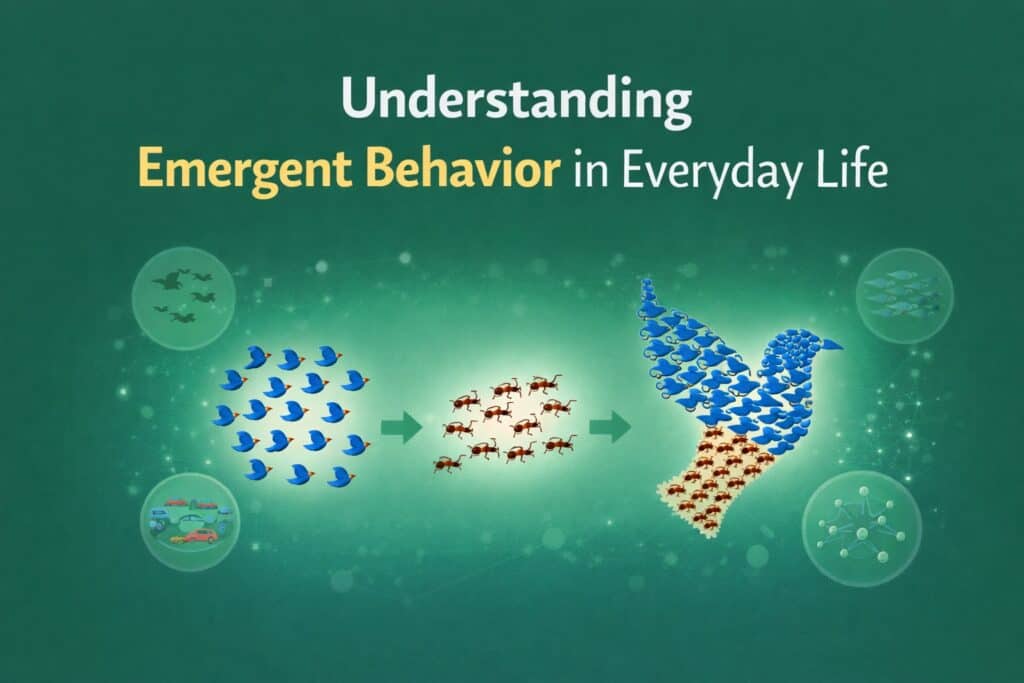
Now that you understand what emergent behavior is, let’s talk about how it actually shapes the decisions you make every day. Why? Because no matter if you realize it or not, emergence is influencing your choices more than you think.
Personal Choices
You probably believe your decisions are entirely your own, and to some extent, they definitely are. But a lot of the choices you make are shaped by patterns that emerged from your environment.
Take your morning routine as an example. Why do you drink coffee instead of tea? Why do you check your mobile first thing after waking up? These habits didn’t come from nowhere.
They emerged over time from dozens of tiny influences. Maybe your parents drank coffee. Or perhaps everyone at your first job was glued to their phones in the morning.
Your personal choices are often the result of many small interactions you’ve had throughout your life. And once you see this, you can start questioning which decisions are truly yours and which ones are picked up from your surroundings.
Workplace Dynamics
If you’ve ever worked in an office, you know that every workplace has its own unwritten or unsaid rules.
None of your colleague or manager sits you down and explain them on your first day. You just figure them out over time yourself.
One team might have a culture where everyone speaks their mind openly. The other team might be the total opposite, where people stay quiet in meetings and share their real opinions only in private conversations afterward, or don’t share at all.
But the question is, how did these cultures form? Certainly, no manager drafted a policy saying, “We will be passive-aggressive in meetings, guys.”
It naturally emerged from:
- How a few early employees behaved initially
- How leadership responded to that behavior
- And how new hires adapted to fit in
If you understand this, it can actually help you influence workplace culture. Because if culture emerges from individual actions, then your actions matter too.
Community Effects
We all get so busy with our lives that we forget to zoom out. If you zoom out a little further, you’ll see emergence shaping entire communities.
Why do some neighborhoods feel safe while others don’t? Why do certain communities come together and support each other during difficult times, while others fall apart?
A lot of it comes down to many small, individual behaviors adding up over time. One person starts greeting their neighbors. A few others join in. Someone organizes a small block party. And before long, there’s a sense of community that nobody formally created.
On the other hand, if people stop looking out for each other, small acts of neglect can accumulate too. And suddenly you have a neighborhood where nobody trusts anyone.
The point here is that communities are not built by grand plans alone. They emerge from how individuals within them choose to act on a daily basis.
Speaking of patterns that emerge from individual actions, the same thing happens with AI-generated content online.
When there’s too much AI-generated content online or when this kind of emergent behavior AI creates, it starts shaping what we read and how we think.
If you’re someone who creates content, Undetectable AI’s Detector tool can help you check whether your writing sounds natural or if it’s giving off those robotic AI patterns.
Observing Emergence In Your Surroundings
If you actively look for emergent behavior, you’ll come across it almost everywhere around you. But you should know what to pay attention to.
To do that, you should begin with the small stuff. Let’s say next time you’re in a crowded place, you should observe how people move. Nobody is coordinating with anyone else, yet somehow everyone manages to navigate through without constant collisions.
Pedestrians naturally form lanes on busy sidewalks. People instinctively step aside to let others pass. All of this happens without a single word being exchanged.
Or if not this, then you can pay attention to conversations in group settings. Start noticing how certain topics take over while others die out quickly. Nobody votes on what the group should discuss.
The conversation just flows in a direction that emerges from everyone’s small contributions.
You can also observe emergence in how your own habits have formed over time. Why do you eat lunch at a particular time? Why do you sit in the same spot during meetings?
These behaviors likely emerged from a mix of convenience, social cues, and repeated patterns that you never consciously decided on.
The more you observe, the more you realize how much of life is a result of emergence rather than deliberate planning.
Applying Emergent Behavior To Daily Life
It’s one thing if you know about emergent behavior. But actually using that knowledge to improve your life is where things get interesting.
One practical application is understanding that you have more influence than you think. If workplace culture emerges from individual actions, then every small thing you do contributes to the bigger picture.
Speaking up in a meeting, appreciating a colleague’s work, or even just showing up with a positive attitude all add up over time.
The same applies to your personal relationships. You can’t force a friendship to develop in a certain way. But you can make small, consistent efforts that create the right conditions for a strong bond to emerge naturally.
Another way to apply this is by being more patient with long-term goals. Emergence takes time. You won’t see results overnight because the whole point is that complex outcomes build up gradually from simple actions.
So instead of obsessing over big leaps, focus on the small daily behaviors that will compound over months and years.
And if you’re someone who writes or creates content, think about how your words contribute to larger patterns online.
The internet is shaped by millions of individual pieces of content interacting with each other.
If you want your writing to stand out and feel genuinely human, tools like Undetectable AI’s AI Humanizer can help you refine your content so it doesn’t blend into the robotic noise that’s everywhere these days.
Find out how our AI Detector and Humanizer work in the widget below!
Final Thoughts
Emergent behavior isn’t some abstract concept reserved for scientists and academics. It’s happening all around you, all the time. From how traffic flows to how your workplace culture developed, to why certain neighborhoods feel the way they do.
Once you understand emergence, you start seeing the world a little differently. You realize that small actions matter more than you thought. And that complexity doesn’t always require a master plan behind it.
If you’re creating content in today’s AI-saturated landscape, keeping your writing human and natural is more valuable than ever.
Undetectable AI can help you make sure your content doesn’t fall into those predictable, robotic patterns that readers scroll right past.