Learning how to avoid AI detection has become one of the most searched questions among writers, students, and marketers since language models made it possible to draft content in minutes instead of hours.
That shift changed how the internet gets written. As websites and schools caught on to the trend, detection tools followed close behind, and they were quickly adopted by everyone from Google SEO specialists to university administrators.
The technology behind these scanners is sophisticated, but avoiding detection is absolutely possible if you know the right techniques. The secret is making sure your content is properly humanized and polished before it ever hits a scanner.
Vamos a sumergirnos.
Principales conclusiones
- AI detection is probabilistic, meaning it calculates the likelihood of machine origin rather than offering definitive proof of “guilt.”
- La humanización es la principal defensa, ya que exige romper los patrones simétricos y las opciones de palabras predecibles que las máquinas utilizan por defecto.
- Detectors are not applied evenly. Non-native English writers and formal, careful writers are flagged far more often, so a high score is never proof on its own.
- Google prioriza el valor sobre el origen, centrándose en el contenido útil que ofrece experiencia de primera mano, independientemente de si la IA ayudó a escribirlo.
- Ethics remain the central pillar, since bypassing detection for academic dishonesty carries real risk, while doing so for creative efficiency is widely accepted.
- La escritura híbrida es el estándar de oro, que combina la velocidad de la IA con las anécdotas específicas y la profundidad emocional que sólo un humano puede proporcionar.
- Tools like Undetectable AI pair detection and humanization in a single workflow, so you can spot the exact passages a scanner would flag and fix them before you publish, rather than guessing at what to change.
¿Qué es la detección de IA?
La detección de IA es el proceso de escanear un bloque de texto para determinar la probabilidad de que haya sido creado por un algoritmo y no por una persona.
It’s important to remember that these tools are not “reading” the content for meaning. They are performing a statistical analysis.
They look for specific “fingerprints” left behind by large language models, such as uniform sentence structures and a lack of creative vocabulary.
No vuelvas a preocuparte de que la IA detecte tus textos. Undetectable AI puede ayudarle:
- Haz que aparezca tu escritura asistida por IA de aspecto humano.
- Bypass las principales herramientas de detección de IA con un solo clic.
- Utilice AI de forma segura y con confianza en la escuela y el trabajo.
When you receive an AI detection score, it’s often misunderstood. A score of 70% does not mean that 70% of the words are AI-generated.
Instead, it indicates that the detector is 70% confident the entire passage was produced by a machine. Because these tools rely on math rather than intuition, they are notorious for false positives, flagging human-written work simply because it is clear, formal, or structured logically.
Por qué la gente quiere evitar la detección de IA en primer lugar
El deseo de saltarse estos filtros suele deberse a la necesidad de proteger la reputación o la posición en los motores de búsqueda.
For students, the motivation is often survival. Universities have integrated detection into platforms like Turnitin, y ser señalado puede acarrear graves sanciones académicas o la expulsión.
Even if a student used AI only for minor brainstorming, a high detection score can trigger a grueling investigation. It’s part of why so many students now look into which AI tools are actually safe to use for schoolwork before they ever open a blank document.
Para los profesionales, el objetivo suele ser mantener la confianza. A los creadores de contenidos y blogueros les preocupa que, si su trabajo es marcado, pueda afectar negativamente a la autoridad de su marca o reducir la participación de un público escéptico.
While the technology is a tool for efficiency, no one wants their readers to feel like they’re being served “recycled data.” Avoiding detection is about proving that a human was still the primary architect of the message.
Cómo funcionan realmente las herramientas de detección de IA
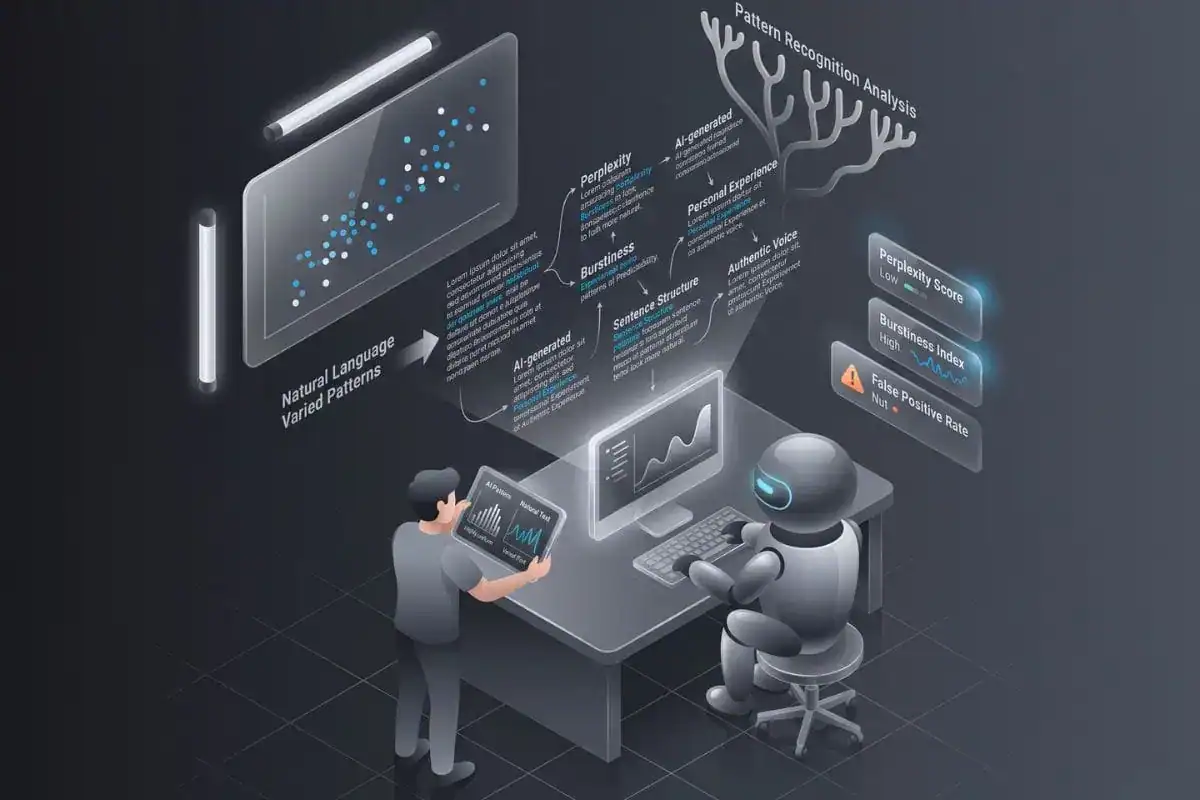
To beat the system, you have to understand how the system “thinks.” AI detectors use three primary metrics to judge your work.
Reconocimiento de patrones y previsibilidad
AI models are designed to choose the most statistically likely word to follow the previous one. This creates a “smoothness” to the text that is very rare in human writing.
Detectors look for this lack of “friction.” If every word is the safest, most expected choice, the probability of AI origin sky-rockets.
La perplejidad y el estallido explicados de forma sencilla
“Perplexity” refers to the complexity of the text. If a detector finds the writing too simple and easy to predict, it labels it as low perplexity, which reads as AI-generated. “Burstiness” refers to the variation in sentence length and structure.
Humans tend to write in “bursts,” a long, descriptive sentence followed by a short, punchy one. AI tends to be very symmetrical, using medium-length sentences throughout the entire piece.
Por qué la detección no es 100% precisa
Dado que estas herramientas realizan básicamente conjeturas, tienen dificultades con la escritura humana de alta calidad que es muy formal.
Research from APSense has even shown that AI detectors often discriminate against non-native English speakers, whose structured and carefully phrased writing often mirrors the “low perplexity” of machine-generated text.

The Fairness Problem: Why AI Detectors Don’t Treat All Writers Equally
This bias against certain writers is worth its own conversation, because it changes how much weight you should actually give a detection score.
The Non-Native Writer Penalty
Detectors were trained mostly on native-English writing samples, so any writing style that leans on simpler sentence structure, common vocabulary, or textbook grammar tends to look “too clean” to the algorithm.
That’s exactly how many non-native speakers write, since they often learned formal, rule-based English rather than the loose, idiomatic version native speakers grew up with. The irony is that the more careful and grammatically correct someone’s English is, the more likely a detector is to mistake it for machine output.
Independent research on detector false-positive rates has found the gap is not small. Some studies put the false-flag rate for non-native writers several times higher than for native speakers on the exact same task, which is a serious problem when a single score can affect a grade, a byline, or a job.
Undetectable AI has run its own AI detector tests and studies that dig into exactly how much these results can vary between platforms, and why relying on one single tool is risky.
What to Do If You’ve Been Falsely Flagged
If your original, human-written work gets flagged, don’t panic and don’t assume the score is the final word.
Keep your draft history, outlines, and research notes as proof of your process. Run the text through more than one detector before drawing any conclusions, since results vary widely between platforms.
And if you’re in an academic or professional setting, ask the reviewer what evidence beyond the score is being used to make a decision.
¿Es realmente posible evitar la detección de la IA?
The short answer is yes, but it isn’t always as simple as clicking a “scramble” button. The battle between writers and detectors has become a sophisticated, constantly shifting game of cat and mouse.
La realidad tras las afirmaciones de “indetectabilidad
Many tools claim to make text 100% undetectable, but the reality is that detection technology evolves constantly.
Avoiding detection is not about finding a magic cloaking device. It’s about editing the text so it no longer follows machine-like patterns. True “undetectability” comes from a mix of software refinement and human intuition.
Por qué ninguna herramienta garantiza la detección de 0%
Because different detectors, like GPTZero, Winston, or Originality.ai, use different algorithms, a piece of text might pass one and fail another. A “0% AI” score is often an unrealistic goal.
The objective is usually to keep the probability low enough, typically under 20%, that it doesn’t trigger a manual review or a red flag.
El riesgo de falsos positivos
You must be prepared for the fact that even perfectly human content can be flagged. This is why it’s vital to keep your research notes and version history.
If you’re ever accused of using AI, being able to show the “evolution” of your draft, how you moved from an outline to a finished piece, is your best defense against a faulty algorithm.
Qué hace que los contenidos generados por IA sean fáciles de detectar
AI has “tells” just like a poker player. One major giveaway is the lack of specific, gritty detail. AI often speaks in broad generalities, offering “fortune cookie” wisdom without the specific, lived-in examples that characterize human expertise.
Another giveaway is the “over-polished” nature of the text. It rarely contains the idiosyncratic metaphors or conversational slang that humans use to add color to their thoughts.
AI-generated content often lacks a strong personal voice, too. It tends to stay neutral and safe, avoiding controversial takes or deeply emotional storytelling.
If an article feels like it could have been written by anyone for any audience, it’s a prime candidate for a high detection score. This is a big reason why what actually counts as AI-generated content matters so much for anyone trying to keep their work sounding like their own.
Formas inteligentes de hacer más natural la escritura asistida por IA
La mejor defensa es un buen ataque. Cambiando proactivamente la estructura de tus drafts de IA, puedes reducir significativamente las posibilidades de ser marcado.
The more creativity and original content you can add to enhance the AI-written text, the less likely it is to be flagged as AI content, and Undetectable AI’s own breakdown of practical ways to make AI writing sound undetectable covers several techniques worth testing on your own drafts.
| Técnica | Cómo funciona | Por qué elude los detectores |
| Inyecte anécdotas personales | Añade una historia concreta de tu propia vida o carrera. | AI has no “life” to draw from; unique stories break patterns. |
| Variar el ritmo de las frases | Utilice frases muy cortas y muy largas en el mismo párrafo. | This increases “Burstiness,” which is a key human marker. |
| Utilizar sinónimos raros | Swap “common” words for more precise, less “likely” alternatives. | This increases “Perplexity” and throws off statistical models. |
| Add “Human” Imperfections | Utiliza un coloquialismo o una transición ligeramente informal. | AI is too “perfect”; small stylistic choices prove human intent. |
Añada su visión personal y ejemplos concretos
Por muy inteligente que sea la IA, tiende a evitar mencionar detalles concretos. Cuando edites tus contenidos, añade tantos detalles y ejemplos como puedas.
These human nuances are what distinguish your content as not being written by AI. If you can mention a specific event from your own week, you’ve already moved beyond the reach of most basic scanners.
Variar la longitud y el tono de las frases
AI loves the “middle ground.” It writes sentences that are almost always between 15 and 25 words. To fix this, intentionally write a four-word sentence.
Then follow it with a 40-word sentence that uses multiple commas and a semicolon. This creates the “rhythmic chaos” that detectors associate with human thought.
Editar en busca de claridad, no sólo de complejidad
Don’t just use a thesaurus to make things harder to read. Edit to ensure the message is clear and punchy. Sometimes, making a sentence more conversational, rather than more formal, is the fastest way to drop an AI score.
Google’s primary concern is that content is written for people, not for engines, so a “people-first” edit naturally helps avoid detection.
AI Detection Is Now a Workplace Issue, Not Just a Classroom One
For a long time, AI detection felt like a school problem. That’s no longer true. It has quietly become a professional one, and the stakes can be even higher.
What Happens When Professional Work Gets Flagged
Several well-known consulting and advisory firms have already had reports and client deliverables flagged by AI detectors, with one report carrying a high probability of being entirely machine-written, a finding later verified by outside investigation.
The fallout wasn’t just embarrassing. It damaged client trust and raised hard questions about whether the underlying research had even been checked.
The same forces are pushing into everyday workplaces too, where employers are increasingly relying on AI checks during hiring and performance reviews, adding real pressure to prove that written work reflects genuine skill rather than a polished but shallow AI fluency that employees project to avoid looking obsolete.
Protecting Your Professional Reputation
The fix isn’t to hide your process. It’s to be deliberate about it.
Keep drafts and source material for anything high-stakes, the same way you would for an academic paper.
Use AI for research, outlines, and first drafts, then rewrite the sections that carry your expertise in your own voice. And if your organization has a policy on AI-assisted work, follow it and disclose your process rather than getting caught off guard later.
IA indetectable Detector de Plagio AI is worth a look if your work regularly gets checked before it goes out the door, since it catches both AI-pattern issues and copied content in one pass.
Consideraciones éticas: ¿Debe intentar evitar la detección de IA?

Aquí es donde el debate se convierte en una cuestión de integridad personal y profesional. Las herramientas existen, pero el uso que hagas de ellas define tu reputación.
If you’re using an Herramienta de parafraseo AI to refine your thoughts and improve clarity, you’re leveraging technology for professional growth.
However, if you’re using it to hide the fact that you haven’t done the required work, you’re entering a moral gray area.
- Integridad académica: For students, the risks are immense. Bypassing detection to submit an assignment you didn’t write is a violation of trust that can have lifelong consequences. It’s always better to use AI as a tutor or research assistant rather than a replacement writer, and understanding how professors actually spot AI-written work can help you see where the real line sits.
- Transparencia en la redacción profesional: If you’re a freelancer, check your contracts. Some clients allow AI-assisted work, while others strictly forbid it. Being transparent about your process is often better than trying to hide it and getting caught later.
- Uso responsable de las herramientas de IA: AI should be the “starting block,” not the “finish line.” The most ethical way to use these tools is to let them handle the repetitive tasks, like outlining or summarizing, while you handle the high-level analysis and emotional connection.
Does Avoiding AI Detection Help or Hurt Your Search Rankings?
This is one of the most common points of confusion for anyone publishing online, so it’s worth separating the myth from what’s actually documented.
What Google Has Actually Said
Google has stated plainly, in its own guidance on generative AI content, that using AI to write is not against its guidelines on its own. What matters is whether the finished page is genuinely useful, accurate, and written with real expertise behind it.
In other words, there’s no secret ranking penalty tied to an AI detection score. Google isn’t running your published pages through a detector and docking points for a percentage.
The Real Ranking Risk Isn’t Detection, It’s Quality
The actual risk comes from publishing thin, generic, mass-produced pages that don’t add anything a reader couldn’t already find elsewhere, regardless of whether a human or a machine typed them.
That’s why humanizing your content is worth doing for its own sake, not just to dodge a scanner. Writing that includes real examples, a clear point of view, and specific detail tends to rank well because it’s genuinely useful, and it also happens to read as more human. The two goals point in the same direction.
Cómo la IA indetectable puede ayudar a mejorar la escritura similar a la humana
Si quiere aprovechar el poder de la IA sin el riesgo de ser marcado, necesita un flujo de trabajo que priorice la salida humanizada.
Undetectable AI is designed to act as that bridge, moving your drafts from “robotic” to “relatable” with a single click.
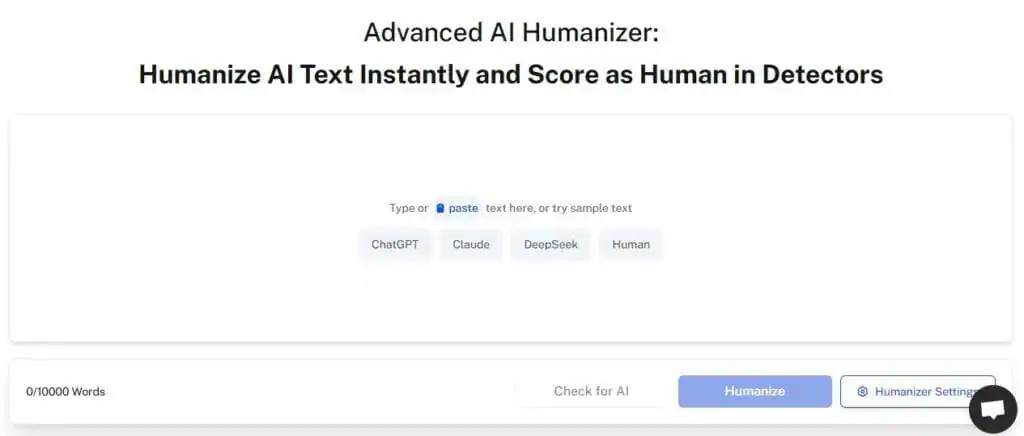
- Humanizador AI: This is the core tool for anyone wondering how to avoid AI detection. It doesn’t just “scramble” words; it rewrites the content to increase perplexity and burstiness, ensuring the final output holds up against even the most stringent modern detectors. Try our Humanizador AI directly if you have a draft that needs work right now.
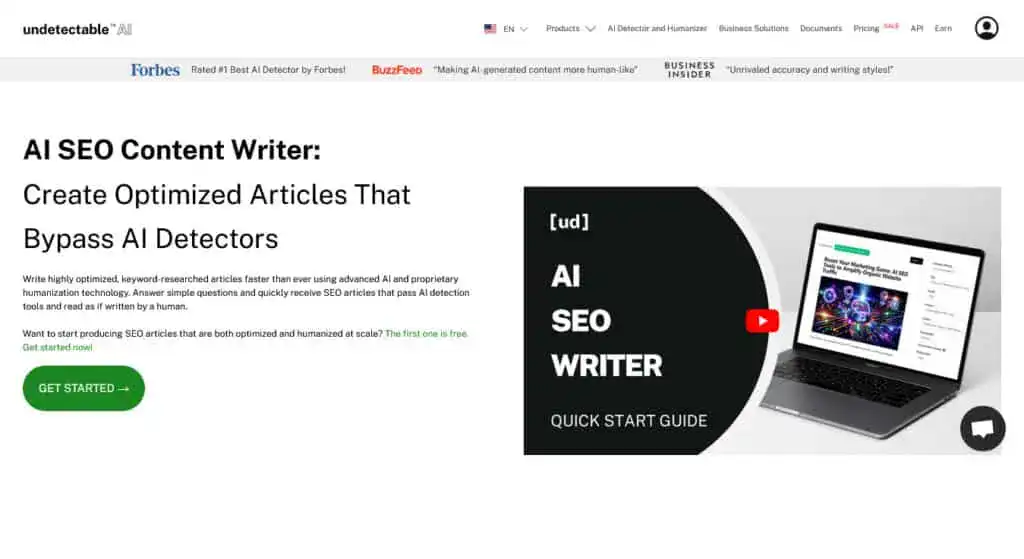
- AI SEO Redactor de contenidos: This tool is built to produce high-quality, long-form content that’s natively designed to pass as human. It integrates current search engine guidelines to ensure your work is optimized for both robots and real people. Explore our AI SEO Redactor de contenidos if you’re producing content at scale.
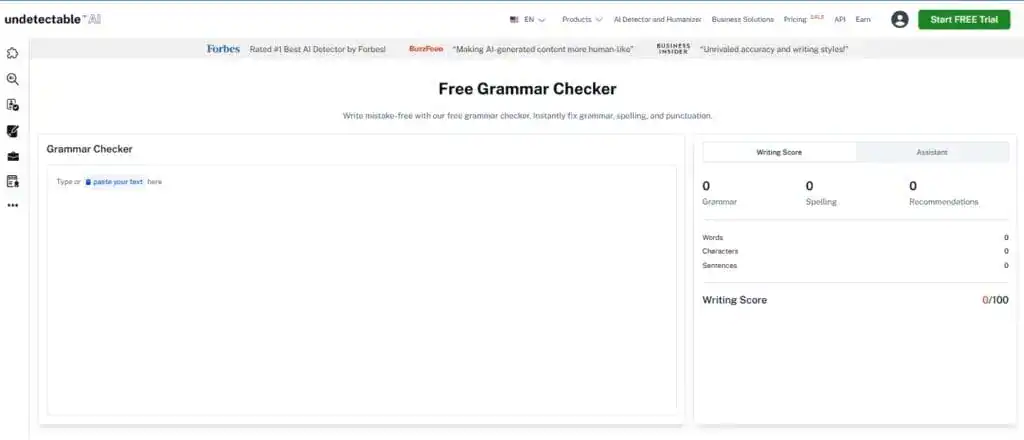
- Grammar Checker: Use this as your final quality-control layer. It ensures that while you’re “humanizing” the text, you aren’t sacrificing the professional polish and technical accuracy required for authoritative writing.
¡Empieza a usar nuestro AI Detector y Humanizer en el widget de abajo!
Preguntas frecuentes
¿Puede Google detectar contenidos de IA en mi blog?
Yes, Google has some of the most advanced detection technology in the world. However, their official stance is that they don’t penalize content solely for being AI-generated. They only penalize content that is spammy, unhelpful, or lacks first-hand expertise.
¿Hay alguna forma gratuita de evitar la detección de la IA?
La edición manual es el método gratuito más eficaz. Reescribiendo la introducción, añadiendo historias personales y variando manualmente la longitud de las frases, puedes reducir significativamente la puntuación de una IA sin gastar un céntimo.
What is a “good” AI detection score?
There’s no universally “safe” number, but most professionals aim for a score under 20%. If your score is 0%, it can actually look suspicious to some professors, since it suggests you didn’t use any modern writing tools at all.
Can AI detection affect my job, not just my grades?
Yes. More employers are running written work, from reports to applications, through detection tools, especially in industries where original analysis is part of the job.
A flagged report can affect trust with a manager or client even outside a formal disciplinary process, which is why keeping a record of your drafting process matters at work too, not just in school.
Do AI detectors get better over time, or is this a losing battle?
Both are true at once. Detectors keep improving, but so do the language models and humanization techniques writers use. Treat detection as an ongoing standard to write well against, not a puzzle you solve once and forget.
Un enfoque mejor: Más calidad que ocultación
At the end of the day, the goal shouldn’t just be to “hide” the AI. The goal should be to produce the best possible content for your audience.
If you spend all your time trying to beat an algorithm, you might lose sight of the people you’re actually writing for.
The most successful writers today are the ones who treat AI as a collaborative partner.
They use it to generate ideas and handle the bulk of the drafting, but then they step in to add the human soul, the humor, the doubt, the specific examples, and the unique voice that no computer can replicate.
When you focus on quality, transparency, and value, “detection” becomes a minor hurdle rather than a career-ending threat. Use the technology to amplify your skills, not to hide a lack of them.
Create content that truly connects, and refine it with IA indetectable para que suene natural, auténtico y humano.