Knowing how to detect ChatGPT generated text has quickly become one of the most useful skills a content creator, teacher, or editor can have.
As generative AI tools like ChatGPT get folded into everyday writing workflows, they also raise red flags for SEO systems, academic institutions, and readers who simply want to know they’re reading something real.
This guide walks through the most effective ways to spot AI-written text, the detection tools worth knowing about, and what Google’s EEAT guidelines actually expect from AI-assisted content.
It also shows how Undetectable AI helps turn machine-generated drafts into content that sounds genuinely human, reads well, and holds up under scrutiny.
Principales conclusiones
-
AI detection relies on patterns like predictable phrasing, low perplexity, and burstiness, not absolute certainty.
-
Multiple detection tools (AI Detector, Copyleaks, GPTZero, Wordvice, Origin Checker, SynthID) provide varied accuracy, so cross-checking is recommended.
-
Google’s EEAT (Experience, Expertise, Authoritativeness, Trustworthiness) guidelines expect AI-generated content to include human voice, factual accuracy, author attribution, and genuine perspective.
-
Detecting AI content stays complex because models keep evolving, watermarking has real limits, and there’s a constant balancing act between automation and authenticity.
-
Undetectable AI transforms flat, robotic drafts into human-sounding content that meets EEAT and SEO expectations without starting from scratch.
-
For creators worried about lingering AI fingerprints, the same platform offers a way to check and clean up text before it ever gets published.
Qué es ChatGPT (y por qué es importante)
ChatGPT is a large language model built on the Generative Pre-trained Transformer architecture, introduced by OpenAI as one of the first widely accessible AI chatbots.
Since its debut, the model line has evolved quickly, adding image recognition and increasingly natural, human-like speech on top of its original text generation abilities. It’s now embedded across multiple platforms, including Microsoft Teams and Bing, thanks to Microsoft’s ongoing partnership with OpenAI.
Although ChatGPT can produce polished copy in seconds, it often lacks human nuance, lived experience, or genuine originality.
No vuelvas a preocuparte de que la IA detecte tus textos. Undetectable AI puede ayudarle:
- Haz que aparezca tu escritura asistida por IA de aspecto humano.
- Bypass las principales herramientas de detección de IA con un solo clic.
- Utilice AI de forma segura y con confianza en la escuela y el trabajo.
That gap is exactly why workflows for both detección y "humanización exist, and why understanding how to detect ChatGPT text has become part of basic content hygiene for publishers and educators alike.
Cómo detectar ChatGPT por ti mismo
If you want to assess a piece of writing without running it through a tool first, start by reading closely for a handful of subtle linguistic cues.
Evaluate Tone and Variation
AI writing tends to lean on neutral, “safe” phrasing with sentences that all land at roughly the same length. A lack of tonal shifts, humor, or emotional variance is often the first tell.
Cuidado con las transiciones demasiado utilizadas
When paragraphs feel glued together by the same handful of connectors (“furthermore,” “moreover,” “in addition”), that repetition is a common AI fingerprint.
Comprobar profundidad descriptiva
Human writers naturally slip in anecdotes, sensory details, or hard-won expert perspective. Those elements are often the first thing missing from AI output.
Prueba de alucinaciones
Fact-check claims, dates, and quotes. AI-generated content can present convincing but flatly incorrect information as though it were fact.
For a more guided walkthrough with real examples, our blog’s practical checklist for spotting AI writing Merece la pena añadirlo a los favoritos.
¿Se puede detectar realmente el texto ChatGPT?

Yes, but not with total certainty. Current tools can assess the probability that a piece of text was AI-generated, though none can guarantee an airtight verdict.
Detection typically hinges on linguistic patterns such as perplexity (how predictable the word choices are) and burstiness (how much sentence length varies), rather than identifying the exact model that produced the text. GPTZero, for instance, leans on these metrics to differentiate human from AI writing.
At a recent Google I/O keynote, the company also introduced the Detector SynthID, which traces watermark cues embedded directly in AI-generated content and can identify AI artifacts across both text and media formats.
Human vs. AI Writing at a Glance
Sometimes the fastest way to build an eye for AI text is to see the contrast laid out side by side.
| Trait | Typically Human | Typically AI |
|---|---|---|
| Sentence length | Mixed, sometimes choppy | Uniform, evenly paced |
| Tono | Distinct, occasionally opinionated | Neutral, agreeable |
| Ejemplos | Specific, personal, sourced | Generic or absent |
| Transiciones | Varied, sometimes imperfect | Repetitive connector words |
| Finales | Open-ended or pointed | Tidy “in summary” wrap-ups |
Why These Differences Matter for SEO
None of these traits are proof on their own. But when several stack up in the same piece, it’s a strong enough signal to warrant a closer look, especially since search engines are increasingly weighing the same qualities when they evaluate content quality.
G2’s research into common AI writing patterns points to the same handful of traits: vague generalities, repeated ideas dressed up in different words, and a tone that never quite commits to a point of view.
Por qué es importante la detección de texto generada por IA
- Preservar la confianza y la credibilidad: In academic, journalistic, or professional settings, knowing whether content was human-written protects both integrity and reader trust.
- SEO y clasificación: Google’s EEAT framework rewards original, human-feeling content. Text that reads as machine-generated can quietly underperform in search results even without an explicit penalty.
- Prevenir la desinformación: Hallucinations and inaccurate AI output can disrupt informed decisions. Detection habits push writers toward the human review that catches these errors before publication.
- Normas académicas y éticas: Schools, publishers, and businesses all lean on detection practices to keep fairness, authenticity, and accountability intact in the content they produce or accept.
Signos que puede mostrar el texto generado por ChatGPT
Even without running a scan, an experienced editor can often catch these clues on a first read:
- Tono robótico y frases repetitivas: AI defaults to neutral language and tends to restate the same idea in slightly different words.
- Falta de voz personal o ejemplos del mundo real: Firsthand insight and anecdotes are usually the first thing missing, and it’s a gap search engines increasingly notice too.
- Hechos alucinados o inexactitudes: Confident-sounding errors that need fact-checking before anything gets published.
- Estructura uniforme de las frases: Heavy use of transitions paired with sentences that all run about the same length.
- Originalidad superficial: Technically clean writing that never quite develops a real argument or point of view.
If you want a deeper dive into the specific vocabulary that gives AI drafts away, our rundown of overused AI phrases covers the words worth flagging first.
Top AI‑Detection Tools
As generative AI keeps getting more sophisticated, spotting machine-written content isn’t optional anymore.
Whether you’re a teacher verifying academic work, an editor protecting a publication’s standards, or a business safeguarding its brand voice, reliable detection tools matter.
IA indetectable
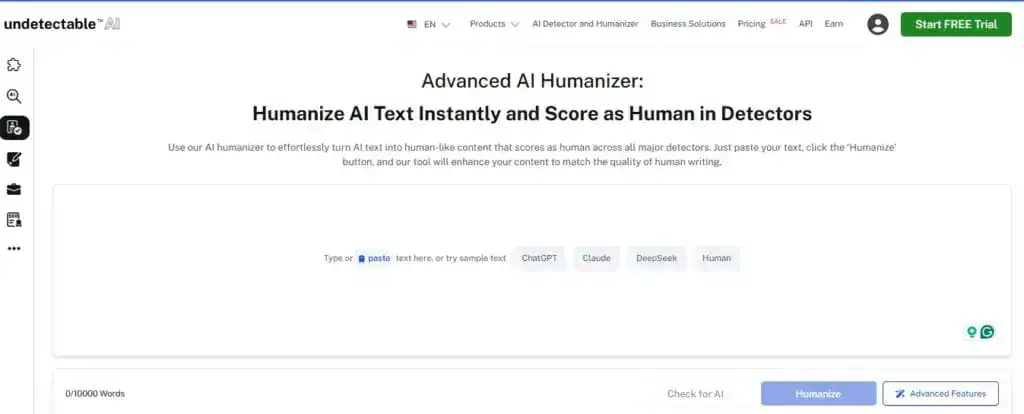
- Identifies likely AI-generated patterns through deep linguistic analysis
- Humaniza los contenidos al instante para adaptarlos a los estilos de escritura naturales
- Combines detection and remediation in a single workflow
- Trusted by millions of users across education, SEO, and enterprise use cases
Undetectable AI stands out because it doesn’t just flag AI-written content, it fixes it. It lets users humanize robotic or overly polished text without losing the original meaning or tone, which makes it a rare tool that supports both oversight and output at once.
Según Revisión 2025 de ZDNet de los mejores detectores de contenidos de IA, Undetectable AI was recognized not just for detection accuracy, but for its ability to humanize content in that same single workflow, setting it apart from most competitors in the space.
TruthScan
- Señala los párrafos, frases y expresiones influidos por la IA
- Análisis línea por línea con puntuación de confianza codificada por colores
- Built for institutions that need documented proof of AI detection
- Integrates with educational and editorial systems for reporting
TruthScan is best suited to teams that need forensic-level detail, showing exactly which parts of a text may have been

Google’s Updated EEAT Rules: What Creators Need to Know
What EEAT Actually Requires From AI Content
Google’s updated E-E-A-T framework, standing for Experience, Expertise, Authoritativeness, and Trustworthiness, has become a cornerstone of modern SEO. AI-generated content isn’t explicitly penalized, but it does need to convincingly reflect human perspective and insight to perform well in search.
Pages that show real-world experience, clear author attribution, or expert commentary tend to outperform anonymous, machine-sounding output, and Google’s systems increasingly reward the editorial care behind them.
Fact-Checking, Engagement, and Technical Trust Signals
Fact-checking is non-negotiable. Unsupported claims or hallucinations can get flagged by both search engines and readers, which drags down visibility and trust together.
Engagement signals like dwell time, click-through rate, and on-page interaction now feed into ranking more than ever, and even technical details, author schema, internal linking, and clean UX, contribute to how trustworthy a page appears.
En Google’s EEAT guidance makes clear, none of this is really about avoiding AI. It’s about elevating AI-assisted content through human oversight, authenticity, and genuine quality.
Pairing a tool like ChatGPT with a humanizing and optimizing layer such as Undetectable AI lets creators meet these standards efficiently, without sacrificing output.
Retos de la detección de textos generados por inteligencia artificial

Despite steady progress, accurately identifying AI-generated content remains a moving target. As models keep getting more capable, they produce increasingly human-like text, which makes detection harder rather than easier.
Many detectors still rely on statistical models that paraphrasing tools or clever prompting can outmaneuver, and inconsistent watermarking standards only add to the confusion.
Rápida evolución de los modelos
Newer models routinely outpace the training data behind existing detectors, opening gaps in accuracy, especially right after a major model release.
Limitaciones de la marca de agua
Some AI systems, like Google’s SynthID, have introduced watermarking, but plenty of models still don’t embed any detectable signature, making content nearly impossible to trace without manual context clues.
Falsos positivos y falsos negativos
Detectors can misclassify sophisticated human writing as AI-generated, or miss genuinely AI-produced content, especially in hybrid workflows involving paraphrasing.
Workload and cost add up too. Frequent scanning with premium tools gets expensive at scale, and manual review is slow no matter how skilled the reviewer is.
On top of that, formal or technical human writing often mirrors the structured, neutral tone typical of AI output, which makes the overlap even harder to untangle when a piece lacks anecdotal or personal detail.
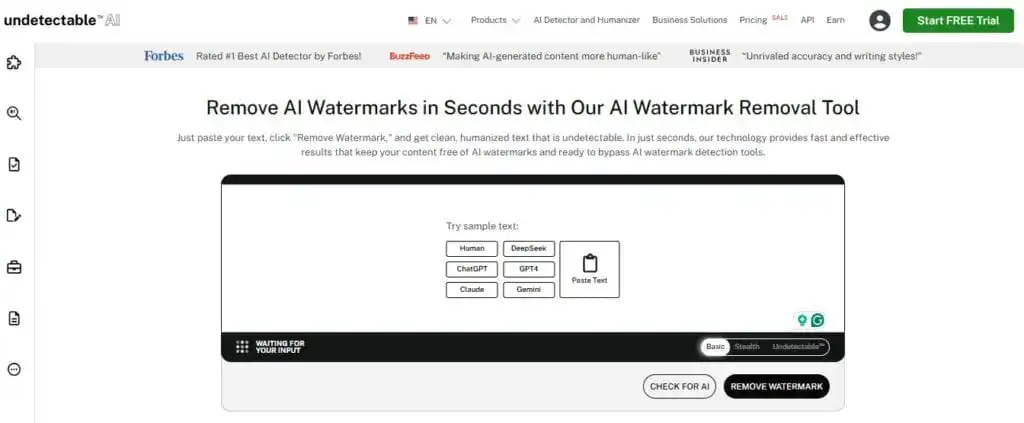
For content that may already carry a hidden AI watermark, our Eliminador de marcas de agua de texto AI offers a simple way to clear those embedded traces and restore text to a neutral, natural form so editors can assess authenticity without interference.
How to Detect ChatGPT in the Real World
Knowing the theory is one thing. Applying it depends a lot on where the text showed up.
In the Classroom
Teachers are usually comparing a student’s current submission against their known writing history. A sudden jump in vocabulary, structure, or polish is often a bigger tell than any single sentence.
In the Workplace
Editors reviewing freelance or vendor content should watch for generic advice that never quite gets specific, plus a suspicious sameness across pieces from the same contributor.
In Marketing and Social Content
Brand voice is the giveaway here. AI drafts tend to flatten personality, so content that suddenly reads more corporate or more “safe” than usual is worth a second look before it goes live.
Full-Spectrum Verification With Deepfake Detection
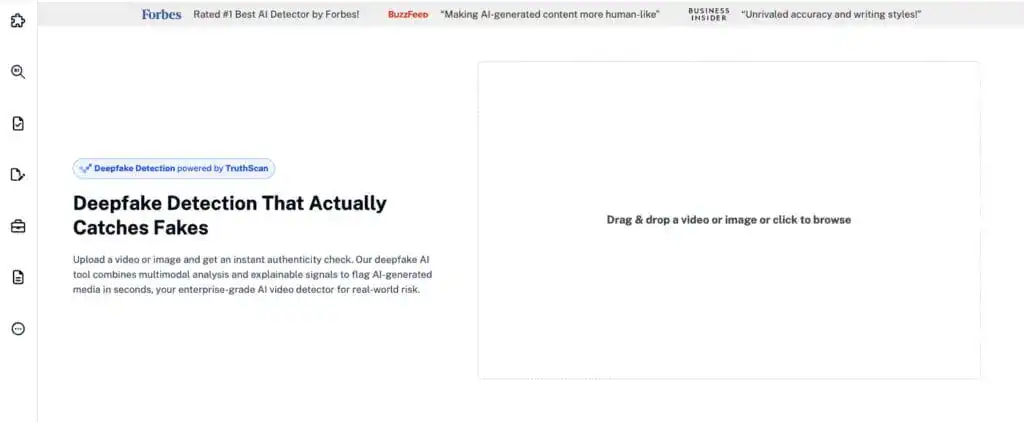
As AI moves beyond text into hyper-realistic images and video, verifying authenticity takes more than linguistic analysis.
Nuestra Detección de Deepfake tool complements text-based detection by analyzing visual and multimedia content for signs of manipulation, inspecting pixel structures, lighting consistency, and facial motion to surface synthetic visuals that might otherwise pass as real.
Used alongside text detectors like TruthScan or SynthID, it gives creators, educators, and publishers a fuller authenticity framework covering both written and visual content.
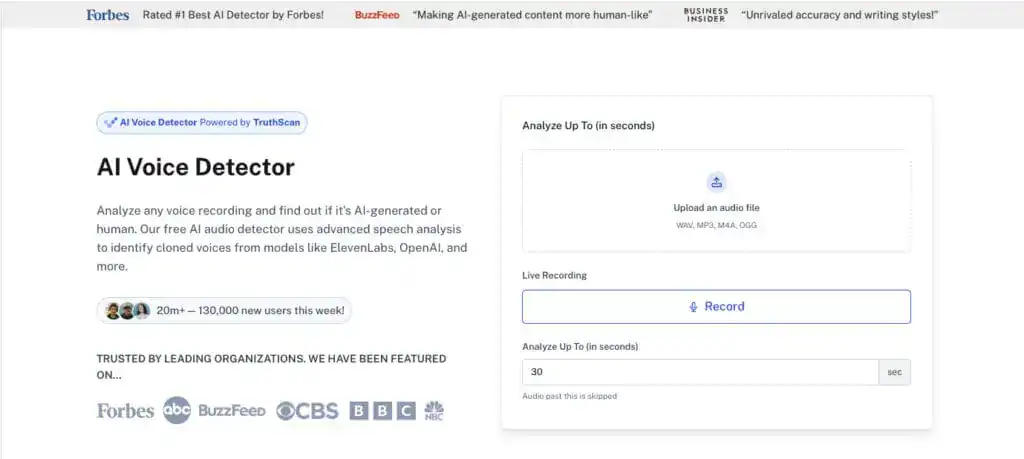
Voice presents its own challenge as cloning technology gets sharper.
If your team works with interviews, audio content, or spoken submissions, our Detector de voz AI analyzes vocal patterns, cadence, and acoustic fingerprints to help confirm whether a clip was generated or altered, protecting against copyright and ownership issues tied to synthesized voice.
Cómo la IA indetectable mejora su contenido
Producing AI-assisted content well requires more than speed. It has to pass detection tools, satisfy EEAT expectations, and still feel genuinely human to the reader. Undetectable AI provides tools that help transform, optimize, and protect content across an increasingly AI-saturated landscape.
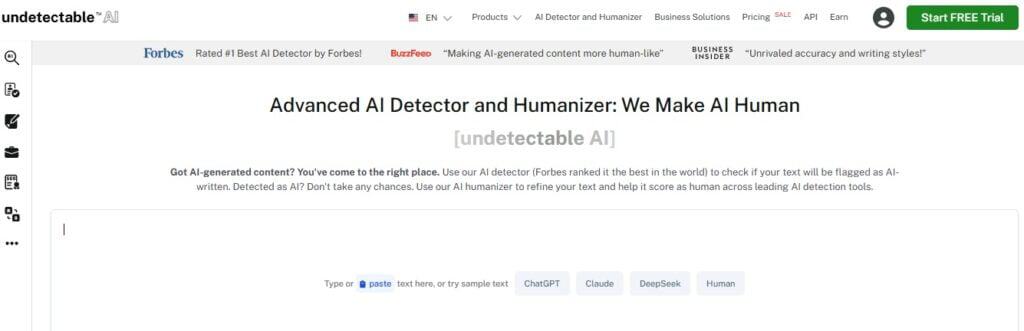
Detector de IA y Humanizador
Instantly scans and rewrites AI-generated content so it reads authentically human while holding up against detectors like GPTZero and Copyleaks. It keeps clarity, complexity, and tone variety intact rather than flattening everything into the same voice.
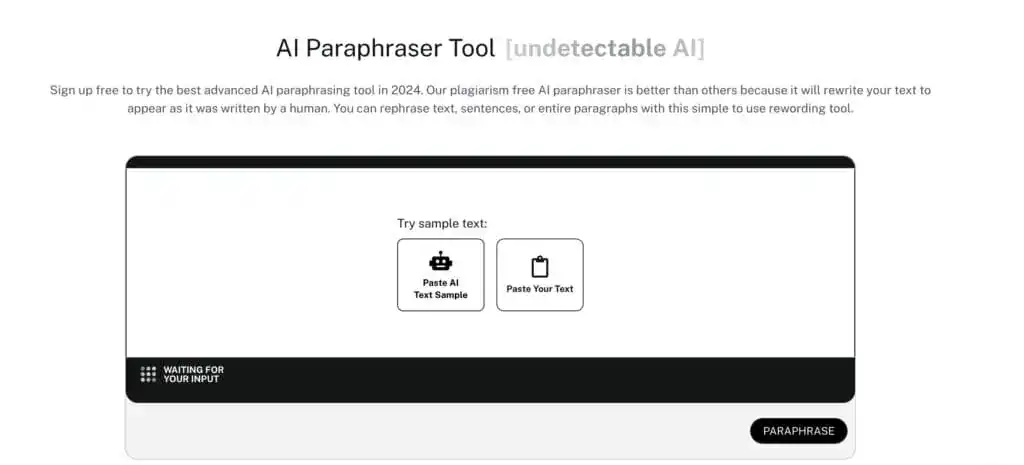
Parafraseador AI
Nuestra Parafraseador AI rephrases robotic or repetitive AI output into more natural, expressive, reader-friendly language that still aligns with SEO and EEAT expectations.
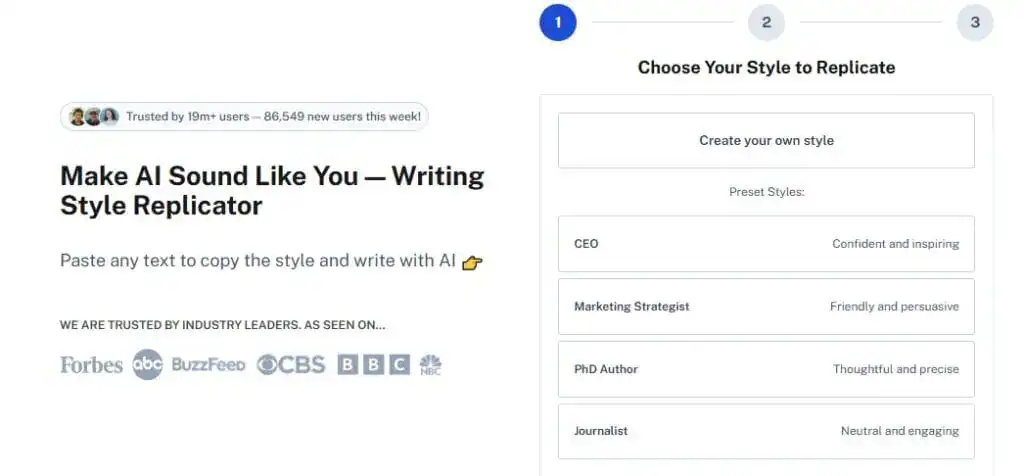
Replicador de estilo de escritura
Our Writing Style Replicator adapts any content, AI-assisted or fully human, to match a specific personal or brand tone, keeping consistency that detection tools generally won’t flag.
Common Mistakes When Trying to Detect AI Text
Relying on One Tool Alone
No single detector is authoritative. Cross-checking a suspicious passage across two or three tools gives a far more reliable read than trusting one score.
Ignoring Context and Non-Native Writers
Structured, carefully phrased writing from non-native English speakers can look statistically similar to AI text. Treat any single detection score as a starting point for review, not a final verdict.
Skipping Human Review
Even the best tools miss things. Pairing automated detection with an actual read-through, especially for anything high-stakes, catches errors that a probability score alone won’t.
Acceda a nuestro Detector y Humanizador de IA de confianza utilizando el widget que aparece a continuación.
Preguntas frecuentes
How do you detect ChatGPT-generated text?
Look for predictable phrasing, uniform sentence length, and a lack of personal detail, then confirm with a detection tool like GPTZero, TruthScan, or Undetectable AI. No single method is foolproof, so combining a close read with a tool-based scan gives the most reliable result.
¿Pueden los detectores de IA localizar definitivamente un texto ChatGPT?
No detector is infallible. They estimate likelihood based on pattern analysis, and tools like SynthID add watermark detection, but no tool can claim perfect accuracy.
Are free detection tools reliable?
Free tools such as GPTZero and Sapling can help with basic detection, but their accuracy is often limited. Undetectable AI offers a more advanced alternative trusted by educators and businesses for its precision and its ability to humanize AI-generated content in the same workflow.
¿Cómo afecta la TAEE a la clasificación de los contenidos de IA?
AI content needs human review, fact-checking, credible authorship, and rich sourcing to align with EEAT and perform well in search results.
What if content contains factual errors, or “hallucinations”?
Always run human review and fact-checking, especially on high-stakes topics. AI tends to generate plausible but incorrect information with total confidence.
How is Undetectable AI different from a basic paraphrasing tool?
Rather than just swapping words, it humanizes tone, improves originality, and factors in SEO and EEAT signals for better detection resistance and stronger search positioning.
Conclusiones
AI-generated writing is everywhere now, and so are the detection tools and SEO expectations built to keep pace with it. AI helps teams scale content production, but human oversight is still what keeps that content authentic and rankable.
Tools like Undetectable AI, TruthScan, and the SynthID Detector all offer real detection capability, while Google’s EEAT framework keeps pushing AI-assisted content toward genuine value, credibility, and reader trust.
Undetectable AI bridges that gap, turning AI-generated copy into human-grade content that passes detectors, aligns with EEAT, and actually delivers for the reader.
For creators who need both speed and substance, it remains a genuinely useful ally. Start humanizing with IA indetectable hoy.