
The word “favourite” isn’t just a fancy way of writing “favorite.” Although both share the same meaning and usage except for the letter “u,” using both interchangeably isn’t recommended.
There are several reasons and myths as to why Americans decided to drop the “u.” One was that they wanted to save money on ink in the 19th-century printing press.
Even Noah Webster made it an issue. He wanted to make American English so distinct from British English that he intentionally erased the “u” from many words.
But in today’s literature, is it really that important? Yes. It keeps your work clear, coherent, and professional.
Both spellings are correct, but the version you choose will depend on where you are and who you’re writing for. It’s as simple as that. Let’s tackle the favourite vs favorite debate once and for all.
Key Takeaways
- Both “favourite” and “favorite” are correct spellings of the same word
- “Favourite” is British English, “favorite” is American English
- The difference comes down to regional spelling conventions, not meaning
- Stay consistent with one spelling throughout your writing
- Your audience and publication location should guide your choice
What Is the Difference Between Favourite and Favorite?
There’s zero difference in meaning.
Unlike homonyms, “favourite” and “favorite” refer to the exact same thing: something you prefer above all others. Your favourite song, your favorite movie.
The word works as both a noun and an adjective, and it means the same thing regardless of how you spell it.


Never Worry About AI Detecting Your Texts Again. Undetectable AI Can Help You:
- Make your AI assisted writing appear human-like.
- Bypass all major AI detection tools with just one click.
- Use AI safely and confidently in school and work.
The only actual difference? Geography.
British English adds a “u” to certain words that American English drops. It’s a spelling convention that goes back centuries, rooted in how the English language evolved differently on opposite sides of the Atlantic. Americans simplified spelling in the 1800s, while British English retained traditional forms.
Think of words like “colour” and “color,” or “honour” and “honor.” Same pattern. Same situation. The “u” is the giveaway that tells you which version of English you’re reading.
When to Use and Example
Let’s look at how each version shows up in real sentences.
Favourite
Use “favourite” when writing for British, Australian, Canadian, or other Commonwealth audiences.
Examples:
“Tea is my favourite drink in the morning.”
“She’s always been the teacher’s favourite.”
“What’s your favourite book of all time?”
“The café became a favourite spot for locals.”
In British English, you’ll also see related words spelled with the “u”: favouritism, favourably, unfavourable. The pattern stays consistent across the word family.
Favorite
Use “favorite” when writing for American audiences or publications that follow American English style.
Examples:
“Pizza is my favorite food, hands down.”
“He became the favorite to win the championship.”
“What’s your favorite way to spend a Sunday?”
“The restaurant is a favorite among tourists.”
American English drops the “u” across the board. You’ll see favoritism, favorably, and unfavorable. No exceptions.
Both versions function identically in sentences. You can swap them out based on your audience without altering the grammar or meaning.
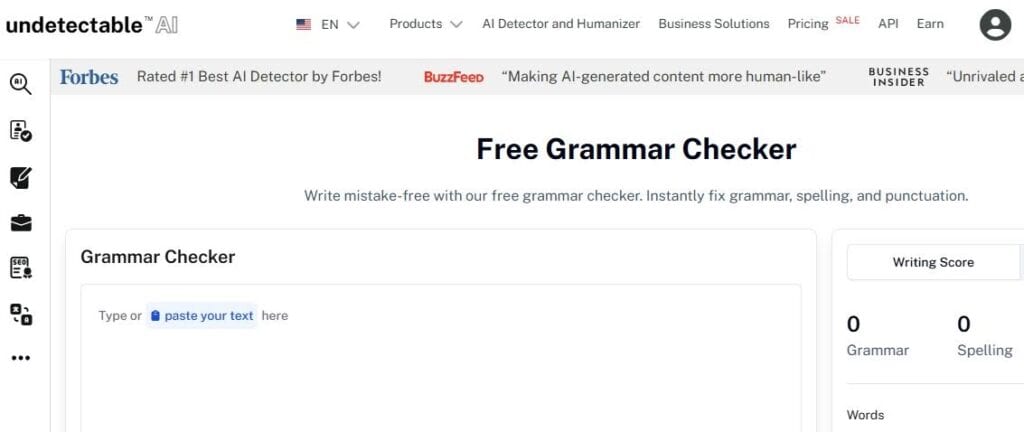
Accuracy often matters more than preference. Undetectable AI’s Grammar Checker helps ensure that timelines, explanations, and example sentences remain grammatically correct and internally consistent, especially when switching between British and American English conventions.
Context and Region Matter
Your location doesn’t have to dictate your spelling, but your audience does.
If you’re an American writer creating content for a British magazine, use British spelling. If you’re a Canadian writing for an American website, switch to American conventions. It’s about meeting your readers where they are.
This matters more than you might think. Using the wrong regional spelling can make your writing feel off. Not wrong, exactly, but like something doesn’t quite fit. Readers notice.
They might not consciously register it, but inconsistent spelling creates a subtle disconnect.
Professional writers learn to code-switch between variants. It’s a skill that makes you more versatile and marketable. The more comfortable you get with both systems, the easier it becomes to adapt your writing for different audiences.
American vs British English
The favourite/favorite split is just one piece of a much larger puzzle.
American and British English diverged over centuries of separate development. When American English was standardized in the 1800s, lexicographer Noah Webster pushed for simplified spellings.
He wanted American English to have its own identity, distinct from British conventions.
Webster’s changes stuck as Americans started dropping the “u” from words like “favour,” “labour,” and “colour.” They changed “centre” to “center” and “theatre” to “theater.”
British English, meanwhile, kept the traditional spellings.
Today, these differences are baked into each version of English. Neither is more correct than the other. They’re just different branches of the same language tree.
Other common British vs American spelling differences include realise vs realize, organise vs organize, defence vs defense, licence vs license (as a noun), and travelled vs traveled.
The pattern repeats across hundreds of words. Once you learn the rules, spotting the differences becomes automatic.
The favourite/favorite distinction extends beyond just this one word. Understanding it helps you recognize the broader pattern in English spelling variations.

Undetectable AI’s AI Detector can help ensure your writing reads naturally and maintains a human-like flow, especially for international audiences.
It helps identify rigid phrasing, unnatural transitions, or patterns that may feel mechanical when explaining regional language differences, keeping the content clear and readable across English variants.
Favourite or Favorite in Writing
Consistency is everything.
Pick a spelling style and stick with it. Don’t write “favourite” in one paragraph and “favorite” in the next. That’s the fastest way to look careless or unprofessional.
Most professional writing follows a style guide. American publications typically use the Associated Press (AP) Stylebook or the Chicago Manual of Style, both of which specify American spelling.
British publications follow guides like The Guardian’s style guide or The Times’ house style, which use British conventions.
If you’re writing for yourself or don’t have a style guide to follow, choose based on your primary audience. Writing for a global audience? Pick one and commit.
Academic writing has its own considerations. American universities want American spelling. British universities want British spelling. If you’re submitting to a journal or conference, check their submission guidelines. They’ll tell you which convention to use.
Blog posts, social media, and casual writing give you more freedom. Just be consistent within each piece. Switching mid-article breaks the flow and makes your writing feel scattered.
Business writing adds another layer. If you’re employed by a company, they likely have a preferred style. International corporations sometimes default to American English for consistency across global offices, while others let regional offices use their local conventions.
Check your company’s brand guidelines or ask your editor.
Common Mistakes to Avoid
Mixing British and American spelling in the same document is the biggest error. It happens more often than you’d think, especially if you’re switching between autocorrect settings or copying text from different sources.
Watch out for autocorrect trying to “fix” your spelling: If you’ve set your word processor to British English but you’re trying to write in American English, it’ll mark “favorite” as wrong. Don’t let your software override your intentional choice.
Another mistake: assuming one version is more formal or correct. British English isn’t fancier or more proper. American English isn’t sloppy or simplified. They’re regional variants, both equally valid.
Some writers try to mix and match, using British spelling for some words and American for others. Don’t. It reads as inconsistent and confuses your audience about what convention you’re following.
Here’s a sneaky one: forgetting about related words. If you use “favorite,” you also need to use “favoritism” and “favorably.” If you write “favourite,” stick with “favouritism” and “favourably.” The spelling carries through the entire word family.
Copying and pasting from multiple sources can introduce inconsistencies.
If you pull a quote from a British article and another from an American blog, you might end up with mixed spelling. Always review and standardize before publishing.
Tips for Consistent Spelling
- Set your language settings before you start writing: In Microsoft Word, Google Docs, or whatever tool you use, select either English (United States) or English (United Kingdom). Having these settings in place helps autocorrect and spell-check align with your chosen style.
- Create a personal style sheet if you write regularly: List out common words you use and which spelling you prefer. Reference it when you’re unsure. Over time, the correct spelling for your chosen style will become second nature.
- Use find-and-replace strategically: If you’ve written a draft and realize you used the wrong regional spelling, search for “our” for British English or check instances where you might have missed the “u” for American English. Fix them all at once, but be careful not to change words like “hour” or “pour” that legitimately include “our” in both variants.
- Read your work out loud: Your eye might skip over spelling inconsistencies, but reading aloud forces you to slow down and notice details. You’ll catch mixed spellings more easily this way.
- When in doubt, check a dictionary: Make sure it’s the right dictionary for the dialect. Merriam-Webster is American. Oxford is British. The dictionary you consult should match the English variant you’re writing in.
- Remember that consistency matters more than preference: You might personally prefer British spelling, but if you’re writing for an American audience, your preference takes a back seat. Serve your readers first.
- Keep a list of commonly confused pairs handy: A quick reference saves time and prevents breaking your flow to Google the same question repeatedly.
Consistency is easier to maintain when guidance is clear and memorable, especially for writers working across regions or switching between projects.

Undetectable AI’s AI Humanizer fits naturally into the process. It helps turn abstract spelling rules and style preferences into practical, easy-to-follow guidance, so tips don’t stay theoretical.
Instead, they become repeatable habits that writers can use to improve grammar and apply without second-guessing every spelling choice.
Try out our AI Detector and Humanizer right below!
A “U” Problem, Not a You Problem
Favourite or favorite? Now you know it’s not actually a question of correctness. It’s a question of context.
Choose the spelling that matches your audience and stick with it. British English for Commonwealth readers, American English for U.S. audiences. Simple as that.
The English language is messy and full of quirks. Regional spelling differences are just one of those quirks. But understanding them makes you a more intentional, professional writer.
So next time you hover over that keyboard, wondering whether to add the “u” or not, you’ll know exactly what to do. No more deleting and retyping. Just confident, consistent spelling that serves your readers well.
Write with confidence and consistency using Undetectable AI to match your audience perfectly.