
The iPhone 15 Pro Max still doesn’t have a split-screen mode. The Galaxy series has had it since 2016.
But here is the wild part…
When Apple users find this out, they don’t rage-tweet. They don’t switch brands. They just shrug and say, “Eh, I probably wouldn’t use it anyway.”
Meanwhile, if Samsung makes a minor misstep (like removing a charging brick) the internet treats it like a war crime.
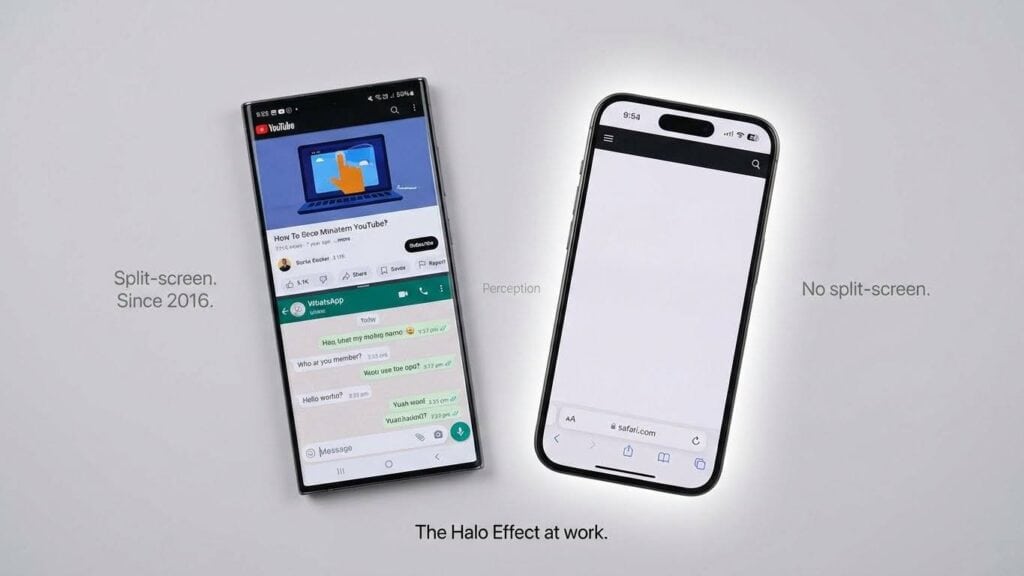
Why the double standard? This is the power of the halo effect in action.
Apple’s “Premium Halo” is so blindingly strong that it rewires how we perceive flaws.
We view Apple’s missing features as bold, minimalist design choices, while we view a competitor’s missing features as failures.
But this glitch doesn’t just happen with phones. It happens with people, brands, and hiring decisions every single day.
In this guide, we are going to deconstruct this fascinating brain glitch.
We will answer what is the halo effect, break down the halo effect definition, and explore the deep halo effect meaning that influences everything from your wallet to your relationships.
Let’s dive in.
Key Takeaways
- The halo effect meaning one positive trait (like beauty) makes us assume a person has other positive traits (like intelligence).
- Our brains hate confusion and love shortcuts. We use “System 1” thinking to make snap judgments to save energy.
- In the online world, your writing style is your face. High-quality writing creates a halo of authority.
- The horn effect is when one negative trait makes us blind to a person’s strengths.
- You can counteract this bias by slowing down your judgment, using blind hiring processes, and using AI tools to check your content’s tone.
What Is the Halo Effect?
So, what is the halo effect exactly?
The halo effect definition is a cognitive bias where if you see one positive quality in a person, your brain automatically assumes they are great at everything else, too.
It’s a mental shortcut (or affective heuristic) where your positive feelings “leak” from one area to another.


Never Worry About AI Detecting Your Texts Again. Undetectable AI Can Help You:
- Make your AI assisted writing appear human-like.
- Bypass all major AI detection tools with just one click.
- Use AI safely and confidently in school and work.
The name comes from religious iconography, where a circle of light (a halo) represents total, holistic goodness.
In psychology, it means that one shining trait can blind us to a person’s actual flaws.
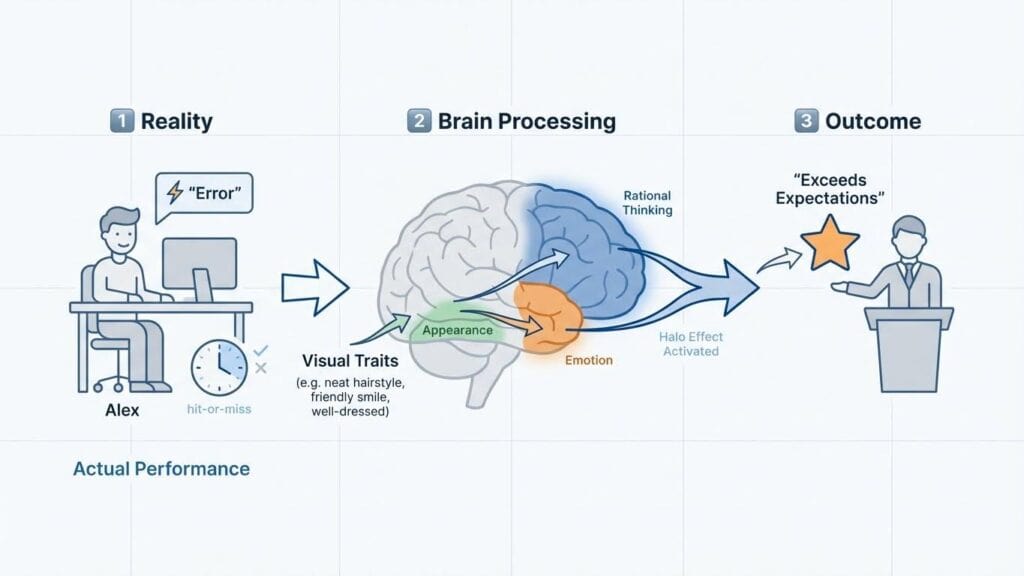
Let’s understand this with the example of “Alex,” who is a marketing manager at a tech company.
Reality → On paper, Alex is an average employee who makes small calculation errors in his reports, and his punctuality is hit-or-miss.
The Trigger → But Alex looks the part. He is tall (a trait people link to leadership), he wears expensive custom suits, and he has a deep, confident voice. He never stammers in meetings.
The Glitch → When his boss rates his analytical skills, she ignores the data. This is a classic example of the halo effect. Her brain thinks, “A man who speaks that clearly and dresses that sharply must be organized.”
The Result → Alex gets an “Exceeds Expectations” rating. His charisma created a “halo” that hid his technical flaws.
What Causes the Halo Effect?
Halo effect psychology suggests it is a built-in feature of how our brains are wired.
Here are the four main reasons our brains play this trick on us:
- The Brain Hates Confusion
We absolutely hate it when our beliefs clash (called Cognitive Dissonance).
If someone looks like a supermodel (Positive) but acts like a jerk (Negative), it confuses the brain. To fix this, the halo effect kicks in to force the data to match.
It tries to keep the “Good = Good” equation intact.
It’s easier to paint someone as “all good” than to deal with a messy reality.
- The Brain Loves Shortcuts
Nobel Prize winner Daniel Kahneman explains that we have two modes of thinking:
| System 1 (The Gut Feeling) | System 2 (The Math Problem Mode) |
| Fast, automatic, and emotional | Slow, logical, and tiring |
The halo effect is a “System 1” shortcut. Back in the caveman days, we needed snap judgments to survive.
So, instead of storing 50 different facts about a person, the brain uses a “data compression” trick.
It just stores one tag: “Good Person.”
↓
When you ask, “Is he smart?”
↓
The brain checks the tag and says “Yes,” without checking the facts.
- Words That Hang Out Together
Research shows that words like “attractive” and “intelligent” are often neighbors in our vocabulary.
They appear together in books, movies, and daily chats. Because our brains hear these words together so often, the neural pathways connect them.
- The Beautiful = Good Trap
Evolution wired us to look for healthy partners. In the wild, clear skin and bright eyes were signs of “Good Genes” and health.
Over thousands of years, our brains got their wires crossed. We started confusing “Good Genes” with being a “Good Person.”
This is a core part of the halo effect meaning. We mistake a biological signal for a character reference.
Why the Halo Effect Matters
You might think the Halo Effect only applies to human faces, but in the 21st century, content is the new face.
In our virtual world, the reader can’t see your smile or your sharp suit. All they can see is your text. The structure, tone, and flow of your writing act as your “digital appearance.”
If your writing feels warm, and flows naturally, it creates a “Positive Halo.” The reader subconsciously assumes, “This person is smart. They put in the effort. I can trust this.”
But the opposite is also true.
If your text feels robotic, repetitive, or uses those boring AI words, it triggers the “Horn Effect” (the evil twin of the Halo Effect).
Even if your facts are 100% correct, the ugly delivery makes the reader doubt everything.
This is why tools like Undetectable AI’s AI Humanizer are so critical. It helps you scrub off that robotic stigma, and replaces the flat, predictive patterns of AI with the natural, bursty flow of a human writer.
This ensures that when people (or Google) read your work, they are judging your ideas, not the tool you used to write them.
Halo Effect Examples
Let’s break down 4 examples to understand the halo effect meaning more precisely:
- The Iron Man Assumption
Tony Stark is a genius, a billionaire, and insanely confident. Because of this, audiences (and characters in the movie) assume he must be an emotionally mature, responsible leader.

Reality: He has massive ego issues, makes impulsive decisions, and is a deeply flawed human. But his charisma blinds us to his recklessness.
2. The Ronaldo Effect
Cristiano Ronaldo is an exceptional athlete with a disciplined physique. Because he is a legend on the field, fans often assume he is a perfect role model in every aspect of life (his business decisions, personality, and ethics).

The “Halo” of his athletic excellence spills over, making us think he can do no wrong.
3. The Ted Bundy Paradox
Ted Bundy was a serial killer, but he was also handsome, charming, and well-dressed. Because of his Halo, people (including police and judges) struggled to believe he was a monster.

They thought, “He looks like a law student, not a killer.” His charm blinded everyone to the ugly reality for years. This is the dark side of halo effect psychology.
4. The Elon Musk Effect
When Elon Musk tweets about a random cryptocurrency or a political idea, millions of people instantly believe it’s genius because he built great rockets and electric cars.

The halo of his engineering success spills over into areas where he might not be an expert, like politics or medicine.
Our brain is hardwired to be tricked by a nice suit, a famous name, or a charming smile. It’s biology. But you can double-check it with Undetectable AI’s AI Chatbot. Paste the text into Undetectable.ai Chat and ask:
“Ignore the source. Is this argument logical?”
Unlike you, the AI doesn’t care if the speaker is a billionaire, a football legend, or a movie star. It doesn’t get dazzled by charisma. It only sees the raw data.
Don’t let the “Halo” blind you. Get the objective truth in seconds.
Try Undetectable AI Chat Now →
Halo Effect vs. Horn Effect
To understand what is the halo effect fully, you must know its evil twin: The Horn Effect.
| Feature | Halo Effect | Horn Effect |
| Working | One good trait makes you blind to their flaws. | One bad trait makes you blind to their strengths. |
| Feeling | You trust them instantly without proof. | You suspect them instantly without proof. |
| Common Triggers | BeautyConfidenceExpensive clothesA famous name. | Being lateMessy hairTyposA nervous voice. |
| Workplace Example | The lazy guy gets promoted just because he is charming and confident. | The genius employee gets ignored just because they are quiet or awkward. |
| Brand Example | Apple: It costs $1,000, so it must be the best quality. | Budget Airline: It’s cheap, so it must be unsafe. |
| Hiring Example | He went to Harvard? He must be a genius! | He has a gap in his resume? He must be lazy! |
Impact of the Halo Effect
The Halo Effect creates a world of inequality. For every person who gets an unfair advantage, someone else pays the price.
- In the Courtroom (Justice System)
✅ The Positive: Attractive defendants are often treated with leniency because juries struggle to believe a “good-looking” person could be a criminal.
❌ The Negative: Defendants with “untrustworthy” or asymmetric faces receive harsher punishments for committing the exact same crime.
- In Your Paycheck (The Economy)
✅ The Positive: Attractive employees enjoy a “Beauty Premium,” earning roughly 10-15% more and getting promoted faster.
❌ The Negative: Highly capable but average-looking peers are often ignored or stagnated because they lack the “social capital” to get ahead.
- At the Doctor’s Office (Healthcare)
✅ The Positive: “Healthy-looking” patients are often assumed to be low-risk (though this can be dangerous if a doctor misses a hidden illness).
❌ The Negative: Overweight patients often face a “Horn Effect” where doctors dismiss serious conditions (like cancer) as just “weight issues,” leading to delayed treatment.
- In the Market (Business)
✅ The Positive: Established brands (like Apple) enjoy an “invincible” status where fans buy everything they release without questioning the quality.
❌ The Negative: Innovative startups with better, cheaper products fail to survive because they cannot break through the “Halo” of the big giants.
How to Counteract the Halo Effect
Fighting your own subconscious is hard. Halo effect psychology operates faster than you can think. But you can fight back:
- For You
Simply knowing the halo effect definition is your best defense. Ask yourself: “Do I actually like their idea, or do I just like their voice/shoes/smile?”
Force your brain to look for the opposite.
- If you are dazzled by someone: Force yourself to find three potential weaknesses.
- If you dislike someone: Force yourself to list three things they do well. This breaks the “Good = Good” loop.
- For Bosses
Use blind hiring.
- Use a strict scoring rubric. If a candidate is super charming but gets the math question wrong, the rubric forces you to give them a 0 for math.
- Never interview alone. You might be charmed by a candidate’s smile, but your colleague might notice they didn’t answer the question. Averaging scores from different people cancels out individual biases.
- For Writers
As we mentioned, if your writing feels robotic, readers trigger the “Horn Effect” and assume you are lazy or fake.
Use Undetectable AI as your safety net. Before you publish, scan your text. If the tool flags your writing as “AI-Generated,” you know your human readers will feel that same disconnection.
Use that feedback to rewrite and inject some personality, ensuring your “Textual Halo” stays polished and human.
Give our AI Detector and Humanizer a spin in the widget below!
Final Thoughts
The Halo Effect is like wearing rose-colored glasses that you didn’t buy and can’t easily take off.
It makes the beautiful seem good, the confident seem competent, and the famous seem infallible.
While we can’t completely rewire our caveman brains to stop making snap judgments and ignore the halo effect psychology, we can at least pause before we sign the contract, hire the candidate, or believe the tweet.
So, the next time you meet someone who looks like a superhero and speaks like a poet, do yourself a favor: Check their math.
Ensure your insights stay authentic and human with Undetectable AI.