
Writing a book is one thing, and writing an appropriate title for your book is another thing. A majority of writers struggle to name their books, even when they believe that they have written the best work so far.
Nobody warns you about how difficult it is to write a book title during the whole writing process. The pressure of trying to create a good first impression is enough to discourage you from choosing a good book title.
However, it is not a problem. There is a process involved in picking a great title. You just have to know which step comes first and which comes last.
Key Takeaways
- You need not accept the first book title that comes to your mind.
- The title of a book must be short and memorable.
- Your title must match the tone of your story, the theme, and the target audience.
What are Book Titles?
A title is merely the name of the book. It is what reflects the theme, story, or message of any book. However, if you think about it well, a title is your book’s identity.
It is the first marketing copy your book will ever have. It also sets the tone before anyone decides to read the actual content.
Book titles can be in any form. It could be just a single word, like Toni Morrison’s ‘Beloved’ or Stephen King’s ‘IT’.


Never Worry About AI Detecting Your Texts Again. Undetectable AI Can Help You:
- Make your AI assisted writing appear human-like.
- Bypass all major AI detection tools with just one click.
- Use AI safely and confidently in school and work.
A title could also be a phrase or question, like ‘Who Moved My Cheese’ by Dr. Spencer Johnson or ‘Gone With The Wind’ by Margaret Mitchell.
There is no way to title a book as it usually depends on the author, genre, reader, or the theme of the book.
It is, however, important that a good book title should:
- Grab attention
- Provide a clue as to the story of the book, but not too much
- Be easy to remember
- Create curiosity and emotion
- Be easy to pronounce
Book titles are not just restricted to fiction books; you would also find them in academic books.
Therefore, when you are the kind who writes about literary work, you should know how to write the title of a book in an essay or how to quote a book title properly, according to the style guide you are using.
Step 1: Understand Your Audience
One of the points that you need to understand before you start to work on title ideas is your audience. You need to ask yourself, “Who is This Book For? Your audience plays a huge role in your title.
For example:
- A thriller audience will expect something mysterious.
- A self-help audience will prefer something practical and promising.
- A romantic reader would be attracted to a more heartfelt or dramatic language.
The title of your work should leave your readers with the impression that they are the ones the book was written to.
When an individual picks a book, he or she wants to know what they are getting. As a writer, therefore, you should not forget about your audience.
A science fiction novel will be attractive to one group and not to a group of romance lovers.
If your story is an international thriller or is set in a foreign country, it would be pleasant to have other titles besides English.
To create a title that will show that you are aware of your audience, the question that you should ask yourself is:
- Who is my ideal reader? (Age, interests, reading habits)
- What genre is the book, and what are the genre titles that have already been established in the genre?
- How do I want my reader to feel when he/she looks at the title?
- What is the premise of my book?
In case you are writing a business self-help book, your readers want to know exactly what they are getting. Titles of books such as Atomic Habits are effective since they convey a benefit or an idea at first glance.
However, when you are writing literary fiction, you are free to be more abstract and poetic.
Step 2: Brainstorm Creative Ideas

Now this is the fun part. This is where you get creative and write down every single idea that comes to your mind. It does not matter whether the idea is weird or awkward.
Brainstorming can be stressful to the mind, though it might appear like a fun activity. However, with the proper techniques of brainstorming, you are likely to have a lot of fun, not to mention the fact that you will come up with great ideas.
The techniques include:
- Considering your Themes: You need to consider the themes in your book in your brainstorming session. Once you have made note of the themes, list them and attempt to create titles around them.
- Looking at Your Central Image or Symbol: You can also look through your book to find recurring symbols or images. It could be an object or place that carries weight.
- Using your Protagonist or Antagonist: Sometimes, a nice title for your book is the title that includes the main character. The only thing you need to do is to come up with a catchy name for your character. Also, the book must be devoted to the character and his/her progress. You can consider Harry Potter or Sherlock Holmes as examples.
- Reading Your Own Work: Sometimes the most effective idea comes out after reading your work. Therefore, you need to read your manuscript slowly and underline any phrases, dialogue, or descriptions that seem to make a good book title. You never know, the title may be hiding in the book itself.
- Using the ‘Something’ of ‘Something’ Format: This is a popular method for authors, and the good thing is that it works across all genres. E.g., The Song of Achilles or The Shape of Water.
- Going Abstract: In some cases, less is more. A one-word title may just be all you need to make your readers interested in your work.
- Inclusion of Subtitles: In non-fiction, it is a trend to open up with abstract titles and then a subtitle that discusses the book’s content. As an example, Deep Work: Focused Success in a Distracted World.
Brainstorming has no boundaries with regard to the number of titles you can write. The first step involves having no less than 20-30 ideas of titles that you would refine.
The most appropriate title is the one that comes unexpectedly.
Step 3: Keep Titles Short and Clear
When naming books, the longer title may not be the best. The most memorable book titles are usually the short ones.
This is due to the fact that they are simplified, easier to share, and direct to the point as opposed to long titles.
In some cases it is hard to recommend a book that has a long or a complex title as most people like to recommend books by simply reading out the title.
Take titles like Dune, It, or 1984; they all have something in common. These are simple to articulate, look up, and recall.
When considering how to come up with a book title, you should do the following:
- Aim for 1–5 words if possible.
- Avoid titles that are complicated or hard to spell.
- Make sure the title sounds good when you say it out loud
- Check that it is easy to search online for marketing purposes
While short titles are perfect, there are times when you have to use longer titles. Sometimes longer titles work because they create intrigue and humor.
However, when you have come up with more lengthy titles, it does not have to resemble a compilation that you assembled, as you could not figure out what to omit.
After selecting potential titles, you can use the Undetectable AI’s Word Counter to check the length and readability of every title. A brief measure of length will tell you whether your title is difficult or easy.
With our AI Word Counter, you can make a difference in how your title grabs the attention of your readers.
Step 4: Refine and Reword Titles
After successfully brainstorming, you probably have a list of potential titles that need fine-tuning.
The fact is that even though you imagine yourself to be a creative genius, there is a likelihood that some of these titles may not be worthy of being a title, and that is ok.
All you need to do is polish up and rephrase a few of your choices. Putting your title through this process is not just about cutting words; it is more about improving the impact of the title.
The process of refining and rewording titles includes:
- Cutting the Fluff: You need to remove fluff, i.e., redundant words that are contributing to the text length but not value. You should ensure that not even a single word of your heading goes to waste.
- Playing With the Word Order: Changing the order of words completely changes the meaning of the title. E.g., ‘The Dark River’ vs. ‘River of Darkness’ appear to be similar; however, their impressions are absolutely distinct, and it is all because of switching the order.
- Experiment with Synonyms: The other method of modifying a dull word is by using its synonyms. As an example, the Journey can be referred to as the Pilgrimage or the Crossing.
- Take into Account the Connotations: It is not new information that words are loaded with emotions. Two words that mean the same thing might have more emotional weight than the other. Like now, ‘Silence’ feels different from ‘Quiet.’ One word has a more eerie feeling than the other. Also, if you use ‘Crimson’ instead of ‘Red’, you have changed the connotation. You have to choose words that match the tone of your book.
- Look for Rhythm: A good title usually has a natural rhythm and flow. Therefore, it is important that you read each title aloud to be sure.
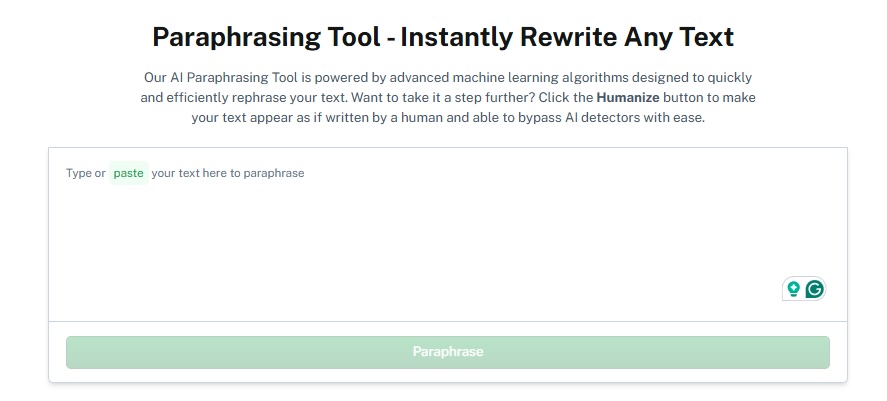
This stage of the ‘How to write a book title’ process is where you need tools like the Undetectable AI’s Paraphrasing Tool.
You probably have a title that you believe to be ideal, but you do not yet think it sounds ideal. That is not a problem.
All you need to do is copy and paste your title into the Undetectable AI Paraphrasing Tool to help generate a title that has more clarity.
Our AI Paraphrasing Tool is the best way to see your idea from a different angle and find other options that you might not have thought of yourself.
Step 5: Test Titles Before Finalizing
Now you have 3-5 working alternatives, and you are trying to choose the most appropriate one. This could be done through testing.
Most writers make the mistake of choosing the title they are most attached to without thinking of the actual readers.
You have to consider the fact that, even though you wrote the book, you are not the final consumer. You have to test title ideas on the consumers.
You can do this by:
- Asking Your Target Audience: If you can, share your shortlist with people who actually have an interest in reading your book. Their response to each title in the list will provide you with sufficient insight into the title to employ.
- Writing Communities: It is also possible to share your message in such writing communities as Reddit, where you can meet people like you, and they can share their candid opinions.
- Running a Poll: You can use your Social Media pages to run a poll on the best title. This method can be fast, low effort, and insightful.
- Using Google: You can use Google to search for your options online. This will assist you in determining whether a book of the same title is already in use.
- Trademark or Copyright Checking: You must also check whether your title is not already owned by a third party. A quick USPTO search could prevent you from stepping on someone’s toes.
- Sleeping on It: Your choice today might not be your choice tomorrow. When you have a title, put it aside for a day or two, and if you are still so enthusiastic about it, then employ it.
Always remember that your title should be comfortable not only to you, but also to whoever you are addressing. If your gut says ‘this is it’ and your readers agree? You are good to go.
How Undetectable AI Can Assist in Book Titles
Titling a book is not easy, and even the most creative writers find it difficult to do so on their own. They rely on the kind of tools that Undetectable AI provides.
With Undetectable AI tools, you can figure out how to write a title of a book in an essay easily.
Our Undetectable AI’s Title Generator is like having an assistant that never runs out of ideas. You just need to give the tool a brief description or a paragraph, and you will be given several options.
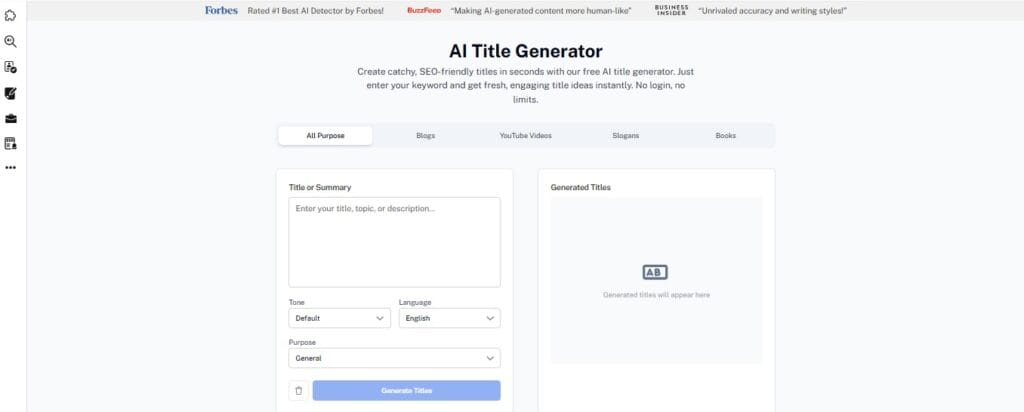
Once you have used the AI Title Generator, you can also apply the Undetectable AI’s AI Humanizer to rephrase titles so as to make them more human and more authentic.
The titles can be reworked by our Humanizer to feel as though they were written by a human being.
Try out our AI Detector and Humanizer right below!
Final Thoughts
The entire process of writing a book title will not be difficult or dull as long as you follow the step by step guide. Keep in mind that you are the creator of the text, not the last audience.
So your title has to be an invitation to your readers into your literary world. Make sure your title grabs attention, provides a clue, is easy to remember, and creates curiosity and emotion.
If you ever get stuck trying to brainstorm for title ideas, use Undetectable AI.