
When I read Harry Potter for the first time as a child, I was obsessed with the world it was set in.
Before I even watched the movies, I had a vivid picture of the towering spires of Hogwarts, the flickering candlelight in the Great Hall, the winding staircases that seemed to move on their own.
I could also smell the lingering aroma of roasted dinners and imagine the way students and teachers marched through the corridors.
That writing, like that of hundreds of other literary gems, is a great example of imagery.
Imagery means describing a place, person, object, or idea using your senses so the reader can imagine it fully. It has many forms that can be used in almost all types of writing.
While writing good imagery takes a lot of effort, anyone can learn it with consistent practice and by studying authors who excel at it.
In this article, we explain the imagery definition, provide a lot of imagery examples, types, and some bonus writing tips.
Key Takeaways
- Imagery refers to describing something using sensory details so that the reader can experience it.
- There are 7 types of imagery: visual, auditory, gustatory, olfactory, tactile, organic, and kinesthetic.
- Imagery is not limited to fiction. It is useful in novels, poetry, creative writing, essays, and professional/technical writing.
What Is an Imagery?

Merriam-Webster defines imagery as “the use of vivid or figurative language to represent objects, actions, or ideas.”
In plain, everyday terms, it means to describe something so well that a reader can imagine what it looks, smells, tastes, or feels like. You could say, it is a word-based sensory simulation.
Imagery has always played a central role in storytelling. Ancient poets used to animate battlefields and seas.


Never Worry About AI Detecting Your Texts Again. Undetectable AI Can Help You:
- Make your AI assisted writing appear human-like.
- Bypass all major AI detection tools with just one click.
- Use AI safely and confidently in school and work.
Medieval storytellers used it to infuse religious texts with awe. Romantic poets used imagery to portray nature in an almost spiritual way.
In modern writing, too, imagery is very widely used to get the reader to feel the moment rather than just read about it.
How Writers Create Imagery
Imagery can not happen by accident. A writer has to engage their all 5 senses with internal physical and emotional states to make a scene tangible.
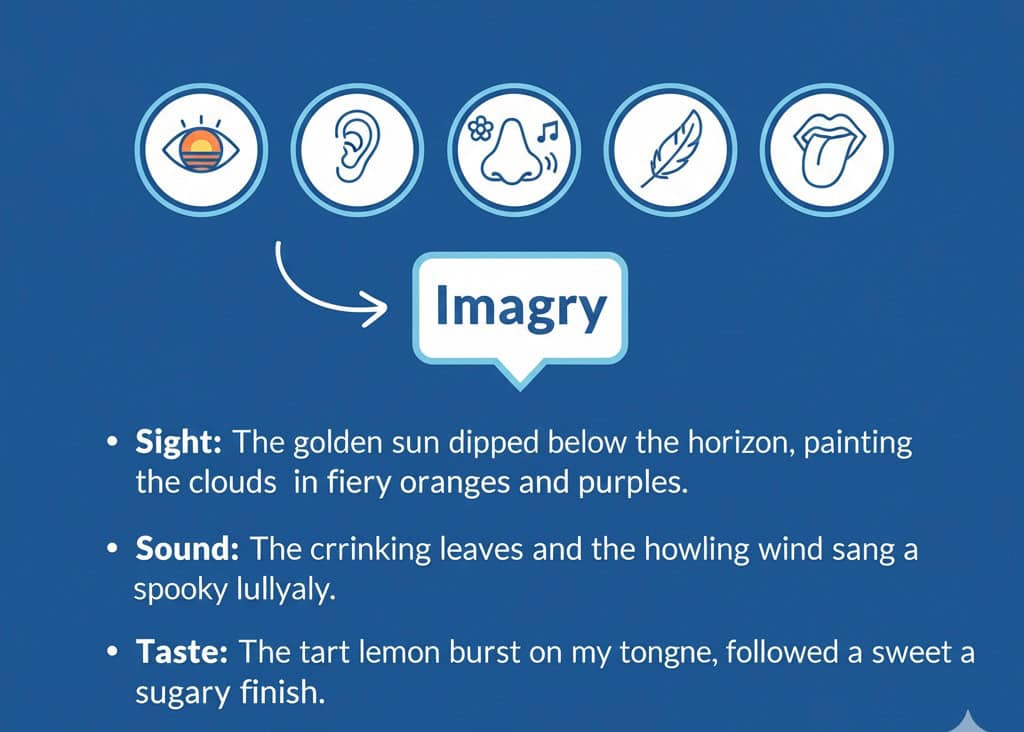
Here are some questions writers must answer:
- What does the scene look like? What colors, shapes, and contrasts are present?
- What does the environment sound like? Are there whispers, crashes, silences, or echoes that should be described?
- What does the air smell like, and can any memories be linked to that smell?
- What does the texture feel like to the touch?
- What does something taste like? How do flavors interact with the character’s current situation?
- How are objects or bodies moving?
- What does the character feel from the inside?
These questions combine layers of sensation to create multi-dimensional, immersive experiences.
Major Categories of Imagery With Examples
We can categorize imagery into 7 types, 5 of which are your physical senses, i.e., sight, smell, taste, smell, touch.
The other two include the description of moving objects and the internal emotions humans carry, like pain, fear, hunger, etc.
Visual
Visual imagery is the most instantly recognizable type. It describes something based on sight.
A writer using visual imagery translates the look of a scene, character, object, or landscape into words vivid enough that your brain treats them almost like snapshots.
The words describe specific, high-impact visuals that you can easily create a picture of in your head as you read them.
The following aspects are great examples of visual imagery usage:
- Lighting
- Color
- Shape
- Size or scale
- Movement
Charlotte Brontë in Jane Eyre uses visual imagery brilliantly as she writes:
“A crimson curtain, hung before the arch, shut her out from view; and the fire shone full on her, illuminating every lineament of her face as she bent over the hearth.”
Similarly, in Frankenstein, Mary Shelley describes Victor Frankenstein as:
“His yellow skin scarcely covered the work of muscles and arteries beneath; his hair was of a lustrous black, and flowing; his teeth of a pearly whiteness.”
Auditory
As the name suggests, auditory imagery builds upon the listening sense of a writer and their ability to convey it through words, such that the reader can imagine how they would hear it.
It includes obvious noises, like dialogue, music, explosions, etc., but also subtler sound elements like cadence or silence.
Some very commonly used descriptions of sounds are voices, footsteps, wind, silence, echoes, clashes, whispers, etc.
Auditory imagery can be used to:
- Expose power dynamics
- Emotional states of characters
- The atmosphere of the room
Look at this example of vivid auditory imagery from an excerpt of A Tale of Two Cities by Charles Dickens:
“The rattling of the carts, the loud and harsh sounds of voices, the heavy tread of marching feet, and the clanking of iron chains made a terrible music.”
Gustatory
This type of imagery describes something according to how it tastes. When writers use gustatory imagery well, it extends far beyond the descriptions of foods and drinks.
It can be used figuratively to hint towards comfort, deprivation, luxury, poverty, nostalgia, disgust, desire, survival, you name it!
Gustatory imagery is very classically used to describe the social class differences with striking efficiency. A single mention of food or flavor can stand in for an entire social condition.
In Oliver Twist, Charles Dickens explains so well how the scarcity of food reflects how Oliver was reduced to survival conditions:
“Oliver walked twenty miles that day; and all that time tasted nothing but the crust of dry bread, and a few draughts of water, which he begged at the cottage-doors by the road-side.”
Olfactory
Olfactory imagery appeals to the sense of smell. Smell is neurologically tied to memory and emotion more directly than any other sense.
A single odor can summon fear, comfort, disgust, nostalgia, or desire instantly.
Unlike sight or sound, smell is invasive. You can look away from an image, you can block out a noise, but you can’t choose not to smell what’s in the air.
In 1984, George Orwell begins with Winston returning to his apartment block, where the air carries the smells of “boiled cabbage and old rag mats.”
Winston is then called next door, and the atmosphere there prompts a vivid sensory description,
“a sharper reek of sweat, one knew this at the first sniff, though it was hard to say how”—was clearly “the sweat of some person not present at that moment.”
Tactitle
You can also describe something based on sensations of texture, temperature, pressure, pain, and movement. Tactile imagery pulls the reader into the character’s body to feel a scene physically.
Naturally, many tactile descriptions have deeper, implied meanings. For instance, the cold of a room can suggest loneliness. The grit under one’s nails can indicate hard labor or struggle.
Here’s an example of tactile imagery from Ray Bradbury’s novel, Fahrenheit 451.
“He opened the bedroom door. It was like coming into the cold marbled room of a mausoleum after the moon has set.”
Organic Imagery
Organic imagery is a unique category of imagery that uses internal sensations and feelings.
Such sensations describe the physiological states that a character experiences, like:
- Hunger
- Thirst
- Fatigue
- Nausea
- Fear
- Dizziness
- Pain
- Emotional turmoil
In other words, organic imagery captures the felt experience of being human such that the narrative feels immediate and lived-in for the reader.
It is used alongside tactile or visual cues most of the time.
Charles Dickens used hunger time and again in Oliver Twist as organic imagery. For instance,
“Hunger and recent ill-usage are great assistants if you want to cry; and Oliver cried very naturally indeed.”
Kinesthetic Imagery
This type of imagery conveys movement, muscular or skeletal tension, and the sense of physical action or motion.
It allows readers to feel the dynamics of a scene like running, falling, grasping, balancing, or struggling.
The difference between a limp, tired stride and a leaping sprint conveys two different moods and personalities.
Kinesthetic imagery can be used to reveal character traits and to describe pacing that indicates stressful situations.
In the example ahead, Herman Melville captures the physicality of being on a ship in motion:
“With his gaff, the gaffman hooks on to a sheet of blubber, and strives to hold it from slipping, as the ship pitches and lurches about”
Imagery Across Different Forms of Writing
Imagery is one of those linguistic tools that has its place in every form of writing.
Because humans are inherently sensory beings, we enjoy vivid descriptions in everything, be it prose, poetry, creative fiction, journalism, professional communications, etc.
It is the backbone of world-building and character development in long-form writing, as in novels. The layering of sensory detail keeps readers engaged over hundreds of pages.
Poetry is a condensed form of writing.
Since poets rarely have the luxury of lengthy exposition, each word they use must evoke multiple layers of meaning. Imagery is great for poetry as sensory details can have many different interpretations.
Even in academic and professional settings, you can occasionally find imagery. Case studies may use sensory analogies to make abstract data more relatable.
Imagery vs. Description
Imagery is not the same as description. Rather, a subset of it. Description in general refers to providing information about people, places, objects, or events.
For example, the answers to questions like What is something made of? Where is it located? use descriptions, but they may not be imagery.
Descriptive writing can be purely informational because its primary intent is to make the reader understand.
A paragraph explaining the arrangement of furniture or the layout of a street may be purely descriptive, but it does not necessarily make the reader experience the scene.
Imagery is experiential and sensory. It lets the reader see, hear, smell, feel, and move around the room and also experience what it feels like internally as you do so.
Description can exist without strong emotional engagement, but imagery almost always creates a lived experience.
So, all imagery includes some description, but not all description is imagery.
How to Spot Imagery in a Text
To identify imagery in a text, you will have to look for sensory detail, i.e., words or phrases that appeal to your five senses.
Pay attention to words that describe texture, temperature, light, shadow, sound, internal sensation, etc.
Often, the longer you linger on a sentence to imagine it in your mind, the easier it will become to identify imagery.
If you are in the English learning phase, try to read the text aloud. Hearing the flow of descriptive phrases highlights sensory elements that you might miss in silent reading.
You can also annotate the text whenever you identify imagery. Label the words as visual, auditory, tactile, gustatory, olfactory, kinesthetic, or organic imagery.
It will train your eye to recognize imagery patterns, and over time, you’ll get way better at it!
And when trying to write with imagery, try using Undetectable’s AI Humanizer to describe your text with vivid, sensory-rich language. For learners, the tool is great as a model for how to infuse sensory depth into their own writing!
How to Write Your Own Imagery
Before you write your own imagery, you will have to be very observant of the world around you.
Notice the little things like how light falls on surfaces, how air smells after rain, how movement feels in your body, how a tense emotion manifests physically, and think about how you can describe them in words.
Engage your senses as you think of relevant words.
To refine your skill and develop a consistent voice, use Undetectable AI’s Writing Style Replicator.
Paste some text samples from established authors known for rich imagery into the tool. The more context and range you provide, the better. It will create a custom style profile based on your input.
Once your profile is set, you can type any scene or narrative you want the AI to generate and get an output rich in sensory detail.

After your content is ready, you can use Paragraph Rewriter to refine your structure and flow. It will reorganize the words and phrases in your sentences that need fixing and omit any unnecessary details.
Give our AI Detector and Humanizer a spin in the widget below!
Conclusion
Getting better at imagery requires detailed observation of the world around you, sensory awareness, and a whole lot of practice.
You need to notice the world in all its textures, colors, sounds, and motions and read authors who excel in imagery to expand your vocabulary so you can describe it.
Practice, consistent, deliberate practice, is the only thing that will take you far.
If you use Undetectable AI alongside, you’ll be learning much faster and will notice your writing gets better as you internalize more and more sensory descriptions.
Explore Undetectable AI today!