
Are you also an English language learner who gets confused when you see two words with very similar spellings and meanings?
You might also come across different writing pieces, some of which use labor and the others use labour. This can have you wondering, is it labor or labour? Which word is the right one, or does their use depend on the context?
Moreover, if you are a writer, you could feel confused as to which one to use in your writing. Since good writing requires uniformity and consistency, one should use either labor or labour throughout their writing.
In this article, we are going to discuss which one to use when and where. Why do the two spellings “labour or labor” exist? And how both spellings fit in workplace and political contexts.
Let’s dive in.
Key Takeaways
- Labor is the standard spelling in American English. Labour is the standard spelling in British English and the rest of the English-speaking world.
- The split goes back to Noah Webster’s 1828 dictionary, which dropped the “u” from words like labour, colour, and honour.
- In medical writing, both labor and labour refer to childbirth. The spelling depends on your audience, and not the meaning.
- Some proper nouns break the regional rule. The Australian Labor Party uses the American spelling, while the British Labour Party keeps the “u.”
- You should pick one spelling and stick with it throughout your piece. Mixing both looks sloppy.
What’s the Difference Between Labor or Labour
There is no fundamental difference between labor and labour. Labor is used in American English, whereas labour is used by the rest of the English-speaking world.
There is one exception, however. In Australia, the American spelling is used to signify the Australian Labor Party. This is because of the influence of the American labor movement on the founders of the Australian Labor Party.
In all other contexts, Australians use labour.


Never Worry About AI Detecting Your Texts Again. Undetectable AI Can Help You:
- Make your AI assisted writing appear human-like.
- Bypass all major AI detection tools with just one click.
- Use AI safely and confidently in school and work.
The British Labour Party has the u. The transition from -our spellings to -or spellings is considered to be one of the major differentiating factors in American English. Labor, along with several -or words became the prevalent spelling in the U.S. around 1840.
Core Meaning
The word labor originated from Middle English: from Old French labour (noun), labourer (verb), both from Latin labor which means ‘toil, trouble’.
Labor as a noun:
Labor is used as a noun in the English language to signify work, especially physical and manual work.
Some examples of using labor in sentences include:
- This kind of work would require a lot of labor.
In this context, labor refers to manual workers who are collectively referred to as labor.
- She is about to go into labor.
In this context, labor refers to the process of childbirth.
Why Two Spellings Exist
The two spellings exist mainly because of regional differences. Is it labour or labor? As previously discussed, labor is used in the United States and labour is more commonly used in the rest of the English speaking world.
One might wonder if it is labour day or labor day. Both spellings are correct and only differ due to regional differences that we are going to discuss further.
In the United States, for example, the adoption of labor is owed to Noah Webster’s 1828 dictionary, in which he uses -or for words like labor, color, and humor.
In the UK, however, most of these words came from Latin, where the ending was spelled -or. They were first adopted into English from Old French.
Following the Norman Conquest, the ending became -our to match the later Old French spelling.
When to Use Labor
When you are writing in American English or writing for an American audience, consider using labor as it is the more commonly used word in the United States.
When to Use Labour
When writing in UK English (Commonwealth) and for the rest of the English-speaking world, using labour is the more informed choice.
Avoid using mixed spellings in the same piece of writing while keeping the above points in mind. Writing styles such as MLA expect the writers to follow standard spelling conventions based on their regional English.
Moreover, when referring to specific organizations such as labor parties, use their official name. This includes the British Labour Party and the Australian Labor Party.
Lookout for specific terms. For example, the term “laborious” is spelled the same in US and UK English.
Labor vs Labour in Workplace and Political Contexts
Labor or labour in a workplace refers to its employees. In the workplace context, labor is known as the physical or mental effort exerted by humans for the production of goods and services. And in return, they earn money for it.
In the workplace context, use labor when writing for a US based audience. Use labour when writing for the UK and the rest of the English speaking audience.
In a political context, Labour is often used as a proper noun to refer to the UK Labour Party. This is something we have discussed previously in this article.
Labor also includes the use of machines, tools, and other equipment by the workers to get the work done. Time spent on planning, organizing, and supervising production also comes under labor.
According to an ideal economic model, labor or labour is a homogeneous input, which means all workers produce the same kind of work with the same set of resources.
Labor vs Labour in Political Context
Labor in a political context could refer to the policies set by the government that govern the employee-employer relationship.
In all political contexts other than these exceptions, use labor when writing for a US audience and labour when writing for the UK and the rest of the English-speaking audience.
When you’re adapting the same piece of writing for both US and UK audiences, it’s not just about swapping the spelling. Phrasing, tone, and even terminology can differ.
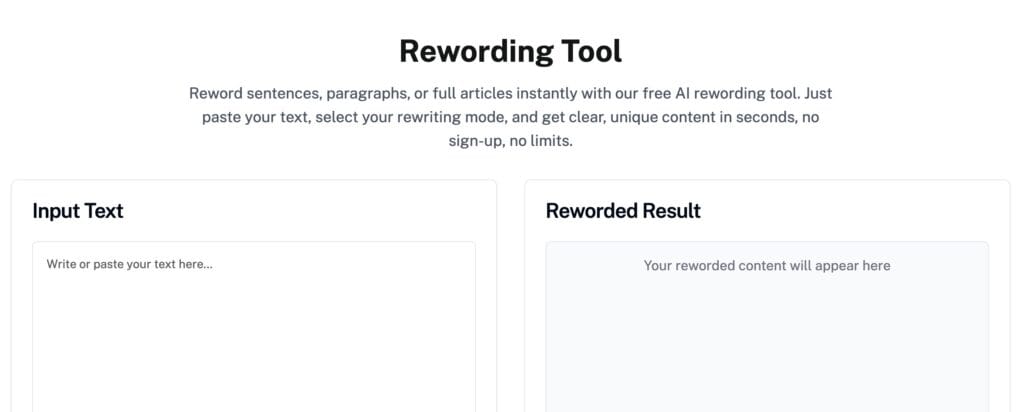
Undetectable AI’s Rewording tool can help you rework content for a different regional audience while keeping your message intact.
Labor vs Labour in Medical Writing
In medical writing, labor or labour is used when talking about childbirth. Both words mean the same thing, and the difference is purely regional.

When writing medical manuals and juggling with medical jargons, you can use Undetectable AI’s AI Humanizer to keep medical explanations readable and accessible for the common folks.
When writing in a medical context in UK English or referring to an audience other than the United States, use labour.
When writing in a medical context in US English and referring to a US audience, use labor.
When you need help in verifying medical visuals’ authenticity, use Undetectable AI’s AI Image Detector to make sure the visuals are authentic and not AI-fabricated.
Real Sentence Examples

Some real sentence examples of labor or labour include:
- Me and my brother labored/laboured to fix our car.
- This work requires a lot of labor/labour.
- Most countries celebrate labor/labour day on 1st May.
- Manual labor/labour has become pretty expensive.
- She was supposed to go into labor/labour two hours ago.
Choosing the Right Spelling for Your Audience
Before you start writing, you need to figure out who will be reading it. If it’s a single-region audience, the choice is quite straightforward.
But if your content reaches both American and international readers, like a blog or a product page, you’ll need to pick one and commit.
A good rule is to match the spelling to where most of your readers are. If your analytics show 70% US traffic, go with labor. If your audience skews British or Australian, go with labour.
And watch out for words like “laborious” that don’t change regardless of region.
Fun fact: Those can trip you up if you’re doing a find-and-replace across your draft.
To keep your writing professional, clear, and aligned with your brand voice, you may count on Undetectable AI’s Writing Style Replicator to help maintain your brand identity throughout your writing.
When choosing the right spelling for your audience, keep in mind to use the same spelling throughout your writing. Using labor in some places and labour in others, can harm your credibility as a writer.
Furthermore, it can signify carelessness in your writing. Readers could think that you did not bother to proofread your draft and published it hastily.
Give the AI Detector and Humanizer a try right below!
Final Thoughts
Labor or labour? Well, both are correct and used commonly in write ups all over the world. The major difference is the audience you might be writing for.
For a US audience, labor is the correct choice. But for a UK audience, Labour is the correct choice.
Understanding this difference can help writers maintain uniformity, clarity, and credibility in their work.
Whether you are writing about workplace policies, political movements, or medical contexts, choosing the more appropriate spelling throughout your writing helps build trust with your audience and ensures your message is clear and informative.
By keeping your audience in mind along with the key points we have discussed in this article, you should be able to decide which spelling is correct in your context and avoid confusion.
And when in doubt, use Undetectable AI tools.